The spirit lives on

I am on a roll, five posts in five days and with a sudden do or die rush to hospital shortly before Christmas I have plenty of time to think as I recuperate and reflect 

Today with 2012 coming to end here is a little reflection from me on Australian Year of the Farmer which started with a bang and sadly closed with a whimper.

I know co founders Philip Bruem and Geoff Bell had all the best intentions and invested their heart and souls into their baby so I am not going to talk about all the things that went wrong but I do want to talk about some of the ways we as farmers can leverage the momentum going forward of what was a great idea executed with too little money and not enough grass roots involvement .

I’ve seen many things change for the better over the last 12 months. Colin Beetles reflects on the big picture here. I want to talk about what I see is happening at grass roots level and in particular the social changes 

I am noticing more and more farmers are less indignant. We know we cant afford to sit back and say people should appreciate us because we feed them. We know it is our role to build the relationships beyond the farm gate with our communities and our customers and the decision makers and start those two way conversations. Gone is the idea  that the community should wake up everyday and say “thank a farmer” and more and more our farmers are saying “ thank a consumer”

We are looking at new and innovative ways to raise awareness and build a sense of pride and support for our committed, caring and professional  farmers. I for one salute our farmers on their growth in 2012.

We are seeing a new type of AGvocay leadership working side by side with our agri- politicians and they are taking on the tough issues like Live Export. Its going to be a long road but they are cutting through 

There are now a lot of damned good grass roots initiatives out there stepping up to the plate and building the farmer to consumer value chain partnership and letting industry take a back seat and concentrate on what they do best  Whether it be quirky things like the Great Cafe Challenge, using social media like Ask an Aussie Farmer, sharing our stories like Fleur McDonald’s 52 Farming Stories in 52 Weeks, starting campaigns or writing petitions or just great photos like this one. A great example of its not what you say but how you say it that delivers the goods

Sheep On Verandah

Sheep on Andrew Irvine’s verandah during Murrumbidgee Floods, Wagga Wagga in March 2012. | Photographer: | Andrew Irvine

We know farming today has moved to a new dynamic. It is all about relationships, about values and about people – its all about selling the sizzle not the steak (whilst appreciating and respecting the cow that produces it ).

We know that selling the sizzle is very often out of our area of expertise and it we want to do it well ( and we must our future depends on it)  we need new skills sets.   In particular it is the women in farming who are seeing this new way of farming as their area of expertise and its the grass roots who are putting together the programs and providing the training and our women in agriculture are chafing at the bit to get involved and they are en masse.

Yesterday I mentioned Women Influential, there is the great work of Georgie Somerset and the QRRRWN network, Art4Agriculture’s Young Farming Champions Network and between us I am positive we could list another 50.

And back to Australian Year of the Farmer, Art4Agriculture has been very lucky to come to the attention of one of their celebrity ambassadors Sara Leonardi McGrath. I am very excited to tell you that for Glenn and Sara celebrating our farmers and the great food and fibre we grow is NOT going to finish at the end of 2012.

274822-mcgraths

Sara is a little dynamo and since I first met with her in January this year her mind has been ticking over looking at some clever ways she can use her talents and connections in the art world to build city country relationships and take them to a whole new level via a partnership with Art4Agriculture. She is great fun to work with and the team and students and schools involved are loving it 

The partnership starts with an exhibition of 8 of our Archibulls at Sara’s MCLEMOI GALLERY in Chippendale in the last two weeks in January Read all about it here.

Sara is also supporting us to launch another new concept which I hope to be able to share with you in early February. The Art4Agriculture team have been investigating ways to enable all Australian farmers to be in driving seat and ensure the success of the Art4Agriculture vision and programs and with Sara’s support we think this concept is goer

So fellow farmers whether you have #hadagutfull are #proud2farm encouraging the community to support #duopolyfreefriday ringing the bell on #agchatoz telling your story on #AskanAussieFarmer or are proud #youthinag the Year of Farming Families is just around the corner so lets work together and keep up the momentum and in the words of Connie Ross

Despite droughts, floods and bushfires, the spirit lives on.

Most farmers just never give in! ‘

Cause, despite the frustration, we’re feeding the nation

And that’s a great battle to win!

and remember its our “battle” – lets do it our way

Who’d be a farmer I hear you say

I love this poem by Connie Ross from Henty in NSW I am sure you will too


‘Who’d be a farmer’, I hear you say.

Well, it’s really quite hard to explain!

While we scan the sky and the weakest stock die …

We’re hoping and praying for rain!


So many decisions just have to be made;

What to sow, when to plough, what to cull.

Unreliable markets for livestock and grain,

Indeed, life will never be dull!


Long hours in the paddock and office as well.

The seasons dictate what we do.

Custodians only of this fragile land,

Demanding the best we can do!


Yes, prescription farming’s the name of the game,

For cropping’s a whole new frontier.

Alone, on a tractor, the moon coming up,

No chance for a sleep now, it’s clear.


Mustering sheep, marking calves, spraying weeds or whatever,

There’s always more work to be done.

But despite the long hours, there are many rewards,

And farming can also be fun!


A sense of achievement… a job well done,

When you’ve put up a brand new fence.

Or sinking a dam, maybe sowing a crop,

Well, its hard work … and yes, common-sense!


When you pull a live calf and the odds were not good,

Then he takes those first steps to his mother.

Well, it makes it worthwhile and you can’t help but smile,

Farming’s a life like no other!


It’s a joy to be tailing a big mob of sheep

When the land wears a mantle of green.

On a horse, or a bike, with a good dog in charge;

 Other farmers will know what I mean.


At the end of the day when the light ebbs away

And the quick pulse of life seems to slow.

 In the hush of the night all the cares of the day

Seem to melt with the sunset’s warm glow.


Despite droughts, floods and bushfires, the spirit lives on.

Most farmers just never give in! ‘

Cause, despite the frustration, we’re feeding the nation

And that’s quite a battle to win!


Makes you soon realise, what matters in life.

‘Who’d be a farmer?’ you say.

Well, if I had a fresh chance to do it all over …

I still would choose no other way!


By Connie Ross,  Henty


Nick & Tractor B & W view

Sue Middleton nurturing people who feed people

I recently was lucky enough to catch up with the remarkable Sue Middleton twice in a period of four weeks.  Sue was the “RIRDC Australian Rural Woman of the Year 2010” and farms with her husband Michael in the Wongan Hills In WA.

Sue and I share a similar passion and commitment to drive change in agriculture. Sue is particularly committed to building capacity in rural women and me in our young people.

Sue is heavily into making a difference, where it counts, at policy level. According to Sue ‘Policy is a dark beast, untraceable. to influence policy and make a difference you have to learn the skills – it takes patience and tenacity.’ Mentored by Cathy McGowan who Sue’s says ‘taught me the value of pinpointing what makes a difference to the people you want to convince to help you solve your particular issue. If you want results, discover what engages your audience, find where that intersects with what you’re after and speak to that.’

Sue’s commitment runs in the family and her daughter Lizzie Brennan together with Catherine Marriott has recently set up Influential Women to ‘recognise the inherent power women have as natural communicators and seek to nourish their infinite potential’ Lizzie and Catherine custom design training to draw upon the strengths of women and build their skills and confidence in communicating their unique story.     

Sue Middleton Jenni Hawkins Lynne Strong and Lucinda Corrigan

Sue Middleton, Jenni Hawkins, me and Lucinda Corrigan at CCRSPI conference in November 2012

We first featured Sue as part of our Art4Agriculture case studies in 2010. See here. Today I want to share with you what she had to say when asked the question ‘What do I wish non-farmers and the Australian Government understood about farming?” as part Fleur McDonald’s 52 Farmers in 52 Weeks series for Australian Year of the Farmer. Read it in full here  

‘What do I wish non-farmers and the Australian Government understood about farming?” 

Sue answered …….

Firstly that what we do is really risky and we are at the mercy of weather.  That means that not every product we produce will look the same. Oranges with a blemish on their skin are just as good as fruit without a blemish on it.  Blemish is caused by wind – it’s a very natural part of fruit.  Learn to eat fruit and food that doesn’t look perfect but is identical in every characteristic that impacts your health!   This one shopping habit alone will save you dollars in your pocket.

We are wasting 50% of the food we produce in Australia. We don’t need cheaper food – we need to stop taking good productive energy and turning it into waste!  If people focused a little bit more on reducing the food waste from their homes, they would find their food bills dropping dramatically.

Buy as direct as you can- each week take one product that you consume and find a way of purchasing it as directly from a farmer as possible.  Start reading labels  – be ferocious in your food stores – demand locally produced food where you know the food production standards are high.  You have all the power – exercise it – start reading food labels and start checking where food comes from.  We do supermarket checks regularly and supermarkets frequently label fresh food incorrectly and say it comes from WA when it really comes from interstate – check the labeling and challenge the stores to be more accurate.

The government needs to understand the huge impact of policy changes.  The banning of live trade to Indonesia has rippled through WA agriculture and caused huge impact not just on northern Australian cattle farmers.  We now have $500k of straw in our paddocks we can’t sell because the bottom fell out of the pellet market.  The knock on effect of decisions like the cessation of the trade has been gigantic.  The government doesn’t pick up that tab, and they need to be VERY cognizant of the impact of their decision making.   We do not need them to add to our market risks.

Finally I would like people to know we are in a very technical game. It is very science driven and we utilize all knowledge we can to improve our sustainability constantly.  Looking after the land and our animals is a priority for us.  But we are in a marginal game and we are unprotected in the world markets competing against countries that are highly subsidized.  It is not a level playing field in this globe!  To keep our noses ahead we need more investment in research, development and most importantly extension so we can keep learning and driving our businesses productivity and profitability further.

And what does Sue love about being a farmer?

It is great to drive around the crops doing a crop-run when they are growing well.  There is no greater pleasure than growing a great crop.  Conversely in the dry years it can be tough when the rain doesn’t come and the crops get compromised.  It is also very satisfying to see our animals grow well and we love to see them in good condition. 

Growing things is what we love.

The line in the sand

I was recently asked to speak at the CCSPI Conference ( Climate Change Research Strategies for Primary Industries) by my good friend Esther Price who is the guru of agricultural conference event management in this country and I said no

I said no because

  • Firstly it was the last session of the day on the last day of the conference and everybody knows no-one hangs around for the last session of the day on the last day of the conference.
  • Secondly because I had a hell of a lot happening in my life and I was starting to spread myself way too thinly and felt I wasn’t delivering to the level Art4Agriculture deserved, our Clover Hill Dairies business deserved, my family deserved and I what I deserve. Recently my wise friend Victoria and I spent a Sunday putting together a strategic plan for me. Wow how organised is that.  So I ran this conference through “is this conference core business A to Z scenario?” and its screamed “NO NO NO – this is not the best use of your time Lynne”
  • And thirdly farmers rarely get paid to speak at conferences and in the majority of cases I think its because we don’t ask and this has got to stop.  So for the first time I drew my line in the sand and emphatically said no.

Well Professor Snow Barlow head of the CCRSPI conference committee is a bit like me in that ‘no often means almost yes’ and the next thing I know he is on the phone giving me 20 reasons why I should be there. I happened to mention that I would like to hear Bernard Salt speak as well as Sue Middleton and Dr Jude Capper. Snow then had a light bulb moment, though he couldn’t promise anything, but would breakfast with Jude, Sue and Bernard tempt me.? Did I ask to be paid for speaking you ask.?  NO ( hang my head in shame) I crossed my line in the sand. BTW This is firmly on my New Years wish list for 2013 and I see a Farmers Speakers Network looming on the horizon.

Having breakfast with Sue Middleton was easy – we are already good friends, but Snow did not deliver Bernard nor Jude – but he did put forward a very exciting proposal at the end of the conference and I look forward to catching up with him on that.     

My gig was on a panel and to Snow’s credit he did get a lot of people to hang a round. Panellist members were Lynne Strong wearing my  farmer hat , Dr David George (National Climate Change Adaptation Research Facility), Caroline Brown (Department of Primary Industries, Parks, Water and Environment Tasmania), Professor Tim Reeves (Tim Reeves & Associates) and Dr Mark Howden (CSIRO).The audience in the main was researchers and government and policy makers and some farmers

The brief “ A discussion on climate change needs into the future: in light of the knowledge exchanged at this conference, what are the climate change research and capacity needs for the sector into the future? Perspectives from a leading farmer, research manager, policy analyst, research director and leading researcher. Panellists will provide their own perspectives on the topic, before opening the floor to audience questions and open discussion”.

So what did I have to say? 

Here is the guts of it ………

The most immediate threat to agriculture in this country is I believe not climate change, not drought and not water restrictions. It is the disconnect between farmers and their customers and consumers’ lack of understanding and discomfort with modern farming practices

This has led to whole new playing field for both farmers and researchers. Consumers today are 5 x more interested in knowing that you care about the environment and your animals than in knowing that you have the knowledge to look after to them. That is values outsell science 5 to 1

My work in the community shows me the social environment that farmers find themselves in today is totally foreign to most of them and they in the main don’t have the skills sets to engage in two way conversations with the community and build the bridges that will address this

Whether we like it or not farming today is under more scrutiny than ever and increasingly accountable to the public 

Farming today

  1. Is all about people
  2. Is all about relationships
  3. Is all about values

It’s a marketing exercise. Today our farmers have to sell the sizzle, not the sausage. Delivering the sizzle is what drives me ( I love this analogy but cant take credit for it)

I have been asked to represent ‘farmers’ on this panel and what they want with respect to Climate Change research & capacity.

If I asked a group of 100 farmers this question I know I would get at least 100 different answers.

If I asked a group of 100 scientists this question, I would probably get 300 different answers – and I probably wouldn’t understand any of them!

Seriously the point I am making here is

•          We need to remember that ‘farmers’ is really a collective noun for a diverse group of individuals that happen to produce food and fibre. Every individual in this group has different perspectives and opinions about what Climate Change means to them

•          researchers have a major problem in communicating what they do

What farmers and researchers do have in common is they both have a product to sell  and everybody in business knows you go broke fast if you are selling a product nobody wants to buy  So we have a great opportunity to work together here to keep all of us in business  

So today I am going to try and tackle all of these points through a partnership model.

I will do it from my personal perspective but I hope the insights I have gained as a farmer, a climate champion and from the broader community through our Art4Agriculture programs will prove useful to you.

Point 1

Let’s consider the needs of farmers first. Generally farmers are practical people and they want the SAUSAGE. Most think that the research is pretty well covered.

Personally – I am a Champion of targeted research I get excited by the possibilities but sooner rather than later. I want a tangible product that I can apply on my farm… when I am ready for it (i.e. the sausage).

Slide1

The product (technology or technique) has to directly relate to satisfying my needs. If it ticks any of the following it will go on the list of things to consider

Slide2

Note that this is not the list of things that ‘get done’… just the list of things to consider at this stage! The list of things to get done is a completely separate list, kept securely on the fridge between my husband and his breakfast. (see footnote)

Slide3

Get on this list and you have it made – Poor man no wonder he has indigestion He is lucky to get time to sit down for breakfast.

Your Climate Change product must in this orderSlide4

Slide5

Point 2

Let’s now look at the most important person in the value chain – the consumer

Now – Has anyone eaten raw sausage? I don’t recommend it. For your Climate Change SAUSAGE to be palatable you need to cook it i.e. add some SIZZLE.

So whilst some of you are busy translating research into tangibles for farmers, we really have some work to do selling the SIZZLE to consumers in the broader community.

Slide6 

Remember that farmers are a part of this broader community too.

Our customers today have a very poor understanding of modern agricultural systems and have become distrustful of the way we manage our natural resources and care for our animals. We have to admit – we seriously have some work to do!

Farmers and researchers need to engage with the wider the community so they are comfortable with what researchers and the farming community are doing to tackle climate change – we can’t build extra value in our food and fibre products unless our customers KNOW and are COMFORTABLE with the core values of the product.

People want to make the decisions to buy they don’t want to feel they have been sold something that doesn’t fit with their own values. It is all about TRUST and you build trust through engagement and communications.

My Art4Agriculture programs have been directly and very successfully targeting these issues but there are plenty of other ways to reconnect using Climate Change as a common issue both communities have an interest in.

In conclusion – if you ask me about what the key Climate Change needs are for the farming community then I would advise you to crank up the barby and get those sausages sizzling…

Provide me with Climate Change SAUSAGES that are tangible – preferably with bread and tomato sauce so they target my needs and I add them to “the List”.

Make sure your sausages are well cooked – with plenty of SIZZLE. I want to make sure everyone around me can smell how delicious they are, and know what a great product you have developed. Particularly the broader community needs to know what I am eating – and why I am doing it for them. 

Engagement is the key and there is no-one better positioned to kick goals in this high priority area than a collaborative and cohesive partnership between farmers and researchers.

The time is now – Let’s do the sizzle together like its never been done before

Slide7

Bon appetite!

Footnote: This list is wearing my farmer hat, my other hats have different priorities – no wonder I need a strategic plan

Martin Place like you have never seen it before Our sheep and cattle farmers bring the farm to the city

As a follow up to my post yesterday on Brand Australia and how Australian farmers must find innovative ways to tell our story. I have some exciting news for you today, Meat and Livestock Australia are doing just that  

As you know the Art4Agriculture team pour their heart and soul everyday into promoting our farmers and are  successfully rolling out in school programs using art and multimedia  to tell agricultures story to the 3.5 million school children in Australian schools ( well with more money we could reach that many)

Today Meat and Livestock Australia (one of Art4Agriculture’s partners) have taken their sheep and cattle farmers stories to the Sydney CBD via their Target 100 initiative to turn Martin Place in Sydney into a virtual farm and how impressive it is

Sydneysiders beamed onto Aussie farms via the giant screen 2 (1) 

This has been done before overseas but I believe it is a first for Australia. In May 2010 the Young Farmers Union of France transformed the famous avenue in Paris the Champs Elysées, or Elysian Fields into a massive celebration of French farmers .

The-Champs-Elys-es-in-Par-006

By bringing in 8,000 plots of earth and 150,000 plants to the city and installing them, amid sheep and cattle, along three-quarters of a mile of the thoroughfare, farmers were attempting to highlight an aspect of French life which they believe is too often overlooked by Paris.

Organisers of the event, which cost private investors €4.2m to stage and ran for 2 days said they hoped to attract up to two million people to the newly bucolic avenue running from the Arc de Triomphe to the Place de la Concorde.

From wheat and mustard to grapevines and Limousin pigs, the avenue’s pavements have been carpeted with lorry-loads of produce from all over France, among it 650 fully grown trees and a vast array of flora intended to symbolise the country’s biodiversity.

Gad Weil, an outdoor events planner coordinating the Nature Capital event with the young farmers’ union, said the spectacle had brought people together in order to showcase Gallic agriculture.

“Lorry drivers, truck drivers, farmers, woodsmen, events planners: these men don’t usually work together, but here everyone is doing so with a smile,” he said during the night-long operation that transformed the Champs Elysées into a long strip of greenery. Visitors were able to buy plants and produce for themselves, as well as tasting regional specialities and took part in a mass barbecue organised by Paris butchers. ( borrowed from  http://www.guardian.co.uk/world/2010/may/23/french-farmers-champs-elysees)

Australian cattle and sheep farmers last night transformed Sydney’s Martin Place into a cattle and sheep farm complete with live animals, native bushland and farmers beamed in via a giant screen to talk directly to the people of Sydney.

Farmer, Stuart Austin from Katherine Northern Territory (1)

Farmer Stuart Austin in Martin Place

For today and tomorrow only, members of the public will have the unique opportunity to speak directly to cattle and sheep farmers without leaving the city. The giant screen will project them into Aussie farms using virtual technology and by doing so will help bridge the gap between urban and country Australia. Sydneysiders can also enjoy a free lunchtime barbeque and have the chance to win meat trays worth $50.

Sydneysiders visit the Target 100 Virtual Farm in Martin Place

As shown in a recent research survey*, more than half (58%) of urban dwellers are interested to know about the process undertaken to produce the beef and lamb they consume. The Target 100 Virtual Farm presents an opportunity for open discussion with Australian farmers leading the charge in sustainable farming practices.

“This is a great opportunity for Sydneysiders to meet and talk to real Aussie farmers and gain a better understanding of how beef and lamb get from the paddock to the plate,” said Queensland beef cattle farmer, and Target 100 spokesperson, Kara Knudsen.

Farmers, Kara Knudsen and Stuart Austin in Sydney's Martin Place (1)

Farmers Kara Knudsen and Stuart Austin in Martin Place

“I anticipate people will be surprised to find out what actually goes into managing a farm. It’s not just about mustering cattle or shearing sheep; it’s a full-time job that requires knowledge of botany, hydrology, geology, entomology, zoology and meteorology. We’re excited to give our city friends a sneak peek into what we do,” Knudsen added.

Popular journalist, blogger, qualified health coach and Target 100 ambassador, Sarah Wilson will also be on hand at the Target 100 Virtual Farm, sharing tips on why beef and lamb are an important part of a healthy and sustainable diet.

“I’m keen to encourage people to gain a better understanding of where their beef and lamb comes from. My eating philosophy is one that encourages a diet that’s high in protein, so beef and lamb are often on the menu. The Target 100 Virtual Farm will give us the chance to ask the farmers all we want to know about the practices that go into farming the beef and lamb we love to eat”, said Sarah.

Art4Agriculture event director Kirsty John will be joining the buzz and connecting up with the Target 100 team in Martin Place tomorrow and I am looking forward to hearing all about it 

Time to get our act together and tell it like it is OZ farmers

Today’s blog post is in the main a refection on this article by Mick Keogh (reprinted below) from the Australian Farm Institute “Australian Food is probably better and cheaper than US Food but Australian farmers just don’t tell anybody”

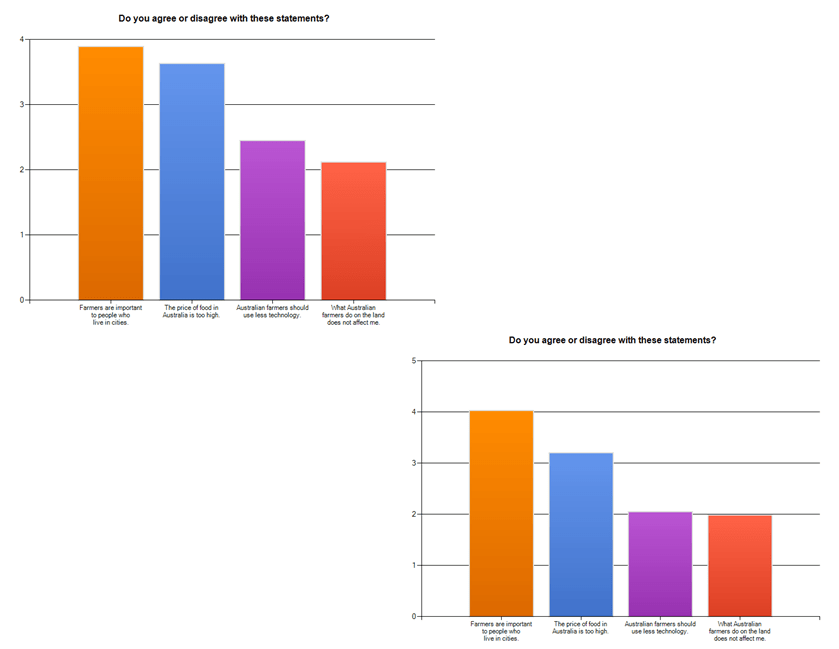
As part of the Archibull Prize we undertake entry and exit surveys to get an understanding of what young Australians today think about agriculture and farmers 

As part of the survey we ask the students if they think food in this country is too expensive. We use content like this post to raise awareness and then ask the question again in the exit survey

As you can see from these graphs (entry survey on top left and the question do you think food in this country is too expensive is in blue) we are cutting through slowly but surely.

Slowly we believe is because the misconception that food in this country is too expensive is not rebutted by farmers and promoted by individuals with an agenda that says food at rock bottom prices ( and to hell with the consequences to farmers, their livestock and the environment) is a birth rite in this country  .   

image 

Food as a percentage of income in Australia is 10% according to http://cironline.org/reports/map-world-food-statistics-2971

Food for 9B OZ 

  In the US on the other hand food as a percentage of income according to the same source is 6.4%

Food for 9B US

Mick Keogh in this article challenges the accuracy of the US stats

While travelling through the USA and talking to both farmers and agricultural policymakers, it is not uncommon to hear the claim being made that US farmers produce the cheapest and the best food in the world, and for that reason US consumers should be grateful, and the US government should maintain current farm support policies. Given the unfailing generosity and courtesy of people involved in US agriculture it would be rude to challenge that assertion, but it does raise the question of whether such claims are valid. 

A careful comparison of US and Australian food prices would be a major task, and no doubt the comparison would vary depending on seasons and relative abundance of different products in different locations. However, a quick and dirty (and statistically invalid) comparison reveals an interesting result. 

Using the online prices advertised by one major Australian retailer for a select basket of basic grocery items and comparing those with the prices charged in-store for (as near as possible) identical items in a major US grocery retail outlet, and including adjustments for sales tax (not included in US grocery shelf prices) and relative exchange rates, the following graph displays the differences in prices per standard unit (Kg, Litre, dozen, standard weight loaf) in percentage terms. 

Grocery prices

Meat items were generally cheaper in Australia, fruit was generally cheaper in the US (although that varies by location), vegetables were mixed, and milk and home-brand white bread was markedly cheaper in Australia.

For the full ‘basket’ of items, assuming a consumer purchased one unit (Kg, Litre, dozen, loaf) of each item, the total cost in Australia was 14% less than the cost for the US consumer.

As noted, this is not in any way a statistically valid comparison, but as a quick snapshot it seems to indicate that food prices in Australia may in fact be marginally cheaper than those in the USA. And when it comes to quality of fresh produce, first impressions are that the quality of trim, packaging and products are generally better in Australia than the product on offer in the USA. This applies in particular to dairy and meat products (and to coffee, which is absolutely atrocious in the US!).

One of the major differences observed between farmers in the two nations is that Australian farmers are generally more reticent about proclaiming how good they are at what they do, and seem less willing to make claims about how cheap and good food is in Australia, compared to other nations. 

Perhaps its time Australian farmers and the agriculture sector started to more actively promote the benefits they provide for Australian consumers, and the advantages more generally for consumers who buy Australian farm products.

Another great article by Mick on how we could do promotion better can be found here

A Place to Remember

I have arrived home after four weeks on the road/in the air from one side of Australia to the other taking up opportunities to deliver my big picture vision for agriculture in this country to a house with no electricity. An annoying regular occurrence that happens when you live in a rainforest that attracts lightening like a magnet

I now have a new laptop with 10 hours of battery so here I sit updating my blog whilst I wait for the power to come on so I catch up on all the jobs that have been piling up in my absence

I  have so much to write about. Today I will share with you something I saw on Southbank in Melbourne yesterday I cant stop thinking about.

How beautiful is the walk along Southbank. Night or day

southbank4

I was on the phone to my friend Annie Burbrook who said when I mentioned this to her that Southbank was one of her favourite places.

Annie was coughing as she had been for months shaking off whooping cough that had raged through her son’s class at school and he had bought it home. Like me she is furious with people who chose not to vaccinate their kids and put other peoples’ children as well as their own children at risk,

I was telling her about an article I had read recently in The Conversation on just this topic  found here Parents’ decisions about vaccination and the art of gentle persuasion.

Then I saw it. At first I was quite excited. The first thing I saw was the Christmas tree, then the long table, some high chairs, and chairs and plates for little people and I thought this was a big Christmas lunch for young children

IMG_0914A Place to remember

And sadly it was and as you can see from this sign IMG_0913

not only was it for young children, it was for parents, the uncles, the aunties, the men and women, young and old who lost their lives on Victorian roads this year.

It had a powerful effect on me. I hope it has a powerful effect on everyone who sees it and this very impressive campaign reduces deaths on our roads over the December/January period and for months, perhaps years to come 

Spread the word #aplacetoremember

Recycle Reuse taken to a whole new level

The last two weeks have seen me traverse the continent. Firstly to WA where I attended my first Australian Landcare Council board meeting at Katanning. . Then back to QLD to speak at the Naturally Resourceful Conference in Mitchell. A special thankyou to the very dynamic Sue Middleton who also lined up a number of meetings with potential sponsors who can help Art4agriculture bring the Young Farming Champions and ArchIbull Prize to WA

What a blast Naturally Resourceful Conference in Mitchell was. I haven’t had so much fun in ages. The women of Mitchell are a shining example of when things have looked the bleakest, extraordinary people have seen a different way forward. Compelling visions of ‘better’ have inspired them to overcome massive odds before and they have done it again. It’s a remarkable and brave thing to do.

In fact “I have a dream today” was the foundation of both my presentation and Vicki Jones’ who preceded me. I have asked Vicki if I can share her story and I look forward to her saying yes.

Now whilst I like to think I was the highlight of the  day I was well and truly upstaged by the special entertainment provided by Marg Enkelmann who creates Farm Wearable Art: Using Recycled Materials Found on the Farm.

The pictures tell the story and I also took some very funny videos which I will load when I get home.

Now its hard to beleive but you are now looking at dresses made out of tractor tyres silage bags wool packs and everything else that was once part of the working farming landscape.

IMG_7482 

Marg Enkelmann

IMG_7528


IMG_7593

IMG_7571

IMG_7554

IMG_7587

IMG_7568e

Can you believe this

IMG_7591

Where is your ANZAC spirit Coles?

Today this media story ‘Kirin dairy business no longer a curdling story’ is doing the rounds on twitter along with this classic photo from a report on German dairy farmer protests in Brussels 

246688_494716883872628_2097300242_n

Back to Oz ‘OUTGOING Lion chief executive Rob Murray said the fresh milk part of the dairy business was in a terrible state and not too dissimilar to the profitability profile of a charity. ”We have a challenge which is the core of the business, the fresh milk business, which is a charity – in fact, a lot of charities do better than that,” Mr Murray said. He went on to say the blame … was down to Coles and Woolworths, which nearly two years ago launched their own-label milk priced at $1 a litre, effectively undercutting branded milk sold by Lion. ”We don’t make any money [on milk],” Mr Murray said. ”The simple truth of that is nobody is making money and you can’t make money if [consumers] buy milk at $1 a litre, it physically can’t be done.”

This begs the question if Lion see themselves as providing a charity service (giving milk away for free) where does that leave their farmers?

Dairy farmers are a volatile lot in the EU aren’t they? There were images like this in 2009 when Belgian farmers continued European-wide protests by spraying about three million litres fresh milk onto their fields.

0,,4701138_4,00 

Back to OZ where earlier this year the owner of Coles Wesfarmers announced “their full-year net profit rose 11 per cent to $2.126 billion and its Coles unit capped a third year of market-beating performances as it stepped up its price war with bigger rival Woolworths.” See previous post here.

Its clear Coles P&L doesn’t mirror that of a charity. Their CEO Ian McLeod earns $15.63 million in salary alone. McLeod’s spectacular earnings are more than double that of his boss, Wesfarmers CEO Richard Goyder, who made $6.9 million last year.  I don’t know whether to laugh or cry when they spruik the milk price wars are solely to help Australian families.

Australian dairy farmers tend to be a pretty peaceful lot. We have a lot of faith in the ANZAC spirit of helping your mate out, regardless of the consequences and knowing that your mate will do the same if the situation was reversed. The sense of doing what needs to be done when it needs to be done. 

The ANZAC spirit of people like QLD school teacher and blogger Lisa Claessen who has organised a petition which you can sign here.

The ANZAC spirit and fighter for all things of value to rural and regional OZ Alison Fairleigh who has an innate sense of what’s right and wrong and what is good and evil in the world.

As Alison reminds us ‘As consumers we have the power to drive market trends. We can stop buying home brand milk, and vote with our feet and our wallets.  We can all accept our personal responsibility for ensuring a sustainable dairy industry for the future of all Australians’.

As a farmer I ask Australian consumers to help us fight Coles where it hurts them not in our fields and in our streets. Lets show them we will never surrender our farmers just so Coles can line their pockets with gold driven by short term vision and pure greed

Lets get our ANZAC spirit out Australia.  All it takes is a signature here.

Farmers and the Community maintaining the rage in the Milk Price Wars

The Farmer’s Angel Alison Fairleigh has gone into to bat for Australian dairy farmers. You can read the full version (snapshot below) of her fabulous blog post here

Someone described consumers to me the other day as “notoriously dense”. Just like sheep, we have a herding mentality and the large supermarkets (Coles & Woolworths), with their multi-million dollar marketing budgets, play on this mentality perfectly for guaranteed market share, mega profits and shareholder satisfaction.

Let’s take a look at $1 per litre milk as an example of how well the duopoly pull the wool over consumer eyes.  People purchase the so-called “discounted” milk because it’s cheap, because food budgets are tight and because they feel they are making a small saving on an item that is a staple for most families. But are they really saving? As this infographic from Dairy Defenders portrays, they are paying for it on other items.

supermarket

Our dairy farmers are continuing to maintain the rage too with Milk Marian Marian appealing to Curtis Stone’s sense of community in this thought provoking blog. Marian is appealing to Australians to email Curtis as she thinks he maybe he’s” blissfully unaware of the damage” to Australian farmers and the threat to Australian food caused by his highly successful marketing campaigns on behalf of Coles. Marian says “I intend to appeal for help by emailing him at contact@curtisstone.com and am sure he’d love to hear from you, too”

I will be emailing Curtis too and inviting him to visit Paradise.

Clover Hill Dairies

Perhaps he might even like to stay the night so he can get up and help milk the cows and meet all our wonderful young staff whose jobs and futures are under threat by the fallout from the supermarket milk price wars.

He can meet some of our cows that we have nurtured from their first breath.

Emma and calves

He can meet Peena the lamb. I am sure he will find her just as fascinating as the cows do

Peena the Lamb

He can meet Nick and Emma who are looking forward to bringing up the 8th generation of dairy farmers at Clover Hill

IMG_3385

It will be interesting to see the response to my invitation. I am confident Curtis would love to come but will Coles let him?. My impression is they are just not interested in seeing the real story.  I have probably got more chance of getting Bill Gates to visit my farm than Coles allowing Curtis Stone to come.Coles management just don’t get it and sadly I don’t think they want to get it. Management have short term targets and short term vision and all they care about is getting their bonuses and appeasing shareholders.

As farmers we get up every day to do our very best to live up to the promise of best outcomes for people. animals and the planet. As a result of the milk price wars there are now hundreds of farmers receiving prices like 12c/litre for their milk. It is ridiculous that Coles just don’t understand this is not enough money to fed cows, feed your family, reduce your footprint and deliver best environmental outcomes and spend money in your community or employ people, let alone all the other things on farmer wish lists. Something has to give and just how do you chose and live with the decisions you make.

Maybe the only answer is to become as detached from reality as Coles appears to be and if that is the only option one thing I know at Clover Hill we wont choose to ever stoop that low

Come and visit paradise Curtis and see for yourself. We will show you our best country hospitality as we are very #proud2dairy

Follow us on Twitter @chdairies