Growing the milk business

In 2000 our dairy farm was a one man operation milking 80 cows twice daily.

In 2005 our cow numbers had increased to 180 and we moved to milking three times daily

In 2008 we took on a second lease farm and milked a total of 400 cows three times daily

Today we employ ten people and milk 500 cows on two farms

The home farm never ceases to amaze me.

In the last 35 years the amount of land we farm on has stayed the same.

The number of people working and the cows being milked keeps increasing.

IMG_4039

Clover Hill cows coming home for milking Boxing Day 2011

In 35 years the dairy has grown from a 6 bale walk thru to a 5 aside herringbone to a 14 aside double up herringbone.

IMG_4031

Michael reflects on the milk biz changes in his lifetime

And the milk vat. More than anything I think the milk vat gives the most visual story of the growth of our milk business

This week we installed a 30,000 litre milk vat.

When we installed the 5,000 vat in 1995 we never dreamed we would fill this let alone get to the stage were we filled it twice a day.   Its hard to believe 30 years ago our daily milk production fitted into a 1,000 litre vat.

Its no mean feat getting a 30,000 litre vat up our hill let alone finding enough room to put it at the dairy

The vat would replace two x five thousand litres vats we currently have

Blog (3)

Inside

Blog (4)

Outside

As you can see room isn’t exactly abundant

Milk vat0001 

So the sacrificial lamb was my garden – but all in a good cause

So now we had found the spot.  The next thing was to source a vat, only to find it had to be made in New Zealand and that took 16 weeks. Then it needed 2 cranes and a team of specialists all available on the same day at the same time to make it all happen.

Between the farm team we managed to capture this historic day via mobile phones and camera/video footage.

You can watch the video footage here

and see the photographs here

Blog (6)

Not one but two cranes

IMG_3626

The truck driver looked pretty pleased to get it there all in one piece. The trip from the dock wasn’t exactly a walk in the park with the vat shifting quite a bit to one side on the way as you can see

Blog (5)


IMG_3678


IMG_3689

But its amazing what team work can do

Blog (7)

or at least what Ozzie team work can do. Soon found out half the parts to make it work were still sitting on the dock in NZ

Blog (1)

Christmas at the dairy

It always amuses me when people assume the cows get a day off for Christmas. Do breast feeding mothers get Xmas off? I don’t think so.

After all when you take on the responsibility of caring for other living things whether they be animals or children it is 365 and 24/7.

No-one is complaining at Clover Hill – though Michael is not quite sure how he scored the midday shift at the home farm but then that still leaves 21 hours to celebrate.

On our farm Louise coordinates the Xmas cheer.

Louise is just one of those people everybody loves having on their team. Louise brings the festive spirit to the dairy like no other

IMG_3803

For the babies she looks after

IMG_0389

and this one just 4 hours old

IMG_3780 C

for Sean

IMG_3806

for Martin

IMG_3845

There is also rumour Louise has pictures of Michael and Nick with antlers on. They are yet to surface but rest assured I am on working on it. WATCH THIS SPACE

The girls waiting to be milked think all of these hijinks are highly amusing.

IMG_3730

Though they are a bit jealous when they find out Louise has Antlers for Eileen but not for all of them!!

IMG_3790

But then Eileen’s face is adorable and lends itself to superb photo opps don’t you think?

Its not all play and no work. The babies still get fed and weighed to make sure we are taking just as good care of them as their mums do.

and back at the Chook pen new life has arrived for Christmas

IMG_3904

But the girls got off the eggs before they had all hatched. So the farmers took over from nature and bought a few more into world

IMG_3915IMG_3916

Which we will give back to their mums in a few days

Craig saved Christmas for our next neighbour by finding and fixing her broken water pipe

IMG_3825

Michael said thanks Craig with a few beers.

IMG_3828

The grain arrives and gets unloaded and Col is still trying to find out why all the parts haven’t arrived from NZ to install the new 30,000 milk vat. OMG Can you believe someone can put a vat this size on a ship and let it sail it across the ocean and left all the other bits that make it work sitting on the dock which now all have to be put on a plane and flown over. All that CO2

And what do you know?  Its dawn and its all happening again.

The girls say “Do we really have to go down that big hill this morning?

and Nick and Sean bring the springers (cows calving in the next 3 weeks) home

IMG_3874

And next thing you know the girls are back in the dairy waiting patiently to be milked.

IMG_3716

Sean’s on the job

Wouldn’t give it up for quits.

Oh no not another whingeing farmer story

People say farmers are always complaining about the weather. When it’s supposed to be sunny farmers say it should be raining and when it’s supposed to be raining it’s supposed to be sunny.

So when I got a call from the local radio station wanting to do a story on the weather with the opening line “ Surely all you dairy farmers must be happy this rain will be making the grass grow” you can imagine little Ms #Agvocacy thinks to herself the last thing I want to do is a “whingeing farmer story”

But I thought no this is a good story to tell – there are many very good reasons for farmers’ preoccupation with the weather.

Farmers after all are no different to anyone else in business. Everyone likes to feel they are in control and the weather is one of the key things farmers want on their side but it is the very thing they have no control over. But whilst you can’t control the weather you can certainly control how you are prepared for it.

Rain is topical this year right across the country. In our region we had our so called 1 in 50 year flood in March when 500 mm or 20 inches of rain fell in 48 hours. So what does that look like?

Well here is a typical sunny day at Lemon Grove Research Farm for the cows

Photos0001

This is what it looked like in the same place at 10am on March 21st during our 1 in 50 year flood

Photos0002

The same spot one hour later. The water rose in front of our very eyes. So fast we almost didn’t get cows onto higher ground quick enough and five cows washed away and sadly one drowned.

Photos0003

And what was happening at the home farm?

Photos0004

  This is our neighbour Viv determined to get “that shot”. 

This was almost repeated two weeks ago when we had 8 inches (200mm) in 8 hours

This year we have had at total of 110 inches (2500mm) of rain. This is 65% more rain than our average good year but it is a “drought” compared to 1950 and 1974 when the farm had a whopping 140 inches (3500mm)

So what about all that green grass you ask?

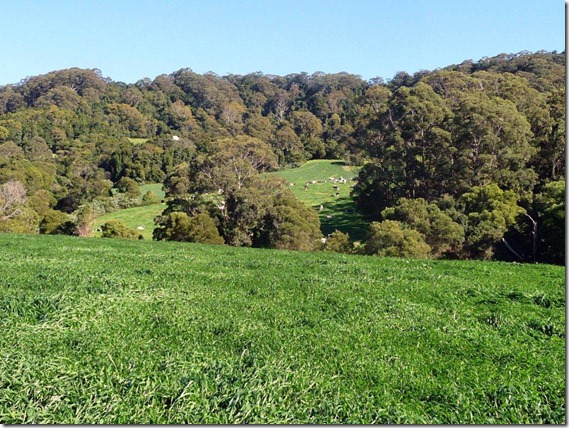
Grass for cows (or should I say pasture) is all about quality not quantity. Cows are discerning diners as my good friend Milk Maid Marian says. They like grass that is short and sweet.

2214

It doesn’t get much better than this

Short. sweet grass is full of sugar. For plants to produce sugar they need plenty of sunshine.
Looking back from Easts to Cows in Yard Paddock 0011

Chocolate for cows 

In fact growing grass is a fine art that all good dairy farmers have perfected to a tee and there is a saying in the industry that the difference between a good farm and the rest in just two weeks.

In fact we are doing pasture trials at the Lemon Grove Farm just to prove the anecdotal evidence.

Michael in Lucerne @ Lemon Grove

Michael is a bit of a pasture guru as you can see

There is a great little story on how we grow grass at Clover Hill Dairies as part of the Jet and Emma Farm Management Series here if you would like to know the nitty gritty.

This is also time of the year when farmers often take advantage of the excess of grass to store some fodder for winter by cutting high quality pasture to make hay and silage.

It isn’t a myth. You do need to make hay while the sun shines but for that you need a 48 hour window of dry weather

tilly in haystacks

Making Hay on Jamberoo Swamp (Photograph courtesy of Linda Faiers copyright)

As I said earlier dairy farmers can’t control the weather but we can prepare for it and often that is just simple things.

For example cows are no difffrent to people when it comes to wet feet. Just like standing in water makes your feet soft and wrinkley so does standing in wet soggy paddocks for cows. So we do things like add extra zinc to the cows feed to help harden their hooves which helps reduce the incidence of sore feet.

Feed inj the dairy 0005

Each cow gets fed a specially formulated ration in the dairy at every milking. This is a perfect way to fine tune the diet when weather conditions and pasture growth aren’t ideal for cows.

We also make sure our laneways are super smooth highways and the team are very mindful of the cows and move them at very gentle pace during the wet especially on the home farm where the hills become very slippery.

Strongs veiw to the sea

The mountainside that looks so pretty can be turn into a cow slippery slide nightmare in a couple of hours

The perfect place to dairy

Jamberoo is the birth place of the Australian dairy industry and its still a great place to dairy for all the right reasons. We have great volcanic soil, which means despite all the rain the drainage is still excellent and the water moves away very quickly. Our cows aren’t whingeing as you can see.

IMG_2262

There is always plenty to eat Rain Hail or Shine

What about the radio interivew you ask?  Well except for managing to move the flood back a whole month ( cant believe I said that) it went off okay. You can decide here

Walking when too much is not a good thing

At Clover Hill Dairies we milk 500 cows three times daily on two farms.

Milking three times a day is not the norm but we do it for a multitude of reasons which are good for people, cows and the planet.

Milking three times a day means lots and lots of health benefits for our cows but those health benefits rely on good time management.

Good time management is essential because cows need at least 12 hours a day to sleep. ( If you want to read the heavy science you can find it here.)

So as our cows walk backwards and forwards to the dairy three times daily we need to make sure they do that with as much cow comfort as we can provide so they can do it as quickly and efficiently as they can.

cows in line

Cows travel super highways at Clover Hill  (special thanks to Penny Scott who took this gorgeous photo)

To help them do this we have created a series of “supermoo highways” on our farms.

Lynne Strong images (2)

Like this and this –  Cars and people like them too. We get lots of the “keep fit” crowd walking up this road

IMG_1509

50% of our farm is rainforest and part of our role as land stewards is to make sure our farming practices do not impact on the native vegetation or the wildlife.

So we have supermoo highways through our rainforest as well .

Here is a great example of development of one through the rainforest

Cows Walking thru rainforest

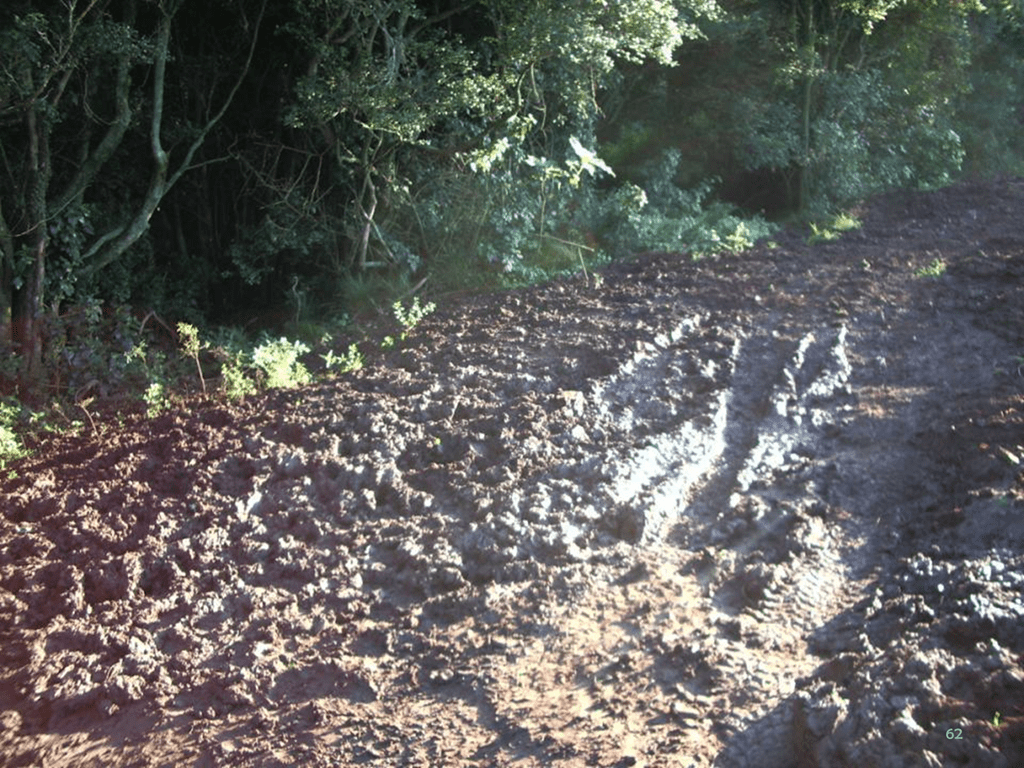
This one was fine like this when we milked twice daily but it looked like this when we got a lot of rain and the cows started using it three times daily

Mud0062

So what did we do. We got some advice from rainforest experts and some cow comfort experts and we did this

Cows on Picasso Laneway  0006

Picasso Corner

Firstly we separated the cows and the rainforest with a fence.

Cows on Picasso Laneway  0001

Then we poured concrete on the laneway.  We had happy cows and a happy farm team who found the cows liked the new comfortable road and were very keen to come back to the dairy for milking.

Then we needed to spend some time nurturing the rainforest. So we found some more experts to give us the right advice like Erin and the team at Landcare Illawarra

P1110010

Erin with Tony Hepworth and Mike Swanson from South East Landcare 

The troops came in and did their bush regeneration thing and achieved some great outcomes like this

10 July Picasso Corner  (12) 

Confidence to Grow Photos for Facebook   (13)

What about those cows getting their 40 winks!!!!!!!!!!

Yesterday I went for a walk and it gave me great pleasure when I came across the cows in the paddock at the end of the laneway we call Picasso Corner (another story) and saw this paddock full of very happy cows RESTING

Erin and Ann 0002

Great outcomes all round me thinks

Next Gen giving our farm lots of TLC

It was a huge day at the farm on Wednesday with our eco warrior Erin Lake leading a team of volunteers in revegetating an important area of our riparian (areas around our waterways) zone.

Little aside on Erin – Erin has passion for biodiversity like no other and she takes every opportunity to share her passion with the world

In her role as a Art4Agriculture Young Farming Champion

ERIN PAYTNER

Here is Erin with the Castle Hill High School Archibull Prize entry team. See the video she made for her school presentation to Castle Hill High School here. Its awesome

Out in the streets hunting down and eradicating the dreaded evil Madeira Vine

Madeira Vine

or waging the war against the nasty environmental invaders on farms across the Illawarra and south coast

Erin Lake and Jake Proust  Clover Hill Dairies Bush Regeneration team

Here she is with fellow A team bush “regener” Jake Proust

Or organising community events like Dune Day

View album

Erin Lake event organiser

or spreading the good eco messages thru the media

Erins Passion for the Land

Or engaging with and encouraging young people to have a greater appreciation for the landscape

Erin Blog Post0002Erin Blog Post0001

Now back to today’s story –  the volunteers hailed from the National Green Jobs Corps– a youth training and employment program encouraging young people to be involved in the NRM ( natural resource management) industry.

Erin identified an area in one of our creek lines as an important wildlife corridor which links together two significant stands of Rainforest on the farm, and in need of a little help to get re-established.

So the wonderful Michael (Strong) arrived at the site before any of us were even awake, to slash the Kikuyu to make it easy for the volunteers to plant into. And what an amazing job he did! Oh and as usual- he did it with a big smile

Michael and Lynne Strong

Michael my hero – ooooooooooh palpitations

The Green Corps arrived early to get stuck into the planting. They were very excited when they found out that they were going to be getting a lift to the site in the back of Erin’s Ute (albeit very slowly) – but just as excited when they found out they were going to be revegetating some important sub-tropical rainforest.

Back of Truck

The trees that were used in the planting were nothing short of amazing- there was a huge variety of local species supplied by Richard Scarborough from Landcare Illawarra. Richard tells us that these trees were grown from around 7 different local nurseries and this makes sure that there is a wide genetic diversity in the plantings, which is very important for biodiversity.

PA160185

Richard Scarborough – local legend

The trees we planted included some of Erin’s favourites – Native Tamarinds (Diploglottis australis), Black Apple’s ( Planchonella australis)

and even a couple of Giant Stinging Trees (Dendrocnide excelsa)- which are a very important local rainforest trees apparently ie if you can forgive the almighty sting you receive if you brush against one of the leaves! and I dont find myself very forgiving in this instance particularly after the day I thought a young one was a Tobacco Bush which I decided to pull out withy my bare hands. Oh how I regretted that little “do good” effort

Baby Stinging Nettle Tree

Stinging Nettle Trees love the soil at Clover Hill – I don’t love them  – baby ones popping up everywhere – that “thing” with the big round leaves next to the Red Cedar ( love them)

So the Green Corps did an amazing job of planting nearly 200 trees and we were very grateful for the use of a Petrol Auger that was supplied by Landcare Illawarra!

Erin and Mick returned on Friday to put on the tree guards (thanks to Couriers Please for your as always delayed service… LESSON TO ALL NEVER EVER USE “COURIERS PLEASE”).

We are trialing the use of Milk Carton Guards as they are biodegradable and very appropriate for a planting on a dairy farm!

6484259949_0a9f79e2b6IMG_2996

And seeing some of our milk goes into PURA cartons I think we should be able to get a better deal on our next purchase and I can assure you it wont be “Couriers Please” who bring them to the farm

Our maintenance regime will be just as important and our plan is to mow and snip to keep the Kikuyu down and use a light Glyposate mix to keep the grass away from the plantings. This is where the guards will be very useful- they highlight where the trees are to the mowing contractors, and they protect the plants from any spray drift while they are only little. Once they grow to a metre- they will need very little maintenance and they will grow into beautiful trees before we know it.

So all in all a great day and another example of how effective partnerships can make a huge difference and lead to great successes in Natural Resource Management on Australian dairy farms and help keep our cows happy and healthy.

AYOF  (3)

Erin is a great advocate for the Nationals Green Jobs Corps Initiative. “This is a program that works. I have been lucky enough to be involved with a number of these groups and I have found that their team leaders are consistently brilliant- patient and very enthusiastic about training these young people- and learn a lot themselves from working with such a diversity of people.” says Erin

Well Done Green Corps and Erin!

Something isn’t quite right in paradise

This week the milking cows are taking their morning feed (4am to 12 noon) in the paddocks in front of my house. I so look forward to this part of the grazing rotation which at this time of the year comes around every 14 to 18 days.

Now the cows seem to know I have a new camera and are doing their best to provide the rural idyll but this morning things were a little too perfect.

Firstly there was this

IMG_2026

that was fine. Then there was long lingering looks like this

IMG_2030

Then there was thousands (never let the facts get in the way of a good story) of looks like this

IMG_2036

Quick turn on of the tap at the kitchen sink confirms my suspicions lots of thirsty looking cows means broken water trough. Michael to the rescue once again

You are our hero Michael – shame about the shorts

IMG_1533

Creepy crawlies live in paradise too

I am a sixth generation farmer but I don’t like snakes, rats and spiders any more than your average city person

I grew up in NSW heartland and saw plenty of brown snakes that knew to keep well away from my father and his shotgun.

At Clover Hill there are no shotguns but plenty of red belly black snakes and no shortage of pythons including the one that has been living in the Illawarra Flame tree just outside my kitchen window scaring the bejesus out of my visitors when he/she suns him/herself on my front steps and my chooks 24/7

Chooks

Yesterday I was enjoying a freshly made latte with milk straight from the udder so to speak before joining my sister for a Foodscape Tour and looking out the kitchen window I spotted what was causing all the commotion in the chook pen

IMG_1594

Now I didn’t have time to take pictures of this snake let alone video footage ( yes I did that too) and then discover this snake was indeed stuck in the netting and in desperate need of rescue.

So who do you call?  WIRES of course and who was the best person for this job at this time? Michael of course. Though not happy that I thought he had more time than me to do this.

But its not just about time is it? In this case he was the person who could lend a hand if necessary (and there was no way in the world I was going to wear that hat) and besides I had a Foodscape Tour to join

So what happened to “Clover” the snake you ask. Yes Hugh from WIRES called our snake Clover

Find out if here if there is a happy ending for Clover

Hugh from WIRES and Clover our friendly python who ate too many rats at once–thank god it wasn’t my chickens

A picture paints a thousand words

When people ask me where I live I invariably reply I live in paradise and I am using this post as one of many to give you pictorial reasoning for this claim.

Clover Hill Dairies is located on two farms in the Jamberoo Valley the birthplace of the Australian dairy industry but more famous today as the place “where you control the action”

The home farm is located on the north east face of Saddleback Mountain in very steep rainforest country. In fact 50% of the farm is rainforest so when you run possibly the most intensive pasture based dairying operation in Australia and farm in this very precious environment you feel a huge responsibility to do what is right for the landscape, the cows and the wider community.

There is no denying it is a challenge but oh so worthwhile.

On Friday the cows where outside my house between the 4am and the 12 noon milking. My camera captured their noon stroll to the milking shed.

Paradise 101

  View from my front verandah. This becomes below when the cows move in.

IMG_1611

IMG_1449

Michael begins the midday milking roundup

IMG_1444

There is no rush. Always time for a two way pose.

IMG_1476

And no shortage of cows with plenty of attitude. 1453 is called Mandelyn Storm Favourite and she looks like she has been in the good paddock a bit too long not that she is complaining.

IMG_1491

IMG_1522

Michael has discovered why the cows are taking a bit longer than usual. There seems to be some silly woman standing in front of them taking pictures

IMG_1537

He just shakes his head and gives me one of his cheeky grins

The cows were back in the front paddock when I went to town the next day

IMG_1646

This is what I saw looking back on my house and the cows when I drove up Saddleback Mountain Rd.

Paradise – we are giving it a pretty good shot don’t you think?

Hello World, Welcome to my world

My name is Lynne Strong and I am a woman with many, many hats. Some I wear better than others I readily admit.

The one I wear most proudly though is my farmer hat. I will be the first to admit it isn’t a hat that I saw myself wearing as a little girl.

NickLynneMichaelStrong3

I grew up on a farm and even though I enjoyed being hands on in the day to day running of the farm and the lifestyle that comes with it the idea of being a farmer was most definitely not on my list of top 10 professions.

I farm today because the people I most care about in the world farm and they are in it for the long haul.

MichaelNickStrong1

Farming today is no walk in the park. Feeding, clothing and housing the world now and in the next 50 years is going to require an extraordinary effort. This means we need extraordinary people to take up the challenge.  My husband Michael, my son Nick and our farm team (and our cows) have put their hands up to take on the challenge and I want to work side by side with these extraordinary people.

So why write a blog. Well my family have been farming in the Jamberoo Valley on the South Coast of New South Wales since 1831 (and in Ireland and Scotland probably for centuries before that).  That is 7 generations of farming families and 180 years of blood sweat, tears, passion and commitment that have gone into what is now producing milk for 50,000 Australians everyday

That’s 180 years of great stories waiting to be told. And I knew from my interactions with our friends and neighbours that the community wanted to hear those stories.

They just needed the right vehicle. So Art4Agriculture was conceived and Art4Agriculuture has its own entire wardrobe of hats.

But people keep telling me there was still a gap missing, we need more farmers to share their stories to help provide the community with real farmers they can relate to.

Writing a blog is indeed a great way to open the door to our farms, share our ups and downs, the frustrations and challenges, the passion and commitment but most of all show the community that the faith they have in Australian farm produce is warranted.

I am writing this blog to join other inspiring farmers who are opening thier farmgates and help inspire other farming men and women to share their stories. To help show them the community does love farmers, that they do want to hear our stories but they maybe a bit concerned about modern farming practices and whether the way we farm today fits into their rural idyll.

Lets not forget farmers are people and not all people are perfect but there is a whole nation of Australian farmers who get up everyday and say “today I want to move one step closer to being being a perfect farmer”.

What is the definition of perfect farming? That’s the challenge – that’s the two way conversation I would like to have with my readers.

I will put this one out there as a definition this morning “We believe that responsible farming is not only about ‘doing the right thing’ but makes sense – for our animals, our landscape, our people and our communities”.

So lets start the conversation I invite my readers to write me a mission statement for their “perfect” farm