We can and should be proud and loud of our farmers

I am the National Program Director for Art4agriculture and one of our signature programs the Archibull Prize is currently rolling out in NSW schools.

So we can get an understanding of where we should be focusing our efforts and whether we are achieving our objectives we conduct entry and exit surveys 

The Archibull Prize has a number of objectives and those which specifically relate to this blog are

  • To provide a platform for farmers and students to connect, share stories and improve understanding of modern farming practices and work through potential solutions together.
  • To communicate to students, schools, teachers and parents that Australian farmers are professional and caring and committed to working towards sustainable farming production systems.
  • To provide a vehicle for urban communities to understand that our farmers must be able to innovate, achieve efficiency gains and intensify their businesses where necessary in order to continue to deliver affordable, nutritious and ethically produced food for Australians and many other people around the world.

The preliminary results of the entry survey are in.  We did not ask questions about the students’ knowledge of the paddock to plates process or whether they thought yogurt grows on trees or not. We knew this wasn’t necessary as we are very confident  the program will provide them with excellent knowledge of where their food comes from.

What we wanted to find out is if the students had the necessary knowledge to enable them to value all services that Australian farmers provide including ecosystem services, healthy food and quality of life.

We readily admit we asked questions we only knew the answers to because we are in this space and what we discovered is what we already knew and that is agriculture has done a very poor job of telling its story.

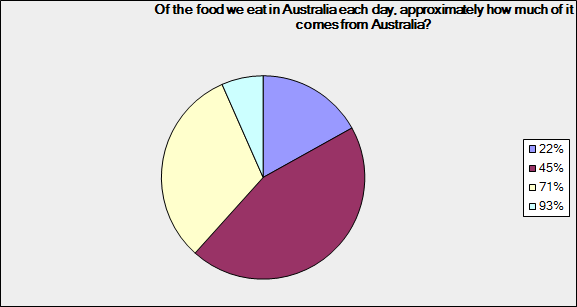
We asked questions that would help the students think about food security. Scary isn’t it whilst 93 per cent of the food we consume is produced in Australia our young people thought it was more like 45%.and I wonder how many adults think the same. I wouldn’t be surprised if its a very similar proportion.    

image

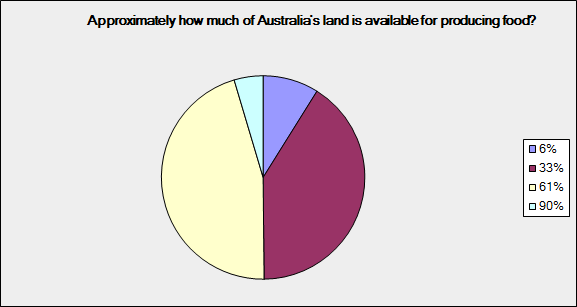
When asked the question how much of Australia’s land is suitable for food production?  The most popular answer was 61% when in fact less than 6% of Australia is suitable for food production.

image

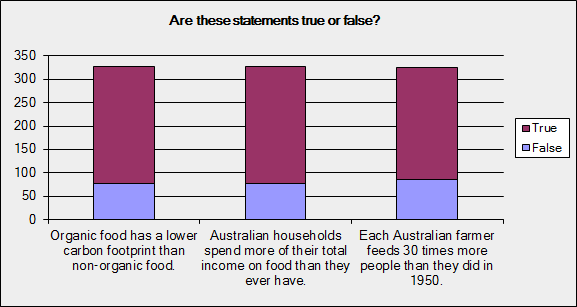
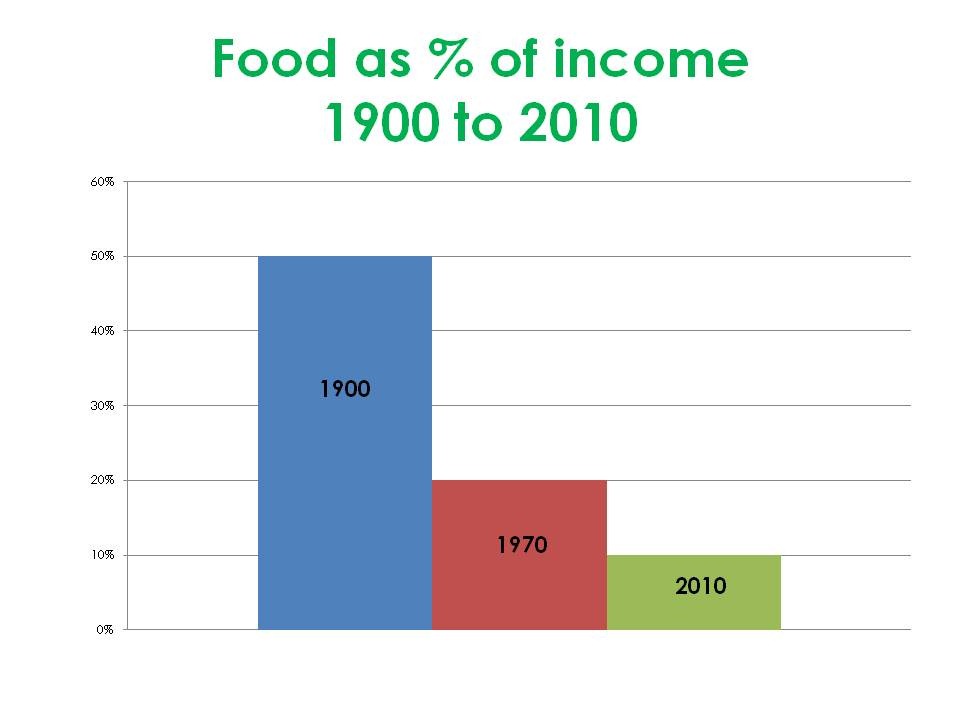
When asked about the cost of food as you can see the students overwhelming thought food spend as percentage of income was higher than it has ever been and everybody who reads my blog knows that food has never been cheaper in this country.

In relation to organically produced food our surveys have always found myths abound. Now I admire immensely anyone who can produce food organically and get a premium for it but no way in the world does it have a lower carbon footprint than conventionally produced food. But as you can see from the graph below the students overwhelming think it does. What was heartening is the students do acknowledge the massive farming productivity gains in Australia in the last 60 years     

image 

This year the ‘Archibull Artwork’ will embrace the theme: “What does it take to sustainably feed and clothe your community for a day?”
The program will cover issues like
1. The role of Australia’s food and fibre industries in sustainably feeding and clothing our  communities.
2. Understanding the challenges our farmers face to feed and clothe people sustainably in a world with a declining natural resource base.
3. The disconnect between consumers and farming practices – how do we find common ground?
4. Understanding the disconnect between the food we buy and the impact that it has on the environment when we throw it away.

Other issues the students will explore include the future of farming and what direction the students see farming going in a social media world as well as looking at the faces of farming and how to personalise farming in a globalised society.

This will be enhanced by visits from young farming champions from rural NSW who will come to the school and talk to the students and share their farming experiences.

We believe this program not only helps turn the light on to the wealth of opportunities that careers in agriculture delivers but also highlights the valuable role our farmers play in the health, wealth and happiness of Australians and many people around the world.  

Coles is making my blood boil

What a month it has been. On the home front Michael took the plunge and attempted the double knee replacement . The less said about the outcome of that at this point in time the better .

Out in the wider dairy community suppliers to Lion via the Dairy Farmers Milk Supply Coop (DFMC) got the devastating news (and there is more to come) of what their “quotas” were likely to be and the atrocious price on offer for Tier 2 milk (milk in excess of quota). What was this bad news?  I am finding it difficult to even put the figures on paper. Farmers supplying Tier 2 milk are receiving a max of 14c/litre and some even as low as 11c/litre

I can categorically say the NSW dairy industry is facing decimation and in the short term its the emotional trauma that is hitting first for those farmers finding themselves affected by this double whammy.

As in any situation like this, various factors have bought on the conditions DFMC suppliers find themselves in. The one underlying factor that is preventing any hope of a revival is the Milk Price Wars started by the Coles Prices are Down Campaign  that comes surrounded with spin like this COLES CUTS PRICES AGAIN TO HELP AUSTRALIAN FAMILIES.

Well I can tell you Coles there are a lot of wonderful, caring dairy farming families hurting very badly at the moment and I am finding it hard to believe you are that naive that you think Australian families want you to destroy other families to deliver an extra $450 savings in their pockets by shopping at Coles

Then this came along and it made me even more furious. In another blatant marketing gimmick Coles has announced it wants to put video cameras on Aussie Farms. This stunt has been covered superbly by Milk Maid Marian in these two blog posts

http://milkmaidmarian.com/2012/08/10/coles-wants-video-cameras-on-aussie-farms/

http://milkmaidmarian.com/2012/08/10/coles-wont-rule-out-cctv-on-australian-farms/

As soon as I have a window I will be officially inviting Coles leadership team to our farm. I can offer them 6 star Eco accommodation, hands on milking experiences as well as a guided tour of our dairy facilities, pasture research trials and natural resource management activities but that will have to wait a few weeks.

Today I am off to Canberra with my farm consultant Dr Neil Moss. Neil and I both care very much about our fellow dairy farmers and we are doing everything in our control to make the future a better world for them to farm in

Today we have a wonderful opportunity to talk to some very bright minds in Australian Government Lands and Coast and we will be listening and having highly productive two way conversations and we will come up with a plan I am confident of that.

And we need to, because, Australia we have a big problem, the supply value chain model isn’t working and we have to get it remodelled fast.

Sustainability must be embedded in the supply chain system. It is imperative we have partnerships between community, government and the private sector to enable our farmers to continue to supply the best quality products for people, animals and the planet.

This will only happy when our supply chain partners become advocates for our farmers and sadly Coles you just don’t get it  YET but you will and I look forward to helping you see the light.

IMG_3385

Coles their future is in your hands – lets make it happen together  

Farmers Knees

The first thing you cant help but notice when you meet this farmer is the big smile (and yes he is pretty good on the eye as well I must admit)

MERCURY.WEEKENDER. Pic taken at Clover Hill Dairies Jamberoo for Two page feature and history and future of Clover Hill Dairies ..pic of Michael Strong round up cows.pic by sylvia liber. 6 September 2006. job number 00065069 SPECIALX 00065069

Michael Strong  – photo taken by Sylvia Liber September 2006

This farmer has been finding it harder and harder to smile every year since 1998 when he had a rather nasty run in with a 900kg plus bull. The bull decided the quickest way to separate Michael from his cows was to slam him in to the closest concrete trough. Well this worked for the bull but Michael is confident a polite word in his ear would have achieved the same thing without leaving him with a lot of broken bones and ultimately a rather nasty condition called Traumatic Arthritis. Traumatic Arthritis is pretty much the same as Osteoarthritis with the added complication of intermittent excruciating pain caused by bleeding in the joints and in Michael’s case his knee joints.

Farmers knees

10 years ago they said he was too young and his job too physical to have knee replacement surgery. Five years ago they said the same thing but when the pain got so bad he could no longer sleep they decided it was time. Double knee replacement here we come. That sounds like fun doesn’t it? For some reason Michael wasn’t looking forward to it  

The big day was to be in April but firstly an altercation between his legs and some lantana bushes and then a wedding to attend ( lots of smiles that day) meant it was delayed until last Friday.

Church

Nick and Emma

Wedding Speech

Now I have always been big on insurance and work on the principle if you cant afford to insure it you cant afford to buy it. Whether that be a car, a tractor or the farm, income protection, life insurance or in this case private health insurance. Michael is in the Mater in North Sydney. Wow never seen anything like it. The quality of care is just unbelievable. Michael has his very own personal nurse and to top it all off the food is good.  Yes believe it or not the food is great

The operation didn’t go quite to plan and they were only able to do one knee – they found far too many bizarre things that needed fixing with one knee let alone two at once.  

Machines

Very pleased to say after 48 hours of fentanyl/morphine cocktails the pain seems to be easing and the smile is back on the face. Full steam ahead I say to a full recovery. Then there is that little hiccup of the other knee. Less said about that one at the moment the better I think

Knee Draining

Next stop Michael – say Whitsundays where you can see knees like these

Knees onthebeach

Some great info on knee replacement surgery can be found here for all of my readers with Farmers Knees

A Very Wicked Problem

I am reblogging this from Art4AgricultureChat because I am very interested in what my Clover Diaries Diary readers have to say about this  

Today’s guest blog 1 is by Gerry Andersen who is the Chief Executive Officer of Foodbank NSW.

image

Gerry has also been involved with the RAS of NSW for the past 25 years and is currently a RAS Councillor and Chair of the Sydney Royal Dairy Produce Committee. I had the pleasure of working with Gerry and the superb team from the Sydney Royal Dairy Produce Show in February this year when I had the honour of stewarding in the ice cream judging section. See the post I wrote about my day here

Gerry’s work with Foodbank has perfect synergies with the ethos of the Archibull Prize where we ask participating students to reflect on sustainable food production and also their role in sustainable food consumption. I am confident like me you will be astounded by the amount of food that is wasted in this country and as a farmer producing some of this food that ends up in landfill it breaks my heart. It will also break your heart to read about the other end of the spectrum that Gerry shares with us in this post. It just beggars belief that this can happen.

Each year two million Australians will rely on food relief and around half of them will be children who often go to school without breakfast or to bed without dinner.

Are the lucky ones so self absorbed and we live in our own little worlds and forget what really matters?. I just don’t know. What do you think?

I do know that as a farmer I am very proud of my fellow farmers participating in the Waste Not Want Not program.

This is what Gerry has to say………………..

Waste not; want not

Food waste is a complex social, economic and environmental problem that is having an increasingly negative impact on our world.

wastegraph

There’s no doubt that when it comes to food production, Australia truly is the lucky country. We live in a plentiful country, with some of the world’s most abundant fresh produce and skilful, efficient farmers. Each year, Australia produces enough fresh food to feed 60 million people – that’s nearly enough to feed the nation 3 times over.1
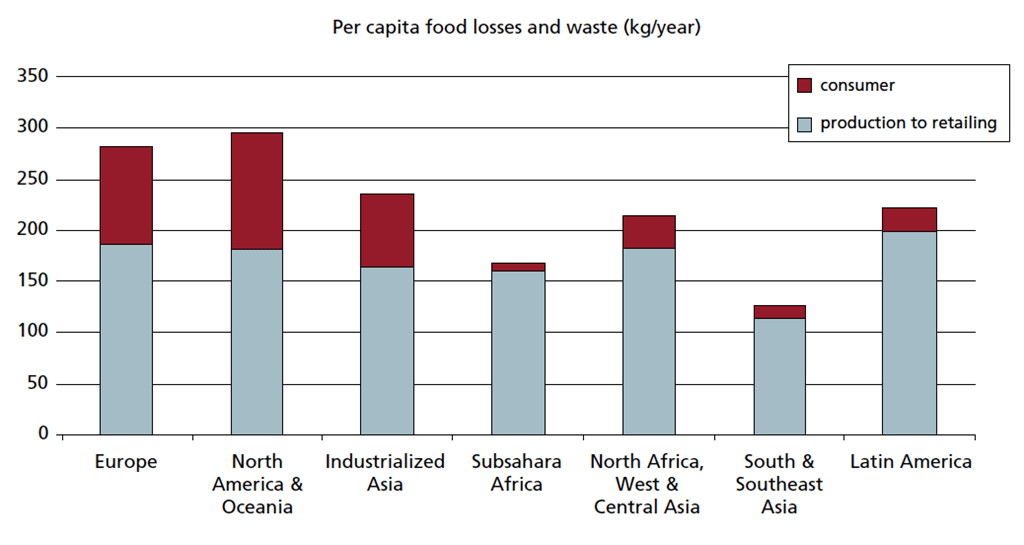
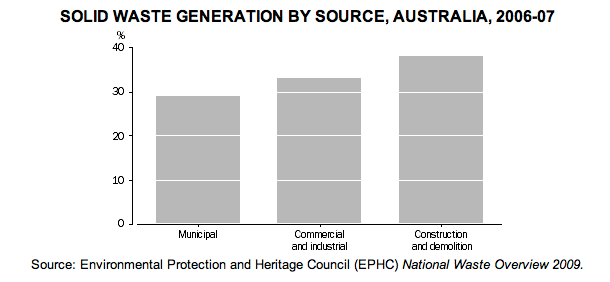
However, recent figures suggest that 4 million tonnes of food is wasted every year in Australia.

food_waste

Of this, 1.38 million tonnes is business food waste and 2.6 million tonnes is household food waste. 2

waste

This surplus food could feed millions of Australians every day. Food gets wasted because we buy more than we need; we cook more than we need; and due to demanding quality standards a lot of produce is discarded because of appearance, despite the nutritional quality still being very good. These food waste facts are startling alone, but when coupled with the fact that 1.2 million Australians do not have access to a safe and nutritious food supply, the situation is staggering.

Many of us eat well and enjoy a varied diet, so it seems strange to be discussing food shortages for Australians; however, for many, access to food is a critical problem. Each year two million Australians will rely on food relief and around half of them will be children who often go to school without breakfast or to bed without dinner. This is where Foodbank, the largest hunger relief organisation in Australia, comes into the equation. Foodbank is a not-for-profit, nondenominational organisation that seeks and distributes food and grocery industry donations to welfare agencies to feed the hungry around the country. The food goes to hostels, shelters, drop-in centres, school breakfast programs, home hampers and emergency relief packages for people in need. Last year alone it redistributed enough food for 28 million meals.

I became involved with Foodbank in 2009 taking up the role of CEO, following retirement from the food manufacturing industry three years earlier. I enjoyed entering the workforce again, and in particular working in the charity sector. Foodbank was initially formed to redistribute wasted food products from Australian food manufacturing and retailing sectors. However, recently the focus has moved to the farming industry.

Foodbank’s Waste Not Want Not program is a unique project that delivers otherwise wasted produce from the Riverina farming community to the tables of hungry families throughout NSW and the ACT. Since the program began in 2011, over 400 tonnes of produce from the Riverina district has been donated. There are plans to roll out the program in many more areas in NSW by 2013. Farmers, including small producers, can donate their fresh fruit and vegetables products that are in excess to demand or not quite up to quality standards, as they are still nutritious and very desirable to feed needy people. Our most common donations from farmers include oranges, pumpkins, onions, potatoes and grain.

There is still a long way to go to achieve an Australia without hunger, but we, as an agricultural community, can play a part to reduce the waste and hunger that exists.

food-waste-hierarchyHeria

Waste Food Hierarchy

This is a very wicked problem that each and everyone of us has an opportunity to make a difference  

For more information on Foodbank and how you can become involved Visit www.foodbank.com.au

1 This article first appeared in RAS Times July 2012.

2 Australia and Food Security in a Changing World. Report of the Prime
Minister’s Science, Engineering and Innovation Council (PMSEIC)
Expert Working Group, 2010.

My light bulb moment

I have just come back from 2 pretty frustrating days of meetings in Canberra. The good news is two great positives have come from those two days of frustration

Firstly I had an epiphany. I know why farmers farm. Despite everything they go through to produce food and fibre for too often, too little return there IS a huge reward. That reward is satisfaction of knowing that you get up every day and have the ability to achieve something very important and most of the time you do it. My last two days in Canberra have shown me that there are a lot of people who don’t get that opportunity and certainly not people who spend most of their lives going to meetings

At Clover Hill Dairies that reward is the satisfaction of supplying 50,000 Australians with nature’s perfect nutrient dense cocktail “milk”.  Three times daily we have the satisfaction/reward of seeing the cows coming into the dairy, the cups going on, the milk traveling from the cow’s udder at 37 degrees through a series of stainless steel pipes to the first plate cooler which drops the milk to 17degrees C then to the second plate cooler which drops it to a further 8 degrees and then into the vat. The vat’s role is to drop the milk to the required just less than 4 degrees C and maintain that temperature until the milk tanker (or the money truck as Nick calls it) arrives.  All this in the blink of an eye lid. Not quite that fast but you get the picture. All this exciting stuff is happening right in front of you. So rewarding. So satisfying.

The second realisation I had is that it is no different at the top of the ladder as it is as the bottom. Too many  “leaders/spokespeople” do not come to decision making table prepared to bring the solutions and/or be part of the solution. When this doesn’t happens its the same old same old and it doesn’t matter how good the facilitation process is, everybody walks out the door shaking their heads, too often blaming the facilitator and the facilitation process at the two meetings I attended was just fine no complaints from me there.

Its horrifying really. People at all levels just don’t have the skills sets to participate effectively in meetings. BTW There were no farmers in the room at either of these meetings. On Monday the people in the room were high end service providers and the like to the agrifood sector

So the second positive is going forward the Young Farming Champions program will now incorporate a session/s on how to turn up at the decision making table with the solutions and effectively participate in meetings.

I for one will be attending those sessions with my eyes and ears wide open. Ready, willing and able to learn because for me there would be nothing more less satisfying than waking up everyday and finding yourself part of the problem.

Slide18

Post Script

A reader of my post today has drawn my attention to the work and writings of Margaret Wheatley who hails from US?. Yes Julie you were spot on. I am indeed very impressed

I have cut and pasted one of her articles found at this link  so you can see if what she has to say resonates  with you http://www.margaretwheatley.com/articles/Leadership-in-Age-of-Complexity.pdf. Have you taken on the hero role at some stage in your life? Then like me this quote will particularly resonate with you.

“This hero’s path has only one guaranteed destination—we end up feeling lonely, exhausted and unappreciated”.


Leadership in the Age of Complexity: From Hero to Host

Margaret Wheatley with Debbie Frieze ©2010 published in Resurgence Magazine, Winter 2011

For too long, too many of us have been entranced by heroes. Perhaps it’s our desire to
be saved, to not have to do the hard work, to rely on someone else to figure things out.
Constantly we are barraged by politicians presenting themselves as heroes, the ones
who will fix everything and make our problems go away. It’s a seductive image, an
enticing promise. And we keep believing it. Somewhere there’s someone who will make
it all better. Somewhere, there’s someone who’s visionary, inspiring, brilliant,
trustworthy, and we’ll all happily follow him or her. Somewhere…

Well, it is time for all the heroes to go home, as the poet William Stafford wrote. It is
time for us to give up these hopes and expectations that only breed dependency and
passivity, and that do not give us solutions to the challenges we face. It is time to stop
waiting for someone to save us. It is time to face the truth of our situation—that we’re
all in this together, that we all have a voice—and figure out how to mobilize the hearts
and minds of everyone in our workplaces and communities.

Why do we continue to hope for heroes? It seems we assume certain things:
• Leaders have the answers. They know what to do.
• People do what they’re told. They just have to be given good plans and
instructions.
• High risk requires high control. As situations grow more complex and
challenging, power needs to shift to the top (with the leaders who know
what to do.)

These beliefs give rise to the models of command and control revered in organizations
and governments world‐wide. Those at the bottom of the hierarchy submit to the
greater vision and expertise of those above. Leaders promise to get us out of this mess;
we willingly surrender individual autonomy in exchange for security.
The only predictable consequence of leaders attempts to wrest control of a complex,
even chaotic situation, is that they create more chaos. They go into isolation with just a
few key advisors, and attempt to find a simple solution (quickly) to a complex problem.
And people pressure them to do just that. Everyone wants the problem to disappear;
cries of “fix it!” arise from the public. Leaders scramble to look like they’ve taken charge
and have everything in hand.
But the causes of today’s problems are complex and interconnected. There are no
simple answers, and no one individual can possibly know what to do. We seem unable
to acknowledge these complex realities. Instead, when the leader fails to resolve the
crisis, we fire him or her, and immediately begin searching for the next (more perfect)
one. We don’t question our expectations of leaders, we don’t question our
desire for heroes.

The Illusion of Control
Heroic leadership rests on the illusion that someone can be in control. Yet we live in a
world of complex systems whose very existence means they are inherently
uncontrollable. No one is in charge of our food systems. No one is in charge of our
schools. No one is in charge of the environment. No one is in charge of national
security. No one is in charge! These systems are emergent phenomena—the result of
thousands of small, local actions that converged to create powerful systems with
properties that may bear little or no resemblance to the smaller actions that gave rise to
them. These are the systems that now dominate our lives; they cannot be changed by
working backwards, focusing on only a few simple causes. And certainly they cannot be
changed by the boldest visions of our most heroic leaders.
If we want to be able to get these complex systems to work better, we need to abandon
our reliance on the leader‐as‐hero and invite in the leader‐as‐host. We need to support
those leaders who know that problems are complex, who know that in order to
understand the full complexity of any issue, all parts of the system need to be invited in
to participate and contribute. We, as followers, need to give our leaders time, patience,
forgiveness; and we need to be willing to step up and contribute.
These leaders‐as‐hosts are candid enough to admit that they don’t know what to do;
they realize that it’s sheer foolishness to rely only on them for answers. But they also
know they can trust in other people’s creativity and commitment to get the work done.
They know that other people, no matter where they are in the organizational hierarchy,
can be as motivated, diligent and creative as the leader, given the right invitation.

The Journey from Hero to Host

Leaders who journey from hero to host have seen past the negative dynamics of politics
and opposition that hierarchy breeds, they’ve ignored the organizational charts and role
descriptions that confine people’s potential. Instead, they’ve become curious. Who’s in
this organization or community? What skills and capacities might they offer if they were
invited into the work as full contributors? What do they know, what insights do they
have that might lead to a solution to this problem?

Leaders‐as‐hosts know that people willingly support those things they’ve played a part
in creating—that you can’t expect people to ‘buy‐in’ to plans and projects developed
elsewhere. Leaders‐as‐hosts invest in meaningful conversations among people from
many parts of the system as the most productive way to engender new insights and
possibilities for action. They trust that people are willing to contribute, and that most
people yearn to find meaning and possibility in their lives and work. And these leaders
know that hosting others is the only way to get complex, intractable problems solved.
Leaders‐as‐hosts don’t just benevolently let go and trust that people will do good work
on their own Leaders have a great many things to attend to, but these are quite
different than the work of heroes.

Hosting leaders must:
• provide conditions and good group processes for people to work together.
• provide resources of time, the scarcest commodity of all.
• insist that people and the system learn from experience, frequently.
• offer unequivocal support—people know the leader is there for them.
• keep the bureaucracy at bay, creating oases (or bunkers) where people are less
encumbered by senseless demands for reports and administrivia.
• play defense with other leaders who want to take back control, who are critical
that people have been given too much freedom.
• reflect back to people on a regular basis how they’re doing, what they’re
accomplishing, how far they’ve journeyed.
• work with people to develop relevant measures of progress to make their
achievements visible.
• value conviviality and esprit de corps—not false rah‐rah activities, but the spirit
that arises in any group that accomplishes difficult work together.

Challenges from Superiors
It’s important to note how leaders journeying from hero to host use their positional
power. They have to work all levels of the hierarchy; most often, it’s easier to gain
support and respect from the people they lead than it is to gain it from their superiors.
Most senior leaders of large hierarchies believe in their inherent superiority, as proven
by the position they’ve attained. They don’t believe that everyday people are as
creative or self‐motivated as are they. When participation is suggested as the means to
gather insights and ideas from staff on a complex problem, senior leaders often will
block such activities. They justify their opposition by stating that people would use this
opportunity to take advantage of the organization; or that they would suggest ideas that
have no bearing to the organization’s mission; or that people would feel overly
confident and overstep their roles. In truth, many senior leaders view engaging the
whole system as a threat to their own power and control. They consistently choose for
control, and the resultant chaos, rather than invite people in to solve difficult and
complex problems.
Leaders who do know the value of full engagement, who do trust those they lead, have
to constantly defend their staff from senior leaders who insist on more controls and
more bureaucracy to curtail their activities, even when those very activities are
producing excellent results. Strange to say, but too many senior leaders choose control
over effectiveness; they’re willing to risk creating more chaos by continuing their take-charge, command and control leadership.

Re‐engaging People
Those who’ve been held back in confining roles, who’ve been buried in the hierarchy,
will eventually blossom and develop in the company of a hosting leader. Yet, it takes
time for employees to believe that this boss is different, that this leader actually wants
them to contribute. It can take 12 to 18 months in systems where people have been
silenced into submission by autocratic leadership. These days, most people take a wait and see attitude, no longer interested in participating because past invitations weren’t
sincere, or didn’t engage them in meaningful work. The leader needs to prove him or
herself by continually insisting that work cannot be accomplished, nor problems solved
without the participation of everyone. If the message is sincere and consistent, people
gradually return to life; even people who have died on the job, who’re just waiting until
retirement, can come alive in the presence of a leader who encourages them and
creates opportunities for them to contribute.
Leaders ashosts need to be skilled conveners. They realize that their organization or
community is rich in resources, and that the easiest way to discover these is to bring
diverse people together in conversations that matter. People who didn’t like each other,
people who discounted and ignored each other, people who felt invisible, neglected, left
out—these are the people who can emerge from their boxes and labels to become
interesting, engaged colleagues and citizens.
Hosting meaningful conversations isn’t about getting people to like each other or feel
good. It’s about creating the means for problems to get solved, for teams to function
well, for people to become energetic activists. Hosting Leaders create substantive
change by relying on everyone’s creativity, commitment and generosity. They learn
from firsthand experience that these qualities are present in just about everyone and in
every organization. They extend sincere invitations, ask good questions, and have the
courage to support risk‐taking and experimentation.

Are You a Hero?
Many of us can get caught up acting like heroes, not from power drives, but from our
good intentions and desires to help. Are you acting as a hero? Here’s how to know.
You’re acting as a hero when you believe that if you just work harder, you’ll fix things;
that if you just get smarter or learn a new technique, you’ll be able to solve problems
for others. You’re acting as a hero if you take on more and more projects and causes
and have less time for relationships. You’re playing the hero if you believe that you can
save the situation, the person, the world.
Our heroic impulses most often are born from the best of intentions. We want to help,
we want to solve, we want to fix. Yet this is the illusion of specialness, that we’re the
only ones who can offer help, service, skills. If we don’t do it, nobody will. This hero’s
path has only one guaranteed destination—we end up feeling lonely, exhausted and
unappreciated.
It is time for all us heroes to go home because, if we do, we’ll notice that we’re not
alone. We’re surrounded by people just like us. They too want to contribute, they too
have ideas, they want to be useful to others and solve their own problems. Truth be told, they never wanted heroes to rescue them anyway.

Parts of this article are excerpts from Walk Out Walk On: A Learning Journey Into
Communities Daring to Live the Future Now. Margaret Wheatley & Deborah Frieze.
Berrett‐Koehler Publishers.

Milk comes from Cats or does it

I thought it was time for a bit of light hearted relief from all the things that have made me angry in the last few weeks.

This week I was asked to define success over a range of initiatives I am involved in and this is what I wrote for

AGvocacy

Success beyond the farm gate is acknowledgement by the community that Australian farmers are

  • Professional and caring and committed to working towards sustainable farming production systems.
  • Underpinning Australia’s quality of life through ongoing innovation, efficiency gains and intensification to deliver affordable, nutritious and ethically produced food for Australian consumers and many other people around the world. 

Young Farming Champions program

Success for the Young Farming Champions program is Australia-wide network of trained, articulate and passionate young farmers talking directly with the communities they supply!

When I saw this picture I thought the Young Farming Champions will know they have been successful when supermarkets think their customers are knowledgeable enough about food and fibre production that this type of signage is no longer necessary

How funny is this?

Cat milk

The Big Permeate Controversy – What a storm in a tea cup?

Let me explain why I and my fellow dairy farmers would like everyone to buy permeate free milk even though permeate is completely harmless

I wrote this post the day after some brands of milk went “Permeate Free” and low and behold it was so popular it actually trended on Google. The reason for this was consumers went shock horror when they saw the Permeate Free label on Australia’s most beloved milk brand and that advertisement on TV that made me so cranky. As it turns out most people had never heard of permeate and rushed home to Google it to find out what it was.

Dairy Farmers Milk now Permeate free

Nowadays food scares are a media magnate and consumers greatest fear as surveys show Australians care most about food and their health. Thanks to programs like a Current Affair who when they are chasing ratings routinely do a food scare segment and the “evil” permeate was becoming a favourite  Food scare stories are so popular what we have now in the supermarket is essentially foods in the “Controversy free isles” and foods in the “Controversy isles”

Now I assure there is nothing evil about permeate, its just a milk by product. See this previous post which explains what permeate is. But in their wisdom the major milk companies decided making milk permeate free and advertising it would increase market share for their brands. Well all it has done is put Permeate Free milk front and centre of the Controversial foods isle thanks to this very misguided labelling and advertising campaign by the milk company in question.

But there is an excellent reason why you should buy it.

PLEASE PLEASE PLEASE everyone buy permeate free milk as the milk processors need to buy 10-15% more milk from dairy farmers. This is because previously they added 10 to 15% permeate to milk to standardise it. Permeate free means they standardise it by essentially taking some of the cream off the top. Which means Permeate Free milk is just like it comes out of the cows with some homogenisation and pasteurisation .

Read what Dr Heather Bray has to say on this here

Hear me talking to Sarina Locke from ABC National here

The Power of Language

Today’s post has been written by Angus Whyte profiled beautifully here by Fleur McDonald in January.

The power of Language

A Robert Brinkerhoff Illustration

The post has been prompted by two posts I wrote recently. Firstly on Art4agriculuture Chat about Young Farming Champion Stephanie Tarlinton’s recent speech at the Dairy Research Foundation Symposium which saw her voted the favourite speaker of the day. Scroll half way down the page past my background info to read Stephanie’s very powerful speech she titled the “Conversations of Change”. The other post referred to a presentation at the same event given by Dr Jude Capper that prompted this post on Clover Hill Dairies Diary “Little Golden Book Farming” 

This is what Gus has to say ……..   

Interesting that language can mean different things to different people; it can bring people together or divide them. When farmers talk about new technology they are talking about GPS technology that allows them to plant, fertilize or spray exactly where required, or telemetry systems that allow them to remotely control waters, maybe even individual animal ID systems that feed the animal its exact requirements. All technologies that have helped reduced food spend as percentage of income in Australia from 50% to 10% in the last 100 years

Applications of Computers in Sustainable Agriculture

When consumers hear new technology in agriculture they hear “triffid like” GM plants or the latest spray that will kill everything, even hormone growth promotants that will turn stock into the incredible hulk, well green anyway.

Horrors of GM

The question might be; “how can the language show the reality?” The reality is that farmers and consumers both want the same thing – healthy, nutritious, ethically produced food and fibre that was grown with the best interests of the planet in mind” 

agriculture 0012

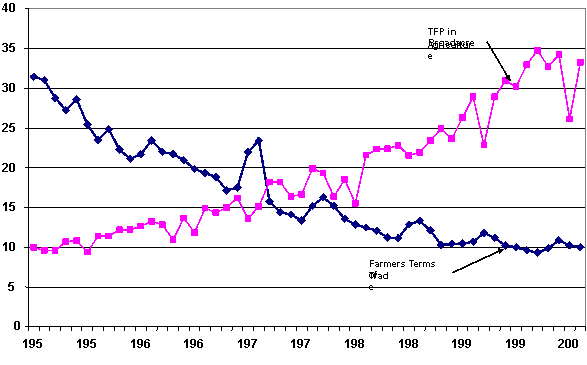
Lets have a look further at how we may be using the same language; when consumers want food produced “like the way it has always been produced, the old fashioned way”, and the farmers want to be able to produce a good product “without working 8 days a week 30 hours a day, the old fashioned way”. When farmers talk about “efficiency gains” they are talking about being able to produce the same product with less of a carbon footprint and still make a margin aware that the “terms of trade” are constantly reducing.  Remembering whilst the cost of food had gone up 40% in the last ten years (CPI has gone up about 50%), the farmer’s share has gone from 20 cents in the dollar to 17.

Total Productivity

Total factor productivity (TFP) in Australian broadacre agriculture and farmers’ terms of trade: 1953–2004.Source ABARES


When consumers hear “efficiency gains” they seem to hear “factory farms” or that farmers have found a better way to make even more money than they already do. These thoughts conjure up images of cruelty and money hungry, both traits that are disliked (and rightly so) in our community.

P1020049

To bring the language together if consumers think that farmers must invest in the environment regardless of the cost then consumers must show the environment the same respect and seek produce that is raised consistent to their values, then buy it, regardless of the cost. I put it to you that if farming was so easy and you can make so much money then why are less than 1% of our community involved and that is decreasing every year?

I must admit I know that we can produce food and fibre in a way that means consumers and farmers needs are met, even exceeded. You will notice that I will not mention money when I’m talking about needs. Consumers have no more right whatsoever to expect food at a reasonable price if they don’t believe farmers have no right to get paid a reasonable price for their produce. Everyone involved in the production of food through to eating it, should be aware of the social and ethical values of living in a community. The “carbon tax” is an attempt to place an economic value on something that we as a society should value, which is the living within our means and not having negative external impacts on the environment.

When we purchase an item we should ask ourselves: Has this been produced with respect to my personal values of welfare, health etc.? Has the item been produced without external impacts on environment, community etc.? These values can’t have an economic value placed on them and yet all talk about the long term health of the planet and the community.

When we buy food you can look to “make an investment in your health and future” or you can see it as “a cost that needs to be reduced as much as possible.” I believe that we as a society are so used to eating poor quality food that is “cheap”, if we based our decisions on food quality we would need much less and actually save money.

Count Nutrients not calores

Just so that we are all taking the same language we as consumers need to build closer relationships with our producers so we understand how our wonderful food is produced, then we can make “value based” decisions when we purchase. As you are all aware large supermarkets are service based industries that don’t produce anything and they make it very difficult to build a relationship with your farmers. So you should find vendors that can tell you who, how and where the food is grown, tell you its story, then you can make a judgment on the values of that product before purchase. This way you can ensure that you aren’t just making a good investment in your own health, also that of the broader community and the planet.

Food_System_Diagram

Remember the statement “no man is an island”, our dollars dictate our values so if we truly want to see change then we need to understand that our choices impact on others, we are all part of the same community on planet Earth.


The Author: Angus Whyte lives with wife Kelly and 8 year old son Mitchell at “Wyndham”, a 12,500ha pastoral property on the Anabranch River 85km north of Wentworth NSW.  “We consider ourselves “graziers”, in that we turn plants into money through livestock and we don’t mind what sort of livestock we run. Our attitude to farming is simply to work with nature rather than against, so we no longer have weeds, we have “plants with stories” that we can learn from and our aim is to make our business simple and our ecosystem extremely complex, the more complex the better.”

If you would like to join in the conversation on Twitter Gus tweets as @GusWhyte and farmers and their extensive and diverse networks discuss all things food and fibre under #agchatoz

Recently farmers have been concerned about how we are being stereotyped see I am not Happy Woolies and we are adding #proag to our tweets ( when there is room- I mean 140 characters is pretty tight at the best of times) to discuss this.

FYI #proag is short for professional and caring farmers 

Little Golden Book Farming

I recently heard Dr Jude Capper speak at the Dairy Research Foundation Symposium in Camden. She had a lot of thought provoking insights about consumer images and perceptions

“We have cars and airplanes. We have treatments for cancer and heart disease. Why is it that in every other business sector we celebrate increased efficiency and productivity thanks to new technology while when it comes to food more and more people want it done the old-fashioned way?” Dr Jude Capper

Lets have a think about this Little Golden Book notion of farming and this fascinating (not sure that is the right word ) push by consumers for farmers in 1st world countries to “slow down” and go back to the 1950’s way of farming

In 2000 our farm was a one man operation milking 80 cows producing 800,000 litres of milk. Today we milk 500 cows and supply 50,000 Australians with milk every day. We employ 10 people and we have reduced our environmental footprint by over 35 per cent per litre of milk produced. That’s cause for celebration wouldn’t you think?.

Lets take a look at the average Australian farmer. In 1950 he/she fed 20 people, in 1970 he/she fed 200 people. In 2012 he/she feeds 600 people.I would think that’s one hell of a lot to be proud of.

Lets take a look at the cost of food compared to income.

Slide8

Wow what else can you think of that has gone down in price in real terms? But is anybody celebrating our farmers because of this?. I don’t think so

It you are still not convinced lets really put it into perspective. Let me assure you not  everyone has this luxury. This is what Pakistanis spend on food

Slide1

Yes you read correctly 42% of their income. Note the number of people employed in agriculture at nearly half the country. In Australia less than 1%.of people are farmers. The hunger index is “alarming” Their food consumption in calories is 1/5 of ours and 25% of people are undernourished.  Don’t know about you but that’s pretty sobering for me.

Now lets have a look at few things Dr Capper had to say at the Dairy Research Foundation Symposium. Dr Capper by the way comes from the US where they spend 6% of their income on food

She put up this slide to highlight that our footprint is related to our productivity whether we are human or livestock or cars for that matter

Environmental Impact per unit of Production Slide 1

Yes at first glance vehicle 2 has the lowest footprint but as you can see in the next slide footprint its a function of how many people the vehicle carries.In other words how productive the vehicle is

Environmental Impact per unit of Production

Take home message from that one. You cant judge the system without all the facts

Bus vs Car

Back to the 50’s rural idyll.  Where has agriculture gone wrong I ask? We are seeing consumer alienation from agriculture and the food system expressed through concerns about

  • nutrition,
  • food safety,
  • affordability, Yes affordability – haven’t they seen that graph.
  • environmental sustainability and animal welfare

The armchair experts are telling consumers the answer is apparently to buy organic or grow your own. Dr Capper told the audience based on the current productivity of the world’s organic dairy industry we would need 25% more cows and 30% more land to produce the same amount of milk if all dairy farmers went organic. In the US alone that means they would need a further 3.5 million dairy cows.!!! Heaven forbid.

Where has agriculture in 1st world countries gone wrong.? Its obvious isn’t it! Agriculture has done a bloody awful job of telling it’s story. Instead of proud and loud messages we have let others tell our story and sadly I didn’t get the impression the dairy farmers in the auditorium by their questions to Dr Capper were going to rush out and share their wonderful news stories with the rest of the industrialised world.

Another story for another day. The Holstein vs the Jersey cow and how the dairy farmers in the room in my mind got the wrong take home message from Dr Capper’s talk that day

Today I am embarrassed to be a Dairy Farmers’ supplier

Today I saw for the first time the new advertising campaign by Lion for their “permeate free” milk and I was devastated


The lowest from of advertising is to denigrate some-one else’s product to sell yours and when I saw this add I was embarrassed to be a Dairy Farmers’ supplier. It would appear from the add the “evil” milk is UHT but the media gives me to think its the “No name or House Brand” fresh milk they are referring to.

This is what happened on our farm the day Dairy Farmers milk went permeate free.

IMG_0607 

We had to put 25,000 litres of our milk down the drain. This was because Lion didn’t have the capacity to pick our milk up. No explanation just a phone call.  “Let it all out” 

Permeate Fallout

First it was the 5,000 litre vat.

IMG_0613 

Then it was the 30,000 litre vat.

It was a 24 hour process to ensure it went onto the paddocks as fertiliser and not into our waterways. The look on the staff’s faces when we had to do this was devastating. Thank god the cows didn’t know.

I just shake my head. My social conscience went into overdrive. 1 billion people go hungry every night and we are asked to tip the perfect food cocktail down the drain.

Curious about Permeate then you can read about it in a former blog post I wrote here or find out more by watching this catchy little vid Dairy Farmers have also kindly put together to keep you informed

Its interesting when Permeate burst onto the scene with great fanfare back in 2008 industry reaction was “no comment” Now its “trendy” and it apparently sells milk to talk about it.

By the way I cant find a dairy farmer who knows the “dairy farmer” in the add so it would appear at this stage he is an actor. Somebody please tell me I a wrong as we certainly don’t need people pretending to be dairy farmers as well