Why GDP Gets So Much Attention


Same money, two doors. Most of it went to the houses.

Last time we cracked open GDP and found the weird bit: your house can double in value without the country making one extra thing. We worked out why. You buy a house that’s already there, you’re richer, but nothing new got built. That’s just savings in a nicer jacket. Money goes into a business instead and it buys gear, takes people on, makes stuff. That’s productivity, and that’s the thing that lifts everyone, not just the bloke who spent the money.

So your house doesn’t count. Fine. But here’s the bit you’d be right to ask about: so what? Why does that matter for the whole country, not just for you?

Because the country’s only got so much money to put to work. And where it goes decides what kind of country you end up living in.

Picture all the nation’s savings as one big pool. Every year money flows in, and it has to go somewhere. It can go into businesses that make things and hire people. Or roads and trains. Or it can go into buying houses that are already standing and bidding the price up. Same pool, different doors. And for years now we’ve shoved a massive chunk of it through the housing door.

Money through the productive door, the country can make more next year than it did this year. More stuff, more services, more done per hour. That’s the pie getting bigger. Money through the housing door, the pie doesn’t grow. The same house just changes hands for more. You feel richer because the number on the place went up. But the country can’t actually do or make a single thing more than it could before.

Do that for thirty years and you get exactly what we’ve got. A country that looks loaded on paper and can’t work out why it feels stuck. The money’s real. It’s just locked up in land that makes nothing. And the things that would grow the pie, the businesses, the new industries, got starved of the money that went into property instead. That’s the bit people miss. The boom in one is the drought in the other. Same pool.

Here’s what that looks like on a normal Thursday. The jobs figures came out this week and they were grim. Unemployment up to 4.5%, worst since late 2021. Thirty-three thousand more people out of work, nearly 19,000 jobs gone in the month. Hit young people hardest, youth unemployment’s over 11% now, and this month the losses fell mostly on women. That’s work getting harder to find, which worries a household long before it worries anyone in Canberra. And on the very same day, the share market had one of its best days in weeks. Two numbers, one morning, pointing opposite ways. What’s good for the big end of town and what’s good for your kitchen table just aren’t always the same story.

That gap right there is the whole thing in small. A country can post lovely-looking numbers while the ground under ordinary households gets wobblier, because the wealth and the work have come unstuck from each other. And part of why they came unstuck is where the money went. Money sitting in land that just gets dearer isn’t money building the businesses that’d hire those 33,000.

You see it everywhere once you’ve spotted it. Wages that don’t climb like they used to, because there’s no productivity growth underneath pushing them up. A tax system that rewards buying the thing that makes nothing and punishes building the thing that does, so even more money goes through the wrong door. Smart people and big money chasing the next property deal instead of the next business, because that’s where the easy money’s been. None of these are separate problems. It’s the one problem wearing different hats.

Lets not make it too neat. Housing isn’t all dead weight. Building new homes is good, very good. It employs a lot of people, and having a roof over your head is worth something no GDP number ever captures. And plenty of countries with dear housing still get along fine. One bad month of jobs figures doesn’t prove any of this on its own either, the economy has its own ups and downs that have nothing to do with houses.

So it’s not that houses are the baddie, and it’s not that one bad month of jobs figures proves the whole thing on its own. It’s that when a whole country leans this hard on the one thing that doesn’t grow the pie, year after year, the pie stops growing.ย And when the pie stops growing, you’ve got less to go round for everything else.

That’s why it’s a big deal. The GDP in not some magic number on the telly. The GDP is the scoreboard for one choice the country keeps making without quite meaning to: do we build the thing, or just sell each other the thing we already built for more. We’ve spent a long time doing the second. And the bill for that isn’t a number. It’s a country that could’ve been doing more, and isn’t.

Your house doesn’t count. Turns out that’s not some quirk of the accounting. It’s the whole story in one line.

The Cleverest Bit of Marketing in Australia Right Now

Two founders in work aprons concentrate on detailed work at a cluttered workbench, while a relaxed man in a pale linen suit leans in the open doorway with one hand extended, palm up, doing none of the work but waiting for his share.
Never done a stocktake. Still wants his share.

Betty’s brother Kevin rang from Kiama last week, properly worked up. His daughter’s got a startup, a real one, the kind with late nights and not much sleep, and Kevin had just seen something online about the government coming after people exactly like her. “They’re punishing the ones having a crack,” he told Betty. “Did you see what they’re calling it? An aspiration ambush.” Betty hadn’t seen it. But she could hear that Kevin had already made up his mind, and that whatever he’d watched had done a very good job of helping him.

So she went and had a look. And what she found wasn’t really a tax story at all. It was one of the sharpest bits of marketing you’ll see all year.

We’ve spent two posts on GDP (See here and here).ย  Your house doesn’t count, and the country keeps shoving its money through the housing door instead of the door where things actually get built. If you missed those, the short version is: money put into a business grows the country, money put into an existing house just makes the house dearer.

Well, this week a bunch of young business owners turned that exact argument into one of the sharpest marketing campaigns you’ll see all year. And whatever you think of the politics, the craft is worth a look, because it’s a masterclass in how to win an argument before anyone’s checked the facts.

Here’s the setup. The budget proposed changing capital gains tax, the tax you pay on the profit when you sell something for more than you bought it. The change makes sense for the housing door, taxing property investors harder so houses stop being such a one-way bet. The founders even say they’re fine with that bit. The trouble is the same change also hits people who sell a business they’ve built. Same swing of the door, and it caught the workshop along with the houses.

Now watch what they did with it.

First, the name. They didn’t call it “proposed CGT discount reform.”

They called it an aspiration ambush. Two words, and you already know whose side you’re meant to be on. “Aspiration” is the good thing, having a crack, building something. “Ambush” is the sneaky thing done to you from behind. Stick them together and you’ve got the whole grievance in a phrase a headline writer can’t resist. That’s not an accident, that’s branding.

Second, the line. The letter says, near enough, we work the hours, we carry the risk. You can’t argue with it. It doesn’t mention tax rates or indexation or any of the stuff that makes your eyes glaze. It just plants a flag: we’re the ones doing the hard yards. Try writing a reply that starts “well, actually” to we work the hours, we carry the risk and see how you sound.

Third, and this is the bit I’d frame and hang on the wall, the silent partner meme. Some of them made fake ads casting the Prime Minister as a 47% shareholder in their business. One posted that he’s a bloke who has never done a stocktake and somehow still gets 47 per cent of the business and takes zero risk. That’s the silent partner gag, and it’s perfect, because it takes an invisible, boring thing, a tax on a sale that might happen years from now, and turns it into a freeloading mate who turns up at payday having done nothing. Everyone’s had a version of that bloke. You feel it before you’ve thought about it. Region Canberra

No wonder Kevin shared it. That’s the gag working exactly as designed, it travels from a screen in Kiama to a phone call with his sister before anyone’s checked a single number.

Fourth, the messenger. They didn’t wheel out grey men from a lobby group. They badged it founders under 40. Young, building things, the future. It’s much harder to paint a 35-year-old who started a company as a greedy fat cat, so the campaign chose faces that don’t fit the villain costume.

Put it together and you’ve got a textbook job: a sticky name, a line you can’t argue with, a meme that does the thinking for you, and the right faces out front. It went everywhere. Sky, the papers, an open letter straight to the PM. That’s what good marketing looks like, it makes its point feel like common sense before the other side has finished clearing its throat.

Now, here’s where Betty keeps her wits about her, because clever marketing is exactly the thing you should be most careful around. Being well-sold isn’t the same as being right.

Albanese’s comeback is, frankly, not bad either, it’s just nowhere near as catchy. He says the campaign is being run by right-wing parties and their allies, and that the meme misses how the tax actually works: it’s only paid when a business is sold, not every year, and most small businesses pay little or no capital gains tax when they sell. If he’s right, the “47% silent partner” doesn’t apply to most of the people sharing it. But “it’s only realised on disposal and most SMEs fall under the threshold” will never, ever beat a funny picture of the PM stealing half your business. The truer claim is losing because the catchier claim is winning. That happens a lot, and it’s worth noticing when it’s happening to you. Western Advocate Region Canberra

So two things are true at the same time. The founders have a real point, the tax change really does seem to clip the productive door as well as the housing one, and that’s the exact problem these posts have been about. And they’ve dressed that point in such good marketing that you should slow down and check it rather than just nod along. Both can be true. Usually are.

That’s the lesson, and it’s a bigger one than capital gains tax. The side with the better slogan isn’t automatically the side that’s right. They’re just the side that hired the better wordsmith. Your job, Betty, is to enjoy the craft, and then go and find out whether the thing it’s selling you is actually true.

Funny old world. We started by working out why your house doesn’t count, and we’ve ended up watching the country’s smartest marketers fight over the door it should’ve been going through all along.

Your House Doesn’t Count (And Other GDP Surprises)

A whole house, and the scale reads zero. That’s the thing about GDP nobody explains: a home going up in value adds nothing to what the country actually produces.

A couple of weeks ago I drove seven hours to hand out how-to-vote cards, then wrote the whole thing up. Quite a few of you read it. This week my big adventure was reading about capital gains tax for forty minutes on a perfectly good weekday because a Michael West Media piece landed in my inbox and I couldn’t help myself.

Every time the New York Times, Michael West Media or The Conversation turns up, I do a deep dive. A very deep dive. So between the seven days at a polling booth and the forty-minute tax binge, I think we can all agree: I need to get a life.

The good news is I’m going out with friends this weekend. Nice wine, good food, great company. Long overdue.

Before I go and remember what conversation with non-economists feels like, here’s the thing that piece explained that finally made GDP make sense to me after years of nodding along and understanding nothing.

The two kinds of “investing”

There are two ways to put your money to work. They look the same. They are not.

You can buy something that already exists, like an established house, and wait for it to go up in value. You end up richer. Good for you. But nothing new got made. The house was already standing. No extra jobs, no extra goods, nothing extra for the country. Your wealth went up and the nation’s output didn’t move an inch.

Or your money can go into a business. The business buys equipment, trains people, makes products, hires staff. That lifts what the country can actually produce. More gets made for every hour worked. That’s productivity, and productivity is the thing that makes wages rise over the years, for everyone, not just the person who put the money in.

So one is a win for you. The other is a win for you that’s also a win for the whole country.

That was the click for me. I’d always heard “investment” and pictured someone buying a rental. Turns out economists barely count that as investment at all. If it isn’t increasing what the country can produce, it’s really just savings wearing a nicer jacket.

Why it matters for the budget

For 25 years Australia poured its money into the first kind. Existing houses. The tax system practically begged us to, with the 50% capital gains discount and negative gearing making an established property the smartest tax play going.

The result is a $12 trillion housing market, nearly four times the value of every company on the stock exchange combined. A mountain of money sitting in houses that just go up in price, instead of in businesses that build things and employ people.

As one financial writer, Harry Chemay, put it in Michael West Media last week, residential land “may appreciate over time, but it does not by itself generate any economic output.” A house going up in value makes the owner richer without the country producing a single thing extra. michaelwest

That’s what the 2026 budget is trying to shift. Nudge the money out of “buy an old house and wait” and into building new homes and backing businesses. Whether it works is a separate question, and the government has done a woeful job explaining any of it, which I got into elsewhere. But the idea underneath is sound, and it’s the first time I’ve properly understood why anyone bothers measuring productivity at all.

If you want the plain-English version of what the budget actually does to your tax, I wrote that for Betty from Blacktown here. The polling booth piece, if you missed it, is here . And the family farms and capital gains argument is here.

Right. Wine.

Grazing Amidst Urban Expansion Finding The Sweet Spot ๐Ÿ™๏ธ๐ŸŒพ


As urban boundaries stretch and twist, let’s not forget the green fields and the mindful practices that sustain them. Here’s to a future where growth and green can coexist, beautifully. ๐Ÿ™๏ธ๐Ÿ’š๐ŸŒพ

In the shadow of rapid urban expansion, the distinction between prime agricultural land and productiveย prime agricultural land has never been more crucial. As our countryside skirts ever closer to the bustling edges of expanding cities, the importance of utilising every inch of agricultural space wisely and sustainably cannot be overstated. Today, more than ever, the practices we adopt on these precious plots of land can ripple through our ecosystems, economies, and communities. ๐ŸŒ๐Ÿ’ก

In the context of farming, the term “productive” specifically refers to land or farming practices that not only support the growth and health of crops or livestock but crucially have the ability to generate a positive return on investment (ROI), ensuring the economic viability and sustainability of the agricultural operation.

Why Timing is Everything in Grazing ๐Ÿ•’๐ŸŒพ

Amidst the push and pull of urban development, the practice of grazing dairy cows at the optimal stage of grass growth emerges not just as good farming but as a necessity for maintaining the delicate balance between productivity and sustainability. Here’s a closer look at the benefits of getting this timing just right:

Optimal Nutrition for Peak Performance ๐Ÿฝ๏ธ๐Ÿ’ช

In areas squeezed by urban pressures, making the most of available pastureland means grazing our cows on young, nutrient-rich grass. This ensures they’re getting a diet packed with the energy and protein needed for top-notch milk production, a critical factor when land is at a premium.

Digestive Health and Happiness ๐Ÿ˜Š๐Ÿ„

The health of our dairy cows is paramount, and grazing at the right moment promotes efficient digestion and nutrient uptake, vital for the well-being of the herd and the quality of milk produced. Healthy cows in healthy pastures are the bedrock of productive dairy farming.

Sustainable Pastures, Sustainable Future ๐ŸŒ๐Ÿ’š

As urban areas encroach on agricultural land, the importance of sustainable pasture management becomes magnified. By practicing rotational grazing and ensuring cows graze at the ideal growth stages, we’re not only optimising milk production but also contributing to soil health, biodiversity, and carbon sequestration. In the face of urban expansion, these practices are vital for environmental stewardship. #SustainableFarming

Economic Efficiency: More Moo for Your Buck ๐Ÿ’ท๐Ÿฎ

In the context of diminishing agricultural space, efficiency is key. By maximising the productivity of each pasture through precise grazing management, dairy farmers can navigate the challenges posed by urban sprawl, ensuring a profitable operation that thrives on quality, not just quantity. #EfficiencyIsKey

The Practice of Precision Grazing ๐Ÿ“๐ŸŒฑ

Precision grazing stands as a beacon for dairy farms encircled by urban growth. It allows for meticulous management of grazing schedules, ensuring that cows feed on grass at its nutritional peak. This method is essential for sustaining an endless cycle of growth and regrowth, vital for farms fighting for space and relevance against the tide of development. ๐Ÿ”„๐ŸŒฟ

The Takeaway: Grazing Gold ๐Ÿ†๐ŸŒพ

As we navigate the complexities of farming in the age of urban expansion, the role of targeted grazing practices becomes not just beneficial but imperative. It’s a testament to the resilience and adaptability of modern dairy farmingโ€”a commitment to excellence in the face of encroaching urban landscapes. So, let’s raise a glass to the farmers who make it possible for us to enjoy high-quality dairy, all while stewarding the land with care and foresight. ๐Ÿฅ›โค๏ธ

Remember, in the ballet of progress and preservation, every step, every graze, counts. It’s not just about sustaining; it’s about thriving. #DairyFarming #GrazingGold #UrbanExpansion

As urban boundaries stretch and twist, let’s not forget the green fields and the mindful practices that sustain them. Here’s to a future where growth and green can coexist, beautifully. ๐Ÿ™๏ธ๐Ÿ’š๐ŸŒพ

Little Golden Book Farming

I recently heard Dr Jude Capper speak at the Dairy Research Foundation Symposium in Camden. She had a lot of thought provoking insights about consumer images and perceptions

โ€œWe have cars and airplanes. We have treatments for cancer and heart disease. Why is it that in every other business sector we celebrate increased efficiency and productivity thanks to new technology while when it comes to food more and more people want it done the old-fashioned way?โ€ Dr Jude Capper

Lets have a think about this Little Golden Book notion of farming and this fascinating (not sure that is the right word ) push by consumers for farmers in 1st world countries to โ€œslow downโ€ and go back to the 1950โ€™s way of farming

In 2000 our farm was a one man operation milking 80 cows producing 800,000 litres of milk. Today we milk 500 cows and supply 50,000 Australians with milk every day. We employ 10 people and we have reduced our environmental footprint by over 35 per cent per litre of milk produced. That’s cause for celebration wouldn’t you think?.

Lets take a look at the average Australian farmer. In 1950 he/she fed 20 people, in 1970 he/she fed 200 people. In 2012 he/she feeds 600 people.I would think that’s one hell of a lot to be proud of.

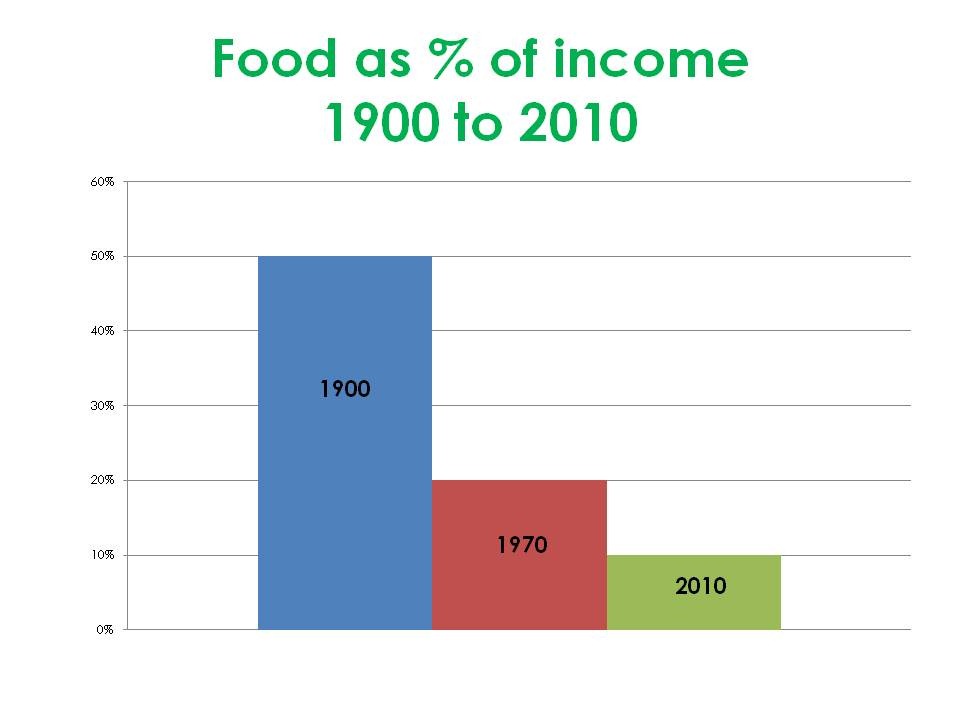
Lets take a look at the cost of food compared to income.

Slide8

Wow what else can you think of that has gone down in price in real terms? But is anybody celebrating our farmers because of this?. I don’t think so

It you are still not convinced lets really put it into perspective. Let me assure you notย  everyone has this luxury. This is what Pakistanis spend on food

Slide1

Yes you read correctly 42% of their income. Note the number of people employed in agriculture at nearly half the country. In Australia less than 1%.of people are farmers. The hunger index is โ€œalarmingโ€ Their food consumption in calories is 1/5 of ours and 25% of people are undernourished.ย  Don’t know about you but that’s pretty sobering for me.

Now lets have a look at few things Dr Capper had to say at the Dairy Research Foundation Symposium. Dr Capper by the way comes from the US where they spend 6% of their income on food

She put up this slide to highlight that our footprint is related to our productivity whether we are human or livestock or cars for that matter

Environmental Impact per unit of Production Slide 1

Yes at first glance vehicle 2 has the lowest footprint but as you can see in the next slide footprint its a function of how many people the vehicle carries.In other words how productive the vehicle is

Environmental Impact per unit of Production

Take home message from that one. You cant judge the system without all the facts

Bus vs Car

Back to the 50โ€™s rural idyll.ย  Where has agriculture gone wrong I ask? We are seeing consumer alienation from agriculture and the food system expressed through concerns about

  • nutrition,
  • food safety,
  • affordability, Yes affordability โ€“ haven’t they seen that graph.
  • environmental sustainability and animal welfare

The armchair experts are telling consumers the answer is apparently to buy organic or grow your own. Dr Capper told the audience based on the current productivity of the worldโ€™s organic dairy industry we would need 25% more cows and 30% more land to produce the same amount of milk if all dairy farmers went organic. In the US alone that means they would need a further 3.5 million dairy cows.!!! Heaven forbid.

Where has agriculture in 1st world countries gone wrong.? Its obvious isn’t it! Agriculture has done a bloody awful job of telling itโ€™s story. Instead of proud and loud messages we have let others tell our story and sadly I didn’t get the impression the dairy farmers in the auditorium by their questions to Dr Capper were going to rush out and share their wonderful news stories with the rest of the industrialised world.

Another story for another day. The Holstein vs the Jersey cow and how the dairy farmers in the room in my mind got the wrong take home message from Dr Capperโ€™s talk that day