White knights don’t deliver story book endings

This time last week I had the next 4 weeks mapped out. A hugely successful Archibull Prize and Young Farming Champions program in 2014 needed refunding for 2015/16 and once again all my energy would go into do everything I physically and emotionally could to ensure these great initiatives would continue

But as always something comes out of left field that too often seems like a white knight request. Some-one, something, some-where is a victim needing saving from the big bully. This time the big bully is apparently the state government and their Regional Growth and Infrastructure plan which some believe could mean the end of dairying in this region and our regional community as we know it.

I have been in this space now for 15 years and I have learnt white knights are rarely appreciated, are used and abused and in reality achieve very little. So I have a new approach and that is building capacity for people to have the skills sets to help themselves. Sadly the dairy industry is a long way behind in understanding what it actually takes to provide their farmers with these skill sets.

Free range farming

For me on a personal growth level his head in the sand attitude has delivered great outcomes. It has meant success has had to come from building networks with people and organisations (and learning from them) who have the grunt, desire and drive and COURAGE to get the best outcomes for the common good.

I have now read the draft strategy and I am excited. For the first time I am reading a government document that is using language that gives me hope they might just get it. But success will only come if the community uses its skills and local knowledge and expertise and takes a collaborative and cohesive approach and works with them.

My post yesterday “When good men do something” showed you can achieve change the seemingly impossible almost overnight if you nail the right course of action.

Yes it’s important for the community to stand up and be counted but it’s how they do it that will define the future for the Illawarra

BTW this document really puts first world problems into perspective.

Our region is going to grow by 65,000 people over the next 17 years and 25% of them will be over 65. We apparently need 45,000 more houses for those people. On top of somewhere to live they need jobs, infrastructure and food and we need to ensure that these needs are balanced with the environment and their lifestyles.

I am a farmer. I know 158 more people worldwide a being born every MINUTE. That’s a 158 more mouths to feed every minute and in our region apparently every 1.5 people needs a house?

That is a very serious first world problem!!!!!!!

So what will be my call to action when it’s my turn to speak at the community meeting?

Let’s work with the state government (not against it) and get it right. It’s time to use our energy wisely and smartly.

When good men do something

Once upon a time I was a mouse. Head down, bum up, working my butt of to get a pharmacy degree which thanks to Gough Whitlam was within my reach

Today I was doing the big clean up and came across this newspaper clip

The Sun Lynette Lindsay Feb 8 1977

Lynette Lindsay – student

I remember the 8th of February 1977 at Central Station when the photographer approached me wanting a photograph and a grab for The Sun newspaper and I nearly had a heart attack. OMG should I do this. What I am going to say.  But I bit the bullet and I did it and said something ( in hindsight not very supportive of the man who got me an education) then for another 30 years I said nothing.

What I found was that not much gets done when you say nothing.  Edmund Burke famously said ‘evil triumphs when good men do nothing”. These days its known as the bystander phenomenon.

Agriculture traditionally has applauded the heads down, bum up approach and sadly the world has moved on without us.

These days I say a lot when I think it is important to say something and DO something. In 1977 I was catching the 4.24pm train from Central to Kiama. You needed to get there very early to get a seat because the train only had four carriages and almost 40 years later catching the same train you needed to get there even earlier because that same train still only had four carriages. But these days I believe everyone can make a difference if we use the skills sets we have wisely and smartly.

In those 40 years I have learnt a lot. I have learnt bystanders are very important people. They can either watch the world go by or they can get actively involved in defining what the world looks like.

In October 2014 the 4.24pm had 4 carriages. In November 2014 the 4.24pm has 8 carriages. This is a story in part about the power of twitter but most importantly its a story about deciding what you want your world to look like and recognising sometimes its up to you to not only envision it, you have to paint it, frame it, hang it and invite people to see it and celebrate it

Who did I tweet. Some-one who could and did make a difference. Extract from Hansard

clip_image002

KIAMA ELECTORATE PUBLIC TRANSPORT

Tuesday 21 October 2014

PRIVATE MEMBERS STATEMENT

New South Wales Legislative Assembly

Mr GARETH WARD (Kiama) [9.25 p.m.]: I take this opportunity to congratulate my friend the member for Drummoyne on his elevation to Parliamentary Secretary. My electorate of Kiama is the most beautiful in the State. As a life-long resident, the reason I stood for Parliament was to do something for the community I grew up in. Whilst I may be a member of a political party, my first and foremost commitment will always be to my electorate and my home. It is for this reason that I bring to the House the case for improved public transport. The 4.24 p.m. Central to Kiama service makes a sardine can look spacious. While I appreciate that there will be fluctuations in demand for various services, I have never had such a consistent stream of complaints as I have with this service.
In dutifully representing my constituents, I have faithfully referred all complaints to Transport for NSW and the Minister. The response I have received from the department is simply inadequate. In language that would make Sir Humphrey Appleby blush, I am told that Transport for NSW is “monitoring” the situation. Is it really? Has the department monitored people having to stand for uncomfortable distances on a daily basis? Is it monitoring customer frustrations as calls for change are made without any reply? Is it sympathetic to the cause of commuters or is the talk of delivering a timetable with commuters in mind rich on rhetoric and thin on substance?
Lynne Strong is a woman from my electorate who rarely needs introduction, but for the benefit of the House Lynne is a cutting edge dairy farmer from Jamberoo. Lynne frequently has business in Sydney and likes to utilise our train system to avoid driving to Sydney. In Twitter exchanges with Lynne earlier in the year I saw photos of crowded trains with passengers jammed in, with many standing the entire distance from Sydney to Wollongong. Having caught this train myself, as late as Friday, I am also aware of the problems associated with this service. After meeting with Lynne and other frustrated commuters, I decided to petition the Government in order to make it clear that this is a situation I will no longer tolerate. In order to make my point I have been tabling a page a day in the House in order to continually remind Transport for NSW of this problem.
I place the House and the Government on notice. This petition will continue to be run until this problem is fixed. I will not accept obfuscation and bureaucratic fob-jobs as acceptable responses to my constituents’ concerns. What is clear is that there will be no shortage of signatures to fill the pages I will present to the House. And if I have to fight the Government, of which I am a part, that is exactly what I will do. Make no mistake: These words are strong but also deliberate. They are strong because I came to this Parliament to be my community’s voice on issues of importance to us; and they are deliberate because I have also experienced the problems so many of my constituents have experienced.
I am grateful that so many public transport fights have yielded success in the past. Since becoming the local member of Parliament, the South Coast line now has 125 new express services. The timetable has been changed to speed up Labor’s slowed services to ensure that commuters save more than an hour a week because of changes to the timetable. The Government is presently constructing a brand new station at Shellharbour Junction. We have secured station upgrades at Albion Park and Gerringong, and new commuter car parks at Kiama and Oak Flats. We now have an electronic ticketing system—a system that Labor spent $127 million on attempting to introduce without a single ticket sold. We now have quiet carriages and more police on the line. I trust the House does not think that these changes have not come without my gratitude.
But the most basic fact remains: If you purchase a ticket you should expect a seat, and the 4.24 p.m. Central to Kiama service is over-subscribed. I call on the Government and my friend the Minister to listen to these concerns and make the necessary changes our community demands. In the past I have brought many petitions to this place. One petition related to positron emission tomography [PET] scanners at Wollongong Hospital. All members in the Illawarra, both Liberal and Labor, got together to petition the Government for that change—and we fought and won. Another petition related to aeromedical services. When there was a proposal from Ernst and Young based on a submission requested from the Government we faced the possibility of losing this important aeromedical service for our community. Again we fought and won that valuable fight. As someone who is passionate about the community I grew up in and who wants to make it a better place, one of the best things I can do is to ensure that this House is a vehicle to facilitate the concerns and express the views of my local community.
At village visits and community meetings and in my electorate office, I have spoken to concerned commuters who just want to have the service that they deserve. I am at my wit’s end. For that reason, I use this opportunity in the House today to do what any good local member should do, regardless of who is in government and any loyalties or allegiances involved. My first and foremost allegiance and loyalty will be to the people who put me in Parliament, that is, my constituents. Today I send this Parliament a message that better commuter and transport services are required. The 4.24 p.m. service is inadequate. I call on the Government to make the necessary changes so that commuters do not have to stand on trains from Wollongong and Central and people have a comfortable journey on longer distances. I thank the Government for the changes it has made but I make it very clear that this change is important to me and my community and I expect this change to be delivered.

A few words from Margaret Heffernan to take away

We all enjoy so many freedoms today, hard-won freedoms: the freedom to write and publish without fear of censorship, a freedom to vote, which women in particular had to fight so hard for; the freedom for people of different ethnicities and cultures and sexual orientation to live the way that they want. But freedom doesn’t exist if you don’t use it.

 I’m going to take on the naysayers, because they’ll make my argument better and stronger. I can collaborate with my opponents to become better at what I do. These are people of immense persistence, incredible patience, and an absolute determination not to be blind and not to be silent.

We make ourselves powerless when we choose not to know. But we give ourselves hope when we insist on looking.

Like Lear, we can learn to see better, not just because our brain changes but because we do. As all wisdom does, seeing starts with simple questions: What could I know, should I know, that I don’t know? Just what am I missing here?

See great Ted Talk here by Margaret Heffernan (ht Julie I)

Get cows out of our rivers protest gets down and dirty

If this protest on the banks of the Yarra last Friday is anything to go by livestock farmers in Victoria are coming under a bit of pressure albeit as a result of pressure on the government to act.

clip_image001

This is the blurb from the Cut the Crap website

Get livestock out of our rivers. It’s time to moove!

We’ve got some pretty spectacular rivers in Victoria. They provide us with the water we drink, and are the lifeblood of our ecosystems and communities. We can’t live without them. Nor can the thousands of native species that call our rivers home. Incredibly ecologically rich places, river banks provide important corridors for native animals, as they migrate and adapt to the changing climate.

So it would be udder madness to let cows and other livestock trample the banks and poo in the rivers, right?! Yet our riverbanks, including more than half the river frontage owned by the public, is open slather for livestock.

Every day 4,500 tonnes worth of cow poo lands in Victoria’s creeks and rivers. Not only does livestock access to rivers destroy habitat, cause erosion and muddy the water, but pooey river water ends up in drinking water catchments!

The solution is simple – fence off riverbanks, provide an alternative watering place for stock and let the riverbanks return to their natural state. It’s a win for the environment, and as it reduces risk of disease and injury to cows, this state-government funded program would be a win for farmers.

It’s time to moove cow out of our rivers.

Now as you can see from this video I share their ethos and have been very active in this space for quite some time

I am not alone. More than 70% of Australian dairy farmers acknowledge waterways are precious and are committed to keeping them healthy and clean.

So what would it take for the other 30% to jump on board? The stats say 9 out of 10 farmers learn from other farmers. The answer is simple. Its time to get out there and share our stories with each other as well as the community, form partnerships and tap into community good funding when its available and lobby the government when it isn’t . After all our farming families rely on healthy waterways just as much as anyone else – perhaps more

Wonderful is waiting lets go out and find it

In the words of Ronan Keating (with a little tweak)

Life is a rollercoaster. So don’t fight it. Just gotta ride it

How big a roller coaster life is often depends more on the choices you make rather than fate and all choices have good and bad consequences and some choices will be smarter than others. You can spend your life beating yourself up over your poor choices but I believe life is too short to do that.

I recently had the pleasure of sitting round the table with a number of like-minded people who have followed diverse career paths at Zoe Routh’s World Leaders Round Table. It was very heartening to see and hear the other people in the room like me struggled at times and continually questioned their capacity to pull off their vision for a better world.

Using Joseph Campbell’s Heroes’ Journey as an analogy. Once I had a cause

“I have a vision for a respected, profitable, innovative, cohesive, and collaborative agrifood sector. A philosophy I hold so strongly that I am totally unwilling to accept defeat,”

that meant more to me than anything else and the mentors arrived in my life I was very excited to cross the threshold

clip_image002

ht Zoe Routh – Source: http://alifetothemax.com/wp-content/uploads/2013/11/the-hero_s-journey.jpg

But I have always and still do struggle with the ‘threshold guardians’ who form part of the tests and challenges in the graphic above.

The well-meaning one’s (usually family and friends) I understand and appreciate but the henchman aka the Nancies amusingly explained in this Glove and Boots video really occupy my head space far too much

To the ‘Shadows’ I say bring it on. They are the ones who white ant you at every opportunity and in my case I want to thank them. They are the ones who (despite what they perceive they are doing) throw wood on and stoke the fire in my belly when I start to doubt myself

At the moment I am truly enjoying and been inspired by the highly frivolous but beautiful new Myer’s add and when the henchman fill my head space, my other voice comes along and says ‘Wonderful is waiting lets go out and find it’

The add is beautiful and I love clothes and shoes. As you can see from this story in the Weekly Times in Miranda’s column “The glamorous face of farming’

IMG_9977

My fav shoes at the moment, including the red ones mentioned in the above article.   

According to Sustainable Fashion academic Professor Kate Fletcher

Fashion feeds our emotional needs- its sets us apart or helps us along

The overlaying of emotional needs on physical goods fuels resource consumption, generates waste and promotes short term thinking as we turn our gaze from one silhouette, hemline and colour palate to the next in search of the next new experience

It also leaves us dissatisfied and disempowered, as physical goods no matter how many of them we consume can never truly satisfy our physiological needs’

I can imagine the Myer add is making Kate cringe and OMG in my endeavours to reduce my footprint on the planet walking away from my love of fashion shopping might be the hardest thing I have ever attempted

Wish me luck. I can’t guarantee it will be on my 2015 New Year’s Resolution list but Jane Milburn has definitely made my list of heroes for 2014

I do want to make a difference in this world like a lot of other people but in this case I am taking one step a time and Myer is doing their very best to be my clothes and shoes fetish henchman but they have given me a wonderful new voice in my head.

Loving this.  Never be afraid to show up before you are ready

ht Fleur Porter

BTW What is my definition of a hero? A hero to me is anyone who makes a commitment (and walks the talk) to add value to the lives of others beyond themselves. As you can see by my definition the world has many many heroes

Our life is designed to challenge us

I have taken a day out of the Archibull Prize judging tour and diverted to Canberra where Zoe Routh from Inner Compass has invited me to be her guest at her Leadership Roundtable and I am looking forward to it

Last night I put together my. Who I am, What I do and Why I do it intro. You know the 2 minute that shares with others what gets you out of bed every morning speech and it reinforced I do have a lot of great reasons to get out of bed in the morning.

I am a great fan of the work of Will Marre. I thought when his newsletter popped into my inbox early this morning so much of what he had to say was extraordinarily relevant to my life at this point in time and a very appropriate start to my day.

I would like to share to some of the bits that truly resonated for me

Our life is designed to challenge us. Our future rarely turns out as we envision. Nearly all our plans for our career, marriage, finances and health don’t materialize as we imagined. When we are surprised by crisis and disappointment it is time to question our desires, our values and our choices. If these moments cause us to pause and reflect and realign with our inner sense of purpose we will grow. If we don’t we will re-enter the cycle of disappointment and self-frustration. This is true for everyone. It is how life is designed.

While it is reasonable to forgive people who seek our forgiveness, forgiving those who hurt us without remorse is masochism. Escaping the anger of past and unresolved pain doesn’t require forgiveness…it requires transcendence. This means that we cease to want justice or to wallow as a victim. We literally transcend our pain by focusing on our own growth, our own power and the positive difference we are designed to make. When we stop investing our energy in our mental movie of past wrongs and disappointments we free our minds so our hearts can embrace today and generate optimism for tomorrow.

And my final thought for the day from Will

Don’t let the tribes we belong to dilute our conscience

RELAX-nothing-is-under-control

Proud to be a farmer, but tired of having to defend my farming practices.

Its been a very interesting week

Last night the RAS of NSW held an agriculture teacher professional development workshop at which I got the opportunity to showcase the work of Art4Agriculture.

It was great fun and I learnt a lot. I met a crocodile farmer in the US and one in the Northern Territory via video conference technology, sampled crocodile meat for the first time and met a crocodile

IMG_2049

I have also had a very inspiring week travelling north with the 2014 Archibull Prize art judge Wendy Taylor to Queensland to see the students’ bovine masterpieces. And what masterpieces they are. You can see them on Facebook here

The students’ artworks this year reflect on their interpretation of how sustainability and agriculture and the community can partner to help feed the world and reduce food waste

Wendy and her husband Craig are both architects and their firm red blue architecture + design has a particular passion for site specific, environmentally sustainable solutions for new houses

As my regular blog readers are aware I am particularly frustrated by how confused the world is about what the word sustainability actually means and what it takes to achieve it. See previous post here

So I asked Wendy the question ‘Do people in general actually understand what the concept of sustainable housing is?’

Wendy said to me ‘well I can honestly say no-one has ever come to me and asked me to design the smallest house I could to meet their needs’

Let’s be honest with each other – we don’t get it.

To be sustainable we all have to be committed to reducing our footprint on the world and we all have to be committed to doing it together

Which brings me to “What’s making me cranky at this point in time?”

This week its Marie Claire and Sustainable Table et al. See Page 279-280 November 2014 Marie Claire

Those well-meaning but naive almost evangelistic people who believe and promote that you can put farming practices into boxes like artisan, boutique or organic = good for you. Whilst conventional farming = factory farming = not good for animals and the planet and people

If you just happen to be like the majority of family farmers in this country who grow food and fibre for the commodity market so that Australians from all economic backgrounds have the opportunity to afford it you are then perceived by label association to automatically fall into the ‘unsustainable, unhealthy, or unethical’ category.

If we are going to meet the challenges of feeding the world and reducing the abomination that is food waste then this rural idyll mentality has to stop.

The story should be about farmers engaging with consumers and the importance of eating real food, rather than highly processed food. Not about promoting one farming practice over another

Australian farming families are mums, dads, sons and daughters, sisters and brothers, husbands and wives. They’re just as interested in the environment and what they feed their families and animal welfare, as people in cities. They just happen to be farmers, growing some of the world’s best real food and fibre and they are feeding 20 million people here and another 40 million people overseas.

Let them get on with it. Enough I say. Lets not pitch farmer against farmer. Let’s work together to help all farmers be the best possible farmers they can be.

BTW This article is well worth a read – To feed the world in 2050 we have to change course

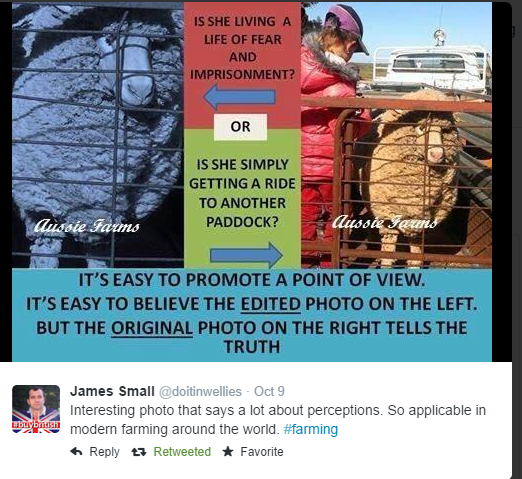
Animal welfare and animal cruelty. There is a big difference

This tweet caught my eye yesterday.

YFC

Original photo source here 

As did the Sustainable Table movement again

This group are doing fantastic work in their drive to address one of the biggest problems on the planet – Food Waste but they are making me so cranky about the way they are depicting main stream agriculture.

So how does main stream agriculture get the real story out there. Who is our audience?. What are our messages? Why are some people so ready to err in favour of the propaganda proliferated by the picture on the left

Lets look at our audience. It certainly isn’t the hardliners on both sides ( and yes agriculture has them too). In laymans terms they are in the main a lost cause and a big waste of energy.

As the scientists say

Firstly they are motivated to believe what they do, and unless those motivations change, it is unlikely they will be swayed by rational argument.

Secondly their logic is self-sealing, designed to be impermeable to external reasoning. Source here 

Lets look at our messages. What are our messages?  Yes its definitely time we get those right

In the first instance it is time we make a strong delineation between animal welfare/wellbeing and animal cruelty. If the hardliner animal liberationists where truly serious about animal cruelty they would be targeting owners of companion pets who make up more than 60% of the people charged for animal cruelty. Note farmers make up less than 5%.

Why don’t they target companion pet owners you ask? . Yes that is definitely one question we should be asking. I think in this case this just reinforces my point that this group of people have their own agenda and reducing animal cruelty seems to be well down the list of their priorities with raising money at the top.

So getting back to Sustainable Table (see footnote) who I have mentioned in my blog before. See here

Its a beautiful website, obviously started by some very passionate people doing some great things.  This initiative also has some very credible people backing it as do a number of people who promote similar farming enterprises. I have no problem at all with people who want to farm using these philosophies but I want to use this post to debunk some of the very naive thinking that underpins this ethos and makes me really cranky by promoting it by deriding large scale farming practices

What a difference their approach is to the Fair Food Farmers United beautifully outlined by Tammi Jonas here. Tammi is an advocate of the ‘produce less for more’ model and walks the talk.

Don’t produce more for less, produce less for more.

By that I mean we must value the land, animals, and workers and ensure their health is paramount in every agricultural system and then ask eaters to pay a fair price for our efforts.

All of which is easier said from a farmer in a miniscule supply chain selling direct to eaters. The bigger challenge is for the majority who are under pressure from centralised market power and long supply chains…

What do you think? How can we address the serious structural imbalances between farmers, processors, distributors and supermarkets in Australia? How can we support all farmers to make a living growing food in the fairest ways possible?

I will be blunt. I believe the Sustainable Table approach to the way they depict main stream agriculture farming practices ( or what they believe are main stream agriculture farming practices) is dangerous and divisive and damaging to Brand Agriculture and needs addressing by mainstream agriculture.  Its time for polite, constructive and robust two way conversations. Its time to invite them to our table.

Footnote: I don’t view Sustainable Table as hardliners

Growing the Australian dairy industry is not all about farmgate price

ABC reporter Catherine McLoon has eloquently reported today on the Productivity Commission report into the Australian dairy industry found here

In a nutshell the Productivity Commission report says that without added incentives dairy farmers in Australia have no motivation to increase production.

“Productivity gains by farmers have underwritten profit in dairy manufacturing and sustained the industry in recent years.

“A lot of the context for this sort of inquiry has been an expectation that we will grow the industry as New Zealand has grown its industry,” Mr Harris said.

“If we are to do that, we will need to provide incentives to farmers to continue to take the sorts of productivity enhancing measures they have to date.

“That will probably involve improvements to the working relationship between manufacturers and farmers.” Says Commission chairman Peter Harris

It also says if processors want more milk and they do as the slide below shows they are going to have to get more creative and the commission believes quite rightly that paying an increased farmgate milk price is not necessarily the answer

clip_image002[7]

Slide from David Lord’s CEO of Saputo’s presentation at PICCC 2014 Think Tank

In the first instance to the processors defense they can only pay what they get out of the marketplace. For those processors supplying the international market the export market is definitely a roller coaster. For example awesome returns last year now predicted to be horrendous in 2015/16 and that will flow back to the farmgate as the recent announcement by Fonterra NZ shows. See post from Milk Maid Marian here

‘Processors are paying the highest possible prices relative to the trading conditions. says David Lord CEO Saputo

On the domestic front we all know it’s a nightmare supplying a duopoly with the power that Colesworth have

At a farm level dairy farmers do tend to talk far too much about farmgate price instead of focusing on what’s left over when they take out all their costs. As we all know using the used car analogy it’s not what you get paid for your used car that counts it’s the price difference between the new car and the used car.

So how can the processors get creative and work with their farmers to ensure that they have enough money in the bank at the end of each month to make the investment in blood, sweat and tears worth it?

David Lord recently outlined the Saputo model going forward

According to Mr Lord

‘There are significant improvements to be made in efficiency gains over the way farm systems currently operate:

· Maximising individual farm performance and profitability;

· Effective extension programs that spread best practice and attract broad participation;

· Transitioning of farm assets into the hands of those who want to grow

The extent of the impact will be determined by decisions taken by farmers; debt / equity position, stage of life, optimistic / pessimistic outlook, quality of farm assets, appetite for change…

Also what struck me from this presentation is there is HUGE room for improvement in the way our dairy farmers are perceived by their processors

clip_image004[5]

Slide from David Lord’s CEO of Saputo’s presentation at PICCC 2014 Think Tank

As you can see Mr Lord classifies his suppliers in this instance as

  • Model Farm
  • Reluctant Improver
  • Resistant to Change
  • Likely to Exit.

Mr Lord was asked by the audience how many of Saputo’s Australian suppliers fit into the ‘Model Farm’ category and if my memory serves me correctly his answer was 30%. No-one asked him his definition of ‘Model’ but I think the other classifications make that fairly clear.

It would very interesting to do a survey of all Saputo’s Australian suppliers and ask them which category they believed they fitted into

Mr Lord also made it clear that the processors needed to get very market savvy and focus on Australia’s areas of strength which are underpinned by our reputation for quality

clip_image006[6] Slide from David Lord’s CEO of Saputo’s presentation at PICCC 2014 Think Tank

clip_image008[5]

Slide from David Lord’s CEO of Saputo’s presentation at PICCC 2014 Think Tank

So if all the other Australian processors perceive their farmers to be in the same categories as Saputo Australia and 70% are either reluctant Improvers, resistant to change or likely to exit how does the industry work with the reluctants and the resistants and support those likely to exit. Or better still how do we as farmers work with our processors to change those images and perceptions and descriptions of ‘reluctants and resistants” ?

I recently met with Dairy Australia’s new whizz kid in this space former private consultant Neil Lane and as it turns out Neil is putting together an extensive array of programs to help our Australian dairy farmers get fair returns for their efforts and very importantly have the capacity to ride the peaks and troughs.

I have invited Neil to provide an outline of his model with my readers.

According to Neil Dairy Australia’s new Farm Business Management program is still in development stage with a proposed roll out in early in 2015.

The planks will

1. Imbed farm business management and analysis principles across the industry so that we have consistent and correct use of terminology and metrics in farm business analysis

2. Offer capability building programs that will include a series of capability programs covering Farm Business Management skills required across the spectrum of Novice (thinking about applying of an ABN) through to Expert where a successful farmer looking to better utilise their skills and their balance sheet. This type of capability building would also be targeted across all sectors of the industry including but not exclusive to service providers, milk processors and researchers.

3. Provide better tools to help farmers manage their farm business. The first initiative planned will be an energy driven milk feed and milk budget that links to a cash flow budget.

4. Roll out DairyBase which is a queryable database that will house physical and financial performance farm data sets and allow for more detailed farm business analysis across the spectrum from individual farm level to industry analysis. This will help farmers to ask the questions they need to ask about their business and provide a tool which will allow them to benchmark their own business year by year against their own previous performance.

I look forward to sharing what is happening in this space to support our dairy farmers from both an industry and processor supported level with you over the next 12 months.

I look forward to the day when the CEO’s of our dairy companies talk with pride about all their farmers.

Lets not forget farmers have ownership of what’s in their control and it’s time we acknowledged we too have a pivotal role in determining our profitability and the way we are perceived. Profitable farmers are empowered and able to invest in innovation, technology, employ and give back to the landscape and the cows that underpin their business success. Market savvy farmers also realise how they are perceived plays an important roll in their leveraging capacity

Once we have a majority cohort of financially literate, confident and proud Australian dairy farmers (and only then) will we have a strong foundation for the Australian dairy industry to grow and grab the opportunities as they arise.

We are all in this together. Let’s embrace it

Some great food for thought can also be found at David Edgerton’s blog found here

Another great grass roots initiative to help build farmer capacity to ride the peaks and trough from from James Walker can be found here Agrihive  

we are all in this together

Feeding the world is a very complex problem. Are we really up for the challenge?

I had a very inspiring week which began with the PICCC Think Tank on sustainable intensification.

Double Food Production

warning signs

Energy

Sustainable Intensification (SI) is of great interest to me because it is potentially an ideal scenario for high rainfall, highly fertile soil farms in high amenity value land pockets like this one.

The presentations which you can find here provided fascinating insights into what farmers who wanted to travel the path of SI could aspire too.

I was lucky enough at lunch to sit next to the man who first coined the SI phrase Professor Tim Reeves whose presentation you can find here

Professor Reeves uses the Oxford University definition of SI

“The goal of sustainable intensification is to increase food production from existing farmland while minimising pressure on the environment. It is a response to the challenges of increasing demand for food from a growing global population, in a world where land, water, energy and other inputs are in short supply, overexploited and used unsustainably. Any efforts to ‘intensify’ food production must be matched by a concerted focus on making it ‘sustainable.’ Failing to do so will undermine our capacity to continue producing food in the future.

As Nick Rose from Fair Food Farmers United reminded me this week the complex problems of feeding the world will not all be solved by producing more food. Good article here 

I caught up with Cathy Phelps from Dairy Australia for coffee the following day. Cathy is Dairy Australia’s Natural Resource Management Program Manager and she has possibly  seen every farming system and as diverse array of farmers  ( including those of David Lord’s See slide 9 here )  that exists. Cathy shared this great quote from Sir John Beddington, UK Government’s Chief Scientific Adviser with me

‘we should not promote ideologies, like ‘organic’ farming and instead focus on evidence based information to identify sustainable farming practices

“… instead of continuing the ideologically charged ‘organic versus conventional’ debate, we should systematically evaluate the costs and benefits of different management options. In the end, to achieve sustainable food security we will probably need many different techniques—including organic, conventional, and possible ‘hybrid’ systems—to produce more food at affordable prices, ensure livelihoods for farmers, and reduce the environmental costs of agriculture

Again I ask the farming community can we stop focusing on whose system is best and celebrate all the great farmers out there and work with the rest of the world to reduce the horrendous and heartbreaking problem of food waste.

Food Waste

Pictures are from Professor Reeves presentation See here   

There was also a lot of discussion about building capacity in farmers and the difficulties of even starting to have discussion with us about this.

Building Farmer Capacity  

Slide Source here 

It is very often said by many people too many of us over estimate how good our  farming practices are and our financial literacy is.  I will blog about that shortly if I am game 

Definition of Fair Food open for discussion?

I recently presented at the Australian Landcare Conference and must admit I walked away quite sad. The conference itself was awesome ( and so wish I hadn’t missed this presentation) but I was so frustrated by the mixed messages that at times came both from the stage and the audience. There was the woman in the audience who was very lucky I wasn’t standing directly behind or beside her when she stood up and said the only ethical farmers are those using organic farming principles. Anyone who reads my blog knows this is rubbish for a number of reasons but in this case once again I reiterate its not the system that determines “ethical’ farming practices its the management of the system.Lets get it right madam its the people not the concept. See Footnote for my definition of “ethical”

People who market their produce by degrading others make me so cranky. Its so wrong and so desperate and its damaging the reputation of agriculture.  If your product cant stand on its own feet and have its own compelling value proposition why customers should purchase it over another then you are wasting your time.

The other thing that caught my attention was the growth of the “produce less be paid more” farming philosophy. I have no problem with this philosophy at all and there is a definite market for genuine differentiation from a small but growing group of people who are willing to pay for food produced according to their values.

But lets put the facts on the table and the proof is not there that it is a more sustainable model than the ‘produce more with less’ known in agricultural circles as sustainable intensification ethos that the majority of Australian commercial farmers follow. The proponents of the ‘produce less and and be paid more’ model suggest Australia and other first world countries should produce only enough food to feed their own countries and assist third world countries to be self sufficient.

This is very noble indeed and I too have no problem with the values behind this. But is it realistic?. If you look at the fact there are very few countries who are happy to trade and our little country sits about 4th on the world list that’s a bit scary. Our grains generally go to third world countries and our livestock products supply the growing demand for protein by the upper and middle classes in Asian countries. Bringing developing countries up to a level where they can feed themselves is a very complex problem. Interesting article here. Only small farmers and agroecology can feed the the world.

It is well recognised this will not happen until women in these countries are educated and who is going to pull that one off when women are too often the contribution of women is so undervalued in many of these countries.

It is also well recognised in countries like ours we have had cheap food for so long we think its a birth right. We have to ask ourselves the question. Will we not only be prepared to pay more for food and also pay more taxes to support people in other countries to become self-sufficient?????

On top of this every year the amount of arable land worldwide decreases by 1%. There is a worldwide water crisis. As the per capita use increases due to changes in lifestyle and as population increases, the proportion of water for human use is increasing. Together with the mismanagement of water resources world wide this means that the water to produce food for human consumption, industrial processes and all the other uses is  very scarce. world_water

Source Water Woes See here

BTW Did you know Australia is the largest consumer of freshwater globally?. See what we (CSIRO) are doing to address this here. Hopefully this research hasn’t been affected by the massive government budget cuts to the CSIRO

This week I am off to the Primary Industries Climate Challenges Centre Think Tank on Sustainable Intensification where I will hear from world experts on this model. Whilst our business followed the sustainable intensification model I would be quite happy to join the group of people farming to ‘produce less to be paid more’ but I wouldn’t be spruiking that its more environmentally or animal friendly until the science tell me it is. I have invited the Fair Food Farmers United to share what drives them, their vision and their mission and I am thrilled they have agreed. I look forward to sharing that blog with you as well as what I learn next week.

Update Tammi Jonas free range pig and cattle farmer has now written a follow up blog that shares what drives her found here . Tammi is an advocate of the ‘produce less for more’ model and walks the talk. I love the way she has summed up her blog. If you have some thoughts on the question she poses please go to her blog and share them

Don’t produce more for less, produce less for more.

By that I mean we must value the land, animals, and workers and ensure their health is paramount in every agricultural system and then ask eaters to pay a fair price for our efforts.

All of which is easier said from a farmer in a miniscule supply chain selling direct to eaters. The bigger challenge is for the majority who are under pressure from centralised market power and long supply chains…

What do you think? How can we address the serious structural imbalances between farmers, processors, distributors and supermarkets in Australia? How can we support all farmers to make a living growing food in the fairest ways possible?


My last thought on this today “How genuinely committed is the world to getting Saving the Planet right and are we all prepared to walk the talk?

Tomorrow I will blog on the big NGO’s who support the sustainable intensification model.  Many farmers will be surprised and may do a big rethink on who they partner with. Maybe not – one of agriculture’s problems is we don’t get out enough. We do a lot of talking and not enough listening. After all if we don’t listen how can we expect to be heard

Footnote Please note I am not anti any type of food production system as long as it fits my “ethical” values – i.e. food produced in a way that respects animals, people and the planet and provides a fair return for the farmers.