Fighting alligators isn’t much fun

In the last two years I have been very lucky to have met some amazing farmers from different industries all over Australia through my role as a Climate Champion as well as working with the new breed of exciting young farmers through the Art44agriculture Young Farming Champions program. These young people have fire in their bellies and see farming, and the entire agribusiness chain, in a new light.

Nick and Emma Eng Shoot (10)

Young people like Nick and Emma have fire in their bellies and see farming, and the entire agribusiness chain, in a new light.

Anyone who reads my blog post regularly will also note my growing concern for the  hostile environment our farmers are finding themselves in. As Victorian dairy farmer Ron Paynter says its like fighting alligators all day, everyday.

Its just bizarre when you think of the 1 billion hungry people in the world, half are small farmers – a quarter are landless labourers working on plantations and over 24,000 people are dying of hunger each day, half of them children. Yet the spend on agricultural research and development is a mere 1.8 cents of the developed world’s science dollar. This gives a very clear idea how unimportant most of the world’s governments now consider food production to be. (Chartres C, World Congress of Soil Science, Brisbane, August 2010)

We talk a lot about the rural urban divide but I believe the real disconnect is between value and price. Consumers in affluent countries do value food they just don’t want to pay for it. The Australian government absolves itself of responsibility and fosters the notion of food at rock bottom prices as a birth rite. (See what Julian Cribb has to say on this at bottom of the post)

There is a complete lack of lack of understanding of not only what is required to produce high quality affordable nutritious ethical food BUT also what it takes to do this consistently and AD INFINITUM.

In Australia, agricultural farm land has become the poor cousin to mining and residential land. Whilst mining is yet to impact on our farming enterprise there is a constant regional conflict between the need to house people without sacrificing our most productive farm land to housing.

Surely is must be a plain as the nose on your face and Louise Fresco is right when she says  “Food is as important as energy, as security, as the environment. Everything is linked together.” After all sustainable food production and consumption is pivotal to the health, wealth and happiness of all Australians and many people around the world.

What’s the answer?

Well I am giving it a lot of thought as I prepare my presentation for the 2012 Managing the Future of Australian Farm Land Conference next week.  I am looking forward to hearing and working with the “big ideas” people to do my little bit to ensure our policy makers have all the facts to enable them to make the best decisions for everyone including our farmers.

We all have a role to play.  Its time to take the shackles off our farmers and enable them stay in business for the long haul.


Why Farmers Need a Pay Rise…

by JULIAN CRIBB on 22 SEPTEMBER 2010

Extract

Globally and especially in developed countries, food has become too cheap. This is having a wide range of unfortunate – and potentially dangerous – effects which include:

§ Negative economic signals to farmers everywhere, telling them not to grow more food

§ Increasing degradation of the world’s agricultural resource base

§ A downturn in the global rate of agricultural productivity gains

§ An ‘investment gap’ which is militating against the adoption by farmers of modern sustainable farming and other new technologies

§ A deterrent to external investment because agriculture is less profitable than alternatives.

§ The decline and extinction of many local food-producing industries worldwide

§ A disincentive to young people (and young scientists) to work in agriculture.

§ Loss of agricultural skills, rural community dislocation and increased rural and urban poverty affecting tens of millions

§ Reduced national and international investment in agricultural research and extension

§ Lack of investment in water, roads, storage and other essential rural infrastructure

§ The waste of up to half of the food which is now produced

§ A pandemic of obesity and degenerative disease that sickens and kills up to half of consumers of the ‘modern diet’, resulting in

§ Soaring health costs causing the largest budget item blowout in all western democracies

§ The failure of many developing countries to lay the essential foundation for economic development – a secure food and agriculture base – imposing direct and indirect costs on the rest of the world through poverty, war and refugeeism.

From this list it can be seen that low farm incomes have far wider consequences for humanity in general than is commonly supposed.

Are farmers the victims of their own apathy?

I am re blogging this post from Alison Fairleigh today found here as I believe Alison deserves some answers from the people she works so hard to give a voice to

This is what she had to say

More questions than answers


Two weeks ago, on hearing the National Centre for Farmer Health had had its $1 million annual grant cut in the Victorian State Budget, I started a petition in the hope of putting enough public pressure on the Victorian Government to see the decision reversed. I have no links to the Centre whatsoever, but given my vocal advocacy for farmer health and mental health it seemed unconscionable that I wouldn’t get fired-up and try to do something about this: a case of ‘put-up or shut-up’ so to speak. So, without much forethought, I jumped in boots and all, expecting a flood of support for the petition from Australia’s farmers and farming communities … but I was naive and wrong. There has been barely a trickle of support and quite frankly, I feel embarrassed for putting myself out there when no one asked me to do so. And now I’m left asking some very hard questions: Why? Why hasn’t there been the flood of support I hoped for?

The first and most obvious response is: Who the bloody hell am I to start the petition in the first place & expect support? The answer to that is no one! I’m absolutely nobody! But I’ve seen dozens of petitions started by ‘nobodies’ just like me go off the scale with signatures, so I’m going to dismiss that answer for the time being.


Do people agree that the National Centre for Farmer Health should NOT be funded? Is that why the petition is not gathering support? Is it superfluous to other, better programs and people see it as a waste of public funds?


Are people completely unaware that the National Centre for Farmer Health existed and therefore, really could not care less if it’s funding has been cut because they don’t believe it has any direct impact on them?


Are farmers still so oblivious to the health and safety risks associated with working in agriculture that they couldn’t give a rat’s proverbial about research and education into these areas? Do they feel the safety regulations that may come about as a result of research conducted by the NCFH will impede on them being able to work in the way they would like to?


Do farmers still not understand the power of a signature on a petition? Have they already forgotten the personal impact of 150,000 signatures on a GetUp petition that brought the entire live export industry in Australia to a halt overnight?


Is there still so much stigma in rural communities towards mental illness that farmers feel too ashamed to put their names to a petition in support of a centre that directly addresses and researches their mental health?


Is it apathy? Does it just boil down to people not giving a damn? Are they willing to whinge about cuts to services in the bush but not willing to do anything about it?


Are farmers just worn down and tired from all the things they have to fight against and one more thing just seems too much?

As you can see, I have far more questions than I have answers but am inclined to think it is, in part, due to a combination of all of the above … and that is really sad. Apathy is rife in the whole Australia … but ordinary, everyday people become a powerful force when they join together as one voice.

If, per chance, you do think the National Centre for Farmer Health is a good thing and you would like to see it saved, then here is a link to the petition – it will take less than one minute of your time:

http://www.change.org/petitions/save-the-national-centre-for-farmer-health

The first cut is the deepest

A toast to health, wealth and happiness

Art4agriculture is a proud supporting partner of the National Centre for Farmer Health photography competition and I am speaking at their conference in September

The Centre provides national leadership to improve the health, safety and well-being of farm men and women, farm workers, their families and communities across Australia.

The NCFH has been operating since November 2008 and the Centre focus revolves around the ethos “that a healthy Australian farm is a healthy farm family”

Worryingly the the Victorian Government has just cut the Centre’s budget by $1M which will seriously impact on its ability to continue to function.

Passionate advocate for rural communities and rural mental health services Alison Fairleigh has started a petition asking the community to join her “in sending a message to the Victorian government that our farmers are important to the future of this nation and we will not let them be undervalued in this way”

“Last week I was left flabbergasted by news that the Victorian state government had cut funding to the National Centre for Farmer Health which will have implications for farming communities across the whole of Australia. Farmers make an extraordinary contribution to the Victorian economy, as they do to our nation’s economy.  It defies reason that a government would entre into a false economy by cutting back in important areas such as health, mental health and welfare, which will only cost them more in the long term. We as a nation can ill afford to lose any more of our farmers!” said Alison

According to the federal Member for Wannon, Dan Tehan, it is unlikely a cut to continued funding for the National Centre for Farmer Health was a political move and was more likely about tough economic times than politics. He is appealing for a Federal Government lifeline for the centre.

Greens leader Christine Milne says “The greatest challenge for rural and regional Australia is to lift productivity without access to more land and without access to more water. That means massive investment in research and development.”

“They (regional Australia) also need an investment in mental health services, because there are huge consequences for individuals and communities in rural and regional Australia, who have very limited access to mental health services, and they are entitled to their fair share.”

Senator Milne said more investment in nation-building was needed to move Australia “away from the resource based economy it is dependent on and towards a creative, brain based, service and information based economy”.

I am not a great fan of the Greens but Christine is spot on here and it saddens me this country cant seem to get the right balance between health and wealth.

In the case of our farmers we readily admit non-one is forcing us to farm. The majority of us go into it with our eyes wide open to the fact that farming in this country has a volatility index of at least 300%. That’s 3 times that of big supermarkets.  We chose to farm knowing there is no government support and we are at the mercy of both the weather and international events.

Farm Cash incomes

Last ten years have been a bit scary and dairy farmers are not alone

One farmer recently described the last 10 years for farmers in Australia as akin to putting everything you own on black at the roulette table and red came up.

Dairy farmers who supply the domestic milk market are selling their product into a hostile environment.

  1. At processor level and retail level – milk companies like Lion who don’t have a profitable market for their milk are cutting farmer quotas not because consumers aren’t buying fresh milk but because the milk price wars are destroying the milk supply chain
  2. At consumer level. – Modern consumers have little knowledge of modern farming practices and are often unnecessarily concerned about intensification of the industry, environmental stewardship and animal welfare

The declining terms of trade are impacting on farmers ability to manage risk and our ability to secure capital.  This is evidence by the bank sectoring tightening lending for dairy farmers particularly in NSW and QLD. This does not bode well for the future of fresh milk in this country.

Far too many of our farmers are being pushed to the limit physically and this seriously impacts on our ability to cope emotionally

Lets not forget our farms and farmers produce so much more than food that we as a community often take for granted. They produce experiences and values that are often overlooked like our farming culture and heritage and generations of handing down of skills and knowledge,

I agree with Dick Smith when he says

I believe that we have reached the time
when our political leaders should show leadership and say there is always a time when
“enough is enough” and we need to stabilise and  grow the quality of life, not  just the
“quantity” of life.

This petition is the perfect opportunity to send a message to all our governments (State and Federal) that if you don’t have health, wealth becomes meaningless.

You can have your say by signing the petition here

Our farmers our future

The consumer is always right but at what cost

Australian farmers everywhere are currently operating in a highly volatile environment with little or no flexibility at the mercy of policy and decision makers who make decisions with little or no consultation

On top of this we are all essentially being asked by our supermarket oligopoly  to subsidise food at rock bottom prices so they can put cash in their tills and money in their shareholders pockets. I have spoken to many of our proud and loud leading farmers recently right across the country and I am getting the same message “It’s a burden that is putting lives on the line”

There are also pressures from consumers who are demanding food produced on farms with high standards of environmental stewardship and animal wellbeing. Good farmers have no problem with this as they share exactly the same values.

However this push to “slow down” as highlighted by this upcoming debate on Tuesday 15 May 2012, at the National Wine Centre, Cnr Botanic and Hackney Rds, Adelaide being held in conjunction with the Collaborate Innovate 2012 conference continues to highlight the community’s disconnect with the realities of commercial farming in the 21st century

The debate is titled “Innovation in agriculture has led to ‘fast’ food. It’s time to ‘slow’ down”

The blurb reads

Innovation has always been part of Australian agriculture from the ‘stump-jump’ plough and Federation wheat, through to minimum tillage, precision agriculture and molecular plant breeding.

Although our innovative agricultural sector feeds approximately 60 million people annually, Australia is now a mostly urban society, increasingly disconnected from food production.

Is it time for a ‘back to basics’ approach to reconnect Australians with food production? Has technology lead to industrial agriculture and cheap food that is not understood or valued by Australian consumers?

Or is continued innovation the only hope for Australian agriculture; to remain internationally competitive and feed an increasing global population?

This timely paper by Mick Keogh from the Australian Farm Institute which you can read in full hereI believe does a great job of putting this affluent society idealism of “Little Golden Book Farming” into perspective. There are some key insights from the article at the end of this post

The paper is titled “Will Locavores destroy the planet?” I am personally a great fan of the Locavore movement and am working with some amazing local thought leaders to actively promote it in my region. I am a fan because I agree with Dacian Ciolos when she says this. “The Locavore movement … empowers consumers to play an active part in the economic development of their local area” and that’s a great thing. It’s not the Locavore movement that will destroy the planet it’s a one size fits all mentality.

Our farming systems cannot be locked into a religious type paradigm of what we think is best. Our farmer must be free to continue to adapt to our changing resource base, the seasons and climate, the economy and our markets. We must acknowledge this if we are going to keep feeding our world from an ever shrinking resource base with a market place that continually wants to pay less for food that costs more to produce. We know we must always use technology and innovation smartly and consider the collateral effects of its use ensuring that our management and farming practices are at best practice. Our farmers must be able to innovate, achieve efficiency gains and intensify their businesses and consumers have to be prepared to pay realistic prices for the food they buy to enable our farmers to this.

This drive to  “slow down” and go back to the 1950’s way of farming mentality is summed up nicely by Mick.

“It is important to recognise that the safe, secure, inexpensive, globalised food system that exists in most developed nations is one of humanity’s greatest success stories, and the principle reason that for the citizens of these nations hunger and famines are an abstract concept, rather than harsh, everyday reality.”

There are no easy answers to the challenges our farmers face and our farmers have a pivotal role to play in being part of the change that agriculture must have. We are pushing through some new frontiers, and this will require a whole of industry vision and a collaborative approach.

I farm for many reasons but in the main its because I believe farmers are part of the noblest profession – the people who grow the food that feeds those we love and cherish.

Sunrise @ Clover Hill May 9th 2012

The view from my office this morning made the early start all the more rewarding

Extract

Will locavores destroy the planet?

Mick Keogh: Australian Farm Institute

‘Local food’ is an increasingly common concept used in food magazines and restaurant menus, and a local food movement seems to be quickly emerging in Australia, encouraging a greater focus on foods sourced from within a particular region. For farmers and food producers, some of whom are under siege from imported products due to the effects of the high Australian dollar and relatively high labour costs, a move by consumers to favour local foods is welcomed. A greater focus on local foods also provides an opportunity to develop new marketing channels, and to avoid food brands disappearing down the insatiable maw of the major retailers. It also provides an opportunity for smaller producers to develop brand identities and to revitalise regions based on food tourism. For a major agricultural exporter such as Australia, however, the international ‘local food’ movement also brings with it some new risks, and the potential for a retreat from the globalised agricultural markets relied on by much of Australian agriculture. In what would also be a surprise for many ‘foodies’, the local food movement has the potential to dramatically increase agriculture’s impact on the environment.

Environmental impacts

One often-claimed attribute of local food systems that is not supported by available research is the claim that local food systems are better for the environment. There have been a considerable number of robust comparisons carried out, and the result is often that the established globalised food supply system has considerable environmental advantages over competing local food systems.

A number of research studies have been carried out to compare the greenhouse emissions and energy use associated with livestock and dairy products from New Zealand that have been transported to the United Kingdom, and similar competing products sourced from the United Kingdom (Saunders & Barber 2008). Table 1 provides a summary of the results of that comparison.

clip_image001

What the table highlights is that the energy and greenhouse emissions associated with the transport of the dairy products from New Zealand to the United Kingdom (UK) are a relatively minor component of the total energy and emission profile of the New Zealand dairy product. The table also highlights that the added energy use and emissions associated with the UK dairy system (where animals are housed for much of the year and require feed and heating) results in the energy and emission footprint of the UK dairy products being almost double that of the New Zealand products, even with the New Zealand transport disadvantage fully accounted for.

A UK consumer opting for the local UK dairy product would unwittingly be selecting a product that has double the energy and environmental footprint of the competing New Zealand product, despite the New Zealand product having been transported almost 18,000 kilometres!

In further comparisons also reported for other commodities, similar results were obtained (Saunders & Barber op.cit.). A comparison for lamb production, for example, revealed that the New Zealand lamb shipped to the UK had an emission ‘footprint’ of 688 kilograms of CO2-e per tonne of lamb compared to the UK product with an emission footprint of 2850 kilograms of CO2-e – more than four times as high.

Comparisons of onions and apples produced in New Zealand and shipped to the UK revealed that, in comparison with competing ‘local’ products, New Zealand apples had an energy and emissions footprint that was only approximately 68% of that of the UK apples (although the results were dependant on the season in which the comparison was made) and in the case of onions the UK product was better for the environment due to its lower emission and energy footprint, but the difference was less than 10%, and data for some parts of the UK onion supply chain was not available.

This highlights that a number of different factors have an impact on the outcomes of such comparisons. For example, the relative environmental merits of agricultural products sourced from different locations can vary depending on the season used for the comparison. Southern hemisphere fruit and vegetable products are relatively more environmentally friendly in northern hemisphere markets during the northern hemisphere winter, when the only competing northern hemisphere products are those that have been in storage for an extended period or that were produced in greenhouses – all the while requiring the use of additional electricity – which adds to the products’ environmental footprint.

Efficient food production

A further aspect of the local food movement that is seemingly at odds with many perceptions is the implications of a ‘local food’ model for the potential of global agriculture to provide sufficient food for a larger future population. While it seems counter-intuitive, a retreat from globalised ‘industrial’ food production on a broad scale would certainly make it more difficult to feed future global populations. There are several reasons for this, as past events such as the Irish Potato Famine highlight.

Between 1845 and 1852, the local potato crop which up to one-third of the Irish population relied entirely on for food experienced a series of catastrophic failures, due to potato blight disease. As a result, it is estimated that up to one million people died of starvation, and one million more were forced by hunger and poverty to emigrate from Ireland, reducing the nation’s population by almost 25% in a few short years. The Irish Potato Famine was by no means an isolated incident at that time. In fact famine is still a common occurrence in many developing nations – in particular in Africa, and major famines have also devastated the Ukraine, the USSR and China during the last century, and continue to plague North Korea, Zimbabwe and the Horn of Africa even today.

Famines, or catastrophic failures of food production systems, have a range of different causes, some of which are natural, and some of which are political. The Irish Potato Famine, for example, was caused by the repeated destruction of the Irish potato crop by a recurring disease, a result of poor agronomic practices and over-reliance on a single crop. It was also caused by a combination of land, tenancy and trade laws which resulted in Irish agriculture being dominated by small-scale tenant farmers with no security of tenure who all relied heavily on that single crop and who did not have access to, or could not afford alternative, non-local food supplies.

Those nations and populations that have avoided major famines over the past century are actually those nations that have embraced the globalised, industrialised, internationally-traded food system, and reduced their reliance on local food. For a wealthy, food-secure inhabitant of a developed nation like the USA or Australia, the concept of starvation or food insecurity is so remote that it does not even register. The abundance of food, the seemingly limitless variety of safe, high quality produce that is available irrespective of the weather or the season, and the endless choice of products from all parts of the world is something taken entirely for granted and which represents such a small portion of expenditure by the average consumer that it hardly registers.

It is also easy to overlook the fact that the benefits of specialisation (growing specific crops in areas where they are agronomically best suited and transporting them to distant markets), modern science and scale economies (made possible by mechanisation) mean that the world is now consistently able to produce a surplus of food, which can be safely and efficiently delivered to any location on earth in a relatively short period of time.

Some sense of the hidden benefits of food production specialisation arises from the recent estimate that for the USA to maintain current output levels for 40 major food crops and vegetables under a locavore-like production system (where no food is transported more than 100 miles) would ‘require an additional 60 million acres of cropland, 2.7 million tons more fertiliser, and 50 million pounds more chemicals’ (Sexton 2011). The result would be a profound increase in the carbon and energy footprint of the US food system, and the destruction of significant natural habitat due to land use change.

Policy implications

So-called local food systems bring many benefits, but as the preceding discussion has highlighted, they can also bring additional costs, and it is important that these are not overlooked. A global reversion away from current conventional agriculture to much more localised food systems could have important negative environmental consequences, and would also bring considerable additional limitations on the ability of the world to feed itself.

This suggests that while policies that support the development of local food systems may be attractive to policy-makers, these should only be adopted if they do not disadvantage existing conventional, globalised agricultural systems. For example, policies that seek to foster local food systems through trade barriers, unnecessary restrictions on the use of new technologies, or the use of inadequate environmental labelling systems are likely to do much more harm than good.

It is also important to recognise that a wholesale adoption of local food systems would have major negative environmental consequences, because the focus on distance travelled by food is misguided. Emissions or energy use associated with transport is often only a very minor component of the total environmental footprint of foods, and therefore reducing transport distances has little effect on the overall environmental impact of a food production system. There are much greater environmental benefits available from encouraging agricultural specialisation and trade, than there are from attempting to limit the distance food is transported.

In all the new-found enthusiasm for local food systems, it is important to recognise that the safe, secure, inexpensive, globalised food system that exists in most developed nations is one of humanity’s greatest success stories, and the principle reason that for the citizens of these nations hunger and famines are an abstract concept, rather than harsh, everyday reality.

Jon Dee, who is an environmentalist, and founder of the Australian advocacy organisation ‘Do Something!’ disagrees with Mick.

He believes the locavore movement is more than just promoting a sustainable environment and includes encouraging social and economic sustainability as well as a seasonal diet.

Do Something’s website here http://foodwise.com.au/

Hear Mick Keogh debate John Dee on Bush Telegraph here 

I am not feeling the love

When I was invited to speak at 2012 Agricultural Land Conference  “Managing the future of Australian farm land” being held by Australian Farm Institute at the end of May I was very excited and honoured

“This two-day conference brings together policy-makers, industry representatives and landholders to consider the most up-to-date information on these issues, and to engage in discussions about what future Australian farm land policy should aim to achieve”.

We recently hostedDr John Keniry in his role as NSW Natural Resources Commissioner who also just happens to be chairman of the board of Australian Farm Institute and you should have seen his eyes light up when he spoke about the work the institute does and what it achieves and I don’t blame him I am very proud of it too

So why did I get this gig and why I am struggling.

Well I got the gig because I am expert in the joys and challenges of farming in a peri urban landscape with both our farmshaving a high rural urban interface.

The tentative title of my talk is “Farming in a Goldfish Bowl – is it doable” Well at the moment it is but it’s not getting any easier and I am starting to question our resilience and why we bother. Now as anyone who knows me or has heard me speak there is no-one more upbeat about farming and proud of farmers being part of the noblest profession than me

In fact I started a Youth Movementto shout it far and wide but at the moment I am not feeling the love and I am angry

Let me share with you why

I normally start my talks with “I have big picture vision for agriculture in this country. I want a dynamic, innovative and exciting agrifood sector that the next generation best and brightest see as a career of first choice but agriculture has a number of internal issues to address before this will happen”

The elephant in the room is farmers lacking the very necessary skills sets to effectively and productively engage with consumers and policy and decision makers and come to the decision making table with the solutions.

Farmers are less than 1% of the population and we know as little about the other 99% as they know about us and that’s dangerous. Sadly it is becoming very dangerous for food security in this country.

Internationally renowned agriculture sustainability expert Louise Fresco points this out very well.

“Never before has the responsibility of feeding the world been in the hands of so few people. Never before have so many people been oblivious of this and have the luxury of taking food for granted” Hear her insightful TED talk here

How does this relate to our story?

Setting the scene. We farm in paradise on possibly the most fertile soil with highly reliable rain fed pastures in Australia – there is no denying that

clip_image002

View from my front verandah

We supply more than 50,000 Australian with milk every day on just 118 ha and to top it all off we do this in a highly sensitive rainforest environment

clip_image004

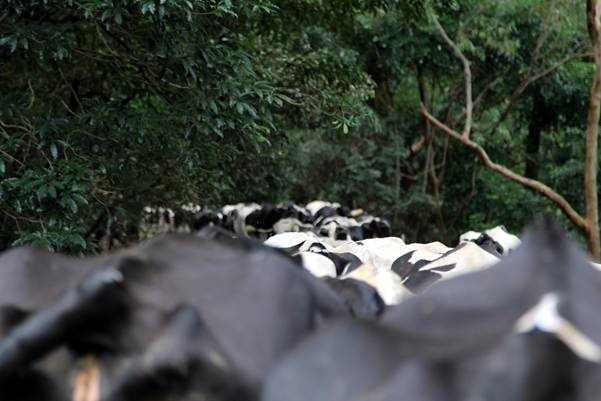
Wow I just love bringing those cows home through Picasso Corner and taking in what we have achieved through strong natural resource management community partnerships

We do it in the middle of a dairy centric rural residential subdivision where houses sell for in excess of 2.5 million and even include a Glenn Murcutt house

Dining court yard with lights

We do it on the edge of Jamberoo where not only do the thousand people who live in the village see our farming practices everyday so too do the tens of thousands of people who travel by on the highway each year .

IMG_8665

Now don’t get me wrong our region loves its farmers and so does the local council. Sadly in the main they love their farmers not because they produce food but because they maintain the landscape and paradise. We do such a good job the local real estate agent took a picture of the Lemon Grovefarm and splashed it right across one of their exterior walls. (must get a picture of that myself)

My Clover Hill neighbours are gorgeous but there a number of them who say privately they love the vista the cows provide but would prefer the cows and their manure had a virtual presence. There are times I cant blame them – turned up to a few events with manure on my shoes myself.  We know reality says you can’t have one without the other. I do hope the ever declining farmer terms of trade and external pressures out of our control don’t determine my neighbours actually witness the ramifications of a cow free landscape shortly.

But I can live with these minor frustrations what I am really angry about is despite successful farming in this country requiring ongoing innovation, efficiency gains, increasing intensification and active farmer/community/decision policy maker engagement this isn’t happening.

Why isn’t it happening you ask?

At a regional level farmers find themselves locked into a system where they are unable to free up capital constrained by archaic planning systems based on prohibition and mathematical exercises. We have regulators who impose urban ideas of separation and rigid rules which they apply in isolation with no understanding of the landscape or landforms.

Too often so called agricultural experts are selected by tender not expertise leading to regulators being ill-informed. The one size fits all and a lack of collaborative ethos stymies diversification and innovation. Well-meaning green councillors have preconceived ideas and prejudices of farmer motivations and are driven to reinvent the landscape into what they think it should look like. In fact this was recently played out when all of the “prime agricultural land” in Jamberoo was zoned landscape or environmental land and because of lack understanding of how our local dairy farmers farm the dictionary definition of dairy farming actually precluded dairy farming. Just as well we identified and reversed that impending disaster before it was too late.

Most of all I am angry with Coles. $1/litre milk is not sustainable. Food has not been realistically priced in this country for a long time and now Coles is hell bent on devaluing it to the level where farmers feel worthless.

What is the answer?

Well Coles and their partner in crime in this race to the bottom to demoralise farmers and destroy agriculture’s viability in this country are out of my control.

However engaging with, and convincing the community and the regulators that fostering the rural idyll of 1950’s style agriculture is unrealistic and counterproductive to innovative, dynamic, profitable sustainable agriculture in the 21stcentury is one I will pursue fervently.

We all have a role to play Australia. Countries who do value food because they can’t grow it themselves will continue to buy farmland in this country. Don’t get angry with them instead recognise valuing your farmers is not enough. Firstly we must be prepared to vigorously lobby our regulators to give our farmers a mandate to innovate, achieve efficiency gains and intensify their businesses. Most importantly we must realistically value the food our farmers produce and be prepared to pay for it.

In the words of Louise Fresco “Food is as important as energy, as security, as the environment. Everything is linked together.” Yet we continue to ignore this at our peril and we are denying these young people a future as part of the noblest profession and this wont happen eitherJulia if we don’t have the farmers to fuel the agribusiness sector.

Thank you Australian Farm Institute for the opportunity to be heard and vent and hopefully help bring the solutions to the table

Some other food for thought can be found here

Richard Black – Farming needs “Climate Smart” Revolution

http://www.bbc.co.uk/news/science-environment-17495031

Geraldine Doogue – Foreign Investment in Australian Agriculture

http://mpegmedia.abc.net.au/rn/podcast/2012/05/sea_20120505_0810.mp3

Shaun Coffey – What Price Cheap Food

http://shauncoffey.blogspot.com.au/2012/03/what-prices-cheap-food-or-do-we-want.html?spref=fb

Marian MacDonald – Confidence to Grow

http://milkmaidmarian.com/2012/05/04/confidence-to-grow-could-foreign-ownership-be-a-godsend/

Lynne Strong – I must be a good person because I am a Christian

http://cloverhilldiaries.com/2012/02/23/i-must-be-a-good-person-because-i-am-a-christian/

Nate Berg – One things missing from the Urban Farm Movement – Farmers

http://www.theatlanticcities.com/neighborhoods/2012/04/one-thing-missing-urban-farms-farmers/1834/

Farmers holding positions of influence

Today Clover Hill Dairies hosted a visit by Natural Resources Commissioner Dr John Keniry and A/Executive Director Bryce Wilde. As always we take every opportunity to share farming stories and farmer commitment to people, animals and the planet with the wider community and people of influence.

Can you imagine how excited I was to find out the commissioner is also a sheep farmer from Cumnock running lambs and producing wool.

With farmers at less than 1% of the Australian population you don’t tend to run into people of influence with a strong farming background who know as much about growing pasture as you do

IMG_0995

Dr John Keniry and the SRCMA team at Clover Hill

As it turns out Dr Keniry has worn many hats in his lifetime including a degree in chemical engineering with first-hand experience in the food and sugar industries. He is Chairman of the Pork CRC and Sheep Innovation CRC and Chairman of the Board of the Australian Farm Institute so he comes to the Natural Resource  Commission with an understanding of the everyday challenges of farming and managing on farm issues and that’s very comforting to this farmer.

IMG_0975

The pasture was looking pretty impressive. I can see the cows licking their lips already when they see this. Erin’s wildlife corridors were looking equally good. Look at those trees grow Erin. What about the Persicaria a vulnerable species that has taken a liking to our creek beds. How rewarding is it that we have been able to link, enhance and establish additional populations of this native herb around the farm  

IMG_1006


Not been able to join us for lunch Michael is not complaining as there is plenty of Panacotta left over to keep him dairy indulged over the next few days

IMG_1003 


Decrease Text Size

Permeate what’s all the fuss?

I wasn’t going to write a post about this topic but people I respect are now  concerned about the addition of permeate to milk and one of Art4agriculture’s Young Farming Champions wasquizzed about it and wasn’t confident answering the question when she gave a recent presentation. So I decided it was time to debunk the misconceptions and get it out in the open

Permeate so why all the fuss?

As always controversy sells newspapers and attracts viewers in droves for TV shows and apparently food controversy does this better than any other topic.

In fact it’s become so popular that we could have controversy food isles and controversy free food isles in supermarkets and food products and brands would be moving backwards and forwards like yo yos as long as the issue continued to improve ratings .

This week its milk and how it is standardised. Below is a nice simple diagram of how milk is standardised. Standardisation means you can put accurate fat and protein percentages on milk product labels.

clip_image002

Fairly straight forward stuff wouldn’t you say? What the labels don’t say is how the milk was standardised and this is causing controversy because the word permeate now emits “controversy”

So how did permeate fall into the controversy isle of the fridge. My opinion is lack of transparency. Transparency within food systems refers to full disclosure of information about rules, procedures and practices at all levels within a food production and supply chain. Transparency ensures that consumers have detailed information about production of a given food item.

When permeate first appeared in the media the reaction from the big milk companies and industry bodies was “no comment”.  Not the wisest decision they ever made.

Milk companies it’s time to fix this mess. If the milk is standardised with permeate put it on the label. Australian shoppers are not known as most discerning in the world, the statistics say we buy on cost and convenience and take 1.7 seconds to make a food item purchase decision in the supermarket. It’s a pretty fair bet that the word permeate on the label won’t even make a dent in sales but the consumer has a right to know and it’s time to show them that respect

Let’s hope this is a lesson learned “truth in labelling” should be nothing to fear. After all if you are not proud of what goes in your product and you can’t talk about it don’t add it.

Back to permeate – Let’s get fair dinkum I can confirm for milk consumers permeate is nothing to fear. It’s just a milk by product just like cream is but I won’t be whipping to put on my dessert any time soon

Food Myths Everywhere

Sydney Royal Easter Show – a career maker

Today is the last day of the Sydney Royal Easter Show and this blog will highlight just how influential a Sydney Royal Easter Show experience can be on Next Gen agrifood sector entrants

Background

We all know young people are the key to success for the agriculture sector and those involved in the sector also know that agriculture has talented young Australians ready to take on the challenge of new and emerging job roles set to dominate the industry.

In my role as National Program Director for Art4agriculture our network is committed to identifying and engaging these exciting young people We are also grounded in the conviction that investing in our young people needs to be made a top priority and we take every opportunity to providing a vehicle to give these young people the profile they deserve

I was introduced to Sharna Holman via the Twitterverse when I noticed her tweeting about the School District Exhibit display. She was obviously a proud supporter of the winning school Muirfield High and she was including people of influence (like pollies) in her tweets.

Having judged the school district exhibits it appeared from Sharna’s tweets she may have extensive insights into the behind the scenes development of a school district exhibit I contacted her and found an amazing young woman with a great story to tell about many things but in particular the influence of the Sydney Royal Easter Show has had on her career pathway

So of course what did I do I asked her to share her story with you as today’s guest blogger

The Sharna Holman story…. 

Hi, my name is Sharna Holman, and I am currently in my first year of a Bachelor of Science in Agriculture at the University of Sydney. I am your normal ‘city girl’ having had no real experience on a farm but from an early age I loved animals.

It wasn’t until starting high school when I chose to study agriculture as an elective that my passion for agriculture sparked.

bathurstexcursion2

I attended Muirfield High School in Western Sydney The school has a 4 hectare farm which allowed us to have cattle, sheep, alpacas, pigs, chicken, bee hives, and of course the obligatory vegetable patches. I soon found I loved learning more about the links between farming and food, and all about agricultural production. I particularly enjoyed  Years 11 and 12, when our teacher Ms Heap took our class on excursions and camps to Camden and Bathurst, and we had a chance to go onto working farms.

bathurstexcursion1

The school agricultural camp to Bathurst is an opportunity for year 12 agriculture  students to see some working farms and have hands on experiences of some examples of the issues we study at school such as erosion. We also went to the livestock saleyards, and saw how sheep and cattle get sold. We helped draft the sheep, and give vaccinations. On another sheep property we visited they were shearing the sheep, so we were able to see how that was done and how they handle the wool once it was shorn.

bathurstexcursion3

As element of the HSC agriculture is a product case study, from the farm to the supermarket. Our class studied milk. As we had already seen the dairy at the Elizabeth Macarthur Agricultural Institute, our teacher organised a tour of a goat dairy. The owner of the goat dairy was able to explain more about the niche market she was in, and sampled the products which was an experience in itself as many of us had never tasted goat milk products before. The camp is great as it is one thing to study something in a classroom; it is so much more powerful and increases knowledge retention rates by seeing and participating in a real life situation.

bathurstexcursion

When I was in Year 10, I was a volunteer at the Sydney Royal Easter Show which was an amazing experience on so many levels including providing insights into consumers knowledge ( or lack of) of paddock to plate production

I loved working at Australian Egg Corporation Ltd area in the Food Farm. This area has changed for 2012 show but when I volunteered here kids could come in and paint eggs.

Day 2 RES 8

It was a lot of fun being a volunteer; I was able to see more of the show as I was in there for most of the days. I think that year I saw nearly every event. Also I found that volunteering at the Easter Show helped boost my confidence in talking to people because you speak to all sorts of people at the show.

Day One RES 3 _Small_

It was my Sydney Royal Easter Show experiences from volunteering and then competing as part of Muirfield High School Show Team and then the opportunity to steward at the show that sparked my interest in agriculture as a career and all the doors and opportunities that it opened up.

Its showtime

I was part of the Muirfield High School Show Team that competed in the Schools’ District Exhibit Display Competition, which began in 2010. It was this competition that really helped me decide that agricultural career was the path I wanted to take.

display5

Everyone you talked to at the show had a story to tell, and they were all so different and interesting. The thing that resonated for me was that everyone loved what they did and they were living a life that made a real difference.

The big ideas for the Muirfield High School District Display Exhibit always come from something that is relevant to agriculture in the 21st century. We know our display gives us the opportunity to tell an important story and engage the audience and prompt discussions about the importance of farmers and farming.

display2

In 2011 we used the Agriculture Higher School Certificate Syllabus as our inspiration with the theme for the display ‘Australian Agricultural Research, Stepping up to the Challenge’. During 2011, it was predominately the Year 12 Agriculture Class working on the display, and as our elective for the HSC was ‘Farming in the 21st Century’ we decided all the research we did for the HSC would make the perfect “big idea” for a display featuring a large rotating DNA double helix. The aim was for people to walk away from our display reflecting on the science underpinning agriculture productivity and innovation and where it will go next.

This year’s display involved students from Year 8 to Year 12 and was themed ‘It all starts with us, Australian Farmers; One World, One Plate’ with the big idea coming from the Australian Year of the Farmer, The display provided a timely reminder that each and every one of us is linked by our need to feed and clothe ourselves

Sydney Royal, April 20121

Teamwork is the key and a diverse number of people and skills are needed to design and create a School District Exhibit display. Art students are needed to help with the painting and designing of the backboard and the arrangement of the display. While Design and Technology students are needed to assist with mechanics of moving elements in the display, of which Muirfield High School has a running tradition of recycling microwaves to make things rotate. A large amount of time is involved in creating the backing boards which are covered in seeds. It is also very important that the judges see only the best examples of Australian produce.

Muirfield High School is extremely lucky as they have an amazing support network coming from both the local community and the Western District Exhibit Display.

Sydney Royal, April 20128

It is common to see parents on the Sunday before the show starts parked out the front of the school with trailers attached to cars to help transport all the backboards and display gear to the show without even having to be asked. The teachers are also wonderful with many teachers giving advice on how things look, such as the art teachers sharing that bold and clear lines are best. Teachers also give up their time throughout the holidays to assist students in manning the display. The team at the Western District are fantastic! They are always keen to share advice and tips. Something that I learnt from them in the first year that the school participated in the competition was that you use hairspray to get the fruit to shine. Western District also supplies Muirfield with majority of the seeds and produce used in the display. It isn’t unusual to see Muirfield High School students walking up and down the Woolworths dome with pumpkins, apples, and bags of seeds in their hands.

IMG_0140

Muirfield and Western District have developed a close relationship over the past few years being involved in the School’s District Display Competition. Often students take breaks from working on their display to go down to Western and see if they need a hand with their display. Students also get invited down to have lunch and hang under the display with the team from Western as well. If you ask the Muirfield students who were part of putting together the display, most are keen to move up to the bigger league and help out Western District once they have finished school!

IMG_0825

The Sydney Royal Easter Show is where as a ‘city girl’ I can go and see the work of our farmers in their cattle or sheep, or the work that goes on to get the horses ready for their classes. But being involved in the show, and knowing the hard work that goes on months before the gates open has changed how I see the show. Farmers and exhibitors don’t just stop working once the show is over, the Sydney Royal Easter Show gives them an opportunity to be proud of the work they have done over the past year, and proud of everyone, in all parts of the agricultural industry.

After speaking to agricultural professors and students at the University of Sydney I knew a Bachelor of Science in Agriculture was for me and was excited by diverse areas of speciality and careers that it would open up for me.

At the moment my passion is biotechnology and genetics, but with all the different areas of specialisation you never know what direction you will follow.

What excites me is I know I part of new generation of young people in agriculture working on important issues that affect not only us in Australia but everyone around the world and I can’t wait to get out there and play my role.

I’m also a big believer in getting young people involved with agriculture at schools and at their local shows. Getting students involved at local shows and on school farms is a way of showing what agriculture really is; fun and exciting! The more students get involved with agriculture, the more myths can be dispelled and show that the agricultural careers are wide ranging and interesting, dealing with things that are important and relevant in our future.

Wow see what I mean – impressive isn’t she

BTW Muirfield High School also competed in 2011 Archibull Prize and their Archie (below) was on display in the Food Farm

Sydney Royal, April 201210

Just what are we teaching our kids?

Yesterday I wrote a post titled “Cows lay eggs don’t they” for Art4agricultureChat after I discovered that a large number of young people going through the Egg Dome at the Sydney Royal Easter Show Food Farm thought that eggs and dairy foods come from the same place. Then of course there was the ACER survey that delivered the international media heading Australian Kids think yogurt grows on trees. Embarrassing indeed. 

IMG_0097

Now whilst those with the knowledge can all have a good chuckle, everyone should be concerned about this lack of knowledge of the basics of food and fibre production. Why you ask? Think about it like this. These young people grow up to become our decision makers. They get to decide how to balance feeding and clothing people with housing people with an ever decreasing amount of land, water and energy resources and that won’t be easy and often there won’t be right or wrong choices just wise choices for people, animals and the planet

Yes Australia, with its vast size and diversity of climates can continue to produce a wide range of high quality produce and products to satisfy its consumers, while contributing to Australia’s economic wellbeing. But these production issues and decisions need to be addressed by all and let’s face it common sense says students should be equipped with the capacity and motivation to make informed decisions about such questions as well as be provided with the opportunities to gain knowledge and skills about the production of the food they eat, fibres they use and the environment they live in. This knowledge and skills should involve all the processes of production, marketing, consumption, sustainable use of resources and waste recycling, i.e. complete paddock to plate and beyond.

To do this, a variety of skills and knowledge are essential, including scientific, technical, problem solving and critical thinking. Knowledge of the past along with innovation is required. The required interest, knowledge and skills need to be encouraged and progressively developed through the curriculum from kindergarten through to Year 12. The Australian Curriculum should provide these opportunities in a manner that is appropriate with student development and at the moment it doesn’t and we should all be lobbying our current decision makers to fix this.

So if agriculture isn’t embedded into the curriculum from K to 12 what opportunities do young people get for hands on food and fibre experiences and knowledge and how is industry helping to address this conundrum ?

Art4agriculture worked with Meat and Livestock Australia on their display at the Brisbane Ekka last year and it was a huge success. This year Art4agriculture have been working with Ann Burbrook and 12 students from Caroline Chisholm College via 4agriculture and Archibull Prize to add a little something extra special to the Meat and Livestock display in the Sydney Royal Easter Show Food Farm for 2012 and I will write a post about that shortly.

In fact MLA actually participates at 5 Royal Shows around the country (Sydney, Brisbane, Adelaide, Melbourne and Perth). They believe Royal shows give them a wonderful opportunity to engage with urban Australians in an environment where they are thinking about agriculture. In each case they aim to have a paddock to plate presence but that depends on the space and location.

So let’s have a look at some of the activities that MLA as part of the 14 day Agri-Disney experience that has become the Sydney Royal Easter Show do to help fill the knowledge gaps our school curriculum doesn’t.

Research over the last five years confirms that 93% of visitors to the Food Farm come to see animals and so “Livestock in the Round” was developed.

MLA 09042012114

No shortage of people to share the Paddock to Plate story with in the Food Farm  This photos shows how Freeway, the Charolais bull, attracts a crowd to “Livestock in the Round” while Sarah and Lisa talk about cattle and beef production

This format allows people the opportunity to get close to, and touch, very large animals that they normally never get see, let alone touch.  The presenter talks about a range of things relating to beef cattle production (or sheep meat production if sheep are in the ‘Round’) and visitors can ask questions.

DSC_0119

Students Annie and Paige from Camden Haven High were guests of MLA in the Round this week

MLA also have a session each day when they get kids into the Round to pretend to be  ‘livestock’. They are tagged (with animal stamp), weighed, scanned (NLIS scales and wand reader) and backline drenched (drench gun with bubble bath) – then they come into an enclosure with 2 sheep and “Heidi the Hereford” (who is a staff member in cow suit). If I was a kid I would think that sounded like a lot of fun.

The Round sessions are supported with interactive and educational games and displays like the Fun on the Farm – which is a touch screen computer game for young children (and the not so young) where players can either water the animals, weight them to make sure they are a healthy weight, move a herd to new paddock to manage the pasture, or protect seedling trees by keeping fences in order.

The picture below shows the Livestock Learning Wall. When you press the button next to the question an LED light trail leads to the right answer

IMG_0086

The Farming and the Environment model below shows environmental cycles on farms such as carbon, water and soil nutrients (dung!)

IMG_0088

There is also Raise the Stakes which is a touch screen computer game for older children and their parents that is a question and answer game where you can Ask A Farmer or go 50/50 to find the right answer and try to get the highest score. There are also towers with some information on cattle and sheep, as well as food safety, nutrition and cooking as well as DVDs running a cooking session and a loop of photos taken to celebrate Australian farmers. Then there is Patti (below) painted by Richmond High School students as part of the Archibull Prize 2011 whose grass patches show the meat cuts she produces. Patti is surrounded by iPads running the iBeef app that shows what cuts to cook for different cooking methods and how long to cook for the desired result.

IMG_0085

Then of course there is the Pièce de résistance Moobix the 2011 winner of the Archibull Prize who highlights the many difference facets of the beef industry but more about this later

IMG_0084

MLA staff are also on hand to answer any questions visitors might have and students from Tocal Agricultural College with a support teacher care for all animals whilst they are in the Food Farm.

The provision of opportunities for students to have hands on experiences related to the raising of animals and growing of plants should not be underestimated in the 21st century. Core values of caring for animals and developing empathy with them are an integral part of this learning area, encouraging students to reflect on the past and move with the future.

The Sydney Royal Easter Show does indeed play a very valuable role but surely we cannot expect it to deliver science literate decision makers can we? Off course not.

Our young people should be provided with day to day opportunities to study all facets of food and fibre production and consumption as part of a school curriculum that provides authentic learning opportunities for students, offering a range of opportunities including academic, technical and skills based for students from kindergarten through to the completion of secondary school.

Lets get it right. The Australian School Curriculum should provide unique opportunities for students to interact with the physical and biological environment and to develop responsibilities that help to make them valuable citizens of Australia who can make the best choices for people, animals and the planet.

Judging can be a tough gig

Yesterday I judged the Schools District Exhibit Display Competition at the 2012 Sydney Royal Easter Show.  The competition has the dual purpose of showcasing talented young people and their team work from NSW schools as well as identifying, encouraging and mentoring young people to feed into the iconic District Exhibit Display teams.

Currently 4 of the 5 District Exhibit Display regions are represented in the School District Exhibit display (lack of space is currently the limiting factor)

Woodenbong Central School is the trailblazer in this field and I understand has been winning the Queensland version of this competition regularly for a number of years. Woodenbong won the first Sydney Royal School District Display competition in 2010. I didn’t judge that year but remembered I had a picture.  How could I forget that chest that opened and closed so effectively.

Woodenbong 2010 P1090373

Woodenbong Central School winning display from 2010

This year the big idea had a celebrating Australian Year of the Famer theme. The students’ vision is to connect city people with the farmers who produce their food and fibre. In their words “ the start of a new day, an opportunity to start new relationships and take agriculture forward together”

 IMG_0171

The school had a six student team representing Yr, 7, 9 and 10 who all come from farming families. Their skills are honed by also studying wood technology, metal technology and art as well as agriculture and having watched them put the display together for the last two years under their agriculture teacher’s eye they are very dedicated to their art.

Woodenbong Central School 3rd Prize

I even learnt  something new from talking to them. Have you heard of Adzuki beans. They are the red colour on their version of the AYOF logo.

Woodenbong Central School is a feeder school for the Northern District display and I understand they have a great mentor/mentee relationship.

Northern District Exhibit

The Northern District parent display in 2012

Menai High School has been competing now for 2 years. This year their display was also an acknowledgement of Australian Year of the Farmer. The display used millet, chick peas, niger, (don’t worry I had to look that one up too) canola, lucerne chaff, wheat and faba beans to give a three dimensional feel to their display. Belinda (seen in the front) is a tribute to women farmers and the display features pumpkins and wool grown by the school.

Menai High School 2nd Prize

Menai High School falls into the Southern District and as you can see from the Southern display (below) at this year’s Sydney Royal which is a tribute to women in agriculture, Menai High School made a fitting link to their mentor display and achieved a very worthy second placing. Menai will also be thrilled to know they took out the Students Choice Award.

Southern District.

Southern District Exhibit 2012 showcased women leaders in agriculture making a difference.

Calrossy Anglican School falls in the region known as Central and have the genius of Architects Craig and Wendy Taylor who have been designing the Central District Exhibit display for over 23 years to tap into if they chose. Calrossy is Wendy’s old alma mater and she is looking forward to sharing her years of experience with the students going forward.

Central District

Central District display takes out Best Design Award at Sydney Royal Easter Sow 2012

The Calrossy display was a tribute to the life blood of their region the Peel River. The display showcased the major food and fibre industries which include the poultry industry, the feedlot industry, olives and lucerne farms. The display also featured plots growing ryegrass and wheat.  The two young men who talked me through the “big idea”  were from Yr8 and Yr9 coming from a dorper sheep stud and a horse, cattle and cropping farm respectively. They both did themselves, their parents and their school very proud and impressed all the judges with their eloquence and passion.

Calrossy Anglican

Muirfield High School falls into Western District and this is their 3rd year in the competition.

Winning the competition in 2011 from Woodenbong by if I remember rightly by just one point last year with this magnificent display (below) highlighting the innovation and science in the agriculture sector in the 21st century.

iMuirfield High School  (2011)

Muirfield High School actively work with and tap into the team from Western District for support, knowledge and produce

Western District Exhibit 2012

Western District won the People’s Choice Award in 2012

Muirfield High School have taken out the blue ribbon again this year with their “one world one plate” theme. Reminding the viewer that the world doesn’t spin without farmers, their  world map is made out of a beach ball that is covered with paper maché. You will note the map of Australia is coloured very brightly which the students said is to highlight that Australian farmers lead the way in innovation (BTW a microwave oven motor drives the spinning ball). The Muirfield team was made up of students from Y8 to Y12

1st prize Muirfield High School

I found the judging task much harder this year with the competition very even and this was reflected in the scores. My two fellow judges Andrew Barnum and Nicole Punt are both well known in the art and design world and I benefited immensely from their broad experience and expertise .

I approached the judging from a farmer perspective being highly appreciative that all of these wonderful young people were helping me tell farming stories to my urban customers – the lifeblood of every farmer’s business. Like the Archibull Prize  judging the highlight is talking the students and finding out the big idea and how it developed and the emotional connection they have with their theme, their study of agriculture and their artwork.

When the judges had all spoken to the students and viewed the displays we sat around the table and chief steward Geoff Bell added up the points to find out the overall winner Ultimately it came down to how well the students had caught your eye and taken you on the journey of their big idea and how they had glued it all together

As Andrew said a “great artwork has a simple clear message that takes a viewer into the artist’s world and holds them there, makes a connection and leaves a lasting impression “

You definitely did that Muirfield. Brilliantly done and this farmer thanks you. In fact I thank each and every student, teacher, parent and community member involved in the preparation of the School District Exhibit displays

You can see the School District Exhibit Showcase in the Woolworths Dome Foyer’s Centre for Agricultural Excellence. It is most definitely worth a look

Special thanks to George Davey for taking the pictures of the winning entries today for me – bit of a superstar with his iPad