Wow what a cow

This is one amazing dairy cow. Her name is Murribrook Lieutenant Tina 2EX and she is a superb example of a Holstein dairy cow.

Tina IMG_7706

Tina is 16 years old and has had 12 calves and has just gone into the resting paddock waiting to have her thirteenth calf.

In her lifetime she has produced a whopping 153000 litres of milk. That means Tina  provides 1500 Australians with milk each year

Up until recently Tina has always taken pride of place leading the cows to and from the dairy. She has this knack of knowing when milking is due and lines up at the paddock gate to notify the herd its times to walk back to the dairy.

Wise dairy farmers select and breed from cows who have a number of qualities that ensure healthy and contented cows.

These qualities include:

  1. longevity
  2. compact udders that allow cows to carry their milk comfortably
  3. good “feet and legs” which help them to walk comfortably. This is very important on our farm as we milk three times daily and our cows walk a lot. For more info see previous  post “ when too much walking is not a good thing “
  4. Feed conversion efficiency. The aim here is to breed cows who can turn grass into milk as efficiently as possible. This has a number of advantages including reducing greenhouse gas emissions and all livestock owners know how important that is. Our cows have a feed conversion efficiency rating of 2.7 which is very high. This means they can turn 1kg of feed into 2.7 litres of milk  which means not only high productivity but little eco footprints

There is lots of science to cow breeding and genes that deliver these qualities have all been identified through genomic mapping

A mature cow like Tina is a product of both her genes (15% genetics) and how she was raised (85% environmental influences)

Tina is a great example of this proven science. Tina is a direct descendent of a very famous imported cow  called  Walkerbrae Triple T Toni, Ex 24*.  Toni was imported by Murray Sowter .

Walkerbrae Triple T Toni

How gorgeous is she and how much does Tina look like her.

Murray was involved in the first live exports from Canada. See his website here http://www.murribrook.com/cow-families/toni.html

We are very pleased to have a number of Tina’s decedents in our herd such as Lightening Tina who is her granddaughter and just about to have a calf of her own

IMG_7749

Lightening Tina – Tina’s granddaughter they are all peas in pod

These days Lieutenant Tina has a life of luxury. She lives in a paddock close to the dairy and doesn’t have to walk very far to access water and shade.  She is just adorable and she has a special place in our hearts.

Read about Tina in the Illawarra Mercury here 

Custodians of the land

Clover Hill Dairies in partnership with a number of local stakeholders has been lucky enough to access Federal government Caring for our Country funding to deliver great environmental outcomes on both local dairy farms and hobby farms which are also providing significant benefits for the waterways of the wider catchment

When we started these activities on the farm five years ago we recognised we didn’t have the expertise required to do the job to the level of significance our landscape deserved so we sought expertise from Southern Rivers Catchment Management Authority and Landcare Illawarra to ensure best on farm and wider catchment environmental outcomes. We outsourced cow comfort expertise from our farm consultant Dr Neil Moss and Dairy Australia’s NSW NRM coordinator Jess Jennings

Then we got stuck into it and we were pretty pleased with the outcomes and ourselves. A couple of years down the track we found we had ongoing maintenance problems and we readily admit we were well and truly out of our depth.

Cows grazing along water ways do a great job of keeping the weeds under control but the negative is they pollute the waterways and the negatives definitely out way the positives

So when you fence the cows out of the waterways and riparian zones the challenge is then how do you control the nasty weeds. Again you get the experts in and this time its was the bush regenerators. If you then take the time and have two way conversations with these amazing people you learn so much and we now have a new appreciation for our native landscapes and the plants who inhabit them.

We have worked with a number of bush regenerators over the years but our favourite is Erin Lake who I wrote about here

Erin with the help of director Ann Burbrook and videographer Tay Plain of Clear Cut Productions is creating a series of short videos with which we aim to engage, enthuse, educate and empower both farmers and rural landholders who care about their land but don’t necessarily have the skills sets to ensure the best outcomes for the landscape and the native animals

Here are some pictorial highlights from the last two days of the film shoot on the farm

IMG_7552

Director Ann and “talent” Erin co write the scripts

IMG_7400

On set Day 1 and Tay checks out the lighting

IMG_7433

and action

IMG_7470

Ann multi-skills and Erin proves to be a natural. Watch out Richard Attenborough

IMG_7588

Day 2. As far as locations go it doesn’t get much better than this

IMG_7580

Learning the lines

IMG_7592

was never so peaceful

IMG_7593

Cant wait to see the outcome of this footage

IMG_7597

New life

IMG_7438

Its a wrap and now long process of editing and reviewing the footage begins

We hope the take home message from our videos will be

Whether you are a commercial farmer or a hobby farmer or just lucky enough to have your own little piece of rural heaven it is pivotal to remember we are just custodians of the land

The landscape and our waterways are our lifeblood, they feed us, they provide us with natural beauty and so much more, they are not a toy and we must treat them with respect

If you don’t have the skills to manage them to the level they deserve GET THE EXPERTS IN

Russian latte–opening the farmgate has many advantages

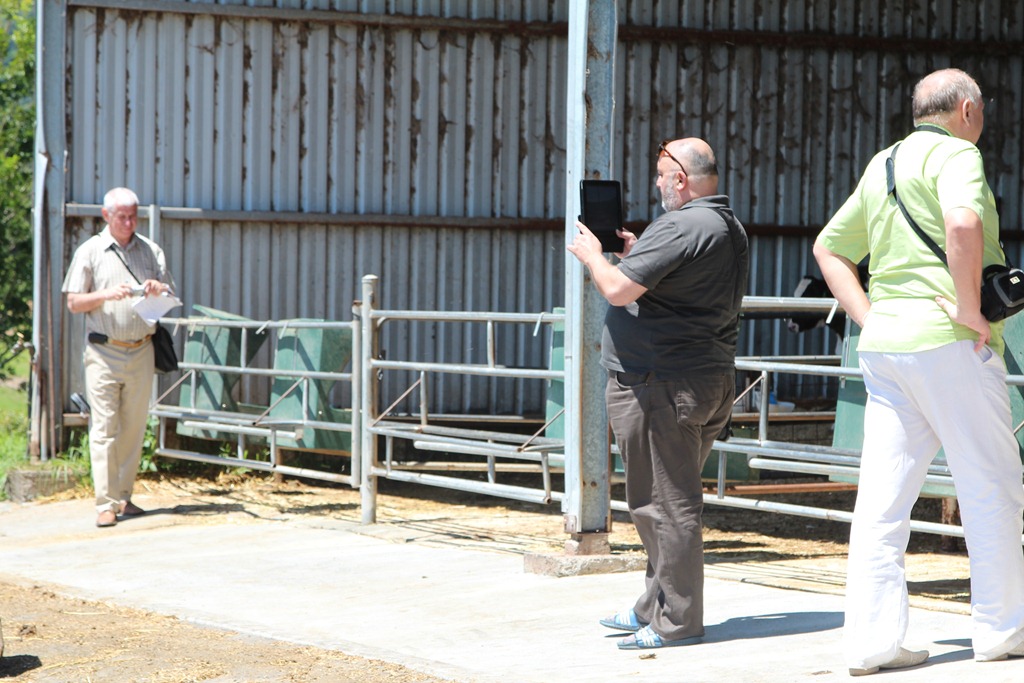
We have been opening our farm gate to international delegations for over ten years.

There is no denying hosting visitors to your farm is a lot of work. It can also be very rewarding and enlightening

I grew up a country town in NSW. I met the first person who couldn’t speak English when I was ten. I was fascinated by the new girl at our school who was Italian and didn’t speak one word of English. How brave was she. We didn’t mean to but I am pretty sure we all made her feel like an alien.

I learnt French at school so was very comfortable travelling to France when I went overseas but I must admit sadly I have favoured visits to overseas countries where the majority of people speak English.

So hosting delegations of farmers who speak no English is quite an eye opening learning experience. Whilst they always come with a translator invariably the translator knows little about farming.

IMG_6585

Dimitry the translator knew little about farming but he made up for that with lots of personality and good humour

The farmers always take loIMG_6702ts of notes

f

take hundred of pictures

IMG_6718

not only video cameras but and Ipads as well

Ipad

and ask a lot of questions

IMG_6637

and like all farmers love big pieces of machinery

IMG_6727

and love to share their farming stories and this weeks visitors from Russia were no different.

IMG_6784

Our consultant Dr Neil Moss was on hand to explain the technical details

Come to think of it I don’t think I have meet a Russian before and these farmers where so Russian. Why was I so flabbergasted when the bottles of vodka were bought out for morning team

Russian Latte 2

There was vodka for the Russian Lattes

IMG_6749

Straight vodka and vodka on the rocks

Russian Birthday Boy

Russian and Aussie icons go down well together

This Russian delegation was from the Volgograd (formerly Stalingrad) region and they were very proud of their heritage presenting me with a replica of the famous Motherland Calls statue.

IMG_7018

The history of this statue is fascinating. Briefly in 1967, the Soviet Union dedicated a towering monument to one of its great World War II triumphs. The Motherland Calls stands 170 ft., hoisting a sword to the sky that measures another 108 ft. 200 steps lead to the base of the statue to commemorate the 200 day battle of Stalingrad where the Red Army broke a German siege, only to surround and defeat the invading army. Motherland is not fixed to her base, though, and seeping groundwater has caused the plinth to lean nearly eight inches.

IMG_6860

I also received a bottle of Russia’s finest and I have since had a few Cosmopolitans to remind me of our new Russian friends

images

салют

Heads up on the research

Our second farm ‘Lemon Grove Research Farm’ PL  was leased in 2008 to grow and diversify our enterprise.

In complete contrast to the home farm whose terrain would challenge the fittest mountain goat Lemon Grove’s 68ha of alluvial river flats provides gentle leisurely access to beautiful pastures for our pregnant milking cows

P1100074

The lush flats at Lemon Grove Research Farm which is adjacent to the Jamberoo township

Despite receiving 33% less rainfall than Clover Hill (and the occasional flood!), we have managed to increase stocking rate on Lemon Grove by 150% to graze 5 cows per hectare. This has allowed us to achieve a 350% increase in milk production from that farm in the last three years.

Flood damage @ Lemon Grive  (2)

Thank God this only happens every 50 years ( touch wood)

This has  been achieved through a combination of improved feeding in the dairy and via our small opportunity feed pad, improved fertility in our pastures and innovative and exciting agronomic strategies that provide us with  a more even supply of high quality pastures all year round

Michael in Lucerne @ Lemon Grove

Michael standing in our lush first foray into the world of perennial pastures in Jamberoo

This leads us to our first and exciting research innovation which is to investigate the role and performance of perennial non-grass based pastures in coastal dairy farms

We were looking for ways to reduce our reliance on high nitrogen fertiliser inputs due to both its potential environmental impact and exposure to price volatility. We have watched urea ride the price roller coaster over the last five year due to its close linkage to oil price and we only see the upward trend continuing    

Roller Coaster

Traditional coastal grass based pastures (summer kikuyu/paspalum; winter ryegrass) are highly dependent on nitrogen  inputs, generally suffer from poor quality and manageability in summer, require re-sowing each year and are limited by root depth in being able to access moisture and soil nutrient and  hence are prone to short term moisture stress. There is also a significant lag (production gap) between rye grass senescing in spring and summer grasses growing well; and between sowing and production of new winter pastures in the autumn

Past efforts to grow perennial ryegrass have ben foiled by insect pests and summer grass weed infestation and dare I say inappropriate management practices .


Neil Moss @ CH


We have been working with Dr Neil Moss from SBScibus for 10 years


We have been refining these pastures in the Jamberoo environment with our consultant Dr Neil Moss over the last 3 years and on our current trial site we have planted a mixture of pasture based on perennial legumes and herbs

Food for thought0003

The trial site is located in paddock 6 with the control site in paddock 5

Over the next 3 years we will share our success and failures (hopefully failures will be few and far between)

This trial is supported by funding from

Food for thought0001

Gearing up to the countdown

Our little Princess Eileen is off on a big adventure to International Dairy Week the largest annual dairy cattle show and sale in the Southern Hemisphere.

IMG_6937

Eileen says watch out world I am on my way.  


IMG_6999

Held in Tatura, Victoria, IDW as it is best known is indisputably the most prestigious event in the dairy industry, showcasing the best quality dairy cattle to over 4,000 visitors from every state in Australia and over 20 countries internationally.  Australia’s dairy men and women bring their top stud animals to compete in a display of over 1,000 dairy cattle from over 6 dairy breeds.

This year for the first time Clover Hill Dairies will be exhibiting in the Jersey section represented by the gorgeous Eileen. You first met Princess Eileen at Christmas when she donned her Rudolph crown

IMG_3790 

Well since then she has been washed and blowed dried and washed and brushed and fed and led and generally pampered daily

IMG_6886

IMG_6928

IMG_6941


IMG_6903

So what does one look for in a show cow. Well this is what you look for and as you can see the stud cattle world has a language all of its own.

  • The animal needs to be long, stretchy, and of good size for her age and breed.
  • It should have sharp, clean withers; a straight, strong back; a long, level, wide rump; and feet and legs with correct set.
  • It should have a good spring of rib and be deep in the chest and rear flank.


ILB illeen

This picture of Eileen taken by professional cow photographer Dean Malcolm shows off all of Eileen’s best assets 

This picture taken by me shows how her udder measures up ( there is a lot of udder talk in the dairy industry )

IMG_6927

  • rear udder should be high and wide with a well defined ligament throughout
  • fore udder should be snuggly attached to the body wall with four teats hanging straight to the ground

Months of preparation goes into preparing show cows. They have to be well fed. The nutritional needs of your show animal are of major importance and should include high quality hay and grains.

Eileen on hay feeder

Now Eileen is quite tiny compared to our Holsteins but like all true princesses she knows how to get her own way and no-one but no-one beats Eileen to the best hay in the hay rack.

IMG_6990

Eileen in the dairy scoffing down her grains whilst she gets milked just before leaving on the truck for IDW

IMG_6996 

Emma says “I will miss her whilst she is away”

Show cows have to be brushed at least once a day and have their feet pedicured. Eileen’s feet are looked after by the team of vets from Sydney University. The cows have to be clipped which improves the animal’s style and overall appearance.

Just as weight lifters strike a pose that demonstrates their taut muscles and fashion models know which profile to present a cow needs to be led and posed so as to show off her best assets  The cow should be lead at a comfortable pace with the animal’s head held high enough for impressive style, attractive carriage, and graceful walk.

IMG_6974

Come Wednesday evening next we will see if all the hard work has paid off. What ever happens Eileen will always be our little princess and doesn’t she know it

IMG_3787

When humans interfere with nature

As part of my Christmas at the Dairy post I mentioned we made the choice of interfering with nature by choosing to artificially hatch out a clutch of eggs two of our chooks decided they were no longer going to sit on after the first four chickens were born

IMG_3903

New life – Four healthy chickens and 17 eggs still to hatch out ( Hen on the left is a Peking and hen on the right is a Silky)

Broody chooks will not only sit on their own eggs but also tend to gather other chooks eggs over the next 21 days. So when the original clutch of eggs hatch the chooks have to make the decision to look after the live ones or continue to sit on the remaining eggs until they hatch and hope the live ones can look after themselves.

Not surprisingly they chose life over potential life – sounds pragmatic to me

However humans have the capacity to help them do both and being big softies Michael and I chose this option.

IMG_3915  

Chicken eggs in incubator 

Its pretty simple to do and very rewarding bringing new chickens into the world

IMG_3916

Once they hatch they stay 24 hours in the incubator and then we move them to their next home

IMG_6267

We use a plastic container like this and cover the bottom with pine shavings or in this case rice hulls

IMG_6274

We supply them with fresh water and chick starter

IMG_6276

and a light to keep them warm

Then we have to make the big decision as to when is the best time to give them back to their mums

IMG_6034

By this time you are getting pretty attached and you tend to keep putting it off and putting it off

So by now the 2nd batch ( they are still hatching) are almost two weeks old and it was now or never

So we decided to put the first 5 out on dusk just as mothers and the chickens they were looking after had gone to bed.

IMG_6312

We were very excited as you can see we managed to tuck “our” chickens under their mums with their brothers and sisters (B&S)

IMG_6158

But it was a different thing next morning. The mums and B&S went off and did their own thing and left “our” chickens to their own devices.

IMG_6369

But we are so proud of our offspring. They are resilient little champions. They have embraced the “chook palace” like they were born there.  

IMG_4860 

Our cows are just fascinated by chooks

IMG_6294

They have figured out how to get fed

IMG_6379

and watered

IMG_6218

They have gone on some big adventures

IMG_6242

Climbed a rock face

IMG_6238

In the meantime they are are not being completely ignored by their mothers and B&S who have walked by many times.

IMG_6296

and are now staying very close by

IMG_6289

With the silky chook keeping a very close eye on their activities. Tomorrow is another day and I wouldn’t be surprised if this silky chook has new family 


In the meantime another chicken has hatched in the incubator !!!!!!

The humans should get their act together and collect the eggs more regularly and  we wouldn’t need to play mums to other animal’s children would we??

What makes the ideal employee

In my previous post Growing the Milk Business I mentioned 80 cows had become 500 and a 1 man operation was now a team of 10

Today employees are more commonly referred to as team members and when I sat down today to write a job description for someone to replace Martin (which wont be easy) I thought of all the attributes that Martin brings to the team.

Martin came to us with no experience and a huge desire and commitment to learn. Martin is in his final year of a physics degree with a view to doing honours. Having struggled through physics as part of my uni degree and hating it with a passion I am fascinated by people who love it and master it and when they decide they want to milk cows in their spare time I must admit I am flabbergasted.

Martin’s commitment to learn the art of milking cows reminded me of my determination to snow ski well. I love skiing ( great start) I had lessons, I read manuals I even have a son who was a ski instructor for a short time in an earlier life and yet no matter how hard I worked at it I just never really got it.

But Martin is different whilst it was a slow process in the beginning you could see Martin would perfect the art of milking cows no matter how long it took and wow once he got he got it what a great team member he is.

IMG_3845
People who milk cows must be committed to their welfare first and foremost like Martin

So what is the ideal team member for Clover Hill Dairies

I recently heard someone speak at the Agrifood Skills conference and they said they hire for character first and foremost. You can teach skills but not character and I think this is wise advice.

So the job description says ( let me know if you think I have missed something)

Applicants must have

1. strong animal wellbeing and team ethic

2. be computer literate

3. Present as personable, clean and tidy

4. Have driver’s license

Will train suitable applicant

Farming is hard work but oh so rewarding. If you love animals and think you have what it takes send me an email.  Future Einsteins welcome and we will train anyone with the right attitude

Paradise through the lens

Yesterday the cows enjoyed the views from the Cooking School paddock

IMG_4325

Heading home (above) and enjoying the morning feed (below)

IMG_4279

But the day didn’t get off to the ideal start for the cows, the neighbours nor the person who forgot to open the gate to the paddock.

Road Cooking school Dixon  (1)

This is the entrance to the paddock where the cows camped until one of the neighbours saw them and told us

This is the entrance after the manure had been scrapped of the road. Heaven forbid 250 cows waiting to get into the paddock can you imagine the mess.  Less said the better then again as they say in the classics “shit happens”.

The Cooking School paddock you ask?

Yes Clover Hill is very unique. It is part of a dairy centric rural residential subdivision with 12 privately owned blocks ranging from 1 to 100 acres and one of these blocks used to be a five star cooking school. Just as well no cooking lesson were being held today.

Today one of the other neighbours was able to have the pleasure of sitting on their front veranda with the cows almost in their front yard.

Unfortunately John and Jenny did host the cows in their front yard uninvited a few years ago as have most of the neighbours at some stage. But as you can see the garden did recover quite spectacularly

IMG_4284

Much to our relief. In fact it was these very agapanthus that took the biggest battering

IMG_4260

And the cows were eyeing them off again today but they were disappointed. John has made the fence cow proof thank goodness.

Speaking of the fence – the rock wall made a magnificent backdrop for this photo today

IMG_4269

I have a Canon 600D which is their beginner top of the range but I do have the EF 24-105mm lens and this lens can turn even me into a decent photographer

Speaking of photographers John’s nephew is the well known photographer Toby Dixon Now this is photography. Check out his photo shoot with Jonathan Brown, Captain of the Brisbane Lions and Paul Gallen, Captain of the Cronulla Sharks here  http://tobydixon.com/blog/?cat=1

Toby has done some adds for Cadbury’s and a few others at Clover Hill as well

Like this classic

Cadbury 'Smooth' 03

This is Clover Hill’s very own  Mandelyn Skyframe Toni

Back to the amateurs

IMG_4375

How’s that view along the backline – might not be in Toby’s league but I am having fun

Weddings in Paradise

Believe it or not this is a story about growing grass.

Rolling green hills, seascapes and briescapes ( not that I think either of our processors make soft cheeses out of our milk – what a shame).

Recognise the backdrop

jamberoo-kiama-the-pavillio_med-22

Four days earlier it looked like this

IMG_3414

This wedding was in November and the bride and groom and the photographer Peter Merison did a rekkie for wedding photos at Clover Hill in late September.

When Peter knocked on the door and asked if he could take wedding photos in the front paddock little did he know how much preparation would go into the timing of the cows eating the paddock off in order to have the grass at the perfect height (and manure free- well almost) to provide the best experience for all parties concerned including most importantly the cows .

The weather was perfect, the grass was perfect, the photos look superb and if the wedding blog is anything to go by the wedding was perfect.

Now back to the finely tuned art form of growing grass for best practice pasture based dairying.

Greener than Green

Looking back from the west to the dairy and the paddock in front of my house  – can you see it?

This picture was taken in the spring and the grass in the forefront of this paddock is almost perfect. A nice blend of oats and annual rye grass at just the right height, with  high energy (carbohydrate) levels and balanced protein content.

Good dairy farmers know their grass so well they can pretty accurately estimate the energy and protein levels of the grass just by looking at it at any given point of the year. Take my word for it this grass is short and sweet and the cows quicken their step when they saw it.

During spring our rotation (number of days its takes the cows to eat off every paddock on the farm) is approximately fourteen days and thanks to the temperate weather and high rainfall this year our current rotation is still 14 days as the ryegrass is still hanging in there. As ryegrass is a cooler climate grass normally at this time of the year it would be too hot and the ryegrass will have died out or gone to seed (grass loses 40% of its energy content when it goes to seed) and the kikuyu will have taken over.

Good dairy farmers are always casting their eyes over their paddocks on a day to day basis to pick the best grass for their cows. If one paddock has got away (the grass is past its peak ) and another paddock is at the perfect stage you go with the paddock that is perfect otherwise you spend your time chasing your tail. Our cows go into a different paddock after every milking. This allows us to pick a paddock with good shade for the hottest part of the day. This means we need to pick three ideal paddocks every day.

Cows on heat  

Yesterday when we bought the cows home from Jack’s paddock we had a number of options which is always a good thing unless more than one paddock is past its best by date. We chose this one known as the dam paddock (for obvious reasons) or paddock 27

IMG_4068 

Each paddock has a number but they also have another name that often has no relevance to the present. Jack’s paddock has an historical significance. Jack and Viv used to own the 100 acres next door and as we have fond memories of them  I imagine this paddock will be called Jack’s paddock for a long while yet.

Back to the wedding. How impressive does this look

jamberoo-kiama-the-pavillio_med-45

and my favourite photo from the blog

jamberoo-kiama-the-pavillio_med-42

Wedding photos in this blog have been used with permission

Touching moments

Yesterday Michael and I went to get the cows in for the midday milking and I captured these touching moments between one of our cows and the next door neighbour’s horses

IMG_4019

A little banter over the fence

IMG_4022

Com’on girl time to go home for milking – OOh cant she stay

IMG_4024

Not listening?

IMG_4020

Kiss goodbye

IMG_4026

Long forlorn looks

IMG_4027

Till next time