#Strongwomen. "I write about the power of trying, because I want to be okay with failing. I write about generosity because I battle selfishness. I write about joy because I know sorrow. I write about faith because I almost lost mine, and I know what it is to be broken and in need of redemption. I write about gratitude because I am thankful – for all of it." Kristin Armstrong
Yesterday at the invitation of Melbourne University I had the opportunity to speak to their 2nd environmental science students on the challenges of farming in a carbon constrained world.
Joining me was Stan Krpan CEO of Sustainability Victoria . Stan had some very interesting insights into community engagement which I look forward to sharing with you in a later post
Integrated pest management otherwise known as IPM in the world of agriculture is an environmentally sensitive way of managing pests. It uses a combination of practices and control methods to prevent problems from occurring rather than dealing with them after they have happened. IPM control methods include biological control, using predators, parasites or microbial pathogens to suppress pests.
The goodies or the heroes in biologcial control are known as ‘beneficials’ – with lady beetles being the well known example – mmh never dreamed “redback spiders’ would wear the superman suit
Looks like this broccoli was a little too fresh from the Fresh Food people – it seems there is a lot to be said for very cold storage
Excitingly for the agriculture sector farming in the 21st Century in 1st world countries is attracting people from all walks of life with diverse careers pathways who bring new specialist skills sets and knowledge to the farm family business boardroom table.
2015 Young Australian Farmer of the Year Anika Molesworth family is a very interesting example of the knowledge and skills diversity farming is attracting.
Lindy, Anika and Simon Molesworth
Anika has worked as an agribusiness banker and spent most of 2015 in Laos researching her Masters in Sustainable Agriculture. As her father Professor Simon Molesworth AO QC will tell you “Anika always had a deep-seated belief that she should help those less fortunate. When she left school she went to Ghana for several months to work with underprivileged children. Ghana and Laos really demonstrate she sees that need and she also understands that if you get the perspective of different challenges in different parts of the world you actually get a more balanced approach to your own country.”
Anika’s parents work in the multiple fields of geology, environment, conservation, heritage and town planning and her brother is a senior adviser to the man who holds the purse strings in this country. Their farm is located in the very harsh climate at Broken Hill
Anika acknowledges she is very lucky to come from a privileged background and its this background that has opened her yes to the big picture and the realisation that finding the solutions to the world’s problems is a shared responsibility and each and everyone of us can use our compassion and knowledge and skills sets to make a difference
Anika met the president of the Australian Conservation Foundation (ACF) Geoff Cousins when she joined him on the panel at the Climate for Change debate at UNSW in November last year. So impressed was the ACF team Anika they subsequently funded her to attend the Al Gore 2016 Climate Reality Leadership Corps last month in the Philippines
This is Anika’s story through her eyes of her trip to the Philippines ………
A visit to the Philippines is a powerful reminder that we are dangerously pushing planetary boundaries. Densely populated, widely impoverished and geographically exposed, the Philippines is one of the world’s most vulnerable countries to climate disasters.
Filipinos take no day for granted. Etched into their consciousness is the frailty of life. The country is subject to extreme weather events, risking sea levels, changing temperature and precipitation trends. The magnitude of the changes are already having real consequences on lives, livelihoods, food security and water supplies.
Filipinos walk a tightrope between paradise and hell on Earth.
It would take a lifetime to explore all of the 7,100 islands that make up the Philippine Archipelago, and even longer to understand the culture and life that exists here. A week in the Philippines gives one only a mere snapshot of the country – a glimpse I welcomed when the opportunity arose last month.
The 2016 Climate Reality Leadership Corps brought together people from all over the world with the vision and energy to tackle the greatest threat to our planet – climate change. Seven hundred proactive visionaries collaborating to wield the collective energy it takes to make systemic and transformative change. A group united by solidarity, hope and action.
I was invited to attend by the Australian Conservation Foundation – Australia’s premier organisation concerned with ecological sustainability – which also recognises the importance of farmers being part of the solution to deliver conservation success. Over the course of three days, participants heard from world-class scientists, communicators, organisers, strategists, innovators, and of course, the Climate Reality Chairman and Former US Vice President, Al Gore. The workshop taught the attendees how to share their story, to understand the science, and how to inspire hope for an alternative way of doing things.
This Leadership Corps was truly remarkable due to being the first post Paris COP21 and held in a country considered a moral leader on the climate change issue.
This slideshow requires JavaScript.
The enigma and contradiction of the Philippines leaves one floundering to make sense of it all. From the chic and sophisticated Filipinos in Metro Manila drinking cocktails, to the scavengers of Smokey Mountain, Manila’s largest landfill, who are the city’s unsung hero recyclers. I listened in awe to the world’s best scientists at the International Rice Research Centre headquarters – who are tackling challenges that affect food production, such as drought, salinity and submergence. I attended Sunday mass with a thousand Filipinos singing praise to their god.
This slideshow requires JavaScript.
I fell in love with the beauty of the forests, the sparkle of the ocean, the welcoming smile and hospitality of the Filipinos. And my heart was broken by the extremity of the poverty, the once pristine ecosystems disappearing forever, the city choking with traffic and pollution in part caused by desperate provincial people migrating to urban centres in hope of a better life.
My eyes were opened in a land of polar extremes. I departed feeling overwhelmed. The challenges this country faces are on a scale beyond comprehension. But with so many brave Filipinos speaking out, taking action, linking arms in defiance – and all the while with warm smiles on their faces – how can these obstacles not be overcome? I was inspired by the number of people dedicating their lives to bettering this country and its people.
The Climate Reality workshop reinforced to me that great people are doing incredible things right across the globe:
Arun George’s startup Avant Garde Innovations aims to introduce innovative, affordable and sustainable solutions – first to India, then the rest of the world – that take renewable energy self-sufficiency and energy empowerment to the next level through a distributed and decentralized approach.
Rina Teoxon Papio throws special mudballs into dirty rivers and waterways in the Philippines. Her organisation Earthventure Inc uses effective microorganism biotechnology to bring these precious water resources back to life.
Carrie Cort is passionate about children’s education, and through Sussex Green Living aims to inspire parents, carers, teachers and children to live a greener and more sustainable existence.
Sarabeth Brockley may live in New York, but her actions are felt much further afield. A Policy Analyst at the United Nations DESA-Division of Sustainable Development, Sarabeth spends her spare time sending care packages that promote social consciousness.
These are just a few of the people I met who are changing the world everyday for the better.
The Climate Reality Leaders came together connected by a shared apprehension about the state of our planet. They left armed with new knowledge and skills, connected to a network of doers, and motivated to drive the transition to a better future…….
This takes the cake. Funniest thing I have seen in a long time and I thought calling The ArchiBULL Prize and sending schools fibreglass cows was sending mixed messages
Is it lamb? Is it beef? Is it even Grass fed? Whatever it is, its a stuff up Coles. Ht to Jasmine Nixon
What meat indeed ??? Ht to Andrew – rider not sure we can pin this one on Coles?
Some other gems courtesy of Andrew
Now for anyone who doesn’t know how you make fairy floss. Yes its sugar, sugar, sugar, sugar and more sugar. No animals where harmed in the making fairy floss and there is no gluten in sight
Step 1: Pour all of the ingredients into a large pot in the order listed above, making sure to pour the water around the sugar
Step 2: Cook from 0 to 133ºC (bringing the temperature up slowly) for 20-25 minutes. If you have a conventional stove top, try medium high or high heat and just watch it closely
Step 3: When it’s boiling DON’t stir it (that will increase the chances of it crystalizing). Take a wet brush and wipe the crytals downs off the side of the pot
Step 4: Let it cool down to around 100ºC and then pour the cooked sugar into small containers (the size of a hockey puck). Pour enough in each container so it is about twice as thick as a regular hockey puck
Step 5: Let the containers sit until they are completely cool
Step 6: Pop the fairy floss candy base (hockey puck) out of the container (gently squeeze the container as you rotate it… patience young grasshopper)
Step 7: Pour a little bit of oil over the fairy floss candy base to stop it from sticking to your hands and then use your thumbs and forefingers to mold the puck into a donut shape (making sure it is an even thickness all the way round)
Step 8: Lay some corn flour on a bench and dip your cooked sugar donut into it, then keep pulling it slowly until the donut gets bigger and bigger
Step 9: Keep dipping it into your corn flour at regular intervals as you pull it bigger, and stop once your donut is about half the size of a car wheel
Step 10: Now you have 1 stand. Fold it into a figure 8 and then with both your hands over the 2 strands keep your front hand still, while the back hand pulls and stretches the strands to become bigger
Step 11: Keep switching hands while making the sure the bottom of your candy always stays in your corn flour mixture
Step 12: Once your 2 strands are long enough, make another figure 8 and repeat with 4 strands, doing this 14 times in total until you have 16,384 strands!
Done. Break it apart, wear it as a moustache, eat it and have fun with it!
I hear patron numbers peaked at 115,000 at the 2016 Sydney Royal Easter Show (SRES) yesterday and there were still 100,000 people on the showground at 8pm. This year the show is not in school holidays and not surprisingly the public holidays has been busy, very busy indeed
For the next three days the crowds will reach their peak at SRES, the biggest event of its type in the southern hemisphere that attracts close to one million people over 14 days
On Thursday I had a request for names of two highly credible, articulate women in the beef and pork industries for a segment on the radio discussing what messages they would like the public to take home about farming from the 2016 Sydney Royal Easter Show (SRES).
I have been attending SRES for over fifty years and I know why I go and the take home messages I would like it to convey to city people have changed a great deal over that time. I look forward to hearing what women from the pig and cattle industry hope the show delivers for their livestock industries
There is no doubt the show is a great opportunity for city and country to connect – how you do that effectively is not always as easy as it might sound?
Cotton Industry advocate Laura Bennett shares her love of the cotton industry with primary school students in the Food Farm at the 2016 Sydney Royal Easter Show
Every single person who pays to walk through the gates has their own problems and in the main want an experience that brightens their day. Farmers hope that part of that experience reminds the community of the importance of farming and farmers
In the wider press and academic community, I watch with dismay as people pitch one agricultural system against the other whether that be organic vs conventional farming, vegetable farming versus livestock farming or going vegan as the panacea to saving the planet
Too often this research and resultant media articles muddy the waters and it is paramount that farmers lobby for robust research and development for farming as a whole as ultimately; these arguments go away if research delivers a win:win solution for people and the planet.
Somehow our farmers have to find ways to work together to go beyond once a year events like the show and become active participants in the food and fibre production debate 365 days. Only in this way can we ensure there is a balanced representation of all interested parties. A pivotal key to success is ensuring agriculture’s “bright, charismatic representatives” are equipped with sophisticated, considered, agreed and sound rebuttals to the more extreme lobby groups and unrealistic arguments.
I think the analysis is correct, but the simplistic conclusion is wrong “Opportunities for mitigation in this sector are plentiful, but they can only be realised with a concerted focus.” I agree there some opportunities for energy efficiency and sequestration (not much in soils however), but cost-effective net mitigation options are still a way off i.e. options that allow further growth in productivity with less total emissions.
The energy and transport sectors have viable alternatives emerging, they just need a price signal to make them fully cost-competitive. However, there are no ‘alternatives’ to food production. There is no alternative food industry that can produce the volume required. Organic agriculture certainly cannot and it typically comes with a higher carbon footprint anyway.
This does lead to a debate about livestock versus other crop sources of food, but there are some solid arguments that show:
removing livestock from the world food equation just makes an impossible task that much harder;
livestock are the only mechanism we have for generating food from the vast rangelands of the world that are unsuitable for other types of food production;
livestock are not just for food in developing countries – they are the banking system (Africa), religious system (India and Africa), transport, power etc
it is really only the privileged minority that have the luxury of choosing a vegetarian lifestyle. The rest of the world just eats what they can afford
Rising vegetarianism will not affect the growth in the livestock industries, as there is clear evidence that the worlds rising middle class (predicted to be 4.9 B by 2030) demand more animal protein with their rising affluence. Supply and demand will mean livestock continues to grow, even if all the privileged urbanites become vegetarian.
The real solution to livestock methane is continued research to develop low methane animals and livestock systems.
If we are going to communicate the real facts perhaps farmers need to have more conversations with each other first and ensure we have a cohesive, consistent, open and honest story to share
Perhaps some questions we could ask ourselves are:
Is the farming sector ready to drive the conversations required?
Are we ready to become part of the wider conversations that influence policy change and incentives?
Are we ready to partner with government and the community to get the best outcomes for farmers and the communities we support?
Back to the SRES and where the conversations about farming are taking place today
If you are going to the show here are a few tips from me
If you have children under 12 the Food Farm is a must visit. You can meet a farmer at the NSWFA stand, climb a huge tractor, make tabbouleh, have some delicious Aussie Apples, learn how to wash your hands properly, make flour and pastry, meet the George the Farmer team and join in their show, which runs on the hour and heaps more
This slideshow requires JavaScript.
Want to learn the real facts about egg production visit the Chook Pavilion and take sit in on Greg Mill’s presentation on the hour
Visit the Natural Fibre Showcase Pavilion and watch the fashion parade
Visit the Wool and Sheep Pavilion – plenty to see and buy here. A crowd favourite is always the shearing competitions
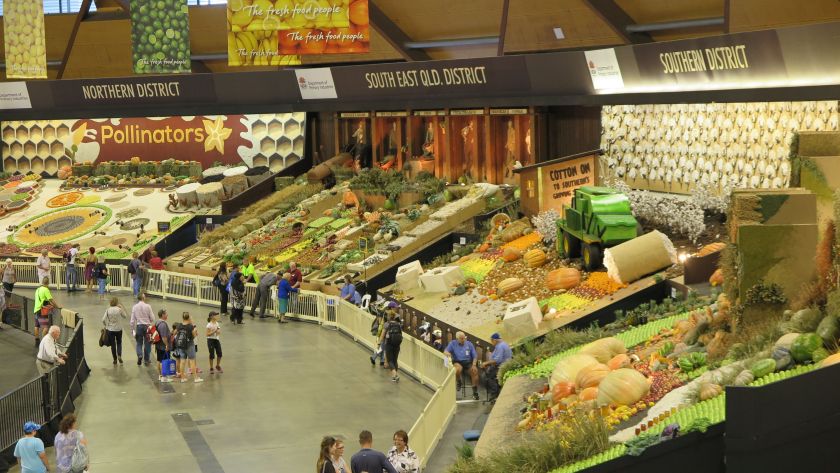
and every-bodies favorite – the District Exhibits
Don’t miss the Schools’ District Exhibits – this competition was won by Hurlstone Agricultural High School with their very thought provoking take on the Wizard of OZ – Yellow Brick Road
If you want a permanent reminder of your visit to the show and the sheer beauty of outback Australia stop in and say G’day to renowned rural photographer Fiona Lake
and a big shout out to all the farmers at the show carrying the advocacy flag on behalf of us all
Yesterday I just happened to be in the right place at the right time to hear 19-year-old Dayna Duncan speak at the Western Sydney University youth Agvocate forum at the Sydney Royal Easter Show
I stood there with my mouth open as this young girl drew me into her world with one of the most polished and inspirational presentations I have ever witnessed.
Dayna’s background and a lot of what she had to say can be found here
A former South Australian Young Citizen of the Year and listed as one of the most 50 Influential Women in SA, Dayna has moved to Sydney to do a degree in medicine at UNSW. I spoke to her afterwards and she said to me that her special passion going forward was rural mental health
I have heard a lot of people speak and I can’t remember ever been so impressed with not only how Dayna moved and inspired me to take action but the techniques she used to do it
Dayna is a graduate of both the Heywire and Foundation for Young Australianss’ Nation Building programs. I have seen firsthand how Heywire works and met other graduates of the Foundation for Young Australians Social Pioneers program and wow are they on a winning formula of a pathway of engaging and nurturing a new generation of Movers and Shakers and Future Influencers
Inspired by Harvey Milk’s quote “If a bullet should enter my brain, let that bullet destroy every closet door.” here is the background behind Dayna’s ‘Breaking Down the Door Day’ initiative which promotes understanding, acceptance, equality and diversity in rural and regional areas.
Dayna was funded to attend the national summit for young change makers entitled, ‘Unleashed’, on 9-10 November 2013, at the Sydney Opera House. While there, she recorded her video ‘Breaking Down the Door’ for the Foundation for Young Australians (FYA) program. Please take the time to watch it
Dayna’s take home message yesterday was
“You don’t have to change the world but you can change some-one’s world”
Kudos also to Western Sydney University Education & Engagement Coordinators, Christopher Vella and April Browne. who run the Youth AGvocate forum where Year 10 students over 3 days experience university life and get behind the scenes at the Sydney Royal Easter Show.
The students then take up the challenge to design and pitch a strategy to the Royal Agricultural Society’s (RAS) Youth Group.
This year I attended with Young Farming Champion Keiley O’Brien as an observer/mentor. We timed our arrival to catch the presentation by Dayna and what a smart move that was
As my regular readers will have noticed I have been furiously blogging for the last three months and that is because I have been struggling to hold it together and doing everything in my power to pull myself out of this emotional rut I have found myself in and I find blogging is cathartic.
When you find sitting on the veranda and watching the girls and thinking how lucky I am to live in paradise just isn’t enough to help you put your public brave face on
I was starting to dread the phone calls that just seem to relentlessly deliver bad news that lead me to think I am losing control of my life. It was starting to get a bit serious and I was starting to feel like a victim and I don’t do victim. It got to the point where I recognised I needed professional help. Good professional help I discovered can require making an appointment 6 weeks in advance so I have been surrounding myself with people who inspire me. When I woke up this morning to this blog post from one of those people the truly incredible Megan Rowlatt I thought I too would use today’s blog to pay tribute the women in my life who inspire me.
But the first person I want to thank is my current mentor who just happens to be a man. Thank you Mike you have kept me on track reminding me that self sabotage is not good for the soul. A special thank to Greg who is the most divine sounding board for my next big idea that requires detail
The women who inspire me all have one thing in common, they are all selfless – they want to do good first
A noble intent is the essential part of leadership. The future is only sustainable when we learn that we’re all in this together. WE not ME. Source
Working with me is not easy. According to Megan my strength is
I have never met someone with so much passion and enthusiasm for the future of an industry and the planet.I have also never met anyone who has a farm ute equipped with lipstick and perfume and kick arse gumboots, what a total boss.
but it can be exhausting keeping up with me
She has a collective of creative ideas constantly being pumped out of her mind, that I often find myself scratching my head wondering where the hell it all comes from and where I should be up to in the conversation at the time because she moves so fast!
My mentor keeps me under control with the rule I can only discuss one thing per phone call. If I have something I want to discuss I email him first. He emails me back with the reminder ” Focus on the strategy ( what you want to achieve) not the the tactics How you are going to achieve it) . Write me your strategy”
“Competitive strategy is about being different. It means deliberately choosing a different set of activities to deliver a unique mix of value.”
Strategy is the “what” part of the equation and helps you answer the question, “What are we trying to accomplish?”
Every business has limited resources and deals with a competitive landscape. The more it does of one thing, the less it can do of another. This concept leads to tactics, or the “how” part of the equation. Your tactics help you answer the question, “How are we going to accomplish our goal?”
Ultimately, a good way to think about the difference between the two is that strategy acts as a guide to a set of actions teams will undertake. Source
Our Art4Agriculture journalist the adorable Bessie Thomas deals with me by have 5 writing pads she always puts in front of her because the story I ring her to ask her to write inevitably turns into five stories
I am always looking for people who share my ethos and are successfully putting it into practice. Last week I was inspired by an article I read about Pip Job and I just went wow
Pip is focused on building social and cultural capital.NAB’s head of corporate responsibility strategy Sasha Courville admires the work Job has done in breaking down the social barriers for farming families to help achieve productive and sustainable environmental outcomes.
“The only way to have a strong agricultural industry into the future is that we recognise the importance of people, the importance of mental wellbeing, the importance of the environment and these are all key elements in strong businesses and strong communities.
Whilst I know of Pip I have never had a conversation with her and was keen to learn more and knowing Megan had worked with her I sought Megan’s assessment and Megan was wax lyrical with the advice “call her Lynne talk to her – she is amazing -she is a doer and she so kicking goals” I am looking forward to our conversation immensely
I am also very lucky to work with a number of selfless young women in agriculture who make up the Young Farming Champions network
All of these young women first and foremost have the future of agriculture as the foundation of everything they do. They know that the key success is cross sector engagement and understanding only when you have a world view and compassion can you build a resilient network of colleagues. They are know that being being communicate and connect effectively is a critical leadership skill and they are all undertaking personal and professional development to help themselves and each other be courageous and outgoing future influences and innovators.
I also want to acknowledge the female members of the Art4Agriculture team who each selflessly contribute to the future of agriculture and my well being
I am also very grateful to the three women I have work with in wool ( Emily King),grains ( Belinda Cay) and cotton ( Sophie Davidson) who all have a great passion for their industry and work tirelessly with my team to grow The Archibull Prize to deliver world class outcomes for farmers and the student participants.
Thank you to Erika who supports me when I let the frustration show and “react rather than respond”. and reminds me to not sweat the small stuff and tells me her door is always open and there is always a her house
I also want to thank my best friend Bev – I have no idea what I would do without you.
I am also grateful to Amazon, my Kindle and Apple TV who always manage to recommend a good feel movie or a book that make me laugh
So please if you find yourself like me sinking into a black hole and putting on your big girl pants just isn’t doing it for you, learn to say no, fill up your own well until it overflows, surround yourself with inspiring people, get professional help, let your friends know you are struggling and most of all keep believing in yourself, focus on the good your life and being the best version you can be .
and thank you John – i don’t think I have ever heard of a more bizarre career pathway but I am glad you took the journey
Confusion of ingredient labels in grocery store. Source
Maths was not my strong point when I was at school and when I became a pharmacist I spent a lot of time double checking my calculations. There is one hell of a big difference between a gram and a micro gram
I also had a great deal of empathy for front of shop staff and their bewilderment with the concept of percentages. Understanding the basics of markup and markdown and margins are pretty fundamental to the profitability of any retail business. It is a skill that can be taught so it was important to identify a potential problem from the start and it became standard practice of the staff interview process to ask the question
‘If an item retailing at $3.50 has had 50% added to its cost price. What did the item cost ? ”
It was extremely rare to get an answer of $2.33 and sometimes no matter how hard a person tried they just couldn’t get the concept that if you add 50% to a number X to get number Y and in turn take 50% off number Y it does not give you the number (X ) you started with .
But when scientists alternate between talking about cancer risk in percentages and whole numbers I can see why the world is very confused. Let alone the concepts of relative and absolute risk
Relative risk
Relative risk compares the risk of cancer in one group of people to that in another group.
The chance of a group with a common risk factor (such as obesity) developing cancer can be compared to the chance of another group of people with a healthy weight. This relative risk ratio will remain constant across the world. But absolute risk will vary depending on how common a cancer is in a particular region.
Relative risk may sometimes be quite high and lead people to believe the absolute risk of developing disease is higher than it actually is.
For instance, a woman from a Western country has a 2 in 100 chance (2% absolute lifetime risk) of developing cancer of the endometrium (lining of the uterus) by the age of 85.
If the woman is obese, her risk of endometrial cancer is twice that of a woman of ideal weight. That is, a relative risk of 2 or 100% greater chance of developing endometrial cancer than a woman who is not obese.
This 100% figure may sound like obese women have a very high risk of endometrial cancer. But, in fact, the risk is still quite low, since doubling the 2% population risk still only makes the absolute risk of endometrial cancer in obese women around 4%. This is still a low probability of cancer.
Be careful not to confuse relative risk with absolute risk and remember the time-frames over which absolute risk can apply. Source
I know I get exhausted doing the maths in my head whilst reading these articles and maybe its one of those things where a little bit of information is dangerous and causing unnecessary concern and its time to focus on helping people understand the basics of a healthy diet.
Dairy farmers are not alone in having to grapple with the vagaries of supply and demand.
Sue Neales reports today in The Australian on Australian milk price woes
Farmers have little control over both their input costs and their output returns – in fact the volatility index of agriculture at 300% higher than the retailers they supply would in most cases scare off even the big risk takers – the share market volatility is child’s play compared to the risks involved with farming.
Most farming businesses cope with the financial and emotional stress by having multiple incomes streams such as
at least one partner in the business having a second off farm income.
diversification – ensuring you dont have all your eggs in one basket – usually not an option for dairy farmers
In light of the December 2015 Paris COP21 climate change agreement do commitments from companies like AGL to transition away from fossil fuels to clean energy open the door for farmers to get a new passive income stream from renewable energy? Is harnessing Australia’s natural resource assets of being the sunniest and one of the windiest countries an opportunity for farmers to do what they love plus maintain the 60% of the landscape they manage and get a fair return on investment?
Can farmers power our communities with clean energy technology – the science and technology says we can but Australian government policy is yet to provide the necessary enabling power
As Mick Keogh highlights in his comments in the Australian Farm Institute February newsletter farmers must and can be part of the solution to meet emissions reduction targets.
The Australian agriculture sector, contributes approximately 15% of total national emissions, is likely to be included in policies that are developed with the aim of achieving Australia’s future emission targets.
This will however require smart policy from government.
As Mick reminds the government
While it is possible to project some future scenarios for agriculture, a major uncertainty is likely to be the confusion created by overlapping Australian and state government policies. Unless these are better coordinated, they will make Australia’s emission target much harder to achieve
Government is starting to see the light
Australian and state government policies are at long last starting to create systems to pay landholders for the environmental services they provide for the community, and addressing the well-recognised inequity that has been inherent in legislation for the past 20 years. It would be a great shame if a lack of coordination between governments simultaneously removed some of potential benefits available to landholders, and at the same time made Australia’s already challenging Paris emissions commitment even more difficult to achieve.
But there are challenges from within. Getting the best outcomes for farmers and Australia is going to require farmers to be actively and visibly part of the conversation in the community – not something we have traditionally done.
Never before has it being so pivotal that our leaders look at new ways to identify and build partnerships with the powerful voices. Do we (farmers) have the will to get out of our silos and work both together, and with the community to enable us to change the culture of how we have traditionally done business.
It is an exciting new era with huge potential for farmers. There will shortly be an announcement of a new public facing farmer group who will be working with the powerful voices to investigate and advocate for farmer opportunities and incentives to harness the potential of our most bountiful asset – nature without doing her any harm. Lets continue to build the win:wins but this will require more than farmer voices at the table
The environmental non government organisations (e-NGO’s) who have launched a campaign against the NSW Farmers Association stance on native vegetation reform in NSW
As the environmental NGO’s get serious about their campaign against the NSW Farmers Association stance on native vegetation reform in NSW I must admit I am in great admiration of how strategic they are.
Agriculture has so much to learn from:
their capacity to plan down to the last detail.
their ability to organise themselves
their ability to be collaborative and cohesive
their ability to be both strategic and tactical
their ability to consult and listen to all the stakeholders
their capacity to align themselves with respected voices
the list is endless
Looking at the recently launched campaign Stand up for Nature– its clear they have consulted with leading farmers
Cash for conservation
We believe farmers who retain native vegetation on their land deserve the community’s support. That’s why we are advocating stewardship payments for farmer who do the right thing.
Broadscale land clearing is an unsustainable farming practice that threatens our water and soils and undermines the long-term productivity of our land.
This practice has turned whole regions of NSW into treeless prairielands full of feral animals and weeds, degraded by overgrazing, erosion, and salinity.
We need new, sensitive approaches to farming, not the same old discredited practices that have done so much harm.
Bushland’s benefits for farmers
In addition to protecting fresh water supplies and native wildlife, bushland:
Improves crop and pasture yields
Provides shelter for stock and crops
Harbours beneficial plants and animals such as pollinators and predators of crop pests
Controls erosion
Reduces land degradation and salinity
Improves water quality and water retention in catchments, and
Moderates global and regional climates.
Cash for conservation
We believe farmers who retain native vegetation on their land deserve the community’s support. That’s why we are advocating stewardship payments for farmer who do the right thing.
Take action today
It is critical that Premier Baird hears from people like you who want to reverse the loss of trees, bushland and wildlife across this great state. Here’s how to make a difference.
and I can assure you the documentary they have just finished filming is going to rock the halls of the NSW Farmers Association to the core
The video features farmers and not just any farmers. Farmers that have been recognized as leading in their field by both their peers, government and the community. Farmers that have been recognised by NSW Farmers Association as leading in their field. It features NSW Farmers board members and executive councilors. The documentary will make it very clear NSW Farmers Association does not have the support from farmers it claims it has and I have just have no idea how they will recover from this.
I can understand why environmental groups for example would worry about these NSW Farmers Association policies.
and this one is even better
So if the Local Land Services arent to be involved in the regulation and compliance – just who is NSW Farmers Association? I think self regulation may be going just a little too far.
Humans are their own worst enemy – somebody needs to protect us from ourselves
Most importantly it doesn’t have to be a war – as NSW Farmers Association agrees stewardship payments for farmers who do the right thing is a GREAT outcome for farmers and the landscape? What a great starting point for a conversation between all stakeholders to get the best outcomes for everybody.
Conservation groups have stormed out of consultations with the NSW government over an overhaul of land-clearing laws they say have been a sham and will fast-track bushland destruction in the state.
The move could reignite one the biggest environmental battles in New South Wales in recent years.
The Baird government is in the final stages of scrapping the Native Vegetation Act, which prevents the broadscale clearing of native vegetation by demanding that farmers “improve or maintain” the environmental outcomes of their site.
As predicted the good news stories are few and far between. Young Farming Champion and Fitzroy Basin Association Senior Project Officer Bronwyn Roberts will be devastated to see the story that I have rebloggged below from The Conversation .
As I have said a number of times this year – who will be prepared to accept the moral responsibility for throwing our farmers into the negative spotlight on biodiversity conservation – War has been declared – who will wear the responsibility for the collateral damage . If there was anything positive our leaders can learn from Gallipoli it was Churchill should have taken his own advice
“It should be remembered that it is no longer possible to force the Dardanelles, and nobody would expose a modern fleet to such peril.” Winston Churchill 1911
Yes the laws need reforming but for some reason some of our State Farming Organisations seem to be under the impression that farmers enjoy going to war to make it happen – its up to us to ensure our representatives understand politics is the art of the possible – trying to achieve the impossible is bad for our health and our image
The following text is a reprint of the same piece in The Conversation 22nd February 2016
It is now clear that land clearing is accelerating in Queensland. The new data confirm that 296,000 hectares of bushland was cleared in 2013-14 – three times as much as in 2008-09 – mainly for conversion to pastures. These losses do not include the well-publicised clearing permitted by the government of nearly 900 square kilometres at two properties, Olive Vale and Strathmore, which commenced in 2015.
Map showing the amount of habitat for threatened species cleared between 2012 and 2014.WWF
Alarmingly, the data show that clearing in catchments that drain onto the Great Barrier Reef increased dramatically, and constituted 35% of total clearing across Queensland in 2013-14. The loss of native vegetation cover in such regions is one of the major drivers of the deteriorating water qualityin the reef’s lagoon, which threatens seagrass, coral reefs, and other marine ecosystems.
The increases in land clearing are across the board. They include losses of over 100,000 hectares of old-growth habitats, as well as the destruction of “high-value regrowth” – the advanced regeneration of endangered ecosystems.
These ecosystems have already been reduced to less than 10% of their original extent, and their recovery relies on allowing this regrowth to mature.
Alarmingly, our analysis of where the recent clearing has occurred reveals that even “of concern” and “endangered” remnant ecosystems are being lost at much higher rates now than before.
While this level of vegetation loss and damage continues apace, Australia’s environmental programs will fall well short of achieving their aims.
Nutrient and sediment runoff, exacerbated by land clearing, is one of the major ongoing threats to the Great Barrier Reef.Great Barrier Reef image from http://www.shutterstock.com
Neutralising our environmental programs
Land clearing affects all Australians, not just Queenslanders. Australia spends hundreds of millions of dollars each year trying to redress past environmental damage from land clearing. Tens of thousands of volunteers dedicate their time, money and land to the effort.
But despite undeniable local benefits of such programs, their contribution to national environmental goals is undone, sometimes many times over, by the damage being done in Queensland.
Take the federal government’s 20 million trees program. At a cost of A$50 million, it aims to replace 20 million trees by 2020 to redress some of the damage from past land clearing.
Yet just one year of increased land clearing in Queensland has already removed many more trees than will be painstakingly planted during the entire program.
The Australian government’s Emissions Reduction Fund (ERF) is paying billions of dollars to reduce carbon emissions from industry. But the carbon released from Queensland’s land clearing in 2012-2014 alone is estimated at 63 million tonnes, far more than was purchased under the first round of the ERF (at a cost to taxpayers of A$660 million).
Species cannot recover if their habitat is being destroyed faster than it is being restored. But under Caring for our Country and Biodiversity Fund grants, the extent of tree planting to restore habitat across Australia reported since 2013 is just over 42,000 hectares – an order of magnitude less than what was cleared in Queensland alone in just two years.
And it will be many decades before these new plantings will provide anything like the environmental benefits of mature native vegetation.
Glossy black-cockatoos are one of the species threatened by Queensland land clearing.David Cook/Flickr, CC BY-NC
The loss of remnant habitat, especially from forests along waterways, means more habitat fragmentation. This is a further threat to many species of wildlife, and it hampers our ability to adapt to a rapidly changing climate.
The federal government has committed hundreds of millions of dollars to improve reef water quality. Yet ongoing land clearing in reef-draining catchments will reverse many of the gains these programs aim to achieve. Last year, Queensland’s Auditor-General reportedthat stronger legislation would be essential to reducing harmful catchment runoff to the Great Barrier Reef.
Prevention is better than cure
We live in an era of tightening carbon budgets, declining land-production capacity and rapidly deteriorating biodiversity, including in iconic places such as Great Barrier Reef. The evidence is clear that we cannot continue to degrade our environment without severe consequences.
It is far more efficient to prevent environmental damage than to try to reverse it later.
The current Palaszczuk government in Queensland has repeated its election promise to re-strengthen native vegetation protections. The amendment bill is due to be introduced to parliament within weeks.
But the minority government relies on the votes of cross-benchers to pass its legislation–so for now, the future of some of Australia’s most precious environmental assets remains uncertain.