Tony Abbott – Nature has a longer memory and a sterner set of justice than we all do

Whether people like my style or not – I am confident one thing they will all say about me is I am action oriented.

I love doers. I admire people who can connect other like minded thinkers and take them with them on their journey for the greater good. And I have never met and worked with a movement that does this more effectively than Landcare.

Nature

For me 25 years on Landcare is an internationally recognised social and environmental movement

I have worked with Landcare in urban spaces and in peri urban environments. I have worked with Landcare on lifestyle farms and on commercial farms, with youth and in schools.

Landcare transcends traditional boundaries to do what nobody else in Australian agriculture has ever been able to successfully achieve in great numbers. That is getting farmers to partner and work together and with the community

Landcare is the perfect model and a shining example for agriculture of what a connected cohesive group of people can achieve together

And thanks to the efforts of Landcare we are reminded that we (as farmers) operate in a broader landscape than just our farms

Farmers who work with Landcare think about their properties as part of the broader catchment which has led to incredible environmental achievements.

I also admire the very bright mind that is Andrew Campbell whose  knowledge of all things land and water and his ability to express his thoughts and opinions verbally and on paper is quite possibly unparalleled in this country

This recent paper he wrote ( with Ian Rutherfurd) for the Conversation on the government’s recent budget decisions on Landcare is a great example

Some of the text that resonated with me on the budget

It  also repeats a pattern of reduced funding and weakened delivery started under former Prime Minister John Howard, and confuses improved agricultural productivity with improved environmental management.

Bait-and-switch is a retail trick where you advertise a product at a good price, pull the customers in, and then switch the product at the last moment for an inferior and/or more expensive version. Under the budget, the bait is Landcare, and the switch is the Green Army.

Funding that would have been gone to seasoned community volunteers, multiplying local efforts, will now go to projects done by inexperienced young people on less than the minimum wage.

No doubt many Landcare warriors would appreciate a hand from some willing young workers, but will the soldiers of the Green Army continue to maintain these projects into the future like the Landcarers would? Unlikely. They will bus in, do the project and leave.

Governments need to be careful about white-anting the business models of existing private sector environmental contractors, and disenfranchising passionate volunteers.

Landcare is about building social capital in rural communities and helping communities to promote sustainable land and water management and more effectively tackle common problems that cross farm boundaries.

I filtered all the content I had put in the category under  The Environment on my blog and I am honoured that I have had the opportunity to work closely with the Landcare movement on my farm and beyond and introduce its ethos and philosophies and goals to so many others.

You have been very short sighted Tony Abbott – our landscape is such an integral part of the health,wealth and happiness of every Australian how can you not value it and the people who nurture it so much more than this budget shows

Ron Boswell get over yourself. Oz farmers are proud of what we and we are confident we will stand up to scrutiny

From The Australian this morning

Beef initiative ‘green thuggery’ SID MAHER APRIL 23, 2014 12:00A


A LEADING Australian trade expert has warned farmers that an environmental sustainability initiative for the beef industry, being promoted by the World Wide Fund for Nature (WWF) and backed by the Cattle Council of Australia, risks tying farmers up in green tape and is a move designed by environmentalists to “control farming’’.

I just don’t get why people like Ron Boswell et al seem determined to undermine partnership initiatives like this between beef farmers and NGO’s like WWF. Senator Boswell et al please don’t try to tell me Australians farmers aren’t dedicated to striving to achieve the best outcomes they possibly can for people, animals, places and a fair return for their efforts doesn’t underpin everything they do 

PPP-w-Circle2

Doing the right thing is not an impost its an honour and a legacy ( see footnote for explanation of the graphic )

Surely Senator Boswell et al you will agree all committed Australian farmers who are in it for the long haul are aspiring for excellence . Setting voluntary goals that the Cattle Council and WWF are working towards allows us to take it to the next step and have some measurables to back up our claims. Measurables are not an impost they are claims Australian farmers can make with integrity.

I judge organisations like WWF on their ethos and  people they employ to help deliver it. Backing up my point please take the time and listen to this fantastic TED talk by WWF’s Jason Clay 

I have worked with the WWF in this country and I am comfortable with what they are trying to achieve. In fact I will be showcasing former Cattle Council Rising Beef Champion, beef farmer and now WWF team member Ian McConnel and WWF’s Change the Way You Live campaign  to students as part of the Archibull Prize this year   

Well done Cattle Council and well done to Dairy Australia who are holding similar talks and throwing this brilliant piece of work on the table for comment by all parties.


Footnote – Some food for thought –  source

Create Value

At the top of the equilateral triangle, representing economic growth, is the effective pursuit of “profit”. In order for sustainable agriculture to achieve its goals, it must fully embrace the profit motive. This motive requires that developments deliver maximum present and future value to stakeholders by being driven by market demand, and that they do so in the most efficient means possible within the holistic triple-bottom-line perspective.

Accept Responsibility

The “people” leg of the equilateral triangle represents the social responsibility of industry professionals to recognize that project design affects a broad level of human well-being. Society requires and benefits greatly from gaining a greater sense of connectedness; having greater access to quality food, shelter, health care needs, as well as work, creative, recreational and educational opportunities; preserving its cultural and biological heritages; being safe; accessing cultural enrichment opportunities; respecting the diversity of its people; and participating in its own governance. Within the context of natural laws, it is every individual’s right to maximize these social opportunities, and it is part of agriculture’s responsibility to foster the culture to enable these opportunities to more readily occur.

Model Nature

The pure “planet” leg of the triangle recognizes the ultimate value and supreme intelligence of our natural world. Our environment offers an infinite number of time tested and successful patterns, designs and structures from the most minuscule particles, to expressions of life discernible by human eyes, to the greater cosmos. We must not only respect our natural world for its power to sustain us, but as we change and modify it, understanding its workings will lead us to the ultimate solutions we require to sustain ourselves. Make no mistake, the earth will survive. It is our societies which may be in peril. Using an ecological standard to judge our innovations will help us determine which solutions will work, and which solutions will withstand the difficult and ultimate test of time.

Eliminate Waste

Emanating from the creation of economic value is the concept of eliminating waste. Waste reduces profit, and as a result must be eliminated, but it won’t be easy. Eliminating waste requires strong visionary leadership that can transform a liability into an asset. It requires team-building, the development of greater trust, and getting a previously fragmented group of people working more effectively together. That is indeed a challenging task, but its relentless pursuit is absolutely necessary if we hope to achieve sustainability.

Quality of Life

Building from our social responsibilities is the understanding that the values our society espouses, and in fact, the spiritual “lift” we gain are more important than the material items we can own and consume. We must value and focus on the “soul” of our lives, for it is the root of true happiness and quality of life.

Energy Flows

Emanating from nature’s model is our understanding of the natural long-term energy flows which emanate from the sun, and are captured by plants, some of which are eaten by animals, which then (along with plants) cycle the energy into the earth, which stores it and ultimately feeds our plants again. Our short-term oriented consumption of these energy stores is seriously disrupting the cycle, and we must learn how to respect, protect and utilize these natural energy flows.

Share Knowledge

Between the “profit” and “people” ideals is the recognition that, as we progress deeper and deeper into sustainable land development, we must be willing and able to share the knowledge we gain with the other stakeholders throughout the world. Our industry has many areas of specialization, and in order for anyone to effectively develop the requisite holistic perspective, we must seek to better understand and address the needs of all the stakeholders throughout the process.

Humans and Nature Co-exist

Rather than man dominating nature, or man being required to avoid nature, there must be a recognition that man and nature can and do co-exist. With this recognition comes an understanding that man must benefit from nature, but that nature must also benefit from man.

Recognize Interdependence

Between the “profit” and “planet” ideals, and stretching to the very epicenter of the triangle is the understanding that we must recognize – in fact maximize the effectiveness of – our interdependent relationships. This interdependence exists not only among industry professionals, but with society as a whole – as well as cause and effect in the natural world. This principle of interconnectedness, inseparability and union provides us with a continuous reminder of our relationship to the whole, a blueprint for the sustainability of our work.

The solutions we seek reside within this fractal model. As we dig deeper and deeper, the model replicates itself, becoming infinitely complex, yet always maintaining the necessary holistic, triple-bottom-line perspective.

Government is a Partner, But Private Industry Must Lead

As we move forward, we must do so in partnership with government, but ultimately, solutions must emanate from the bottom up, not the top down. History has proven that top-down solutions rarely solve the problems they purport to address, and they often create new ones in their wake. It is the private, profit-driven members of the industry itself that can and must take advantage of the opportunity to not only reverse the negative image the industry has been given, but to become the absolute heroes of our time. It’s a momentous opportunity, and the time is right to seize it.

Today’s reality is that the “people” are driving demand for practices that steward the “planet.” To date, the single-minded pursuit of “profit” has been an impediment to truly sustainable development, but as adopters continue to pave the way by incorporating more holistic new – yet proven – practices, the time is rapidly approaching that supply will begin to meet demand.

Are you ready to participate in the bold new world in which we live – where socially responsible and eco-friendly practices not only boost your bottom line, but are required for survival? That world is closer than you may think, and our goal is to help you achieve it. There are a host of emerging technologies, products, perspectives, knowledge assets, and other resources necessary to enable professionals throughout the industry to make it happen. Stay tuned, as they say. There’s much more to come.

Republished from the May, 2007 issue of Sustainable Land Development Today magazine

* Note have replaced the word ‘development’ with ‘agriculture’  to put into context

Meet Danila Marini a city kid who loves sheep and is doing some amazing research to enhance their welfare

I am a big fan of Meat and Livestock Australia’s Target 100 program concept.
 
Target 100 initiative demonstrates the long term commitment of Australia’s cattle and sheep farmers to advance sustainable practices – from an environmental, animal welfare, social and economic perspective – and ensure a sustainable food supply for generations to come. Target 100 outlines 100 research, development and extension activities covering soil, water, energy, pests and weeds, biodiversity, emissions and animal welfare.
 
 
In fact I am a big fan of any industry initiative that allows farmers to play an active role, communicate with each other, share stories, collaborate and feel proud of themselves, their fellow farmers and their industry.


This initiative also has some great sustainability study guide resources for schools and I was fascinated by an animal welfare Target 100 research initiative for sheep that I came a cross reading Food for the Future which has just been released

This  particular project looks at the role of technology in improving animal welfare
and in this case the opportunity to make pharmaceutical and drug delivery systems, including needle-less injectors a more feasible proposition for farmers

You can imagine my excitement when I discovered that Young Farming Champion Jo Newton actually knew one of the researchers involved in this project  

Meet Danila Marini

clip_image002

Originally I’m a city kid; I hadn’t gone near anything remotely like a farm until I was 9 when my Dad bought a small property and started a little hobby farm. I had always loved animals but being on this little farm increased my love for livestock animals and sparked my interest in agriculture.

Me getting my sheep ready for measurements for the first experiment of my PhD

I decided working in agriculture was my calling, so I applied for Urrbrae Agricultural High school, even if it meant travelling 2 + hours a day just to study. I made use of the school’s farm and applied to study in as many agricultural subjects as I could and as a result I received the Urrbrae Agricultural high school “Majorie Bowes Prize”, which is awarded to the highest achieving female in agriculture, as well receiving the Animal Science certificate for participating in animal related subjects. Throughout the years I had a million ideas of what I could be when I finished high school, a livestock veterinarian, a jillaroo, a stud breeder, a farmer, the list was endless, everything sounded exciting.

clip_image004

My year 12 Ag class that attended the South East Tour, where we learnt about different agricultural practices in the South East of South Australia

In year ten I went on an excursion to Adelaide University’s Agricultural campus, Roseworthy and to CSIROs Waite campus. I saw some amazing projects on animal nutrition, animal/plant production and animal/plant health. I was completely fascinated and from that point I decided I could do some interesting work in the agricultural field if I became a scientist. It was a hard choice between animal and agricultural science but in the end animals won and I went on to do a Bachelor of Animal Science at Adelaide University.

clip_image006

My Dad, my Mum and me at my graduation day in 2012 for my first degree a Bachelor of Science (Animal Science)

Like most undergrads I still had no definite idea what I wanted to do when I finished my degree. When it was time to graduate, I thought “why not give research a go?” I mean research was one of the main reasons I decided to go to uni. So with that I went and did honours, for which I was awarded first class. During my honours year I learnt a lot about research, I had a lot of fun and I grew to love sheep.

clip_image008clip_image010

How can you not love those faces!

As the year began to wrap up I knew I wanted to work in animal welfare and if it involved sheep even better! I thought that one of the best ways I could help improve animal welfare was through research so I went looking for PhD projects that had an animal welfare focus. Luckily enough I found a project with CSIRO and the University of New England on self-medication in sheep, which was a double whammy for me! There was a catch though, I had to move from little ol’ Adelaide to an even littler Armidale.

clip_image012

Research sometimes means early starts, late finishes and very long days but I’m not complaining!

The aim of my PhD project is to incorporate pain relief in food, so that sheep and cattle that undergo painful husbandry procedures, such as castration and tail-docking, can eat this food and be relieved of pain. I will also try to train sheep to self-administer the drugs (non-addictive of course) in order to provide pain-relief, this will give us some interesting insight into pain states in animals. I think it will be the most interesting part of my research! In my first year I identified a non-steroidal anti-inflammatory drug (this is what our panadol is) that works at relieving pain in sheep.

clip_image014

clip_image016

My sheepie minions! Together we shall take over the world with great animal welfare practices!

I have just started my second year and I am really enjoying my work, I currently have some interesting experiments planned for this year. They include adding the drugs to food and seeing if it helps to relieve pain in lambs that have been castrated and tail-docked and training sheep to self-medicate.

As you can imagine I’m getting pretty excited about my work. Many think I’m mad having gone on to do a PhD, some days I think I am too but thanks to the support from family, friends and my supervisors at CSIRO and UNE, I am so glad I have started this journey. So here’s to a future of research, helping the agricultural sector and helping animals!

Its scary just how naive the people who join animal activists groups can be

Warning this post is going to be very controversial and I write it in the knowledge that I risk bringing the wrath of the gods down on me

But as a person who has milk in my veins and has supplied it to 50,000 Australians for their breakfast everyday I have been wanting to write a post like this for a long time and then this video came along and gave me the perfect vehicle

Please watch it here

In the first instance it shows just how naive many people who join animal activists groups can be

PETA Mad over cows

In the second instance it asks Animal Activists the question I have been wanting to ask them for years and that is ‘Just what happens to the cows if we stop drinking milk and “set them all free”?

Thirdly I learnt something I didn’t know and that is PETA runs animal welfare shelters and they have killed over 100,000 domesticated animals that have apparently been given ‘sanctuary’ in these shelters.

Yes cow’s milk is for baby cows. Its also the perfect nutrient dense cocktail for human beings and the science tells us having access to this delicious, nutritious staple ( which thanks to Coles is now cheaper than water in this country) is one of the reasons we all have the chance to live into our 80’s

And yes the male of the species is a challenge for the dairy industry in that it doesn’t produce milk. My goodness an industry where the female rules. Heaven forbid.

I can tell you as 6th generation dairy farmer everyday I think of how we can give the best life we can to the male of the species and the answer to that lies in the hands of conglomerates like Coles

When Coles and their counterparts devalue milk and the cows that produce it so its cheaper than water and convince their customers that its all about price and not animal care and the good of the planet – ultimately the life of the baby bull calf is in the hands of those who put $1 milk in their trolleys and fridges.

Then there is this grim reminder of how hard it can be when you let chooks ‘roam free’

Consumers everywhere (and we are all consumers) like it or not its time to think about your definition  of “value” when thinking about dairy,eggs and other Australian grown products.

And believe me PETA and Animals Australia et al do not have the answer. Not drinking milk is NOT the best option for cows or the planet or people for that matter.

Ultimately whether we like it or not every 20 years the number of people depending on one farmer will double. Currently 650 people depend on one Australian farmer. Common sense dictates that the answers lie in producers and consumers working together to get the best outcomes for everyone

Free range chooks – the food chain pecking order

“All you gotta do is get a free range chicken. It doesn’t matter how you get it, buy it or hunt it down with a knife. All that matters is that you treat the animal with respect.”  Christopher Walken

Trust me there are a lot of great reasons why chooks should not be free-range

clip_image002

Free Range chooks live the rural idyll at Clover Hill

I love (d) my chooks and have had them for five years now and it broke my heart to see them penned up. Once they had experienced life beyond the chook house they would look up at me with their sad eyes and run to the gate to be let out.

This time last year I had 30 chooks (and a lot of eggs I couldn’t eat)

I had this many chooks because I just love chickens and could bear to take the eggs away from the brooding mothers ( I’d go broke fast if I had commercial chooks)

clip_image004

I had favourites

clip_image006

This gorgeous little thing and her identical twin sister are (were) a cross between a peking/silkie rooster and a silkie hen

clip_image008

They were so soft and gentle and you could pick them up and cuddle them and they had a great time in the garden. – dig dig digging

But the rural idyll was short lived and over the last 12 months the foxes and the Goshawks have taken every single one and I have shed a lot of tears and felt very guilty about their demise

Dead Rooster Killed by Fox 

Now its one thing to have pets that produce enough eggs for you and your family ( and the whole street if you are like me)  and another thing entirely to have animals that feed the masses   

So now that Woolies have bought into the ‘caged vs free range’ trend lets take a look at some proven facts

Firstly let’s look at it from a sustainability level. Whilst free range egg production systems may improve the welfare ( that word with so many definitions) of laying hens, these systems on average emit 20% more carbon dioxide and use 25% more land per kg of product.

Secondly let’s look at that word ‘welfare’. Welfare includes factors such as whether hens are free to move; whether the system allows them to engage in behaviours that are normal for hens; whether they are protected from disease, injury, and predators; whether food and water are available in the appropriate amounts and type, and are of high quality; and whether the hens are handled properly.

Obviously maintaining good welfare within housing systems usually involves trade-offs.

For me my desire to watch my chooks have fun in my garden was much greater than my focus on their survival ( and the guarantee that I would have eggs)

In the commercial world for example housing systems that allow hens to perform natural behaviours (e.g., nest building for laying hens) may, in fact, result in more challenges for disease and injury control. Conversely, improving disease and injury control by more intensively confining hens can limit the hens’ freedom of movement and ability to engage in normal behaviours

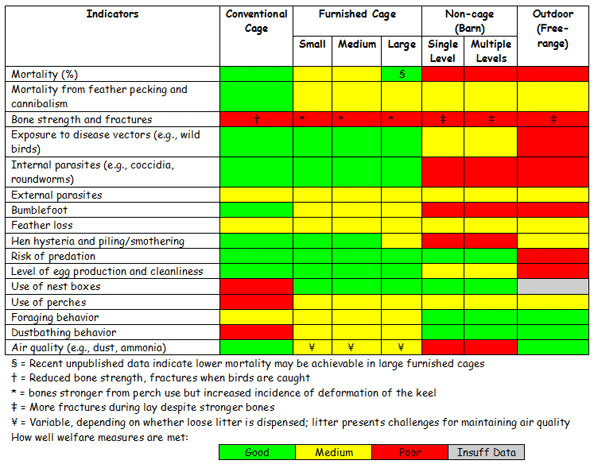
Here it is in table format found here

cage_systems.

A Comparison of Cage and Non-Cage Systems for Housing Laying Hens

No matter which way you look at its complicated See “Fewer hens doesn’t always mean happier hens’ and in a country where consumers are in the main only interested in cost and convenience I shudder to think what it will cost egg producers to meet Woolworth’s criteria and what will happen to egg production in this country if Woolworths don’t pass those costs onto consumers.

Back to me and my seriously dwindling companion animals.  I have decided fish are the go. As it turns out I have a ready made fish pond in the rainforest section of my garden.

Rainforest garden

All it needed was to clean out the filter and change the water (and most probably add some wire to keep out the birds – the food chain can be a scary place to be) .

Fish Pond

As it turned out it was full of tadpoles so I will wait for them undergo the metamorphosis  into frogs (most likely in my area green tree frogs) and then I will be the person who keeps fish 

Frog pond

and In reality my chooks had a wonderful life albeit short life in paradise.

To quote Lenore Skenazy 

“You don’t remember the times your dad held your handle bars. You remember the day he let go.”

And if you need a good laugh like I do when I think about my chooks then this will really make your day – courtesy of Christopher Walken

Rick Farley A life with a lesson for us all

I am a person who needs to be surrounded by good friends to truly relax and find it almost impossible to take 5 when I am left to my own devices

So this Christmas I am determined to break that mould. My front verandah has become my new best friend along with Amazon Kindle and Netfix and Crackle and iTunes

A Google search told me the best TV series of the Year was House of Cards.

I have been fascinated by Rick Farley since I read his 2003 Australia Day address so on my iPad Kindle I am reading his biography ‘A Way Through’

What a contrast my choices of verandah entertainment has been

House of Cards is indeed brilliant but so dark. Kevin Spacey as Congressman Frank Underwood Machiavellian personality is just so evil.

I wish he was an anomaly but we all know there are people in the real world just like him with no empathy, conscience or remorse and believe everything should revolve entirely around them and their quest for power no matter who or what they have to crush to quench their thirst.

Some eerie quotes from the series

Power is a lot like real estate. It’s all about location, location, location. The closer you are to the source the higher your property value.

Choosing money over power is a mistake almost everyone makes. Money is the big mansion in Sarasota that starts falling apart after ten years. Power is that old stone building that stands for centuries. I cannot respect someone who does not see the difference.

Now according to the web President Obama has said of House of Cards and Frank Underwood (who will resort to murder, sexual impropriety, blackmail, fraud and a litany of evils to grease the legislative process).

“I wish things were that ruthlessly efficient….. this guy’s getting a lot of things done”

I would prefer to think the President has been misquoted or spoke in jest

The most poignant part of the series1 for me is the last episode when Frank’s wife Claire (who can do evil pretty well herself) asks Frank what legacy will they leave on the world and he can’t give her an answer.

Such a contrast to Rick Farley who also spent a considerable amount of time in the world of politics.

“In this era of adversarial politics and campaigning there are lessons to be learned from his life, his capacity to get everyone talking to one another, and to agree on a compromise” Natasha Mitchell ABC Radio

“Farley brought competing interests together, listened deeply and patiently, worked from clear principles, helped people to understand each others’ perspective and to find common ground, and often delivered results that everyone could live with. Farley usually negotiated deals that represented real progress, but more importantly, that left a legacy of better relations between competing interests. Invariably, he earned the respect, trust and admiration of those he worked with.” Andrew Campbell

Rick was a city boy who is his own words was

shaped over a long time by a very diverse group of Australians – cattlemen, farmers, conservationists and Aboriginal and Torres Strait Islander people. I thank them all for the education they have provided me. It also has been shaped by over 25 years in the political and public policy arena, which represents both the best and worst of our national endeavour.

As his 2003 Australia Day address shows, Rick had a big picture vision for agriculture in this country and was 100% committed to Australia being the great country it deserves

So I perceive my country now to be a bit lost; still not managing change equitably; searching for its place in the world; looking sometimes for simple truths and solutions which no longer exist – in the middle of a cultural vortex and not quite sure of the exit point.

In that situation, it seems sensible to me to look to the bedrock of our nation, the points that can ground us and give us stability. In my view, these distil down to our country – our land and waters – and the nature of our relationships with each other.

Unless we use natural resources in a sustainable way, we are mining the future. Unless the relationships between our citizens are respectful and inclusive, we are a divided and diminished society.

To me, these are the defining features of Australian culture and identity. Together, they can unite our communities, build resilience, and create a firm foundation from which to meet the ever-increasing challenges we face.

By any measure, we are not caring properly for our natural resources.

We automatically imported European systems of agriculture, based on wet, fertile landscapes, and unsuited to our fragile soils and rainfall patterns. Australia’s wealth depended on agriculture and mining for a long time, and without sufficient knowledge about the long-term results, we went hell for leather……

The tasks before us obviously are enormous. Farming systems will have to change; further adjustment in the farm sector is likely; rehabilitation will take decades and will be impossible in some areas; public and private costs will be huge; new regulatory systems will have to be introduced; and a vast amount of political and social capital will need to be invested.

But unless we do it, in my view we will limit our future as a nation and as a society. Our economic, social and even our spiritual security will inexorably be diminished.

Sadly Rick Farley is no longer able to grow his legacy but eleven years later what Rick said in 2003 is just as relevant today

There is a golden opportunity here – to come together in an act of national will to create a priceless legacy for future generations; to cement part of the foundation for a modern Australian culture and identity. One that builds on the past, but can deal with the new realities we face.

I never met Rick Farley but I am honoured to be working side by side with people who knew him and respected him and I for one will be working hard in 2014 (25 Years of Landcare) to celebrate both his vision and inspire others to make it their mission.

In Andrew Campbell’s article “Whatever happened to brave leaders” he says

Rick Farley … was gifted in speaking truth to power, in cogent language that political leaders and their constituents could “get”. How we miss those clear, far-sighted voices in debates over how best to share the water resources of the Murray-Darling Basin. How we miss their ability to understand and empathise with all sides and cut to the essence, to find a way through to a better place.

In Rick Farley we lost a real national leader, one of the most significant Australians of the late 20th century.

There are indeed lessons to be learnt from his life. Rick Farley may be a “one of” but surely a team of people who aspire to achieve his vision could have a red hot chance This makes me ponder perhaps the most pressing thing wouldn’t you agree is that we (agriculture) identify and nurture the next generation of Rick Farleys?

Moo2Ewe and friends

Now I live on a dairy farm where as you can imagine there are a lot of cows who certainly pay their way. A number of diverse animals alive and life like also live on the farm. Some of whom are sometimes a little bit too friendly and eat far too much food 

Last night I answered a knock at my back door but it wasn’t quite what I was expecting

Clover Hill  Sheep  (17) 

I had not one but two visitors who were quite determined to come in

Clover Hill Sheep  (18)

and cute and cuddly as they were

Clover Hill Sheep  (32)

Running round and round the house playing 

Clover Hill  sheep (30)

Visiting Dorper sheep admire the garden 

Clover Hill  Sheep (34)

but I wasn’t too happy when I saw this

Clover Hill  Sheep (25) 

Note the pots of salad greens which were quickly spotted by the sheep

Clover Hill Vegies no more   (70)

and gobbled up. On top of that I would say there is about one hour’s work involved in cleaning up the back laundry where they had obviously spent some time before they knocked on my back door

Clover Hill  Sheep Poo (65) 

Then early this morning I had a visit from some of my rainforest friends.

Clover Hill  (1)

Does it get much better than this. Early mornings and late afternoons often see my house visited by swamp wallabies

and you will notice my very colourful life like cows friends on the verandah have now

Clover Hill Calves (56)

been joined by a cow I am very happy to have ‘living’ in my garden.

Clover Hill Desert Pea  (45)

At least I can be confident she wont be eating me out of house and home


BTW Those who read my previous post will be as pleased as the locals to see the rain has blessed us and we now have grass. My thoughts go out to farmers in NW NSW yet to be receive rain and  those in a similar situation in Queensland

Sadly I know too much about drought

Bessie Blore is a wonderful journalist, a girl from the city who married a boy from the the bush and I am so proud to know and work with her as one of Art4Agriculture’s Wool Young Farming Champions

Our place “Burragan” is 110km from the nearest town, 200km from the nearest supermarket, and 330km from the nearest major centre – Broken Hill. When I’m not out in the paddock helping with sheep work, I like to write, keep up with global issues, and uncover the strange secrets of our beautiful bush landscape.

Bessie writes a wonderful blog Bessie at Burragan where she shares the highs and lows, the laughs and the not so funny moments with her readers

I have been away for a week and the drive up the hill on Friday tugged at my heart strings.

The front paddock tells it all, the cows rotate around the farm every 14 days. It is 14 days since they were in this paddock and whilst it has a green tinge there is nothing for the cows to eat.

On my travels last week I went through Tamworth on my way to Gunnedah – there is no feed in the paddocks for the cattle there either. It was depressing and unfortunately those  farmers are not alone. Much of NSW and a great deal of Queensland are once again in drought.

Unlike me Bessie is new to the ravages of drought but she tells it so like it is in this wonderful blog post

I don’t know much about drought. Even when I saw her face, I didn’t recognise her.
Years before I moved to Burragan, we visited ST’s mum and dad one summer. Their house yard was a true oasis in the middle of a desert, in every sense. Outside the confines of the garden fence, they were feeding hay to cattle and saving animals from of empty, muddy dams. At the time, I didn’t realise that was what she looked like.

I don’t know much about drought. But I know that she’s inevitable.
I am lucky – or perhaps unlucky and lulled into a false sense of beauty and romance – to have moved to Burragan in the middle of several great seasons. This year, we’ve already had our annual average 11-inches of rainfall. We are thankful for that. And yet it’s dry. It’s dusty. It’s only getting hotter.

I don’t know much about drought. But I can feel her creeping up on us.
The signs are there. Selling stock. Buying hay. Blowing bores. Boggy dams. Empty tanks. Moving stock. Fierce winds. Thunderstorms that are no longer viewed as salvation, but instead, as fire threats. Those afternoons that smelt like rain; but when they came, they looked, and felt, and taste, like dust. Perpetrations for a dry summer.

I don’t know much about drought. But I know she’s more than a lack of rain.
She’s stress. She’s suffocation. She’s the haunted eyes of men whose strength is buckled by the weight of the world, and women who wish they could take the load off.
I don’t know much about drought. But I wonder if we will recognise each other, when we meet again.
I know we can’t be friends, and yet, to survive in this environment I cannot view her as the enemy.
We might have to learn to get along for quite a while.

Clover Hill one day in paradise

How I long for the farm to look like this again and for farmers everywhere to see drought pack its bags and go into hibernation

Todays Youth Tomorrows Farmer

Last weekend I went back to my roots and visited my dad who I have always called John

John is one of a large number of farmers who are contributing to the rising age of the average farmer i.e. still going strong at 83.

clip_image001

John and Lucy

I always thought the ‘average age of farmers’ figures are pretty woolly in that farmers who continue to live where they work never retire.

John and John IMG_6996

Just to prove my point meet John’s  next door neighbour also called John (on the bike – check out my John’s hot Ute) 82 years old  and still running a slick operation his farm 

As my John says “what would I do”.  Indeed unless your lifelong dream is to spend your retirement travelling the world then where better to spend your time than doing what you love best. clip_image003

In my dad’s case that is growing prime Angus steaks for your table

clip_image005

And growing the best pasture he can (and conserving it) to make sure those cows he loves so much are well fed

Now my dad is still waiting for his son to return to the farm.

clip_image007

Things where looking up 3 years ago when all his worldly possession arrived on the door step

But he was lured away by lucrative offers from the mining companies and my dad lives for the time he comes home on short breaks as he is this week. I will do a whole blog post on my dad and his farm shortly.

We know young people are the key to success for agriculture and I know agriculture has talented young people ready to take on the challenge. Young people with fire in their bellies taking every opportunity to generate a buzz around Australian agriculture   .

I know this because I work with these exciting young people every day

This weekend I am down in Bega and taking time out to visit two of these dynamos in  Art4Agriculture Young Dairy Farming Champions, Andrew D’Arcy and Tom Pearce.

Both Tom and Andrew have been farming side by side with their dads ever since they left school (and in reality since the day they were tall enough to put cups on cows)

The Pearce family lives on Pearce’s Rd as you do when generations of your family have farmed in the one spot. My dad lives on a road named after his farm

clip_image009

940 acres of rolling hills, bush and pasture. The pasture is currently 50:50 perennials to annuals with the traditional kikuyu base over sown with perennial and annual ryegrass, chicory and plantain over sown with oats in the autumn for those into the technical

clip_image011

Norm and Tom Pearce work side by side to milk 260 cows in a 16 aside swing over herringbone dairy

The farm is beautiful

This slideshow requires JavaScript.

clip_image013

And the cows  _

clip_image015

and their offspring are happy and contented

IMG_7440

This  one peeking around the corner of the tree is a bit like Tom’s dad a bit camera shy

The farm is heaped in tradition and I so enjoyed the walk from the ‘new’ dairy up to the original walk through dairy where the cows where milked by hand up until the 1950’s

This slideshow requires JavaScript.

Tom’s sister is getting married shortly here and you can see the views will make for great wedding photos

Tom Pearce (3)

The Pearce’s have recently installed a K-Line irrigation system to improve water use efficiency. Whilst they have a 560 mega litre water license , they currently only have a 40% allocation. Water is indeed a very expensive and very precious water resource.

You can check out how K-Line irrigation works in this great little vid

Tom Pearce is of course the farmer who puts the cheese on your cracker

Tom Pearce (10)

and was recently immortalized on the front of Bega’s Colby CheeseTom-Pearce-Farmers-Tasty-Cheese_thumb.jpg

Tomorrow I am off to visit the Andrew D’Arcy. Wow wait till you see the technology on Team D’Arcy’s farm

BTW Curious like I was what this is

Walk thru dairy (1)

Tom tells me this is an antique wooden ice chest now home to Roger the Rat

If you stuff up it pays to tell everyone

On farm field days are a great way for farmers to learn from other farmers. The successes and the stuff ups that farmers share are equally insightful.

IMG_9680

Overview of research and down to the paddock to see it in action 

IMG_9699

At the Lemon Grove Research Farm field day we hosted in July as part of the 2013 Dairy Research Foundation Symposium I bit the bullet and shared the “Wish we had the knowledge, skill sets, attention to systems detail and time to do x,y & z better – Clover Hill Dairies story”

What I particularly liked was that I also got the opportunity to identify farmers in our region who were systems focused and balancing all four to get great outcomes for their cows, their farms and their staff whilst keeping the bank manager happy.

One of the keys to profitability in the dairy industry is having milk in the vat in the quantity and quality you and your milk processor want it to be all year round.

Milk yield of a dairy cow depends on four main factors: (a) genetic ability; (b) feeding program; (c) herd management; and (d) health. A good dairy feeding program must consider the quantity fed, the suitability of the feed and how and when the feeds are offered.

IMG_5199

Paying attention to herd nutrition in the 90 days prior to calving through lead feeding (aka transition feeding) can mean an extra $200 in milk production per cow.  But it’s not just about the dollars – an effective transition program also makes life less stressful for dairy farmers as well as making their cows’ lives safer and easier.

For smart farmers good herd management also means having your herd as “fresh” as possible. Now that doesn’t mean feeding your cows oysters, it means ensuring you have as many cows as possible in the herd at peak milk production. This means managing herd fertility well is paramount.

The top farmers in our region work with the team from Sydney University Livestock Veterinary Teaching and Research Unit.

The Livestock Veterinary Service operates commercial on farm personal herd health and treatment and consultancy services. Activities range from routine procedures such as pregnancy testing through to more complex project planning, clinical trials and disease investigation. A philosophy of the Livestock Veterinary Teaching and Research Unit is to promote application of science and technology to problem solving on the farm.

The Livestock Veterinary Service also provides veterinary students with an opportunity to get hands on experience working with livestock and post graduate veterinarians with an interest in livestock an opportunity to pursue specialty training.

Luke Ingenhoff Vet from Sydney UNI  testing  (5)

Dr Luke Ingenhoff  from the Livestock Veterinary Teaching and Research Unit preg testing cows at Clover Hill Dairies

I identified Phil and Craig Tate from Albion Park as the farmers I believed would share their story with the field day participants in an honest and open way that would resonate with other farmers like us who wished we were just a little better at it.

Craig Phil and Assoc Professor John House

Craig and Philip Tate with Assoc Professor John House tell their story at Lemon Grove Research Farm field day 

Philip and Craig outlined their reproductive system to delegates describing the ‘systematic
routine’ that they believe is the secret to their success.

When it comes to being successful in business, one must create systems. Systems provide a framework for your team to use. In order to create high-levels of efficiency you will need to constantly update your systems and be on the lookout for ways to improve your business’s way of operating. Creating systems will take time, but it will more than save you the time on the back-end.

‘‘The system is the solution.’’ — AT&T motto

BTW I had Craig and Phil’s presentation with Assoc Professor John House videoed so you can watch it too. See link below

So impressive was Phil and Craig’s presentation that Holstein Australia commissioned Lee-Ann Monks to write a story for their journal readers and guess who was invited to take the pictures. Well after all who else would do for nix (when oh when am I going to value my time?)

So off I went with my trusty Canon to Macquarie Holsteins, home of the Tate Family dairy and now the workplace for two of our former employees.

What a delight  are Craig and Phil, such great farmers yet so humble and so proud of their cows   

IMG_5005

Craig and Phil making use of Smart Phone technology to keep good records

Easy Dairy IMG_5103

Good records in the dairy ensure everyone is in the loop. Knowledge is power

Communication is the true lifeblood of a successful organization – a high flow of information so everyone and everything is connected. Easy to say, hard to do.

1258 IMG_5083

The herd favourite 1258

Craig and Phil IMG_4932

Please note Craig took his helmet of for this stationery pix – trust me he does wear it when the bike is moving

Phil IMG_5060

Mutual respect between farmer and cow is very evident at the Tate Farm

Lousie MacMaster Calf Rearer IMG_5325

Louise Macmaster –  Phil and Craig’s calf rearer extraordinaire

and of course looking after the next generation requires team members who treat the calves under their care with as much love and attention as their children

IMG_5301 

and what of former Clover Hill team members John and Tim pictured below at our field day?

IMG_9711 

Tim (left) is now managing the farm across the hill and John is working at the Tate’s along with Louise. 

See and hear Craig and Phil Tate share their successful herd fertility management strategies with the farmers, students and researchers at the 2013 Dairy Research Foundation Field Day at Lemon Grove Research Farm here 


‘‘You must analyze your business as it is today, decide what it
must be like when you’ve finally got it just like you want it, and
then determine the gap between where you are and where you
need to be in order to make your dream a reality. That gap will
tell you exactly what needs to be done to create the business of
your dreams. And what you’ll discover when you look at your
business through your E-Myth eyes is that the gap is always
created by the absence of systems, the absence of a proprietary
way of doing business that successfully differentiates your
business from everyone else’s.’’
— Michael Gerber