#Strongwomen. "I write about the power of trying, because I want to be okay with failing. I write about generosity because I battle selfishness. I write about joy because I know sorrow. I write about faith because I almost lost mine, and I know what it is to be broken and in need of redemption. I write about gratitude because I am thankful – for all of it." Kristin Armstrong
I have had a bit of Annus horribilis in 2013 and looking forward to my Annus mirabilis (Year of Wonder) in 2014.
Do you ever feel like Bessie ( thanks Brian)
I have survived my personal issues by throwing my energy into my professional life and in particular soaking up the bright minds I encounter beyond the farmgate in all of the diverse activities I now engage in. In particular I find the Young Farming Champions particularly invigorating
At home I find writing blogs posts very cathartic and it’s been a very tough week so you might have noticed a plethora of musings from my desk.
When suddenly I found I had no landline and no internet I thought I was going to have a serious meltdown. Mobile service is not great at times in paradise (fix my black spot Tony) and operating off my hotspot is always fraught with frustration
Instead of reaching for the Valium (just jesting) I have made a list of all of the things that are within my power to change that will help my wellbeing and begun ticking them off.
This week I went to my doctor and started that list of tests I should have had 6 months ago (not smart when you have no phone and you are sweating on the results)
Whilst I was there I showed her my health and wellness bucket list and she is helping me work my way through it
Yesterday it was off to the dietician (they call themselves ‘Wellness Specialists” now)
So look out world it is the fit and ideal weight Lynne the world will be seeing sooner rather than later.
So what does that look like to me and this is all about me. I want to be proud of me; other people are irrelevant in this quest
Until I started winning a few awards I was always behind the camera so had to do a lot of searching for pix of me at my ideal weight and fitness. They were indeed hard to find and then I came across this one.
OMG not only did I fit into size 11 jeans 10 years ago I had red hair. Yes to the size 11 jeans think I will leave the red hair off the list
I particularly like this photo because I have my arm around one of the most special people in my life Dr Neil Moss our farm consultant. Neil who has not only held our hand through the bleak years in the dairy industry, he supports all his clients at an unparalleled level through their darkest mental and physical challenges.
Read this great story on how Neil helped local dairy farmer Con Watts survive the devastation of the tier 2 milk pricing narrow minded strategy from Lion to combat the Down Down Down campaign by Coles here
My new ideal weight and health guru is Rebecca and of course she is tiny and super fit and wow is she interesting. I have a medical background which includes a fair amount of what I thought was good nutrition insights but I was quite amazed at the mindset change in this area since I left pharmacy
It’s all about portion size, high protein, low carbs and good fats. No counting every calories just healthy eating and quality not quantity exercise.
This means set the treadmill to incline and do the hard yards for half an hour rather than walking on the flat for an hour. So I can see why I looked like that ten years ago (before I broke my pelvis from a fall from the quad bike) and walked the hills of paradise.
What I find very interesting was the discussion we had on protein and how impressive eggs are.
My breakfast this morning.
Now thanks to Jamie Oliver – Woolworths have taken a very strong stance on caged eggs.
As farmer who has chooks as pets I know how hard it is to let them roam free range and not be wiped out by predators and I am very concerned about the viability of the egg industry and the affordability of this very important protein for Australians going forward.
So tomorrow I am go to share my thoughts ( internet allowing) on why I think this stance by Woolworths may be very naive
And of course milk was at the top of the list as the perfect healthy protein so tomorrow I will be whizzing up a breakfast smoothie
For lunch its the divine Dairy Farmers Thick and Creamy Yoghurt ( all good fat) and peaches,
I call my little piece of the world paradise and for good reason. If gives me great pleasure to wake up very early every morning and breathe it all in.
These days the wonder of it all starts to bring joy to my heart around 5.30am and I spend many mornings on my front verandah just trying to capture the sheer beauty of it all with my camera
This week I was reminded just how much the cows add a whole new dimension to the word ‘landscape’
Whatever my legacy it will always give me great pride to have spent the last 35 years of my life enhancing and sustaining this very special part of the world.
And just to reinforce my point this incredible photo was taken (not by me) just ten minutes from the farm
I am a 6th generation dairy farmer who knows quite a bit about the dairy industry, a bit about the beef, sheep and wool industry and these days I am proud to say I know much more than the average person about the cotton industry.
I will also quite readily admit I probably know little more than the average Joe Blow about forestry, fisheries, rice growing, milking goats, growing avocados, oranges, olives or grapes and many, many of the other paddock to plate and field to fabric processes
This slideshow requires JavaScript.
Dairy farmer Rob McIntosh’s shares the cow to carton story with local school students
So when the Primary Industries Education Foundation released their now legendary survey results that showed some very interesting origins for yogurt I wasn’t overly surprised
But is not the lack of paddock to plate knowledge that is of most concern, its the lack of knowledge about the environmental and health impacts of society’s food choices that will have the most serious long term ramifications.
As a farmer I get this knowledge by understanding what it takes to sustainably produce milk and it doesn’t matter what food or fibre you produce the key principals are the same.
This slideshow requires JavaScript.
There is so much more to farming than producing food and fibre. Dairy farmer Rob McIntosh shows teachers and students how he is looking after his scarce natural resources at Woodside Park, Berry
In the broader non farming community the end result of this disconnect from the food system is that those of us lucky enough to live in first world countries where food is bountiful, belong to a society that surveys show is only interested in price and convenience. This focus on price is not only devaluating our farmers and all the people and industries who support our farmers, it is devaluing our health and our scarce natural resources
Neilson research presented by Courtney Sullivan at the Australian Dairy Conference a couple of years ago showed that most Australians have little knowledge of where their food comes from, that they are aware of their ignorance and that, to put it bluntly, ignorance is bliss. Price was the main driver. Quality was taken for granted. Source here
So way back before the Archibull Prize when I first coined the Picasso Cows concept the aim was to use fun and innovative ways to teach kids where their food comes from. However most importantly it was to motivate them to think seriously about the environmental impacts of their food choices and how their health is affected by the way food is produced
And of course the long term legacy of sending our Young Farming Champions into schools to share their farm stories and experiences is we are reconnecting students with the experts – the farmers
Now I mention Picasso Cows because way back in 2007 there was a local dairy farmer called Rob McIntosh who signed up to host the schools involved in the on-farm visits in his area and he had phenomenal impact.
In the following 6 years I have had a lot of media training and I don’t think Rob has had any!!! Yet after seeing him interviewed on both the ABC and in schools recently he reminds me there are a very small proportion of people out there who just innately “get it”.
Authenticity and honesty are highly valued in communications and who better to tell the real farmer story than the ones who live it daily and can share genuine stories from their farms.
Good communication is also about portraying consistent messages. More consumers want to know where their food comes from and how it was produced. Food safety, quality, animal care and the environment are of paramount importance in the 21st century and so they should be.
What I do want to reinforce to farmers everywhere, it has never been more important to get out there and tell your story. I for one can assure you that it is something you can learn to do and its very rewarding to have the confidence to talk to and get feedback from the people who buy our food and fibre.
Lets not forget farmers do a lot more than produce Food and Fibre, they help underpin the health, wealth and happiness of our great country and that most definitely is the greatest story ever told
This has been particularly rewarding for me as I know just how much our farm has benefited from working with natural resource management professionals and it has given me great joy to be able to partner our Young Farming Champions and the next generation of consumers and decision and policy makers (school students) with these bright young minds.
This slideshow requires JavaScript.
Clover Hill paired with Next Gen to look after the farm’s scarce natural resources
Whereas our Young Farming Champions have their individual food and fibre industries behind them our Young Eco Champions don’t have an umbrella organisation that supports them financially and/or provides them with the type of personal and professional development Art4Agriculture offers and it’s been mind-blowing for me to see how they have flourished under the Young Eco Champions program.
Going into schools the Young Eco Champions have discovered that the knowledge base of students about natural resource management varies widely from school to school from almost nothing to exceptional and seems dependent on the culture within the school with some primary schools in the Archibull Prize 2013 leading the way.
They have found in the main that urban schools have their heads around sustainability in the context of reducing personal carbon footprint through recycling, reduced waste etc. because that’s what is driven through a lot of local council initiatives and some of the students with a rural background understood weed management issues and why it is important to manage weeds however knowledge of what it takes to farm sustainably and wider catchment management issues where almost non-existent.
Last week I joined Young Eco Champion Megan Rowlatt who returned to one of her schools to conduct a bush regeneration workshop with the students.
This slideshow requires JavaScript.
Young Eco Champion Megan Rowlatt and students attacking the evil asparagus fern
I was recently reminded just how important it is for us all to have a wider knowledge of what is happening to our scarce natural resources beyond our front fences when I came across this article Where the world’s running out of water, in one map by Brad Plumer in the Washington Post
Brad asks the question
And with the global population soaring past 7 billion, this is one of the biggest questions the world is now facing. Can better conservation practices and new technology enable farmers to keep feeding the planet without depleting its most important water resources?
Its pretty scary to know that approximately 1.7 billion people rely on aquifers that are rapidly being depleted and would take thousands of years to refill, according to the study in the journal Nature.
The report, “Water balance of global aquifers revealed by groundwater footprint,” identifies aquifers in the U.S., Mexico, Eastern Europe, the Middle East, India and China as crisis zones where groundwater resources and/or groundwater-dependent ecosystems are under threat because the use of water vastly exceeds the rate at which aquifers are being refilled by rain.
The underground reservoir in north-western India, for instance, would need 54 times more rainfall to replenish the water that’s currently being used by farmers and the local population.
In the map below, the blue areas mark where rain can replenish the amount of water being used by humans. Orange or red areas indicate places where people draw out more for irrigation and drinking water than rain can refill.
The grey areas show the extent of the “groundwater footprint” by representing how much water people are drawing from the aquifers compared with how much water each holds.
When we know Australia
is the driest inhabited continent on earth, with the least amount of water in rivers, the lowest run-off and the smallest area of permanent wetlands of all the continents.
and one third of the continent produces almost no run-off at all and Australia’s rainfall and stream-flow are the most variable in the world.
And then you see the big picture problem the world is facing due to an ever increasing scarcity of our precious natural resources its very rewarding to be able to work with and share our Young Farming Champions and our Young Eco Champions and their knowledge diversity and expertise with our school students
Its also very rewarding to be able to provide the schools they visit with the amazing resources our food and fibre industries are creating to show how farmers are doing their bit and striving to do it better and inspiring the next generation to look beyond their front door and get actively involved as well
Examples of some great industry resources can be found on our web page here
Insecticide resistance is the quieter, lesser-known relative of antibiotic resistance. Anyone who has been to a hospital recently knows about antibiotic resistant bacteria. But how many people think about insecticide resistance when they spray their home garden with insecticides?
A research group has published the first directed-discovery research program for a new, environmentally-friendly insecticide from the venom of a native Australian tarantula.
Check out this scary video on milking Tarantula venom
Trudy also undertakes research at the centre with her focus being identifying and management of Bt Cotton boll worm resistance
Use of the Sterile Insect Technique (SIT) together with transgenic cotton expressing the Bt transgene suppresses the growth of the pink bollworm population and facilitates management of resistance to Bt toxin.
Pink bollworm feeds only on cotton bolls and does not damage other tissues.
(a) Sustainable use of Bt cotton to control pink bollworm populations is threatened by the emergence of resistance.
(b) Although costly, repeated release of sterile pink bollworm moths (red) in vast excess to the number of wild moths (brown) can suppress the growth of pink bollworm populations.
(c) Combined use of Bt cotton and SIT ensures that the release of fewer sterile moths can suppress the growth of pink bollworm populations while preventing the emergence of resistance to Bt toxin.
The development of insecticide resistance is a major limitation to successful
pest control in crop production in Australia. Resistance at the field level
results in reduced efficacy of insecticide applications, leading to increased spraying
and reduced chemical options. Insecticide resistance represents a significant economic
cost to growers particularly when more expensive chemistries and mixtures
become necessary for control. Increased spraying also represents an environmental
threat, and has social implications, particularly in areas close to towns.
The Australian cotton industry has been supporting insecticide resistance monitoring
and associated research for over 25 years in an effort to manage insecticide
use and maintain the efficacy of all available chemistries. Helicoverpa (boll worm) is also a major pest of grain and pulse crops
This slideshow requires JavaScript.
Testing for Helicoverpa insecticide resistance at the ACRI, Narrabri.
The Young Farming Champions had fun testing their skills sexing boll worms. I was hopeless at it but Richie had obviously done this before and had picked the boys from the girls in no time
This slideshow requires JavaScript.
Field collections of Helicoverpa eggs are reared in the laboratory and larvae are
tested with doses of insecticide that are known to kill susceptible insects. Survivors
are considered to be resistant. Eggs are collected from all available hosts including
sorghum, maize, chickpeas and other pulses, sunflowers and cotton. This data
is used to determine regional resistance frequencies to identify any changes in resistance.
This slideshow requires JavaScript.
There are many methods used to control insects to ensure high yields and good quality cotton is produced. Using a combination of these methods is known as Integrated Pest Management (IPM), a widely recognised best practice in agricultural insect control.
Some of the methods used to control insect pests include:
Encouraging beneficial insects into the crop, such as ladybirds, spiders, wasps and ants, to eat the pests
Regular monitoring of insect populations and crop damage
Use of transgenic cotton such as Bt cotton (Bollgard II) that is resistant to heliothis
Alternating pesticides to reduce the chance of pesticide resistance
Crop rotation to kill the Heliothis pupae living in the soil
Ploughing the field after harvesting to destroy the Heliothis pupae (pupae
busting)
Biological sprays containing viruses or the naturally occurring soil bacterium Bacillus thuringiensis (Bt) that produces proteins toxic to heliothis
Management of crops to promote early maturity.
Keeping non-crop areas free from weeds, volunteer cotton and other crops
As an example this is the treatment of cotton stubble
Cotton Stubble
After picking the cotton is slashed to break up the quite woody plant. Because it is machine picked, there is some left over cotton on the ground. It looks a lot more than it is and it is not economic to pick up the last bits Once the cotton is slashed it is then mulched into the soil. This is done for 2 reasons.
Firstly to break the resistance cycle of insects. If an insect is resistant to the GM technology it will survive and climb down to the ground to pupate over the winter. In the summer it will fly out as a moth and then breed more resistant larvae. The soil is worked to incorporate the cotton trash and the breaking the cycle and any remote possibility that the insects may be resistant to the GM (or other) technologies.
The second reason the cotton stubble is mulched back into the soil is to increase the organic matter.
A combination of all of these things has seen a reduction in insecticide use of 87% since 2003, with some cotton crops not sprayed at all these days.
Pest control is a major focus of the cotton industry’s environmental program called myBMP, which sets out the latest research and best practice guidelines for controlling insects.
The cotton industry very innovative as you can see and I learnt a lot and it. Thanks Trudy for showing us around
For those of you interested in the lasted R&D&E happenings on NSW dairy farms I am highly confident you will enjoy this article
This video shares Dr Neil Moss’ full presentation on our pasture trials at the recent Sydney University Dairy Research Symposium. See full report (pages 21 to 39) here
Why we did the research at Lemon Grove
Surveys tell us 9 out of 10 farmers learn from other farmers and they want to see research that is relevant to them and their business i.e. they want to see the research working in their own backyard. They want to see research that we deliver a good return on investment in the shortest turnaround time
Lemon Grove Research Farm
Aim
To explore pastures that could potentially reduce Carbon footprint whilst improving productivity, profitability, and management (resilience)
Objective
To grow productive (quantity) and nutritious (quality) pasture that will be
Resilient through extremes of climate (floods and droughts)
Water and fertiliser efficient
Able to fill the feed gaps
Tolerant to captured dairy effluent irrigation
What we did
The trial was conducted at Lemon Grove Research Farm, located on the Minnamurra River floodplain just to the east of Jamberoo, NSW. Control and treatment paddocks were identified in December 2010 and soil tests were taken. One paddock was to be identified as the “trial/treatment” paddock and was to be prepared for the new pasture; the other “control” paddock was to be farmed as per the rest of the property, retaining its kikuyu base and being sown down to oats and Italian ryegrass in early autumn.
The trial paddock was sprayed with 6L/ha of Roundup Powermax (540 g/L glyphosate (present as the potassium salt))on 17.2.2011. Pasture trash was mown and removed and the trial paddock sown down to 110kg/ha of Cooba oats on the 19.2.2011. A small area was topped up in early April following flooding in March. Grazing of the oats commenced shortly after and continued until the 5th of August when the paddock was sprayed again with 6L/ha of Roundup Powermax on 5.8.2011. The paddock was then direct drilled with a disc seed with the trial seed mix of:
8.5kg/ha Stamina GT6 Lucerne
4kg/ha Bulldog red clover
1.5kg/ha Kopu II white clover
1.5kg/ha Will ladino white clover
2kg/ha Tonic Plantain
2.5kg/ha Puna Chicory
The trial paddock was treated with 150ml/ha of Verdict (520g/L haloxyfop present as the haloxyfop-r-methyl ester) selective grass herbicide on the 20.2.2012 to control grass weeds. It was not over sown in the autumn of 2012.
Cows grazing the treatment paddock
The “control” paddock was sprayed with 200mls/ha of Roundup Power Max on the 1/3/2011 to suppress kikuyu growth and facilitate early planting of a mix of 35kg/ha of Feast II ryegrass and 60kg/ha of Cooba Oats. Grazing commenced 16th April 2011. It was resprayed with 225mls/ha of Roundup Powermax on the 16/42012 to suppress kikuyu prior to autumn planting with a similar mix
Researcher Dr Neil Moss SBScibus in the control paddock of Ryegrass and Oats
Fertiliser was applied to both control and trial paddocks as deemed necessary by the farmer. This include urea, some mixed blended fertilisers and an application of liquid dairy effluent. Pastures were grazed only by the dairy herd and no fodder was conserved during the trial on the two plots. Pasture dry matter was estimated pre and post grazing using a C-Dax towable pasture metre and pasture yields determined. Yield data was validated using pasture cuts and estimation of dry matter during the trial. The nutritive value of the trial and control pastures were tested by NIR at Westons Laboratories, NSW.
Where we did it
Results
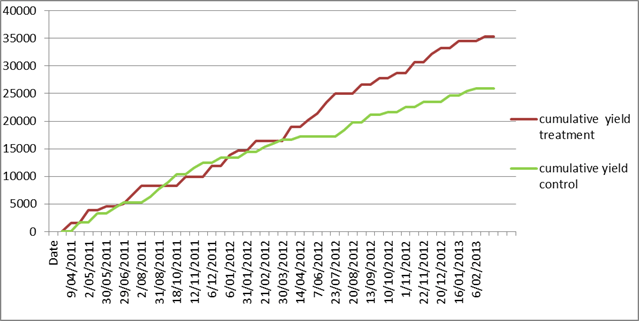
Total yield for the first 12 months of trial, including oats, and control pasture was 16413 and 15310 kgs of DM/ha respectively. Total yields in the six months following removal of the oats were 8134 and 6407 kgs DM/ha respectively. Total 2 year yields from trial and control paddocks was 35365 and 25989 kgs of DM/ha respectively. Cumulative yield data is presented in Graph 1.
Graph 1: Two year cumulative yield data: herbs and legumes (Treatment) v’s kikuyu and ryegrass (control)
The results blew us away
Two-year nitrogen application rates were 289kgs of N for the trial paddock in total and 85kgs of N after the oats and 726kg of N in total and 476kg of N per hectare after the oats in the trail paddock were removed. In the second year of the study, only 30kg per hectare of N was applied to the herb and legume paddock compared to 188kg of N per hectare in the control.
Feed quality data from two samplings in November and February are presented in Table 1
Table 1 Comparative feed quality of herb and legume pasture (treatment) vs. spring ryegrass (control test 1) and kikuyu (control test 2)
Components:
Treatment Test 1:
Control Test 1:
Treatment Test 2:
Control Test 2:
% NDF
30.7
46.3
30.4
51.4
% Crude Protein
32
24.1
33.1
27.5
% Ash
13.33
11.34
11.35
10.41
Lignin % NDF
12.4
3.9
16.8
5.6
% Calcium
1.23
0.58
1.37
0.53
% Phosphorus
0.45
0.42
0.45
0.43
% Magnesium
0.36
0.3
0.36
0.26
% Potassium
3.28
3.13
3.18
3.16
% ADF
23.6
26.3
23.1
26.7
% Lignin
3.8
1.8
5.1
2.9
% NFC
25.2
18.6
27.6
14.4
Relative Feed Value
214
138
217
123
ME (MJ/kg)
11.63
10.8
11.76
10.97
ME CPM (MJ/kg DM)
10.16
8.58
Fertiliser Efficiency Outcomes where excellent
Pasture trial proves to be good news for people,cows and the planet
Challenges
Adverse climatic conditions with four major flood events and one very pronounced dry period during the trial certainly made for an interesting times and showed the trial pasture mix’s resilience to vagaries of the Australian climate
Flood water pooled at the top end of the trial paddock however where the water was able to get away fairly quickly the pasture was very resilient to these extreme weather events
Accessing personnel in the region to do soil testing proved very difficult and we have been unable to have the final soil test undertaken at this point in time
Discussion
This farm based trial has provided useful evidence of the potential for alternative pasture systems based on legumes and herbs on coastal dairies in NSW. The trial pastures have provided at least as much dry matter in the first year as the conventional system with the yield data in year 2 being substantially higher in the trial paddock. The trial pasture appears to have performed very well in the autumn of its 2nd year and did not suffer a planting lag as per the conventional system. It also appeared to continue growing very well off a one off significant rain event in October 2012 during what was a very dry spring and summer in the region.
Nitrogen inputs were significantly reduced in the trial compared to the conventional plots with potential here to reduce fertiliser costs as well as nitrous oxide emissions and exposure to volatile nitrogen pricing. Full soil test data is not available at the time of writing.
Feed quality at all times on the trial was excellent with the farmers reporting anecdotal improvements in milk production when grazing trial pastures, particularly between November and March.
Weeds have been troublesome including both broadleaf and summer grass weed invasion in summer of 2012-2013.
These pastures have significant potential for NSW grazing based dairy systems. There has been considerable success with similar systems on the mid north coast and inland areas, however, problems with both stem root nematode and water-logging have been encountered on some properties. Soil characteristics, particularly, potential for poor drainage, underlying weed burdens and regional pasture pathogens need to carefully considered, when selecting alternative pasture systems as part of a pasture “portfolio”. However, there is considerable flexibility within both pasture species and cultivars in the group of pasture species under investigation to further explore these systems on a region by region basis. Farmers and scientific organisations can successfully partner to produce useful field based research.
What we learnt
The power of the two way conversations – farmers and natural resource management personnel working side by side to understand each other’s challenges and constraints
The value of cross community partnerships to improve NRM and sustainable farming outcomes and improve skills, knowledge, attitudes, and innovations,
That investment in people and on the ground activities that bring them together is critical for long term sustainability, fostering continuous improvement and creating opportunities to learn and grow together.
That communication is more than just sending information. It is a two-way process which creates demand for information delivery, is responsive to audience needs, and provides content in a way which is timely, relevant and understandable to target audiences.
Where to from here
Adoption of research, innovation and practices are critical to attaining long term goals
9 out of 10 farmers learn directly from other farmers or through appropriate delivery of extension based on in field experience of other farmers in familiar and recognisable farming situations.
Farmers want to be able to ask questions in an non threating environment but need highly skilled facilitators who understand both the technical aspects of what they are presenting as well as the people they are working with
This project has produced extremely valuable and measurable results that have important and deliverable environmental and economic benefits for farmers. There is a need funding for extension projects that capture this research and other alternate forage system research. This could be delivered through regional farm discussion groups looking at .
ii) Alternate strategies to annual and perennial pastures – showcasing the work at Lemon Grove Research Farm and farms in other regions doing similar trials.
iii) Developing fodder production portfolios to manage risk and season
When you live in paradise and your desk looks out over the ocean everyday reminds me that I spend too much time at my desk and not enough time on the front verandah chilling out and revelling in the brilliance of it all.
Sunrise
The early morning sun on this divine pink shrub ( whose name escapes me at the moment) which announces the start of spring in my garden
Sunrise morphs into day
Daytime sea for miles views from my verandah
The cows enjoy the view just as much as I do
The flowers and the cows coming home for milking are rejoicing that spring is coming
Check out that hill in the background they had to navigate to get this point. You can see why they stopped to have a rest
With prime agricultural land getting gobbled up by houses and mining the challenge for Oz farmers is to produce more food using fewer resources to generate less waste and reusing/recycling that waste whenever we can
For dairy farmers that requires us to grow more grass per hectare (ha) so we can graze more cows per ha to produce more milk per ha which also means we are reducing CO2 emitted per ha. Here is a very novel way of increasing stocking rate. Love it
Thanks @peterholding for sharing
By the way other ways Oz Farmers are looking after our scare natural resources and getting more food and fibre from less
soil testing and nutrient mapping to allow them to use less fertiliser per ha.
getting more crop per drop
Placing nitrogen fertiliser at depth in cooler times in wet soils to maximise nitrogen efficiency (and thus minimise losses to the atmosphere)
Planting water use and fertiliser efficient, drought tolerant perennial pastures
Assessing and optimising nitrogen fertiliser use and use of alternative sources such as legume rotations.
Using lower emissions machinery and assessing and improving existing machinery and irrigation pumping performance and investigating alternative fuel sources.
Improvements in soil management through stubble retention, reduced tillage and reduction in spraying operations
Measures of success
Farmers are able to increase their productivity:
• per hectare of land
• per unit of nitrogen fertiliser
• per ML water
• per unit of CO2 equivalent emitted
But lets not forget at a basic level, farmers and WWF want the same thing – a sustainable environment that we leave in better shape than we found it.
We have to acknowledge that we’re all this this together, we share the same planet. We all want to support our population while leaving the smallest possible footprint.
Farmers are stewards of over 60% of Australia’s land mass. We take our role in managing that resource for future generations very seriously. We all prioritise the well-being of our environment and animals in our day-to-day operations. Most farmers would have in place practices that respond to variations in climate, none of this is new. But often, the only people who know about it are our neighbours – usually other farmers.
As a Climate Champion I have seen many amazing farmers doing incredible things for the environment. We need to celebrate this loudly.
It’s important for farmers to share our practices with audiences that may have some queries about the way we operate. I am committed to seeking out these people to engage in meaningful ways to create understanding and partnerships. These people will not come to us. In many instances, they wouldn’t know where to look! So by sharing my story with WWF, I am able to engage with an audience I may not normally encounter. I am hopeful this will encourage a discussion around how farmers can work with everyone to build a future in which people and nature thrive.
For too long agriculture has promoted ourselves to agriculture. We need to expand our reach to engage all participants along our supply chains, to create awareness and understanding that will underpin sustainable production into the future. We cannot afford to turn out backs on those who may be uncomfortable with agriculture. They are too important to our future to ignore.
Footnote
Some interesting research on farmer attitudes to climate change found here
Overcoming the climate change sceptics
Many primary producers are resistant to the challenges of climate change. In a study of Australia’s Farming Future the federal Department of Agriculture, Fisheries and Forestry, surveyed 1,000 farmers in relation to their attitudes towards climate change. They also surveyed 1,000 people from urban areas.
While 58% of the urban population believed climate change was real and caused by human activity, only 26% of primary producers held this view. As illustrated in the following diagram these farmer groups were segmented into different types of sceptic. Some were sceptical but had been hit by drought and therefore were prepared to start taking action. Others were sceptical and had not yet felt any environmental impacts so they felt no need to take action.
Primary producer segments in relation to climate change Donelley, Mercer, Dickson and Wu (2009)
The ‘strugglers’ were not only sceptical but had no resources to apply to any remedial action. Even those who accepted climate change science were of the view that government assistance was required to allow them to take action.
These attitudes amongst rural producers are important as they will determine how readily many farmers adopt more sustainable farming practices, reduce new land clearing and introduce programs such as enhanced biodiversity of cropping, interlocking crop cycles, dense polycultures, biochar and carbon management.
Firstly I want to make it clear that the majority of my knowledge too comes from the media and I haven’t visited any of these farms.
What distressed me about the articles was the apparent blame shifting, the government hadn’t done this and should have done this and apparently some animal welfare groups were all up in arms and want to have farmers prosecuted.
Its time we got back to basics. This is a people welfare problem first and foremost and this is where the focus has to start.
It should be just a given that farmers care for their cows and in the main the community think that they do as our Art4Agriculture surveys show
Lets send the animal welfare activists packing and lets look after the people so they can look after their cows. Its time to stop the blame shifting and do what the community does best and surround these people with strong support networks. Lets share the burden, find them some feed for their cows and most importantly show them we care .
If you are a dairy farmer who knows some-one in need of help Milk Maid Marian has listed many of the support networks here
In a bizarre media twist this story has come out today from The Standard Our cows are OK say South West Farmers and Vets which sadly highlights once again that animal welfare in this country is a much bigger story that people welfare