The Power of Language

Today’s post has been written by Angus Whyte profiled beautifully here by Fleur McDonald in January.

The power of Language

A Robert Brinkerhoff Illustration

The post has been prompted by two posts I wrote recently. Firstly on Art4agriculuture Chat about Young Farming Champion Stephanie Tarlinton’s recent speech at the Dairy Research Foundation Symposium which saw her voted the favourite speaker of the day. Scroll half way down the page past my background info to read Stephanie’s very powerful speech she titled the “Conversations of Change”. The other post referred to a presentation at the same event given by Dr Jude Capper that prompted this post on Clover Hill Dairies Diary “Little Golden Book Farming” 

This is what Gus has to say ……..   

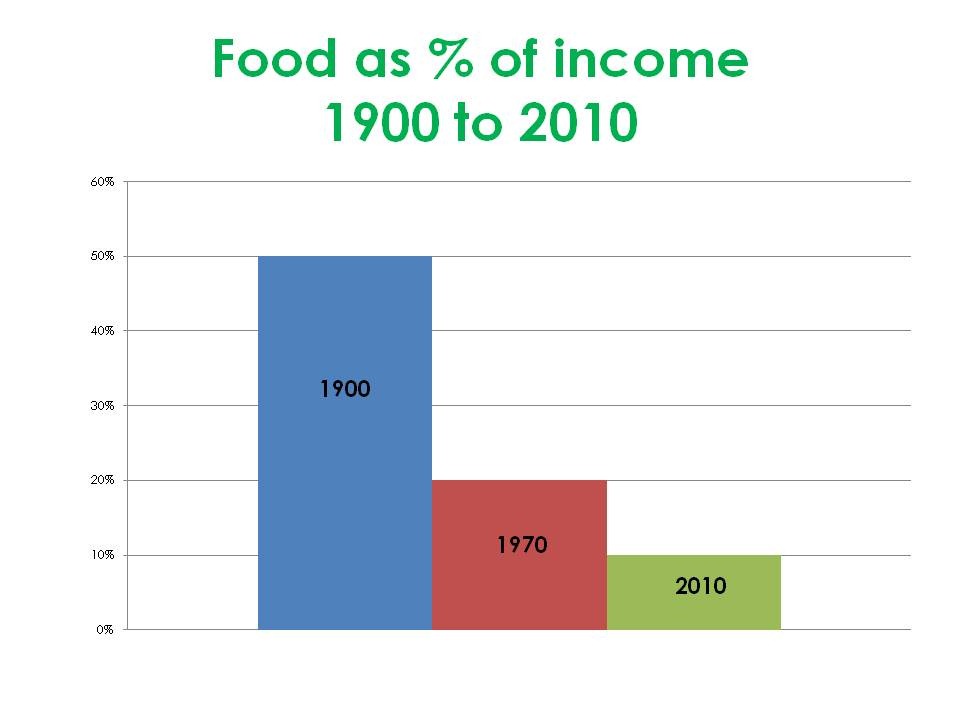
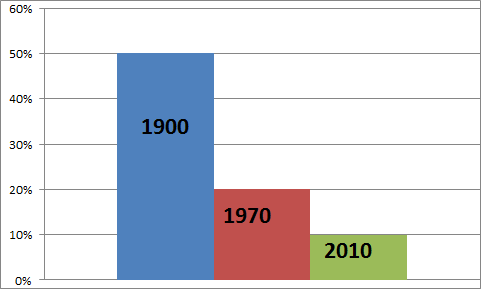
Interesting that language can mean different things to different people; it can bring people together or divide them. When farmers talk about new technology they are talking about GPS technology that allows them to plant, fertilize or spray exactly where required, or telemetry systems that allow them to remotely control waters, maybe even individual animal ID systems that feed the animal its exact requirements. All technologies that have helped reduced food spend as percentage of income in Australia from 50% to 10% in the last 100 years

Applications of Computers in Sustainable Agriculture

When consumers hear new technology in agriculture they hear “triffid like” GM plants or the latest spray that will kill everything, even hormone growth promotants that will turn stock into the incredible hulk, well green anyway.

Horrors of GM

The question might be; “how can the language show the reality?” The reality is that farmers and consumers both want the same thing – healthy, nutritious, ethically produced food and fibre that was grown with the best interests of the planet in mind” 

agriculture 0012

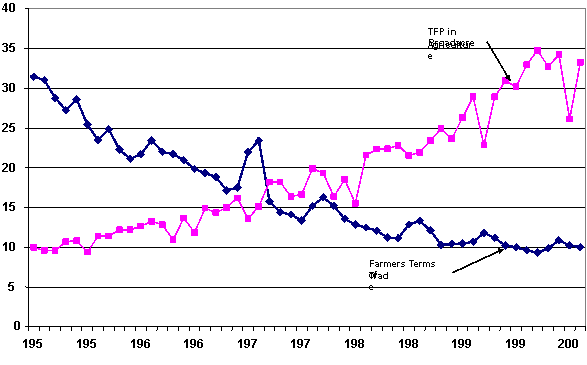
Lets have a look further at how we may be using the same language; when consumers want food produced “like the way it has always been produced, the old fashioned way”, and the farmers want to be able to produce a good product “without working 8 days a week 30 hours a day, the old fashioned way”. When farmers talk about “efficiency gains” they are talking about being able to produce the same product with less of a carbon footprint and still make a margin aware that the “terms of trade” are constantly reducing.  Remembering whilst the cost of food had gone up 40% in the last ten years (CPI has gone up about 50%), the farmer’s share has gone from 20 cents in the dollar to 17.

Total Productivity

Total factor productivity (TFP) in Australian broadacre agriculture and farmers’ terms of trade: 1953–2004.Source ABARES


When consumers hear “efficiency gains” they seem to hear “factory farms” or that farmers have found a better way to make even more money than they already do. These thoughts conjure up images of cruelty and money hungry, both traits that are disliked (and rightly so) in our community.

P1020049

To bring the language together if consumers think that farmers must invest in the environment regardless of the cost then consumers must show the environment the same respect and seek produce that is raised consistent to their values, then buy it, regardless of the cost. I put it to you that if farming was so easy and you can make so much money then why are less than 1% of our community involved and that is decreasing every year?

I must admit I know that we can produce food and fibre in a way that means consumers and farmers needs are met, even exceeded. You will notice that I will not mention money when I’m talking about needs. Consumers have no more right whatsoever to expect food at a reasonable price if they don’t believe farmers have no right to get paid a reasonable price for their produce. Everyone involved in the production of food through to eating it, should be aware of the social and ethical values of living in a community. The “carbon tax” is an attempt to place an economic value on something that we as a society should value, which is the living within our means and not having negative external impacts on the environment.

When we purchase an item we should ask ourselves: Has this been produced with respect to my personal values of welfare, health etc.? Has the item been produced without external impacts on environment, community etc.? These values can’t have an economic value placed on them and yet all talk about the long term health of the planet and the community.

When we buy food you can look to “make an investment in your health and future” or you can see it as “a cost that needs to be reduced as much as possible.” I believe that we as a society are so used to eating poor quality food that is “cheap”, if we based our decisions on food quality we would need much less and actually save money.

Count Nutrients not calores

Just so that we are all taking the same language we as consumers need to build closer relationships with our producers so we understand how our wonderful food is produced, then we can make “value based” decisions when we purchase. As you are all aware large supermarkets are service based industries that don’t produce anything and they make it very difficult to build a relationship with your farmers. So you should find vendors that can tell you who, how and where the food is grown, tell you its story, then you can make a judgment on the values of that product before purchase. This way you can ensure that you aren’t just making a good investment in your own health, also that of the broader community and the planet.

Food_System_Diagram

Remember the statement “no man is an island”, our dollars dictate our values so if we truly want to see change then we need to understand that our choices impact on others, we are all part of the same community on planet Earth.


The Author: Angus Whyte lives with wife Kelly and 8 year old son Mitchell at “Wyndham”, a 12,500ha pastoral property on the Anabranch River 85km north of Wentworth NSW.  “We consider ourselves “graziers”, in that we turn plants into money through livestock and we don’t mind what sort of livestock we run. Our attitude to farming is simply to work with nature rather than against, so we no longer have weeds, we have “plants with stories” that we can learn from and our aim is to make our business simple and our ecosystem extremely complex, the more complex the better.”

If you would like to join in the conversation on Twitter Gus tweets as @GusWhyte and farmers and their extensive and diverse networks discuss all things food and fibre under #agchatoz

Recently farmers have been concerned about how we are being stereotyped see I am not Happy Woolies and we are adding #proag to our tweets ( when there is room- I mean 140 characters is pretty tight at the best of times) to discuss this.

FYI #proag is short for professional and caring farmers 

Have you heard about the Great Cafe Challenge?

Our favourite angel Alison Fairleigh and team have launched with the support of The Land newspaper this challenge

“We challenge every café owner across Australia to carry at least one weekly rural newspaper in their shop”.

Cafe challenge 2

That’s it. So simple. It won’t cost much; it won’t take much time; but the benefits to rural Australians of having more urban people with a greater understanding of where their food and fibre comes from, of the people and communities who produce it, and the conditions under which they produce it, could be extraordinary!

More than likely most people won’t pick up the rural newspaper as their first choice; but when all the other papers are gone, they may just flip through the pages and begin to see a world they know very little about.

Will you accept the challenge? Will you help spread the word?

The Great Cafe Challenge

Alana and Chris at the Chippendale Roastery Cafe have!

Go into your local café today and ask: “Do you carry a rural newspaper?” If not, let’s change that!

(Follow the Great Café Challenge on Twitter & Facebook) and read the background on Alison’s blog here

Little Golden Book Farming

I recently heard Dr Jude Capper speak at the Dairy Research Foundation Symposium in Camden. She had a lot of thought provoking insights about consumer images and perceptions

“We have cars and airplanes. We have treatments for cancer and heart disease. Why is it that in every other business sector we celebrate increased efficiency and productivity thanks to new technology while when it comes to food more and more people want it done the old-fashioned way?” Dr Jude Capper

Lets have a think about this Little Golden Book notion of farming and this fascinating (not sure that is the right word ) push by consumers for farmers in 1st world countries to “slow down” and go back to the 1950’s way of farming

In 2000 our farm was a one man operation milking 80 cows producing 800,000 litres of milk. Today we milk 500 cows and supply 50,000 Australians with milk every day. We employ 10 people and we have reduced our environmental footprint by over 35 per cent per litre of milk produced. That’s cause for celebration wouldn’t you think?.

Lets take a look at the average Australian farmer. In 1950 he/she fed 20 people, in 1970 he/she fed 200 people. In 2012 he/she feeds 600 people.I would think that’s one hell of a lot to be proud of.

Lets take a look at the cost of food compared to income.

Slide8

Wow what else can you think of that has gone down in price in real terms? But is anybody celebrating our farmers because of this?. I don’t think so

It you are still not convinced lets really put it into perspective. Let me assure you not  everyone has this luxury. This is what Pakistanis spend on food

Slide1

Yes you read correctly 42% of their income. Note the number of people employed in agriculture at nearly half the country. In Australia less than 1%.of people are farmers. The hunger index is “alarming” Their food consumption in calories is 1/5 of ours and 25% of people are undernourished.  Don’t know about you but that’s pretty sobering for me.

Now lets have a look at few things Dr Capper had to say at the Dairy Research Foundation Symposium. Dr Capper by the way comes from the US where they spend 6% of their income on food

She put up this slide to highlight that our footprint is related to our productivity whether we are human or livestock or cars for that matter

Environmental Impact per unit of Production Slide 1

Yes at first glance vehicle 2 has the lowest footprint but as you can see in the next slide footprint its a function of how many people the vehicle carries.In other words how productive the vehicle is

Environmental Impact per unit of Production

Take home message from that one. You cant judge the system without all the facts

Bus vs Car

Back to the 50’s rural idyll.  Where has agriculture gone wrong I ask? We are seeing consumer alienation from agriculture and the food system expressed through concerns about

  • nutrition,
  • food safety,
  • affordability, Yes affordability – haven’t they seen that graph.
  • environmental sustainability and animal welfare

The armchair experts are telling consumers the answer is apparently to buy organic or grow your own. Dr Capper told the audience based on the current productivity of the world’s organic dairy industry we would need 25% more cows and 30% more land to produce the same amount of milk if all dairy farmers went organic. In the US alone that means they would need a further 3.5 million dairy cows.!!! Heaven forbid.

Where has agriculture in 1st world countries gone wrong.? Its obvious isn’t it! Agriculture has done a bloody awful job of telling it’s story. Instead of proud and loud messages we have let others tell our story and sadly I didn’t get the impression the dairy farmers in the auditorium by their questions to Dr Capper were going to rush out and share their wonderful news stories with the rest of the industrialised world.

Another story for another day. The Holstein vs the Jersey cow and how the dairy farmers in the room in my mind got the wrong take home message from Dr Capper’s talk that day

I am not happy Woolworths

Agriculture has an image problem and Woolworths you are NOT helping

Have you seen these bizarre adds?

I mean have you ever seen a farmer dressed like “Malcolm”? What about the imagery of rural and regional Australia. What on earth are they thinking? The food looks like it has been transported from the 1950’s

This is what Generation Food and Fibre look like in the 21st Century. They are young professionals who are articulate, well educated, passionate and committed and they deserve better from Woolworths

IMG_3093

Art4agriculture Young Farming Champions from NSW

To make it worse Young Farming Champion Kylie Stretton from QLD tells me she walked into her Woolies’ store this week and they were having Fresh Farm Day “with hay and  stupid hats and shirts with fake freckles”

Fake freckles OMG this all has to stop now. Once again the Aussie Farmer Image is  collateral damage in an advertising campaign.

Enough is Enough. Looking forward to your suggestions on how we tackle this.

Post script

This post has attracted a lot of conversation on twitter. The farmers aren’t happy but if the urban press is right this campaign is pure genius.

The very important question was asked on twitter “What image do we want agriculture/farmers to have”

After much twitter debate the question was answered

How do farmers want to be portrayed in the media? Exactly how they are “professional and caring”  Thank you Woolworths, the Food and Fibre generation fraternity look forward to your new adds with gusto

On another note this is not just a job for Woolworths – image needs to be created and it needs to be actively maintained. I am excited to be part of a team who has been charged by the National Farmers Federation working group on Labour, Skills and Education to help come up with the image vision. I am relishing the challenge and look forward to your feedback when we put our thoughts on the table. I can assure you “professional and caring” will be right at the top of the list

Some interesting thoughts from Dr Heather Bray here “Does getting it wrong bring us closer together”

The hidden costs of Private Label Milk

This morning I had a call from ABC Radio National looking for comment on behalf of our regional dairy farmers on this story National Foods cutting fresh milk contracts.

This story is a very sad reflection on state of the fresh milk industry in this country and the ongoing ramifications of the supermarket milk price war

For many farmers in our region like those in the Bodalla region it is time to sign new milk contracts with Lion ( National Foods) but there has been no communication from our milk supply company (Dairy Farmers Milk Supply Company) who supplies Lion as to price per litre being offered nor contract volumes on offer .

Can you imagine how difficult it is to make smart business decisions in this situation.  Dairy farmers need to make decisions about our cows, our people, equipment and environmental investment twelve months in advance. So to make the best business decisions for everyone on our team we are looking for clear market signals at this time from our processors

Dairy Farmers Milk Tanker at Clover Hill

However, the processors are not able to commit to supply arrangements with farmers until the processors have finalised their contracts for private label milk volumes with the supermarkets.

As currently these contracts are only for short periods of time processors are second guessing supermarkets and the farmers are second guessing how the processors will respond if they don’t get the private label contract and as you can imagine all this second guessing leads to a third rate supply chain model and undermines farmer confidence in the whole milk supply sector

The latest Dairy Australia survey show 85% of dairy farmers in NSW see milk prices as the biggest challenge to the survival of their businesses.

MichaelNickStrong1

So you may well ask why processors continue to supply private label milk to supermarkets. Well they have been asked that at several Senate inquiries so I have an answer (or 3) for you.

In confidential evidence provided to the ACCC Grocery Inquiry 2008 * (see reference at bottom of post) by processors indicate that the main reasons they pursued private label contracts were:

  • overhead recovery—generating revenue through private label sales to contribute to fixed costs of running the business
  • supply relationships with retailers—supplying private label product provides a stronger relationship and possibly improves processors bargaining position in relation to branded products
  • volume—the volume of milk supplied through private label contracts provides some stability to the business

The first national contract for supermarket private label milk was given to National Foods (now Lion) by Woolworths in 2002  The ACCC remarked in 2008 that the change in tendering arrangements by Woolworths in 2002 had a clear impact on the returns farmers received

National Foods (Lion) like all processors tenders for private label milk contracts to maintain relationships with the supermarkets and gain shelf space for its own brands

When the volumes of private label milk were relatively small compared to their own brands then the milk processor could recover the costs associated with supplying this milk at the low price

This is no longer the case. There has been an 11 per cent increase in the sales of private label milk in the last 12 months alone and now private label milk sales are 72% of all fresh milk sales

Fresh Milk Sales

As you can imagine this is putting a lot of pressure on both farmers and processors. In fact I believe whilst all supermarkets in this country compete on price alone the entire fresh food sector in this country is at risk

Already 85% of products in a typical supermarket trolley are either imported or are supplied by foreign owned companies. This will only increase as more and more private label products are introduced so the supermarkets can compete with each other and continue to make profits.

At the moment milk processors have been the first line collateral damage in the supermarket milk price wars, farmers are starting to feel the brunt of it now and it wont be long before it impacts on consumer choice in the supermarket

At the moment shoppers have three choices “Will I buy a local product, will I buy an imported product, will I buy private label?” Unless we all stand up and be counted the only choice will be private label (imported from overseas)

So this is not just about the farmers, families who buy the Dairy Farmers brand are making an investment not just in the future of their community but in the future of Australia

kids 171

Lets all get together and make an investment in the future of this great country

Further commnet on this story in this interview by Sarina Locke found here 

*Australian Competition and Consumer Commission, Report of the ACCC inquiry into the competitiveness of retail prices for standard groceries, July 2008, pp. 234–5.

Fruits of the Forest

In partnership with Landcare Illawarra we are opening the farm to members of the community on Saturday June 23rd 2012.

11699_ManagingVegetation_Flyer LR

On hand to answer the community’s questions and conduct guided tours will be a range of representatives from organisations we work with such as Landcare Illawarra, Southern Rivers Catchment Management Authority, Conservation Volunteers, Small Farms Network as well as local project officers, bush regeneration officers, and landholders to give you a guided tour through the property and discuss the range of techniques used in working with native vegetation on private land.

One of those people will be the fountain of all knowledge on The Illawarra Woodland and Rainforest Project Richard Scarborough who was at the farm today to collect seed from our Yellow Ash and found a plethora of fruits of the forest.

IMG_2564

On the left we have Native Jaffa, some blue gum seed and some orange thorn, with the yellow ash on the right. At the top of the photo is celery wood seed. 

IMG_5618

Also on hand will be the gorgeous Erin who has had an integral role in us playing our part to help increase the genetic diversity of plantings in the Illawarra and potentially increase the level of fruiting of individual species.

If you would like to join us please contact Megan Rowlatt at Landcare Illawarra by email communitysupport@conservationvolunteers.com.au or by phone on 02 4229 7526

Sudoku farming

Today I am delighted to share this guest post by Gus Whyte with you.

By way of background Angus and Kelly with 8 yr old son Mitchell Whyte run a grazing property that is 12,500ha on the Anabranch River at Wentworth in far western NSW.  They have been rotationally grazing to repair the landscape since 2001 and have seen significant changes in that time

Pic254

I first “met” Gus on Twitter and was delighted to see him profiled by Fleur McDonald as part of her 52 farmer stories to celebrate Australian Year of the Farmer.

I just loved this quote from Gus

 “Our attitude to farming is simply to work with nature rather than against, so we no longer have weeds, we have “plants with stories” that we can learn from and our aim is to make our business simple and our ecosystem extremely complex, the more complex the better.”

 and I have been following Gus and his ethos via twitter closely since

The more I talk to farmers across Australia the more I am feeling the social environment we farm in today is totally foreign to most farmers and many are feeling overwhelmed. Today’s food system offers a wide range of choices that allow consumers to purchase food that meets their needs and is consistent with their values

Consumers have traditionally trusted farmers because they believe farmers share their values but the problem is some consumers are beginning to question if today’s agriculture still qualifies as farming. We are seeing consumer alienation from agriculture and the food system expressed through concerns about nutrition, food safety, affordability, environmental sustainability and animal welfare – to name but a few

What the “concerned consumer” fails to recognise is many of our farmers are torn too. Gus and his family farm on 12,500 ha compared to our family farming on 120ha. On that 120 ha we produce milk that sustains 50,000 Australians everyday. We are proud of that but no matter where we farm, how much land we have to do it on or how much we produce our farmers can only give back what the market place is prepared to pay.

Before you judge your farmers Australia (and the world) please reflect on this. “Never before have so few people fed the world. Never before has food been cheaper in this country. Never before have so many people been able to afford to be so blissfully unaware of this”

When you read what Gus has to say can you doubt in any way that Australia has many great farmers who truly care and share your values ?……

The Gus Whyte ethos….

One of the things that I enjoy is to sit down on the weekend with a nice cup of coffee and complete a Sudoku or two. For those that haven’t played there are 9 rows and 9 columns and each row and column should contain the numbers 1-9. Also there are 9 sections that again should contain the numbers 1-9. I liken this to the environment where everything is interdependent and the change of one number has implications right through the whole puzzle/landscape. Of course there are many more than just nine possible numbers when dealing with an ever changing environment, the challenge is to always come up with the same outcome. Farming can not be done with set “systems” as these don’t always take into account the people, land, animals, the changing seasons and the climate etc, instead we need to focus on achieving the right outcomes using what tools/knowledge we have on hand. That is why in some instances organic accreditation may not actually produce the healthiest foods.

DSCN0124

Also like the environment when we focus on one area and do a really good job there, sometimes the other sections may be totally wrong and there is no chance of reaching the desired outcome. When we think of farming we may think of the vocation that aims to  produce the best crop or best wool/meat etc. Aside from farmers there are those that say we should be only eating a plant based diet to improve the welfare of animals, well again this only looks at a small section we need both plant and animals to farm together. One without the other is an incomplete system that will fail.

Few people view farming as the best way to produce healthy food in a healthy environment, while respecting the people and community around them. Maybe we should be seeing farmers as healthy food producers or as environmental regenerators or even nutrient nurturers. While we as the broader community compartmentalize farming we don’t put their real role into perspective so we don’t look to encourage those that fulfil some or all of these roles. As Wendell Berry points out in his book “The unsettling of America” Culture & Agriculture, either we are exploiters or nurturers, there is no in between.

The end goal is for people, animals and the environment to be improving in health rather than the direction they are currently going. The question is “how can we feed and clothe a growing society while looking after the health of us and the environment?” If you say “we are what we eat”, currently you are chemicals, GMO’s & Phosphate fertilizers etc. (yes these are both in the plants and animal products!), while others may be happy with this there are some that aren’t. So how do we change what we currently do to become nurturers and all (people, animals and environment) end up healthier? All of the top businesses/farmers look at the implications of what they do and don’t compartmentalize so let’s extend that a bit.

So let’s start by agreeing on what we see as healthy.; Healthy to me is food that is grown by harnessing Mother Nature to add all the vitamins and minerals required, without the use of any chemicals or fertilizers or by being processed in any way. I’m sure that most would agree that that is very healthy, however how are we going to grow enough to feed all the people?

To put together farming methods that will produce enough food while enhancing the land and retaining wild species will not be simple so will need lots of support from all of us if we would like to be healthier. We can produce more food/fibre than we currently do by harnessing Mother Nature rather than going into battle with chemicals and GMO’s, again that has been proven to be right, we may need to change the concept of farming though. What might drive a change? You ask. Well there is plenty of information around saying that the current food systems we have in place are causing major health problems with depression endemic as well as cancer and many other problems that put enormous drain on our health systems. With drugs only working on the symptoms, surely we need to look deeper at the root cause of these issues. Maybe we will be forced to find out the hard way if we keep doing what we are doing until we reach “peak Phosphorus” in about 2030.

So farmers can be seen as “just exploiters of the environment mining the nutrients & jeopardizing the welfare of animals” or they can be part of the Sudoku puzzle with everything in order, the choice is ours.

You will notice that I haven’t mentioned anything about money as yet, well you can’t put a value on your health or the health and well being of the animals and environment so why would I start. Currently our community puts the mighty dollar above all of the above, we can feed an ever growing world with very healthy food if we start putting some of these issues above money. We can choose to select food on the looks and the “value for money”, or we can start to demand food that is produced more naturally in harmony with Mother Nature, the choice is ours.

P1010012

Farming in a Peri-Urban Goldfish Bowl

Today I am speaking at the Australian Farm Institute’s conference Managing the Future of Australia’s Farmland. Regular readers of my blog will know that I have been agonising over what to say and how to say it for six weeks now. I have shared my work in progress thoughts with my readers along the way.

Here it is from the heart

Slide2

I am a

  • Farmer
  • Climate Champion
  • Program Director and Chair of Art4agriculture
  • Agrifood Skills Ambassador

I seize these opportunities to talk to farmers, decision makers and consumers, all key people who can help me deliver my big picture vision for agriculture in this country

The vision

I want a dynamic innovative exciting and profitable agrifood sector that the next generation’s best and brightest see as a career of first.

I know this is achievable but we have a myriad a veritable rabbit warren of issues and challenges we have to acknowledge and address first before this will happen

Today we are tackling peri-urban Agriculture

Is it possible?I know it is possible to farm on the fringe of our towns and cities because my family business does this every day

My family milk 500 cows three times daily on two farms at Jamberoo. Both farms have a high rural urban interface

The home farm Clover Hillis situated in very steep high conservation value rainforest country

Slide3

It is part of a dairy centric rural residential subdivision which contains 15 houses

Our second farm Lemon Grove Research Farm is located adjacent to Jamberoo Township and has main road frontage. So not only do the 1000 people who live in the village get to see our farming practices every day So too do the tens of thousands of people who drive by on the highway each year

Slide4

Should we farm here?

Rich volcanic soil, 2000mm rain fed pastures and good management practices allow us to achieve KPI’s like this

Slide5

It’s the best place to dairy in Australia so of course we should farm here

Do we want too?

I must admit it is very challenging and unless you are passionately committed to building close working relationship with your neighbours and the community, you may find yourself waking up every morning feeling like you are farming in a combat zone

This is the view from my front veranda you can see why everyone wants to live here

Slide6

I don’t want to move and I don’t think my neighbours should move

So I have been looking forward to speaking to a room full of kindred spirits. People who have also taken up the challenge and dedicated their careers to support the sustainability and fabric of our advanced societies.

Close your eyes and have a listen to this……

10 seconds of silence – Blissful wasn’t it?

Time to just think.

Perhaps you were thinking about the

· extra 350,000people who will born today

· 60 million plus people our farmers feed everyday

· 80,000 tonnes of beef we exported last month

· The 500 million people the cotton industry clothes

· 65000 tonnes of rice we export every year

· 100,000 tonnes of cheese we send to Japan

· Or perhaps the impact on food production of price on carbon

· 3000-4000 GL/yr. of water being lost to farming in the Murray Darling basin,

· the banning of live exports to Indonesia last year

Or perhaps you were thinking you might like rob a bank and move into a house next door to me

· We know that food demand will double by the 2050, driven by growing populations and rising living standards

· We know that 1% of farming is disappearing across the world each year

· Even 1 degree of global warming, accompanied by greater droughts and floods will make agriculture as we know it much more challenging almost everywhere.

If I can steal a line from ‘Apollo 13’ – “HOUSTON – WE HAVE A PROBLEM”! Can we really expect farmers to produce more food, cheaper, with less land and natural resources???

But it’s not just a task for farmers is it? – Solving this problem is a task for everyone in this room.

As a farmer our cows produce the milk that sustains 50,000 Australians every day. It is what we do.

Slide7

Scientists as providers of R&D&E and government policy makers enable us to do this as efficiently as we can.

But it goes much further than this doesn’t it

Every single Australian owns the problem AND is part of the solution

But they just don’t know it yet!

Whilst we all think what we do is vital – most of the people who we are doing it for, are more interested in who is going to win ‘The Voice’ or ‘Masterchef’.

This problem has manifested itself because farmers today are less than 1% of the population

We know as much about the other 99% as they know about us

Never before have so few people fed the world

Never before has food been cheaper in this country

Never before have so many people been so blissfully unaware of this

And regrettably everyone in this room (including me) not only just stood by and watched this situation develop – MANY OF US HAVE ACTIVELY HELPED THIS HAPPEN.

Australia has developed sophisticated supply chains to supply our cities with fresh affordable ethically produced food in fact everything they need.Slide8

Here is the problem as I see it

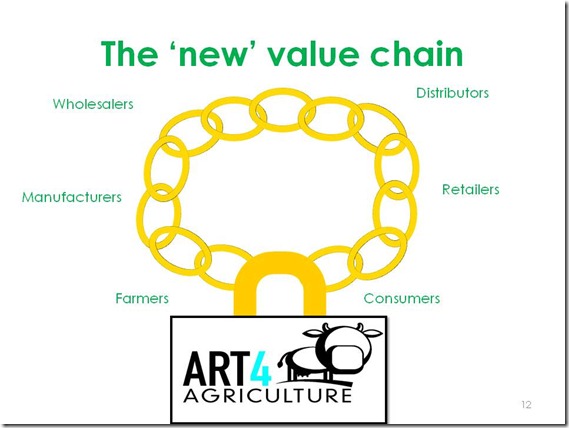
We have a food ‘value’ chain with farmers down one end and consumers at the other. We could not be more far apart if we tried

Slide9

We have become victims of our own success.

Cities have become hermetically sealed from the reality of where their food & fibre comes from.

This is a big problem if we want agricultural production to double over the next 30 years to feed the predicted 9 Billion people.

It is obvious this value chain model is flawed – there is a pivotal link missing – the link that directly connects consumers with the people who produce their food.

It is our job to create this missing link. This link that connects farmers with the people who buy their food and fibre

Slide10

It is a big task. But I believe the very future of our modern society is dependent on communities valuing what farmers do, and providing them with the resources to get on and do it in a way that meets the values and expectations of the communities which they serve.

It is not about farmers getting it all their own way – it is about farmers and communities working cooperatively for mutual benefit.

And that takes ENGAGEMENT.

This is the task…. ENGAGING with all facets of society

  • Let me use my experiences of farming in a peri-urban environment to show you how we have engaged. How we have formed collaborative relationships between government, the community, value chain partners and farmers

Slide11

  • Farming is a business and business is all about building relationship
  • Our business is listening to the market place and is focused on changing with the world. We are not unique in this respect.
  • We have outsourced expertise to help us manage risk and adopted new technologies and farming strategies that improve our efficiency.
  • We have built strong natural resource management partnerships and have undertaken extensive Landcare projects to adapt to climate variability and build carbon in the soil
  • We have innovatively grown our business in a peri urban environment where 90% of the prime agricultural land is now owned by lifestyle farmers without large injections of capital by leasing land from these lifestyle farmers

What else can we do?

Firstly the notion of the farmer as someone who merely works on the land has got to go.
Slide12

We can’t change the world overnight but we can change it.

So maybe we have to ask ourselves 2 questions

1. Who do we want to target?

2. What is the ideal vehicle?

If we can make it fun at the same time then we are doing really well

Let me show you one of our ideas

You have heard “every long journey starts with a single step”?

I work with a team of people who are rolling out the Art4agriculture initiatives

Slide13

They are taking big steps to start engaging with urban communities and young people –

THEY ARE BUILDING A BRIDGE

Why ARE THEY TARGETING young people?

Because YOUNG PEOPLE are future consumers, decision makers and our workforce.

We have 2 signature programs

Archibull Prize and YFC program – They dovetail into each other

How do they work?

Slide14

1. Each school gets a life size fibre glass cows

2. Each school is allocated food or fibre industry

3. Each school is allocated a Young Farming Championwhose area of expertise is that food or fibre industry

Slide15

4. The young Farming Champion goes into the school and shares their farming story with the students and mentors the students

5. Young farming champion is provided with extensive professional development that includes the skills sets that enable them to be comfortable talking to non-farmer audiences

We then ask the students to use their allocated food or fibre industry and their YFC as their inspiration to decorate their cow in the theme

Slide16

“Was does it take to sustainably feed and clothe your community for a day”

We also give points for a series of social media resources we ask them to create which we then load on the web

Slide17

The Archies in the Food Farm at the Sydney Royal Easter Show 2012

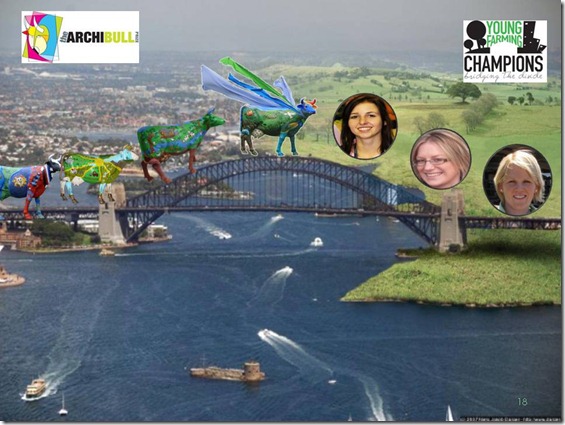
As you can see we are building a bridge from both ends:
Slide18

· Urban side – Archibull Prize build as bridge for students to interact with farmers and put real faces to the food they buy

· Farming side – build a bridge for YFC to hone their new found skills and have two way conversations with the people who buy their food and fibre. The YFC are providing real life examples and inspiring other young people who may have never considered a career in agriculture


Where does R&D and Government fit with this model of engagement?

Well scientists and researchers and policy makers are the pillars that hold the whole structure up.

Slide20

They also have a role to build their own bridges to ENGAGE with the broader community

To explain why their work in supporting agriculture is vital to the future sustainability of our society.

What can be done?

There is no denying this is a huge task and we need to be working together.

ENGAGING with the community (and I am sad to say even between ourselves) needs a much higher priority in our overall thinking if we are going to solve the future issues that face BOTH agriculture and our modern hermetically sealed urban communities.

We MUST add this to our list of ‘most important jobs’

  • · We talk a lot about the rural urban divide
  • But I believe the real disconnect is between value and price
  • Consumers do value food they just don’t want to pay for it
  • Governments tend to absolve themselves of responsibility and foster the notion of food at rock bottom prices as a birth rite
  • Even farmers in different regions are often confused. Dairy farmers in Victoria who supply on a seasonal basis for the international market fail to see why dairy farmers in NSW and QLD who supply the domestic market consistently all year round warrant a higher farmgate price
  • On top of this farm land has become the poor cousin to mining and residential land. Whilst mining is yet to impact on my farming enterprise there is a constant regional conflict between the need to house people without sacrificing our most productive farm land & effectively destroying our food base.
Slide21

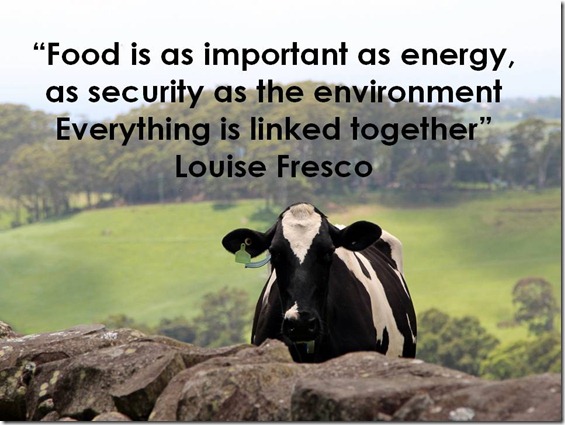
“Food is as important as energy, as security, as the environment. Everything is linked together.” (Louise Fresco)

If Australia is going to get this message

  • THAT food is a topic of social and economic importance
  • THAT responsible agriculture production and food consumption are crucial to world stability

Then farmers, researchers, scientists and policy makers must ALL BE SELLING THIS message and selling it well

My vision for the future isn’t too difficult

It just requires a different way of thinking.

I believe a profitable and sustainable healthy future for the farming sector is achievable

The health and welfare of all Australians and many people around the world depends on it.

To drive the process of change requires champions and leaders. But to change grass roots perceptions, we need grass roots action.

Industry has to take the lead – we need articulate, well educated farmers and we need to identify these people and nurture them and promote them and ensure we retain this talent

We need government and farmers working together with everyone in the value chain selling the message and selling it well that food is a topic of social and economic importance on par with oil

Farm land has to be seen as important as mining land and residential land no matter where it is.

Our farming systems cannot be locked into a religious type paradigm of what we think is best. Our farmers must be free to continue to adapt to our changing resource base, the seasons and climate, the economy and our markets. Our farmers must be able to innovate, achieve efficiency gains and intensify their businesses.

And our researchers and our scientists need to be resourced to help us do this

Our farmers must have access to our best agricultural land if we are expected to keep feeding 60 million plus people from an ever shrinking resource base. We need to get better at engaging with a disconnected market place,that continually wants to pay less for food that costs more to produce.

Consumers are an integral part of this chain. They need to understand and appreciate where their food comes from and be comfortable with how our production techniques must change to meet the world’s need for food.

This can only be done through ENGAGEMENT.

  • This starts with being prepared to pay realistic prices for the food they buy
  • With making wise food choices
  • Understanding the environmental impact of 50% of our food is wasted and ends up in landfill

We all have a role to play. Let’s work together to strengthen and support the missing link

Engagement is the missing link let’s put a price on it and invest in it.

Slide22

Creating a community which is engaged & informed with agriculture is our ‘MOST IMPORTANT JOB’ and is the key to the sustainability of, not just agriculture – but to the ENTIRE FABRIC of our modern advanced society.

WE CAN DO IT

A case of obscured vision… Guest post by Julian Cribb

One of my many hats is being a director of the Dairy Research Foundation which is involved in all sorts of exciting research which includes Future Dairy which bought Australian farmers the Robotic Dairy. You can see the trials being undertaken at the Sydney University Research Farm at Camden here

In honour of the upcoming Dairy Research Foundation Symposium keynote speaker Julian Cribb has agreed to write me a blog post

I draw your attention to this reflection from Julian on our shallow society where people like Craig Thomson take centre stage and the real issues stay in the dressing room

“Back in the 1960s, we’d clearly seen an emerging world food crisis and had launched the Green Revolution to prevent it, lifting global food output by almost 200% in barely 25 years.

Our failure to repeat the miracle in the 2030s and 40s was down to a loss of foresight – we were so obsessed with the trivia of society we simply failed to see what was going on around us. Especially, we failed to make the necessary investments – in knowledge, in skills and in sustainable urban and rural food systems.”

A case of obscured vision ……….

A Case of obscured vision

Dear Children: this is a picture of an Australian policymaker of around 2012 formulating a national food security plan.

I think he is saying something like “She’ll, be right, mate!” but it is hard to be sure, as the voice is rather muffled.

Anyway, you’ll understand that this picture explains all the famines, hunger-wars, failed states, shortages, refugee tsunamis and shockingly high food prices you are experiencing in 2050. Terribly sorry but, besides stuffing the climate, we also didn’t do enough to ensure you had a sustainable food supply. We simply couldn’t see the dimensions of the problem and we left it far too late to do enough to prevent it.

Of course, looking back from 2050 it is blindingly obvious:

– After losing 1 per cent of our farm land a year for the past half century, to degradation and city sprawl, there isn’t enough left to grow double the food

– We ran out of water to grow food in the 2030s, thanks to the megacities and giant resource companies stepping in and taking it off the farmers

– Oil prices went off the chart when the Saudis staged an ‘Arab Spring’ – and food prices went with them. Most farmers and truckers couldn’t afford fuel as we simply hadn’t bothered to develop a sustainable source of transport energy. Several megacities of 20m+ people starved.

– Ditto fertilisers. After the Moroccan revolution (and they supplied two thirds of the world’s P) most farmers simply couldn’t afford it, leading to a yield collapse, especially in high-tech cropping systems.

– After cutting back on agricultural R&D in all western nations for quarter of a century, farmers were left in a massive technology pothole – another reason yields stagnated.

– Two degrees of global warming, accompanied by greater droughts and floods made traditional agriculture much more challenging almost everywhere, cutting food output by around 20%.

This is all rather strange, as we knew that food demand would double by the 2060s, driven by growing populations and rising living standards. Back in the 1960s, we’d clearly seen an emerging world food crisis and had launched the Green Revolution to prevent it, lifting global food output by almost 200% in barely 25 years.

Our failure to repeat the miracle in the 2030s and 40s was down to a loss of foresight – we were so obsessed with the trivia of society we simply failed to see what was going on around us. Especially, we failed to make the necessary investments – in knowledge, in skills and in sustainable urban and rural food systems.

In short, we had our heads up our arses.

Those of you who are by now clutching the ejector seat handle and demanding an escape from this horrible world of the future should front up to the DRF2012symposium to find out how we’re gonna do it!

You only get to hear the good news if you take part.

– Julian Cribb

You can be part of the solution

Over the past few weeks I have written a number of posts sharing my concerns about the future of the farming sector in Australia. I am concerned because I am finding our best farmers are feeling demoralised and physically pushed to the limit by the supermarket prices wars which show no sign of ending and our farmers are questioning why they bother to farm in this hostile environment

Most people have no idea that food has never been cheaper. The graph below puts this into perspective by showing the cost of food as a percentage of income over the last 100 years. That’s a whopping 80% drop and who has funded that drop – farmers that’s who   

image.

This extract from an essay by Julian Cribb explores the issues further. What it also does is provide 8 big ideas solution options that will ensure Australian families can continue to enjoy affordable, nutritious, ethically produced food from Australian family farms. What I would love to know is what you the reader thinks is the appropriate option/s? I look forward to your feed back  

Why Farmers Need a Pay Rise…( Extract)

by JULIAN CRIBB on 22 SEPTEMBER 2010

A Culture of Waste

Food is now so cheap that developed societies such as the US, Britain and Australia throw away nearly half, while developing countries lose nearly half post-harvest. (source: vii)

Societies that pay their farmers such low returns, have found they can afford to send nearly half of the farmers’ efforts to landfill. Or burn in an recreational vehicle enough grain as biofuel in one week to feed a poor person for a year.

In short, the modern food system has established a culture of absolute and utter waste, sustained only by the mining of energy and nutrients (from rock or soil), which will eventually run out or become unaffordable to most farmers.

This situation cannot persist more than a few decades. We will need to recycle and invest in new systems – but for that to occur, farm incomes and the incentive to invest in food production must rise and the economic signal to invest in agriculture must change.

An Unhealthy Situation

Cheap food is at the root of a pandemic of disease and death larger in the developed world than any other single cause of human mortality, and spreading like wildfire in the newly-industrialised world. Cheap, abundant processed food is a driver for obesity, which now affects two in five humans, and plays a significant role in the society-wide increase in cancers, heart disease, diabetes, stroke and bowel disorders.

Cheap food, in other words, is an economic invitation to consumers – including millions of children – to kill themselves prematurely through overindulgence.

Cheap food is the chief economic driver of the greatest budget blow-out in all western democracies: healthcare.

Solving the Food Challenge

The purpose of this essay is to call attention to the effect a never-ending reduction in farmers’ incomes will have on world food security at a time of rising physical constraints to production, including scarcities of land, water, energy, nutrients, technology, fish and stable climates.

At the very time when most experts agree we should be seeking ways to double food output sustainably over the coming half-century, the ruling economic signal to farmers  is: “don’t do it”.

Of course, we can simply obey the economic signal and allow agricultural shortfalls to occur – but that will expose 8 or 10 billion consumers to massive unheralded price spikes, of the sort experienced in 2008, which have a dire impact on the poor, start wars and topple governments – and will not benefit farmers as much as a stable, steady increase in their incomes.

Most of the world’s poorest people are farmers, and it follows that one of the most effective remedies for world poverty is to increase the returns to agriculture. True, this will involve raising food prices for the urban poor but they are less numerous and can more easily be assisted by other government measures. At present rural poverty is maintained throughout the world largely by the economic policy of providing affluent city consumers with cheap food.

It is necessary to state this essay does not advocate a return to agrarian socialism, protectionism, commodity cartels or an end to free markets. In fact, we probably need to move much faster and further towards totally free trade in agricultural products in order to encourage efficient producers – large and small – around the world.

But it does hold up a warning flag about the universal dangers of underinvestment, negative signals and sentiment, resource destruction and rural dislocation caused by the undervaluing of the one commodity humanity absolutely cannot do without, as we approach the greatest demand for food in all of history.

There are numerous ways this issue might be addressed. Here are a few:

1. Price: through an educated “community consensus” that results in willingness on the part of consumers, supermarkets and food processors to pay more for food so as to protect the resource base and enable farmers to invest in new technologies (source: viii)

2. Subsidy: by the payment of a social wage to farmers by governments for their stewardship on behalf of society of soil, water, atmosphere and biodiversity, separate from their commercial food production

3. Regulation: by limiting by law those practices or technologies which degrade the food resource base and rewarding by grant those which improve it

4. Taxation: by levying a resource tax on all food which reflects its true cost to the environment to produce, and by reinvesting the proceeds in more sustainable farming systems, R&D, rural adjustment and enhanced resource management.

5. Market solutions: by establishing markets for key farm resources (eg carbon or water) that result in higher returns for farmers from wise and sustainable use.

6. Public education about how to eat more sustainably;

7. Industry education about sustainability standards and techniques.

8. A combination of several of the above measures.

The technical solutions to most of the world’s food problems are well-known and well understood – but they are not being implemented as widely as they should because of a market failure which prevents their adoption. To avoid grave consequences, affecting billions of people, this failure needs correction.

It also needs correcting because, as long as world food production remains an undervalued activity, then so too will investing in the research essential to overcome future shortages –crop yields, water use, landscape sustainability, alternative energy, the recycling of nutrients and the reduction of post-harvest losses. To satisfy a doubling in demand for food over the coming half century calls for at least $160 billion in worldwide agricultural R&D activity a year – equal to a tenth of the global weapons budget. However this would leave the world both more peaceful – and better fed.

It is not the purpose of this essay to solve the issue of how to deliver fairer incomes to farmers worldwide, but rather to foster debate among thoughtful farmers, policymakers and researchers and consumers about how we should go about it.

However it does question whether some of the ‘old truths’ of the 20th century still apply in the 21st, or whether the era of globalisation and resource scarcity has changed the ground rules.

It also asks whether the unstinted application of overwhelming market force against farmers is the act of a sapient species – or a mob of lemmings?

Over to the sapient ones among you.

–– Julian Cribb FTSE

Julian Cribb is Founding Editor of Science Alert, and is the principal of Julian Cribb & Associates, specialists in science communication. He is a fellow of the Australian Academy of Technological Sciences and Engineering.