Hello Coles its tough being the villain in the story

Every great story has a hero and a villain

This story is all about the hero

Meet Cassandra MacDonald. A young lady who loves everything about the Australian dairy industry

Cassandra McDonald

A young lady who is determined to achieve her dream of being a large animal vet no matter how long it takes

A young lady with considerable artistic talent that she is using for the greater good

A young lady who took on one of the most powerful forces in the Australian supermarket sector and won

Today we salute Cassandra MacDonald

A young lady who stood up to Coles and won

Cassie said

I wanted to show people everyone can make a difference by sharing their story

I wanted the message to reach as many people as it can.

I wanted to show that if you have an important story to tell people will listen

I hope consumers will stop and think about what exactly is happening.

I hope they think about the choices they make

Today the ACCC said via this story from Milk Wars; Coles admits to errors in Campaign

 That Coles spruiked a rosy picture of the dairy industry at the height of the $1 milk wars last year using data it could not substantiate

The supermarket giant has conceded it relied on figures that could not be proven when it claimed that shaving the price of a two-litre milk container from $2.41 to $2 early last year would increase farm-gate prices for producers and lift national dairy production.

Coles has agreed to correct the claims, admitting to the Australian Competition and Consumer Commission that its social media advertising blitz “would be likely to have” breached consumer law that prohibits misleading and deceptive conduct.

Here is Coles mea culpa response

Corrective Notice on our Milk Story  – Coles 

This story is about people standing up and being counted about what’s important to them and using the skills sets and the knowledge they have to get the best outcomes for everyone.

We should all salute those people who put the greater good first because sometimes “fair is equaland today the ACCC proved like Cassie we can all stand up and be counted and make a difference.

Its an absolute honour to know you Cassie and on behalf of farmers everywhere I salute you


What is Fair Food and how do you put a price on it ?

I start this post by declaring I truly hope I have an open mind and wake up everyday ready to have my opinions challenged and a will to move where my values take me  

This week saw the launch of “Fair Food Farmers United” a platform to connect, support and provide a united voice for farmers feeding Australia fairly. Read the press release here

This of course opens the door for many conversations about what is ‘fair’.

I for one am very happy to have that conversation.

What is fair?

Many define it as treating everyone the same, but everyone including farmers are not the same. They have different motivations for their choices, different needs, different causes for their behaviours and different goals.

According to UK Prime Minister David Cameron ‘fairness’ is about  

“giving people what they deserve – and what people deserve depends on how they behave”.

For me ‘Fair’ is about ethics and values and ‘Equal’ is a term you can put numbers against  

Last weekend I attended the Northside Forum to hear Young Farming Champion Jasmine Nixon speak as part of a panel that also included Philip Wright from the St James Ethics Centre.

The panel mix was superb and each panellist resonated with the audience in their own unique way and I was heartened by the way audience listened and absorbed and celebrated all the speakers.   

We had a speaker who spoke with considerable expertise on the science of Genetic Modification, a 6th generation 25 year old beef farmer and a speaker who reminded us all that ethics is hard

Slide2 

In the end ultimately it was how each panellist answered the audience’s questions that determined the take home messages and each speaker gave their answers according to their values not the science ( though it always never hurts to be able to back up your values with some solid science)

For me ‘Fair’ for farmers means everyone in the value chain gets a fair return on investment.

So it all comes back to the individual and what each and everyone of us has invested to bring ethically produced, high quality affordable food and fibre from the farm to you

Ethics is hard and like it or not it is about accepting the cost 

Slide9

Meet Danila Marini a city kid who loves sheep and is doing some amazing research to enhance their welfare

I am a big fan of Meat and Livestock Australia’s Target 100 program concept.
 
Target 100 initiative demonstrates the long term commitment of Australia’s cattle and sheep farmers to advance sustainable practices – from an environmental, animal welfare, social and economic perspective – and ensure a sustainable food supply for generations to come. Target 100 outlines 100 research, development and extension activities covering soil, water, energy, pests and weeds, biodiversity, emissions and animal welfare.
 
 
In fact I am a big fan of any industry initiative that allows farmers to play an active role, communicate with each other, share stories, collaborate and feel proud of themselves, their fellow farmers and their industry.


This initiative also has some great sustainability study guide resources for schools and I was fascinated by an animal welfare Target 100 research initiative for sheep that I came a cross reading Food for the Future which has just been released

This  particular project looks at the role of technology in improving animal welfare
and in this case the opportunity to make pharmaceutical and drug delivery systems, including needle-less injectors a more feasible proposition for farmers

You can imagine my excitement when I discovered that Young Farming Champion Jo Newton actually knew one of the researchers involved in this project  

Meet Danila Marini

clip_image002

Originally I’m a city kid; I hadn’t gone near anything remotely like a farm until I was 9 when my Dad bought a small property and started a little hobby farm. I had always loved animals but being on this little farm increased my love for livestock animals and sparked my interest in agriculture.

Me getting my sheep ready for measurements for the first experiment of my PhD

I decided working in agriculture was my calling, so I applied for Urrbrae Agricultural High school, even if it meant travelling 2 + hours a day just to study. I made use of the school’s farm and applied to study in as many agricultural subjects as I could and as a result I received the Urrbrae Agricultural high school “Majorie Bowes Prize”, which is awarded to the highest achieving female in agriculture, as well receiving the Animal Science certificate for participating in animal related subjects. Throughout the years I had a million ideas of what I could be when I finished high school, a livestock veterinarian, a jillaroo, a stud breeder, a farmer, the list was endless, everything sounded exciting.

clip_image004

My year 12 Ag class that attended the South East Tour, where we learnt about different agricultural practices in the South East of South Australia

In year ten I went on an excursion to Adelaide University’s Agricultural campus, Roseworthy and to CSIROs Waite campus. I saw some amazing projects on animal nutrition, animal/plant production and animal/plant health. I was completely fascinated and from that point I decided I could do some interesting work in the agricultural field if I became a scientist. It was a hard choice between animal and agricultural science but in the end animals won and I went on to do a Bachelor of Animal Science at Adelaide University.

clip_image006

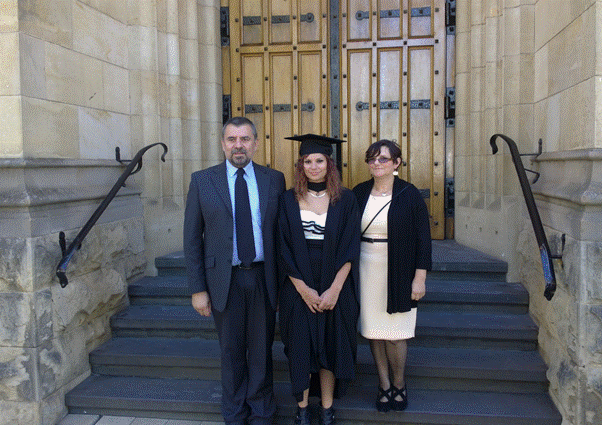
My Dad, my Mum and me at my graduation day in 2012 for my first degree a Bachelor of Science (Animal Science)

Like most undergrads I still had no definite idea what I wanted to do when I finished my degree. When it was time to graduate, I thought “why not give research a go?” I mean research was one of the main reasons I decided to go to uni. So with that I went and did honours, for which I was awarded first class. During my honours year I learnt a lot about research, I had a lot of fun and I grew to love sheep.

clip_image008clip_image010

How can you not love those faces!

As the year began to wrap up I knew I wanted to work in animal welfare and if it involved sheep even better! I thought that one of the best ways I could help improve animal welfare was through research so I went looking for PhD projects that had an animal welfare focus. Luckily enough I found a project with CSIRO and the University of New England on self-medication in sheep, which was a double whammy for me! There was a catch though, I had to move from little ol’ Adelaide to an even littler Armidale.

clip_image012

Research sometimes means early starts, late finishes and very long days but I’m not complaining!

The aim of my PhD project is to incorporate pain relief in food, so that sheep and cattle that undergo painful husbandry procedures, such as castration and tail-docking, can eat this food and be relieved of pain. I will also try to train sheep to self-administer the drugs (non-addictive of course) in order to provide pain-relief, this will give us some interesting insight into pain states in animals. I think it will be the most interesting part of my research! In my first year I identified a non-steroidal anti-inflammatory drug (this is what our panadol is) that works at relieving pain in sheep.

clip_image014

clip_image016

My sheepie minions! Together we shall take over the world with great animal welfare practices!

I have just started my second year and I am really enjoying my work, I currently have some interesting experiments planned for this year. They include adding the drugs to food and seeing if it helps to relieve pain in lambs that have been castrated and tail-docked and training sheep to self-medicate.

As you can imagine I’m getting pretty excited about my work. Many think I’m mad having gone on to do a PhD, some days I think I am too but thanks to the support from family, friends and my supervisors at CSIRO and UNE, I am so glad I have started this journey. So here’s to a future of research, helping the agricultural sector and helping animals!

Drought is now an average year and we need a new way of thinking revolution

The farming community spirit is a bit like a diamond where different facets can shine in different circumstances,” Penelope Wensley

Yesterday I received my NFF Advocate newsletter

It began like this

It’s been a tough start to the year for the farm sector, with much of QLD, NSW, SA and NT still heavily within the grips of drought. The NFF has been working to drive outcomes for Australian farmers, and ensure agriculture is reprioritised on the national agenda during this critical time.

My recent post ‘Drought bringing the solutions to the table’ found here reflected on the need for Australians to see drought as an average year and for farmers to focus on bringing the solutions top the table.

‘Farming needs delivery of business strategies on ground right now that can help and this initiative aims at doing everything possible to deliver opportunities going forward. With no stock, no grass, no rain forecasted and no money in the bank it paints a very grim picture around the kitchen table at most farms around Australia.’  James Walker

Farmers need to be pragmatic we can’t hang our hats on waiting for the the government to step in especially in light of reports like this

Productivity Commission and other recent reporting to government are recommending rationalisation of drought assistance and reform of drought policy. The report recognises that the level of drought assistance has crept from a one in twenty five exceptional event to become more frequent in the presence of a long dry and changing climate. In this circumstance, the general observation emerges that too many farm businesses in too many regions have been receiving Exceptional Circumstances (EC) and other related assistance more frequently than the original definition and policy intent. The level of assistance is now deemed inappropriate and an unsustainable distortion of the farm business sector, particularly in the context of climate change.[17]

According to the report[18]:

Most farmers are sufficiently self-reliant to manage climate variability. In 2007-08, 23 per cent of Australia’s 143,000 farms received drought assistance, totalling over $ 1 billion, with some on income support continuously since 2002. In drought declared areas, most farmers manage without assistance. From 2002-03 to 2007-08, on average, about 70 per cent of dairy and broadacre farms in drought areas received no drought assistance.

Governments need to commit to a long term reform path that recognises that the primary responsibility for managing risks, including from climate variability and change, rests with farmers.

Extract found  here

Governments do care but they listen to voters and in the 21st century developed world people in the main just aren’t interested in other people’s problems

“You have got to not just influence myself and my colleagues, but you have to influence a whole country, it has to be something that, when you walk into a (Cabinet) room, with the 19 votes, you can get 10 of them. And that is what is politics about. – Barnaby Joyce

On top of this Art4Agriculture’s Archibull Prize entry surveys consistently shows us year after year  both teachers and students alike think more than 50% of the food we eat is imported. I am confident our teachers and students are excellent representation of the awareness of the Australian population with regards to where their food come from

Yes farming has done a poor job of showing Australians how much they rely on their farmers to feed them but that’s another story. We have all have choices, so farmers like everyone have to get on the front foot because nobody is forcing us to farm.

Chair of the inquiry, Dick Adams (Member for Lyons, Tasmania), on the importance of agricultural public policy to be more strategic in future with respect to assistance to farm businesses:

Putting our resources into black holes is not where the future is and not a good way to spend the public dollar. I think the Australian people would rather be assisting enterprises that have a business plan looking to the future; that will adapt to climate change and the issues that confront us in the next 20 to 30 years. We’ve also got to look at the opportunities at the enterprise level and look at where we’re going in a world sense. I think farmers will get left behind if they don’t adapt and look for opportunities.  Dick Adams 

This post is about farmers taking their destiny in their own hands and I want to hear from those farmers so I can share their story. Today my feature farmer is James Walker.

IMG_4440_V_rs

James with two of his daughters

I am lucky enough to know James. Young Farming Champion Bron Roberts and I enjoyed James company over dinner in Brisbane in December and what a dynamic, exciting and far sighted young man he is.

James is a Nuffield Scholar and Western Queensland mixed enterprise wool grower grazing 15,000 sheep at Longreach. You will find a great story on James and his farming operation here

James has even mixed it with royalty a number of times with he and his wife Manny among a group of four young families representing the next generation of graziers invited to meet the Prince of Wales and Duchess of Cornwall during the Longreach leg of their Australian visit in November 2012.

James Walker and family meet Prince Charles

Yes and doesn’t Queensland remember 2012 well – the year of the floods. Sadly again Queensland farmers like many in NSW and Victoria are living through another nightmare weather event caused this time by not enough water, with Queensland having the hottest year on record in 2013

James Walker and his family far doing it very tough but he is not standing still. James and his wife Manny are using social media and the Agrihive  website they have set up to help tackle the big challenges around farming including drought.

agrihive-logo

The Agrihive team commitment says it all

If you have a concern problem or opportunity in Agriculture, Agrihive does not sleep until we are on the other side of the concern, problem or opportunity.

Agrihive will move mountains to achieve business, lifestyle and agricultural goals.

Our team is committed, exposed heavily to Agriculture and will provide results.

James has fire in his belly and he is in it for the long haul. James is also a person who DOES care about other people and I can assure you when you read his story you will be just as impressed with this young man as everyone who meets him

This is the Agrihive story in James words…..

Many efforts have been made to fundraise and subsidise the farmers that are facing annihilation. The results of these efforts are limited and lack long term strategy for a weak and fading industry that is exposed to tactical policy changes that lack foresight and courage from our leaders.

Farming needs delivery of business strategies on ground right now that can help and this initiative aims at doing everything possible to deliver opportunities going forward. With no stock, no grass, no rain forecasted and no money in the bank it paints a very grim picture around the kitchen table at most farms around Australia.

We need a revolution in Agriculture, we need to enable farmers to navigate and recover from this complex situation. We need high levels of information that is not rhetoric and long winded, we need result focussed information right now to help us. We do need to accumulate suggestions for long term policy but we need to create opportunities now before another farmer quits our system. That is why we have created Agrihive.

Agrihive is a site that requires you to join, provide real ideas, concepts and results for right now, which will be delivered to the farmers. It honours the resilience of the farming community in desperate unchartered times. As famers we want to take control of the situation.

We want to dust ourselves off and continue being the best producers of food in the World and contribute to the Australian Economy. We are not whinging we are just searching for answers and we are becoming desperate for them. which is best achieved through training, awareness and interaction.

As an example the first instalment of Agrihive is to provide a free 25 minute audio you can access by clicking here. The file contains interviews with three experts in the fields of marketing and feed and fodder analysis.

Farmers will learn what other leading producers have learnt;

  • How to buy fodder like a professional
  • The 3 key measurements for effective feeding
  • How to compare different fodder costs
  • 2014 Cattle market expectations from a marketing expert

Click here to access nowDrought, Fodder, Finance and Future

Agrihive has a suite of information and templates to take control of your business in the drought.

We are progressively covering the following topics and have a growing Agricultural business community.

Savings

There are many layers of cost reduction in Agriculture, Agrihive will uncover spending through key expert eyes and unlock some new discoveries for farmer savings.

Production

The ability to accumulate revenue generating assets is the key to recovery from drought. Agrihive reveals a systematized approach to business performance.

Possibilities

See the Possibilities

Please join now for updates at www.agrihive.com and contribute to real change.

Agrihive will create new opportunities and levels of thinking; revealing new options.

There have only been 500 free CDs recorded so please act now and feel free to pass this message on to your friends and contacts as they may get something good out of Agrihive as it is committed to a better future in Farming.

You can download your complimentary recording by clicking here

“Let our advance worrying become advance thinking and planning” (Winston Churchill).

When I think of James and the conversations I have had with him I think of the quote

THERE are two types of people in this world – the doers and the don’ters.

Doers accept they can create the life they want and then come up with a plan to make it happen. James has got a goal, he has got a plan, he is adapting and look for opportunities.

He is doing what a lot more people need to be doing and that is getting of their backsides and making it happen.

I invite you to join Agrihive now for updates at www.agrihive.com and contribute to real change.

Beef Central have also covered this story here 

Lets not forget people are doing it tough and everybody needs a hand from time to time. This is a great organization doing just that and all Australians can lend a helping hand by supporting them. Visit their website here     

Salute to those who paved the way

I have just had the most wonderful 36 hours visiting Crookwell for the Zone 3 Land Showgirl finals. See previous post

I met some amazing young women and possibly the most adorable and funniest not so young woman I have come across in a long time.

Meet Judy Offley, grandmother of Young Farming Champion Adele Offley

IMG_4124

Adele and Judy Offley pretty in pink

Now I did a little bit of research on Crookwell before I went and discovered that believe it or not in the early 1900’s it was dairying that was the prime driver of local economy with potatoes coming a close second. According to the Town and Country Journal 1907 the Offley Family were one of the leading potato growers. 

This is a little quote from the 1907 article that amused me that was less than wax lyrical about the famers in the area who didn’t fall into the “leading” category. I am confident  the author left town shortly afterwards and possibly not voluntarily  

The country at Crookwell is both hilly and undulating, and whilst being well adapted for dairying and mixed farming is also suited for grazing. A rich red chocolate soil, of great productivity, predominates over the ridges.  A good deal of the land has, of course, been cleared, but a ‘good deal of it still remains heavily timbered,and on hundreds of acres where the trees were felled years ago tho timber still lies on.tho ground. It is, however, not altogether surprising that many of the farms don’t present a highly improved appearance Old ideas and methods die hard in long-settled districts, and as some of the oldest established farms in the country, together with some of the most veteran farmers, are to be found here. Crookwell affords a rare mixture of up-to-date methods, combined with much that is primitive and slovenly.

Well there is certainly no dairying in Crookwell anymore and Judy told me that after growing potatoes for 25 year straight without making a profit (and the accountant telling them they must be crazy) they are very pleased and proud to riding on the back of the merino these days. Whilst there may only be four potato growers left in the Crookwell District my table last night was labelled ‘Sebago’ and every other table was named after a variety of potato. Hail the potato – almost gone but not forgotten in the farming history of Crookwell 

Judy is also very proud of her award winning garden and rightly so with it featuring in some of Australia’s leading magazines. IMG_4117

Judy’s love of flowers has found her in some very amusing situations and a story that I loved today was Judy being invited to do the floral arrangements for the opening of the Goulburn Civic Centre by Premier Nick Greiner 30 years ago.

After spending considerable time on the signature arrangement that Nick Greiner would be standing in front of when he officially opened the centre Judy was approached by two very serious young men in suits who told her that it was very important that the flowers were very firmly secured in the vase as the bomb squad would shortly be giving them the once over.

With a twinkle in her eye Judy told me she thought far too much attention was being paid to the welfare of Nick Greiner and not enough to her vase that the flowers were being displayed in and she would have thought twice about using her own vase if she knew there was a chance it would be blown up.

After many wonderful stories like this we went on a tour of the famous garden and the stories didn’t stop there

IMG_4145 

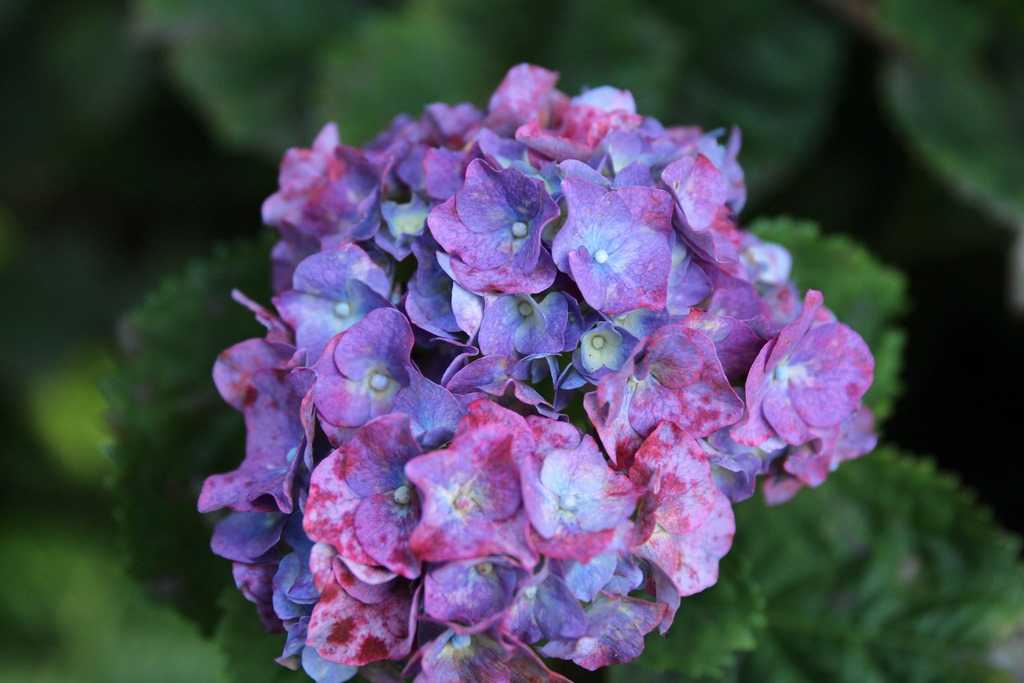
Judy has over fifteen different varieties of hydrangeas in her garden.

IMG_4134

Being a bit of hydrangea fan myself I asked her what was the secret of keeping the cut flower fresh.

Hydrangea

Judy said the key was giving them long soaks in the bath. Something the family did apparently not appreciate coming home from the paddock on a hot summer day to find the bath and shower full of hydrangeas 

IMG_4173

Judy and her husband John recently went on a holiday and left the gardens in what they thought were the trusted hands of the family only to return home and to find that the ‘local hairdresser had been invited in their absence to trim the sacred Weeping Elm and give it a basin cut “

IMG_4172

The Weeping Elm in recovery mode

Everyone else was almost as flabbergasted as Judy and as it turns out the sacred Merino rams were the mystery trimmers.

Judy says to Bruce her son today. ‘Surely those rams must have been in the garden for days before anyone noticed” Bruce just gave her one of those cheeky farmer smiles that say butter wouldn’t melt in his mouth

IMG_4188

I got the feeling it would be quite some time before Judy would leave the garden for too long in the future

Crookwell also has the proud history of being the first branch of the national icon that is the Country Women’s Association and nobody is more proud to be a member of the CWA than Judy. I found this lovely story about Judy’s involvement with the Crookwell CWA here

Judy’s motto: “The farmer’s wife can have a say with CWA!”

With many of her local branches closing she is fervently hoping the Crookwell Branch will be able to celebrate its 100 year anniversary

For Judy I can see that for her its what the CWA does to underpin the health and happiness of rural communities that drives her ongoing support and in particular the Crookwell CWA’s support of CareFlight. Judy was very excited to see the community continue to queue up for Damper (served 6 ways) and Anzac biscuits on Australia Day with the  proceeds going directly to the CareFlight organization to support their community work.

Some of us are born to be mothers and grandmothers and some of us aren’t.  As a mother I set the bar very high when I envisioned what the perfect mother should look and act like and I failed to reach my expectations miserably.

On the other hand I watch my gorgeous friend Bev with her grandchildren and today Judy and am absolutely certain that each and everyone of their grandchildren know just how lucky they are to be surrounded and loved by such hidden treasures.

It was an absolute pleasure to meet you Judy and I salute you. Its women like you who are the heart and soul of rural families and their communities     

Picture You in Agriculture

Picture You in Agriculture

Tonight I am speaking at the Zone 3 finals of the RAS of NSW The Land Showgirl finals

Now it has been said that is this competition is out-dated and is no longer relevant.

Whilst the name of the competition makes me and a lot of other people cringe I can assure you this competition, the opportunities and doors it opens has never been more relevant

I know this because at least 90% of our female young farming champions have been involved in this competition and they tell me the process of preparing for this competition builds their knowledge and confidence and inspires a desire to take the next step and share the positive stories of agriculture with the wider community.

So I am relishing the opportunity to share my story, the Young Farming Champions story and the launch of latest Art4Agriculture’s initiative the Picture You in Agriculture Foundation with the audience tonight and having conversations with the people in the room.

Let me take this opportunity to share with you what I will be saying tonight ……….

Showgirl finalists, ladies & gentleman,

Tonight, I am asking you to ‘Picture You in Agriculture’ –

What does that look like for you?

What does it look like for your family and friends and

What does that picture look like for every Australian out there who relies on Agriculture?

For the showgirls here today, your picture is one that shows your pride for your local community here in Crookwell and the surrounding districts

Its shows a desire to stand up and say we are passionate about agriculture and our rural community.

This is a passion I share with you and I would like to share my story today and what my picture in agriculture looks like.

I was a partner in a family farming operation that proudly provided the milk for breakfast for 50,000 Australians every day.

I have learnt a lot and have grown from the challenges and experiences along the way

I now want to use my learnings to assist young farmers and new entrants into the industry to do the same type of things that I have been able to do.

I want to help them learn what I have learnt. I want them to be proud to share their story.

There is no denying that farmers are the ones feeding the world – they are the body and soul of food production and rural communities.

But farmers cannot do this alone. This is a shared responsibility between farmers and consumers right across the globe,

Every minute the world population grows, adding another 158 more mouths to feed.

More food will need to be produced over the next 4 decades than has been produced during the last 10,000 years combined

We all know these facts we have heard them before but the issue is more complex than economies of scale

The issue that is much more challenging is

how we get the next generation of farmers involved, when farming is becoming more complex, high investment, hard work and there is a perception that it is a low return business?

Moreover becoming a farmer is no longer a birth right but a conscious choice by rural entrepreneurs

So I am going to ask that question that everyone is asking

how do we attract and retain the next generation of rural entrepreneurs and young people to live and work in the rural communities that support them?

Trust me THEY ARE OUT THERE

I KNOW

I WORK WITH THEM EVERYDAY

It can be done AND it is my generation’s role is to invest in them

Since the turn of the century, the amount of land we can grow food on has been decreasing by about 1% a year

So obviously the majority of the additional food needed by 2050 is going to have to come from increasing yields per ha

On top of this according to the WW Fund, today our global footprint exceeds the world’s capacity to regenerate by 50%

So if we continue consuming as we do today we will need the equivalent of two planet earths by the mid 2030’s and we know we only have one

So another very important question

How we reduce waste and produce more food with less water, chemicals and fertiliser?

I know this can be done too – because there are many amazing farmers doing this in Australia everyday

Take my industry as an example

Today’s dairy production requires

• 10% of the land

• 25% of the feed &

• 35% of water used per litre of milk produced than it did in 1940

Wow that is something we can all be proud of

But identifying the problems and challenges around global agriculture and feeding the world is one thing, looking for solutions is definitely more challenging

Perhaps women are the key?

We live in a world that is increasingly social, interdependent and transparent and in this world feminine values are ascendant

Powered by these values – like cooperation, communication and inclusiveness – institutions, businesses and individuals are breaking from masculine structures and mindsets to become more flexible, collaborative and caring

Feminine values are the operating system of the 21st century but women have traditionally lacked the confidence factor

And this is why our show societies are so important.

Every showgirl participant, finalist and winner I have met tells me the process of preparing for this competition builds her knowledge and confidence and inspires a desire to take the next step and share the positive stories of agriculture with the wider community.

And this is where I come in

I am obsessed with identifying talent, and with the development of talent, and with the nurturing and celebrating that talent.

I am obsessed with ensuring that farming, and farmers male and female, are able to take their rightful place in the full global value network available to them.

I also recognise the need to take many stakeholders with me on that journey

So I looked at agriculture’s “leadership programs,” and was disappointed that our young people were too often forgotten about when they had finished their formal training.

I knew that if we were going to build a team of young rural influencers and leaders then what was needed was strategic vision for driving these programs so they would deliver consistent and high quality results for agriculture.

To be brutality honest too often our “leadership programs” are developed as a way to appease agricultural R&D levy payers without being able to articulate or deliver REAL outcomes and benefits for industry.

To me it is imperative that we identify, engage, nurture and support our young people in an environment that allows each individual to build and enhance existing knowledge and skills

We want them to dare others to be different. At times they will need to be fearless.

But they needn’t stand-alone: if we find and elevate these champions, we can leverage their impact and catalyse an even greater change.

More importantly, MY generation will leave behind capable people, who can do it all again, and again…

even backwards and in high heels!

But do it they will…because of us.

As I said earlier THEY ARE OUT THERE

I KNOW

I WORK WITH THEM EVERYDAY

If we invest in them – it can be done

It is incumbent on all of us in this room to be loud and clear to our industries that they must invest in our young people.

Show societies have been doing this for generations, why aren’t some of our industries?

In 2011, 1 invited young people working in agriculture to participate in a program that would not only develop their capabilities to farm with confidence, but also to confidently engage with consumers and everyone along the supply chain.

These young people christened this program the Young Farming Champions program

The young farming champions have grown to be a network of young people who share a passion to tell others about the important role Australian farmers play in not only feeding the world but also providing the knowledge and skills sets to help developing countries to grow the capabilities of their agricultural sectors.

They believe in celebrating diversity, sustainability, creativity and progress.

They believe in supplying the world with trustworthy products, that consumers can be confident in.

They do this by bringing consumers and producers together, by visiting schools and raising awareness, and by telling their stories on social media.

These people are young, exciting and champions of their industries.

AND ……

They are making a unique and vital contribution to the sustainability of our industries.

Vitally important they become part of the Art4Agriculture family and we are always there for them even after they finish our programs.

We continually find them opportunities to build their confidence, use their skills, share their stories, build their networks and create their careers.

In the beginning our trailblazers were all young women

That needs to be celebrated.

Because it is awesome that these mums, daughters, sisters, and wives believe in leaving a lasting, positive legacy on an industry that affects and supports every single Australian, every single day of their lives.

But this story isn’t about me. It’s about the dreams and beliefs of this program and every young person who has put their hand up to be involved, and the thousands of other Australians immersed in their industries.

Let me introduce you to the 2013 Young Farming Champions of the Art4Agriculture program, including your very own Jasmine Nixon and Adele Offley.

And I would like to do this by sharing part of a story written by 2013 Young Farming Champion Bessie Blore that will appear in the next edition of Country Web

Bessie Blore was a city journalist who met a farm boy and followed him back to the farm

In Bessie’s words

You won’t see our faces on billboards or bus windows.

You will find us in the paddocks of our farms, the lecture halls of our universities, the labs of our local research facilities, or the factories of our food and fibre processors.

And when we’re not there, we’ll be visiting schools in Sydney, Brisbane and Canberra (and maybe one day Australia wide), talking to primary and secondary students through our roles as Young Farming Champions.

We’ll be opening their eyes to the diverse, exciting and innovative career opportunities obtainable through agriculture.

Of the 16 people selected to represent the 2013 Art4Agtricultre team, 12 of us are women.

Jasmine Nixon, Hannah Barber, Danille Fox, Naomi Hobson and Kylie Schuller represent the beef industry;

Kirsty McCormack and Liz Lobsley are on team cotton;

Cassie MacDonald a young vet is representing the dairy industry and

Cassie Baile, Jo Newton, Adele Offley and Bessie Blore are flying the flag for wool.

Some of us are fifth generation farmers, and others like me couldn’t tell a sheep from a goat when they were thrown into the industry

And given the average Australian farmer is a 52-year-old male, we’re kicking the stereotype of a weathered, middle-aged farmer, leaning against an old, wooden fencepost with his Akubra dipped to the sunset.

These days the face of farming is just as often female.

Although I’ve focussed on the achievements of women in a typically male industry, the young men involved are no less notable, stepping out of their comfort zone and into city classrooms to share their passions and dreams.

This year alone there is Martin, who flies planes, and writes blogs from his tractor cab;

Ben, who grows enough cotton each year to produce more than 1million pairs of jeans;

Billy, who grows almost everything you’d find in a box of fibre packed cereal;

and Andrew, whose dairy farm is partly staffed by robots. ROBOTS! I’m serious.

We don’t want to be thanked.

We don’t want you to think of us every time you eat a meal or get dressed,

We just want you to believe that what we’re doing – growing food and fibre is as cool as being an architect, or lawyer, or teacher, or doctor, or astronaut…

We think it’s cool, because agriculture is not about farmers. It’s about people.


My work with Art4Agriculture and in particular the Young Farming Champions’ program has allowed to me to realise it will not be me who shapes and changes the face of agriculture but the quality of young people I can deliver for agriculture and their communities through these social enabling programs like the Young Farming Champions

• I’m now devoting my time to creating a Foundation to provide ongoing funding so that we can secure and expand these activities.

• I want to make a difference; the young people I work with want to make a difference. In fact I know we’ve already started to make a difference. And I want to make certain that with the support of my generation we can continue to do this.

• Enabling the next generation of farmers to feed the world sustainably requires knowledge, adoption and implementation of both existing and new technologies, and paddock to plate collaboration and training. Enabling people in this way will help produce the leaders of tomorrow and shape the future face of farming in this country.

The call to action for my generation is

By investing in our young people, and joining me and focusing our time on these activities we can use our time and energy and $ in the best way we can contribute to future of the farming communities that we hold so dearly.

Young people such as our Showgirls here tonight who have shown us they want to make a difference.

Your farmers. Your future. By Bessie Blore

In the future… you will have health.

In the future… you will be valued.

In the future… your world will be even more beautiful than today.

How do I know this?

Because

Today I am planting the healthiest seeds, to grow the best crop.

Today I am tending my flock, to harvest the highest quality fibres,

Today I am nurturing the next generation of calves to produce delicious nutritious milk

Today I am sowing water efficient pasture for my cows to provide the best value proteins.

Today I am using the most advanced technologies in the world, to ensure a flourishing environment, and happy healthy animals.

Today I am a farmer.

And in the future – all this becomes yours.

To the showgirl finalists, be fearless, tell your stories and continue to Picture You in Agriculture

PYIA_Letterhead_Temp

Thanks for the inspiration

The Art4Agriculture Young Farming Champions

Professor Shaun Coffey

The Future of Farming – The Rise of the Rural Entrepreneur – A Rabobank publication

Bessie Blore – Visit Bessie at http://journobessatburragan.blogspot.com.au/

Sacha Bonsor – “Do nice girls really finish last” – SundayLifestyle.com.au

Rick Farley A life with a lesson for us all

I am a person who needs to be surrounded by good friends to truly relax and find it almost impossible to take 5 when I am left to my own devices

So this Christmas I am determined to break that mould. My front verandah has become my new best friend along with Amazon Kindle and Netfix and Crackle and iTunes

A Google search told me the best TV series of the Year was House of Cards.

I have been fascinated by Rick Farley since I read his 2003 Australia Day address so on my iPad Kindle I am reading his biography ‘A Way Through’

What a contrast my choices of verandah entertainment has been

House of Cards is indeed brilliant but so dark. Kevin Spacey as Congressman Frank Underwood Machiavellian personality is just so evil.

I wish he was an anomaly but we all know there are people in the real world just like him with no empathy, conscience or remorse and believe everything should revolve entirely around them and their quest for power no matter who or what they have to crush to quench their thirst.

Some eerie quotes from the series

Power is a lot like real estate. It’s all about location, location, location. The closer you are to the source the higher your property value.

Choosing money over power is a mistake almost everyone makes. Money is the big mansion in Sarasota that starts falling apart after ten years. Power is that old stone building that stands for centuries. I cannot respect someone who does not see the difference.

Now according to the web President Obama has said of House of Cards and Frank Underwood (who will resort to murder, sexual impropriety, blackmail, fraud and a litany of evils to grease the legislative process).

“I wish things were that ruthlessly efficient….. this guy’s getting a lot of things done”

I would prefer to think the President has been misquoted or spoke in jest

The most poignant part of the series1 for me is the last episode when Frank’s wife Claire (who can do evil pretty well herself) asks Frank what legacy will they leave on the world and he can’t give her an answer.

Such a contrast to Rick Farley who also spent a considerable amount of time in the world of politics.

“In this era of adversarial politics and campaigning there are lessons to be learned from his life, his capacity to get everyone talking to one another, and to agree on a compromise” Natasha Mitchell ABC Radio

“Farley brought competing interests together, listened deeply and patiently, worked from clear principles, helped people to understand each others’ perspective and to find common ground, and often delivered results that everyone could live with. Farley usually negotiated deals that represented real progress, but more importantly, that left a legacy of better relations between competing interests. Invariably, he earned the respect, trust and admiration of those he worked with.” Andrew Campbell

Rick was a city boy who is his own words was

shaped over a long time by a very diverse group of Australians – cattlemen, farmers, conservationists and Aboriginal and Torres Strait Islander people. I thank them all for the education they have provided me. It also has been shaped by over 25 years in the political and public policy arena, which represents both the best and worst of our national endeavour.

As his 2003 Australia Day address shows, Rick had a big picture vision for agriculture in this country and was 100% committed to Australia being the great country it deserves

So I perceive my country now to be a bit lost; still not managing change equitably; searching for its place in the world; looking sometimes for simple truths and solutions which no longer exist – in the middle of a cultural vortex and not quite sure of the exit point.

In that situation, it seems sensible to me to look to the bedrock of our nation, the points that can ground us and give us stability. In my view, these distil down to our country – our land and waters – and the nature of our relationships with each other.

Unless we use natural resources in a sustainable way, we are mining the future. Unless the relationships between our citizens are respectful and inclusive, we are a divided and diminished society.

To me, these are the defining features of Australian culture and identity. Together, they can unite our communities, build resilience, and create a firm foundation from which to meet the ever-increasing challenges we face.

By any measure, we are not caring properly for our natural resources.

We automatically imported European systems of agriculture, based on wet, fertile landscapes, and unsuited to our fragile soils and rainfall patterns. Australia’s wealth depended on agriculture and mining for a long time, and without sufficient knowledge about the long-term results, we went hell for leather……

The tasks before us obviously are enormous. Farming systems will have to change; further adjustment in the farm sector is likely; rehabilitation will take decades and will be impossible in some areas; public and private costs will be huge; new regulatory systems will have to be introduced; and a vast amount of political and social capital will need to be invested.

But unless we do it, in my view we will limit our future as a nation and as a society. Our economic, social and even our spiritual security will inexorably be diminished.

Sadly Rick Farley is no longer able to grow his legacy but eleven years later what Rick said in 2003 is just as relevant today

There is a golden opportunity here – to come together in an act of national will to create a priceless legacy for future generations; to cement part of the foundation for a modern Australian culture and identity. One that builds on the past, but can deal with the new realities we face.

I never met Rick Farley but I am honoured to be working side by side with people who knew him and respected him and I for one will be working hard in 2014 (25 Years of Landcare) to celebrate both his vision and inspire others to make it their mission.

In Andrew Campbell’s article “Whatever happened to brave leaders” he says

Rick Farley … was gifted in speaking truth to power, in cogent language that political leaders and their constituents could “get”. How we miss those clear, far-sighted voices in debates over how best to share the water resources of the Murray-Darling Basin. How we miss their ability to understand and empathise with all sides and cut to the essence, to find a way through to a better place.

In Rick Farley we lost a real national leader, one of the most significant Australians of the late 20th century.

There are indeed lessons to be learnt from his life. Rick Farley may be a “one of” but surely a team of people who aspire to achieve his vision could have a red hot chance This makes me ponder perhaps the most pressing thing wouldn’t you agree is that we (agriculture) identify and nurture the next generation of Rick Farleys?

The Amazing Disappearing Farmer A heartfelt story

Browne’s Dairy first caught my attention whilst I was visiting WA in November 2012 with their very heartfelt and very entertaining campaign Save WA Dairy Use by Date Campaign  I wrote about it at the time here and explained very cleverly on film here

Many of their products are very funky

and I imagine appeal to the demographic ( 13-18yrs) who turn to heaven forbid to less healthy alternatives in their teens

Now they are appealing to the hearts and minds of Western Australians through the Amazing Disappearing Dairy Farmer campaign

The Amazing Disappearaing Farmer

According to their website

In a massive show of defiance to those companies who choose to import Eastern States’ dairy products, thousands of everyday West Australians turned out to declare themselves ambassadors of WA dairy. A lucky few were then selected to broadcast their message of encouragement back to WA farmers. They’re West Aussies from every walk of life – young, old, families, parents, brothers, sisters and friends. People like Madeline Abbot and Robert Lorrimer from Ascot, the Rickett family from Ellenbrook and Cameron Powell from Scarborough.

While these people don’t know each other and have probably never met, they all share something in common – they recognise that without the hard work of WA’s dairy farmers, there would simply be no milk. It’s vitally important that our farmers are able to secure a fair return from the market for the milk they produce. This is the cornerstone of Brownes’ philosophy and a cause we are proud to champion.

Imported dairy products are hurting WA farmers – that’s the cold, hard truth. So with the help of our WA dairy ambassadors, we’re issuing a call to arms to all proud West Australians to buy local and support your State. This is one of the messages that our stars of the screen are now relaying on television and online around the State this week.

I look forward to seeing the impact of Brand WA on Western Australians. Will appealing to the heart translate into purchases? Well no-one can say Browne’s Dairy aren’t giving it a red hot go

Courage does not always roar

Courage under pressure

The end of 2013 is nigh and its time for reflection. This year I put my hand up to officially enter the world of agri-politics and as 2014 fast approaches I am seriously asking myself is this the best use of my time, energy and expertise? Very importantly is it the right thing for my emotional well-being?. As I listen and learn and process  I am constantly being reminded of the Edmund Burke quote 

All that is necessary for the triumph of evil is that good men and women do nothing.


I am also constantly buoyed by the great men and women I meet and last Monday saw me in Brisbane at the invitation of Meat and Livestock Australia (MLA) at their Climate Adaptation Producer Workshop. I was quite excited to be attending this workshop because MLA has a collaborative mindset and producers from a number of industries were attending and I love these cross industry think tanks.

I also saw it as a great opportunity to grow my Bring a Friend campaign and take the dynamo that is Target 100’s Beef Young Farming Champion Bronwyn Roberts with me

The group was tasked with answering the following questions (considering all elements of the enterprise – animals, plants, people and the overall system)

1. What are the key research needs for climate for our farming systems?

2. What are the human skills and capacity needs for climate for our farming systems?

3. What do we already know about climate, and is that information (& decision support tools) sufficiently available to livestock producers?

4. What would an ideal farming system look like for your business in 2030? What resources or tools would you require to be more profitable in the future?

Now anybody who has spent even the smallest amount of time with me will know that to me agriculture in this country won’t have a viable future until we start genuinely investing in our people. See previous post here

To me it is imperative that we identify, engage, nurture and support our young people in an environment that allows each individual to build and enhance existing knowledge and skills and pivotally provides ongoing training and development to help them become more effective, and take on bigger and more significant challenges. This also requires us to establish conditions that will allow individuals to engage in the process of learning and adapting to change.

So it goes without saying that I would firmly ensconce myself at the table that was focusing on question 2.

It would not be a discussion without leadership or rather lack of rearing its ugly head and this brings me to the reason why I am finding myself emotionally drained at the end of 2013

In my role as a national dairy industry councillor I attended a number of dairy industry events last month. The hot topic behind the scenes was how was Dairy Australia taking the Horizon 2020 project forward?. No matter how you look at it this is a brilliant document – Horizon 2020

This project explored possible future scenarios for the Australian dairy industry in 2020 and described a desirable outcome.

In the words of the working group it was about ‘looking long and thinking differently’ and creating

  • the necessary farm business “fitness”
  • a positive and proactive culture;
  • (dairy) industry leadership to succeed in achieving a desired future in 2020.

The working group said

These imperatives will require industry to do a number of fundamentally new things and to address existing agendas differently compared to today.

Excitingly Horizon 2020 was to be the start of a process to

stimulate the Australian dairy industry to focus on the future – the opportunities that this future presents and what it will demand of our industry.

There were a number of young farmers on this working group who got the opportunity of a lifetime to travel the world and meet the first movers and the innovators and the champions in dairy right across the supply chain from the US to Europe

Fundamentally for these young farmers leadership growth they were promised by Dairy Australia that

“this process should create an ongoing process of insights and thought leadership to guide industry decision-making in future,

and they would be part of the team

‘to monitor progress on follow-up to this initiative”.

Now we all know there is nothing more motivating that being part of success story

Sadly for this group of young farmers the promise from the powers that be that they would continue to be part of the journey were hollow. I can tell you having been there done that  a ‘thank you very much don’t call us we will call you (and don’t hold your breath)’ outcome is pretty demoralising and I was devastated speaking to some of the young farmers and hearing their disappointment .  

Now these young farmers do have choices and they can challenge the process and I know a few very passionate people are already in their court ready to stand beside them to help them do it. I am telling this story because I want more great men and women in dairy to join this team to fight the good fight     

I am reminded of the Theodore Roosevelt quote

“It is not the critic who counts; not the man who points out how the strong man stumbles, or where the doer of deeds could have done them better.

The credit belongs to the man who is actually in the arena, whose face is marred by dust and sweat and blood,

The man who strives valiantly; who errs and comes short again and again; because there is not effort without error and shortcomings;

The man who knows the great enthusiasm, the great devotion, who spends himself in a worthy cause, who at the best knows in the end the triumph of high achievement and who at the worst, if he fails, at least he fails while daring greatly.

So that his place shall never be with those cold and timid souls who know neither victory nor defeat.”

Yes Agriculture is full of timid souls but I can assure you it is also full of leaders. Leaders who need more than token a ‘leadership alumni” they need support, ongoing training, access to bright minds and people with blue sky visions who discuss the big ideas. Sometimes they even need their hands held.

I know it can be done Art4Agriculture’s Young Farming Champions prove this to me everyday and they inspire  me to keep going and excitingly they have inspired the corporate sector to invest in them.

I will give it a couple of weeks to see if I have the strength to help drive change at Dairy Australia. I am not alone in this endeavour but more farmers need to put their hands up. I look forward to them stepping up to the challenge. Its time to look long and think differently and that starts with challenging the process   

Leadership

HARD QUESTIONS AGRICULTURE NEEDS TO ANSWER

Asking the hard questions


Last Thursday I attended my second Blueprint for Australian Agriculture Forum.

The Blueprint for Australian Agriculture is about finding a new voice and building a coherent, collaborative plan to make significant and sustainable progress.

The attendees had been tasked with determining the actions for ‘KEEPING THE BLUEPRINT ON TRACK’

There was a lot of talk in the room about agriculture’s inability to celebrate success and pivotal need to balance the hard luck stories with the good news which was too often exacerbated by the culture of some of cutting down those who dare tell a positive story

The morning commenced with an address by well-known and thought provoking CRAIG DAVIS who challenged us by saying

There’s a massive gap between the perception and the reality of Australian agribusiness. We think the world is thinking of us in the first place. We think the perception is better than it is. We think we’re a player.  C’mon people, humility.

But the opportunities for Australian agribusiness are enormous.  For all our misguided perceptions, the reality can and should be far stronger than most of us imagine.

Craig’s address was titled the HARD QUESTIONS AGRICULTURE NEEDS TO ANSWER and began with


When you’re born in Australia you’ve already won the lottery. We live in one of the most naturally
abundant places on earth. But are we smart enough and prepared to work hard enough to grow
our good fortune? Or will we squander it like so many lazy lottery winners? These are some of the
hard questions for Australian agribusiness to answer and the NFF Blueprint is designed to
help. But if we are prepared to take on these (and many other) challenges, there’s no room for
complacency. Like it or not, we live in a world of volatility, uncertainty, complexity and ambiguity.
And we’ll need a clever, coherent and compelling Brand Australia to help us realise our potential.

Craig gave the attendees some very sage advice when he said

Australian agribusiness needs to do a much better job of building engagement and relationships with customers and consumers.  Strong relationships are built on a shared purpose, values, experiences and the stories that exemplify and reinforce them. So it is with strong brands.

So what makes this such a challenge for Australian agribusiness?

Two things.

First, brand ‘Australia’ has a mixed reputation for relationships in the region.

In consultations leading up to the Asian Century Whitepaper comments were made about Australia’s apathy and lack of knowledge towards Asia. Our role as a ‘seller of things’ to Asia influences the view of us – we’ll have a price negotiation on everything. We’re seen more as ‘wheeler dealers’ than relationship builders.

(You may have seen some commentary in The Land recently to back this up).

By contrast, the Canadian beef industry has been working with China for many years. Their approach has been holistic and includes partnering on genetics, live cattle, meat and production technologies.

And Fonterra’s deep and abiding partnership with China has served them nicely through thick and thin.

According to opinions canvassed through Advance, Australia’s community of professional expats, “there is a perception that Australians see things through Australian and English eyes, that we look to Washington for political approval and even resent travelling on business to Asia.”

These are not helpful characterizations for relationship building in the region.

The second reason all this matters is that the relationship model is more about purpose, meaning and values than image and communication.

  A great deal of what Craig had to say resonated with me and the background behind Art4Agriculture’s raison d’etre. You can imagine I pumped my fist in the air when he said

I suggest to you that the future of Australian agriculture has a lot to do with rebuilding direct consumer and customer engagement.  And there’s nothing quite like a customer focus to inform, simplify and clarify strategic planning and priorities.

What truly resonated with me was the importance of agriculture sharing the “HOW and WHY” when we tell our story.  

People are overloaded and overwhelmed with information. We’re up against increasingly distracted minds. These people don’t want more communication, they want to feel connected.

The antidote to distraction is more meaning not more messaging. As Simon Sinek says, ”people don’t buy what you do, they buy why you do what you do.”

…….. Clean, green and safe is what we do, not how or why we do it.

You can read this very compelling presentation on Craig’s blog here.


Footnote

Craig Davis has been at the forefront of the global advertising business for 20 years, with high level roles in Saatchi & Saatchi and J Walter Thompson working with many of the world’s biggest brands including Coca-Cola, P&G, Nestle, HSBC, Unilever, Shell, Sony, Bank of China, Toyota, Kraft, Ford and Diageo. He has judged at every major international advertising festival and delivered countless keynote addresses around the world.