History is full of people who could not spell their own names.

Christine Yeats Convenor of the Assessment Sub-Committee of the UNESCO Australian Memory of the World Committee.

A sold-out audience gathered at Kiama Library today to learn from two of Australia’s most experienced historical researchers.

Kiama Historical Society was honoured to welcome Carol Liston AO, President of the Royal Australian Historical Society, and Christine Yeats, its Senior Vice President.

Carol is an Adjunct Associate Professor at Western Sydney University. Her research focuses on early colonial New South Wales, particularly the development of the County of Cumberland and the lives of convict women transported from Britain.

Christine is an archivist and historical researcher who spent much of her career with State Records NSW, now part of Museums of History NSW. She is also Convenor of the Assessment Sub-Committee of the UNESCO Australian Memory of the World Committee.

Carol and Christine set up for their presentations with Vice President of the Kiama Historical Society Dr Tony Gilmour watching cleary please the AV is working 

For local historians, family researchers and writers across the Illawarra and Shoalhaven, having Carol and Christine visit Kiama and share knowledge gathered over a lifetime was a rare opportunity.

It soon became clear that historical research begins with persistence.

Our ancestors could not always spell their own names.

Neither, apparently, could the people recording them.

A surname might begin with Mc, Mac, M’ or a space. Trove may read it differently again. Christine’s advice was simple. Try every variation you can imagine, including a few you cannot imagine, and never assume something is absent because your first search failed.

She also demonstrated how to use quotation marks, AND, NOT and Trove’s persistent links, along with the importance of saving the newspaper title, date and page number. Search results can move as new material is added, meaning the article you found easily today may play hide-and-seek tomorrow.

Newspapers, Christine told us, are wonderful places to begin. They are not necessarily wonderful places to stop.
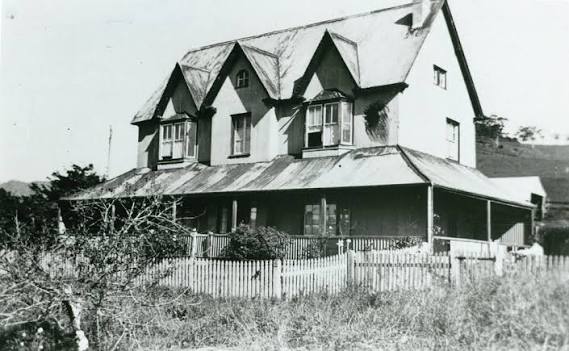
Historic Waughope House and the farm today is still and operating dairy farm

One article about Kiama’s Waugh family contained a letter and plenty of useful clues. It also elevated the wrong family member, incorrectly explained how Waughope got its name and confidently repeated details that did not survive contact with the original records.

Nobody had necessarily set out to mislead anyone. Someone filled a gap, another person repeated it, and eventually the story acquired the reassuring appearance of fact.

Carol took us further back, into colonial records created because Governor King wanted to prevent “fraud, confusion and perplexity”.

That may be the most honest description ever given to a government recordkeeping project.

The Old Register records what ordinary people were buying, selling, mortgaging, promising and fighting over from the earliest years of the colony. Carol showed us why one document is never enough. Every record reflects the knowledge, purpose and opinion of the person who created it. The researcher’s task is to compare it with maps, correspondence, newspapers, land records and other evidence.

Dr Tony Gimour Vice President Kiama Historical Society, Christine Yeats and Cameron McDonald Mayor and Patron

Then a Kiama silk mystery appeared.

Christine had been investigating Anne Waugh, who sent locally produced silk to the Paris Exhibition of 1855. That search led through parish maps, title records, primary applications and annotations left by long-dead clerks.

It also raised a new local question.

Are some of Kiama’s old mulberry trees survivors of its forgotten silk industry?

Kiama Historical Society has a well-earned reputation for bringing together outstanding speakers, fascinating local stories and food tables that deserve their own place in the archives. The magnificent lunch was prepared by the Children’s Medical Research team. 

Nobody walked out with a neat answer to every historical puzzle.

We left knowing where to look next, what to question and why the smallest handwritten number on the corner of a document may change an entire family story.

History, it turns out, is less about finding one perfect record and more about refusing to be defeated by a badly spelled surname, an intimidating website or a very convincing local legend.

Remember the “pinkie” campaign could it fix our e bike problem

Remember this campaign? Will it fix our e-bike problem?

Watch it again and then ask yourself a serious policy question: is this the answer to Kiama’s e-bike problem?

The Pinkie campaign understood something about teenage boys that every threat misses. The whole performance is for an audience,They think they are bulletproof. Fines bounce off them. Warnings bounce off them. The road toll belongs to other people. Could laughter from the girls on the corner be the answer

Kiama has tried the enforcement route before. I mean well before. In the 1880s this town had a big hoon problem. Mobs of forty and fifty boys patrolled the streets from ten o’clock. They damaged everything in sight. Joseph Weston lobbied hard for his solution, “bring back the whip”

Larrikinism, he thundered, was “a social and moral infection which should be stamped out like small-pox”

In November 1883 he got his wish. “LARRIKINS BEWARE! The ‘Cat’ has arrived.” Triangles, a cat-o’-nine-tails and two taws came down from Sydney on Saturday’s steamer, and the magistrate a Mr Connell announced he would happily show the appliance to anyone desirous of seeing it at the court-house. Kiama invented the pop-up exhibition a century early.

In March 1884 the cat made its courtroom debut, produced before three youthful offenders to rattle them. The delinquents smiled. The Bench promised them a taste of it next time. By the close of 1885 the cat was still waiting for its first customer, the most feared instrument in the British penal system reduced to a conversation piece with viewing hours.

This week Council opened a portal where residents can report e-bike incidents. Same recipe, new appliance. Acquire the instrument with fanfare, then wait for the teenagers to reform themselves. The boys on Collins Street will smile at the portal exactly the way the larrikins smiled at the cat, assuming word of it ever reaches them.

Which brings me back to the pinkie. It cost less than a steamer and it frightened more teenagers than the cat ever did. So here is my alternative submission to Council: skip the portal, commission the ad. Or save the money entirely. Collins Street, Saturday night, all of us on the footpath, little fingers raised.

Watch the add again. What do you think?

One Saturday, two events, and the story of three orphans who built this district

Every object on this table holds a story. Yours do too, and most of those stories are one generation from being lost. Saturday 18 July, Kiama Library, the Royal Australian Historical Society is teaching us how to capture them before they go.

Three orphan girls built lives we still drive past every day

I write stories so the people we love are remembered. Memory has a shelf life of about two generations. Your grandchildren will know your name. Their children probably won’t, unless someone writes it down. Every family has people worth remembering, and most families never get around to it.

So when I heard what the Kiama Historical Society has organised for Saturday 18 July, I paid attention.

In 1821 three young sisters, Cecelia, Caroline and Catherine Rutter, were sent to the Female Orphan School at Parramatta. The Orphan School was where the colony put children it had no other place for. It was not a beginning anyone would choose.

Fifty years on, their names were attached to some of the finest homes in this district. Cecelia married Michael Hindmarsh of Alnebank at Gerringong. Caroline married Thomas Surfleet Kendall of Barroul House. Catherine’s second marriage, to Thomas Chapman, made her home at Hartwell House.

For me, one of those names is personal. In 1880 my grandfather’s family, the Chitticks, arrived in Sydney aboard the Samuel Plimsoll, a wool clipper 74 days out of Plymouth. The shipping list records six brothers, aged 15 to 27, every one of them an agricultural labourer, with their mother and sisters listed as domestics. In time the Chitticks bought half of the Alnebank farm. The orphan girl’s ground became my family’s ground. My grandmother’s people had already been in this district since 1831, and my father’s side arrived in 1841. These stories don’t just overlap with ours. They share fences.

I know all of that because somebody kept the records, and somebody else taught me how to read them. A shipping list, a family tree in a booklet, dates and ages in a column. That’s how a name becomes a person whose story you can share.

Carol Liston, president of the Royal Australian Historical Society, tells the Rutter sisters’ story at Kiama Library Auditorium on Saturday 18 July at 1.45 pm. It costs $3 for Historical Society members, $5 for guests, afternoon tea included, and you can just turn up.

The morning session is the one I’d urge you to book

Before the talk, Carol and the Society’s senior vice president Christine Yeats are running a research workshop, 10 am to 1 pm at the same venue. This is a rare thing. The two most senior figures of the Royal Australian Historical Society, in Kiama, teaching the practical craft: how to search Trove so it gives you answers instead of noise, how to use the Historical Land Records Viewer to trace a property and the people who held it, how to read colonial records for the personal detail that turns a name into a person.

Almost every family around here has the shoebox. The photographs with no names on the back. The family tree that stops dead somewhere in the 1880s. The house with a name nobody can explain. This workshop is for that shoebox. BOOK YOUR SPACE HERE 

It’s $25 for historical society members, $30 for everyone else, and that includes morning tea, cakes and lunch. Bookings are essential, so don’t leave it until the week of.

I’ll be there with my own list of dead ends. Whether Trove can crack them is another question. That’s rather the point of going.

Who will be laughing at us in a hundred years

Old newspapers are a gift. They show us a community concentrating very hard on the business of being right about the small things.

In Jamberoo in the late 1800s, people worried about the name of the colony. Australia felt flimsy. Too casual. Too much like a place where people might relax. A proper society, it was argued, required a name with authority and a whiff of empire. Something that would sit comfortably on official letterhead.

The name survived. It now appears on passports, Olympic medals, and road signs without incident.

Beach behaviour also drew close attention. Men bathing in underwear sparked outrage. Editorials were written. Public standards were defended. The issue hinged on fabric, fit, and the preservation of decency. The town believed civilisation rested on correct swimwear.

Electricity prompted years of debate. Poles were discussed. Tariffs were dissected. Who should pay occupied many meetings. When power arrived, streets were lit and grievances brightened along with them.

Women voting caused genuine concern. Serious men warned it would alter women’s nature, upset social balance, and weaken chivalry. These arguments were delivered with confidence and a straight face.

Marriage advice was also a public service.

In 1886, the Kiama Independent offered bachelors a guide to finding a wife. It advised men to observe women closely in the morning. To check her hair. Her dress. Her energy levels. To assess whether she complained of cold, executed unreasonable projects, or wrote too many letters. A man was cautioned against leading a woman to the altar if she showed signs of extravagance or ambition. A good wife, readers were assured, would not be a boaster and a slattern. This bible of rules was apparently the gold standard.

This guidance was published earnestly. Presumably clipped. Possibly discussed over tea.

At the time, all of this mattered. These were serious conversations held by serious people trying to protect their world from decline, disorder, and women who might write letters.

Seen from here, the intensity is impressive.

Which brings us to the present.

We have our own certainties. Our own moral alarms. Our own debates conducted with absolute conviction. We argue about productivity, visibility, optimisation, self branding, and being constantly available. We hold strong views about how people should live, work, partner, parent, age, and perform success.

Future readers will find these pages too.

They will smile at the confidence. They will marvel at the energy. They will wonder how so much attention landed in such particular places.

History tends to be generous. It shows how people worked with the ideas they had.

The more useful question is which of today’s decisions will still make sense once everyone involved is dead and no one is defending them.

Those choices are rarely the ones anyone is busy congratulating themselves for.

They do not come with rules.

And they show zero interest in what a woman looks like before breakfast.


Community Legend Bob Young has a farm that grows farmers as well as grass


Over seventy family members and friends recently gathered at Kiama Leagues Club to celebrate Robert (Bob) Young’s 90th birthday. It was a milestone that said as much about the man as it did about the community that has grown up around him.

Robert John Young was born on 30 October 1935 at Lindfield, the youngest son of Eric and Ruby Young and younger brother to Owen and Ron. In 1948 he moved to his mother’s family dairy farm on Riversdale Road, Jamberoo. Apart from a short stint at Westons, the farm became his life’s work. It later became known as Merley Friesian Stud and remains an active dairy farm today.

Bob married Annette in 1962. They raised three children, David, Colleen and Neil, and now have eight grandchildren, Zac, Dylan, Sarah, Callum, Byron, Lachlan, Aiden and Ellis. In 2018 Bob and Annette moved to Blue Haven on Terralong Street, closing a long chapter on the farm but not on community life.

At the celebration, speeches from family and long-time friends returned to the same themes, Bob’s commitment to faith, family and the wider Jamberoo and Kiama communities. His service includes Kiama Rotary, Kiama Show Society, the Jamberoo Golf Club, the Jamberoo Quartet, Jamberoo Rugby League, Jamberoo Tennis, Kiama Anglican and Kiama Men’s and Mixed Probus. In 2011 he received Kiama Council’s Citizen of the Year Award.

The family story of succession began close to home. David returned to the farm as a young man and took up dual careers, dairy farming alongside a growing building business. He kept the farm running during a period when extra hands were needed. When building work picked up and a young family followed, Bob encouraged him to choose the life that made sense. David went on to a successful career across several sectors and later into senior leadership roles with Anglicare, with the full support of his parents.

That choice opened the way for a different form of succession, one centred on opportunity rather than inheritance. The first share farmer was John Deen, who stepped in when Bob was around sixty. The farm then passed to the Grant brothers, early risers and very capable farmers. They were followed by the Honeys, who stepped in at a time when a major equipment failure could have ended the operation altogether.

Today the farm is run by Mat and Sarah Parker. They represent a new generation of dairy farmers locked out of land ownership by soaring prices yet determined to stay in the industry. The Young family’s approach gives them a pathway, a future, and room to grow.

That is Bob’s quiet gift to the valley. A farm that does more than grow grass. A farm that grows farmers. A farm that continues to reflect the values of the man who turned ninety, surrounded by people who carry those values forward.

#JamberooHistory #KiamaHistory #DairyFarming #IllawarraDairying #JamberooValley #FarmingSuccession #YoungFamilyJamberoo #MerleyFriesianStud #LocalFarmingStories #BobYoung90th #KiamaCommunity #FarmSuccession #GrowingFarmers #RegionalHeritage #IllawarraFarmers