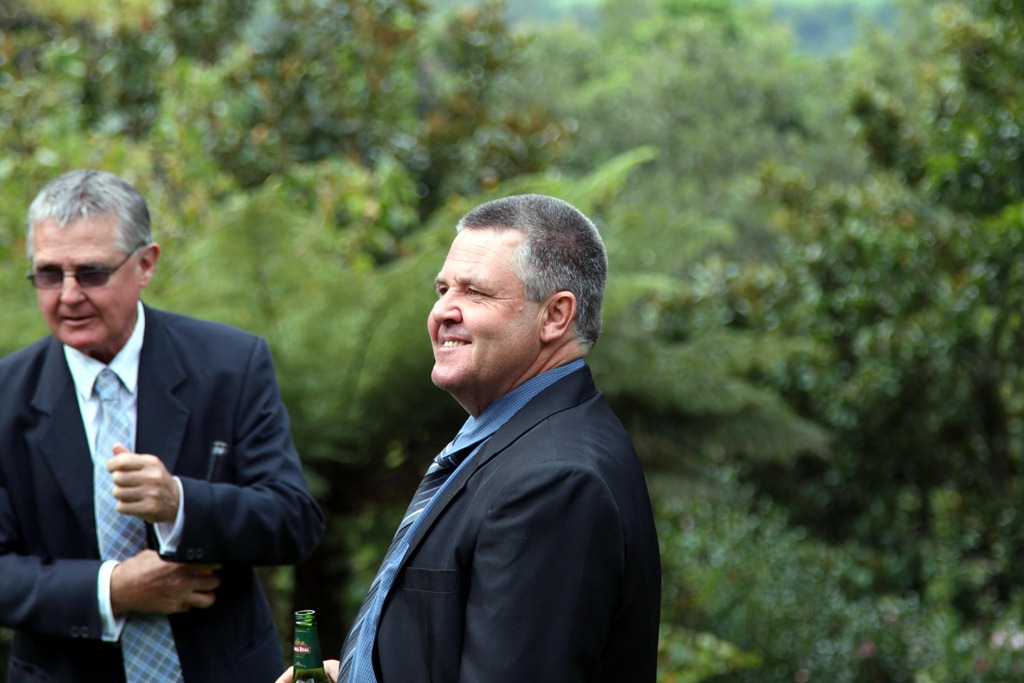
I am not happy Woolworths

Agriculture has an image problem and Woolworths you are NOT helping

Have you seen these bizarre adds?

I mean have you ever seen a farmer dressed like “Malcolm”? What about the imagery of rural and regional Australia. What on earth are they thinking? The food looks like it has been transported from the 1950’s

This is what Generation Food and Fibre look like in the 21st Century. They are young professionals who are articulate, well educated, passionate and committed and they deserve better from Woolworths

IMG_3093

Art4agriculture Young Farming Champions from NSW

To make it worse Young Farming Champion Kylie Stretton from QLD tells me she walked into her Woolies’ store this week and they were having Fresh Farm Day “with hay and  stupid hats and shirts with fake freckles”

Fake freckles OMG this all has to stop now. Once again the Aussie Farmer Image is  collateral damage in an advertising campaign.

Enough is Enough. Looking forward to your suggestions on how we tackle this.

Post script

This post has attracted a lot of conversation on twitter. The farmers aren’t happy but if the urban press is right this campaign is pure genius.

The very important question was asked on twitter “What image do we want agriculture/farmers to have”

After much twitter debate the question was answered

How do farmers want to be portrayed in the media? Exactly how they are “professional and caring”  Thank you Woolworths, the Food and Fibre generation fraternity look forward to your new adds with gusto

On another note this is not just a job for Woolworths – image needs to be created and it needs to be actively maintained. I am excited to be part of a team who has been charged by the National Farmers Federation working group on Labour, Skills and Education to help come up with the image vision. I am relishing the challenge and look forward to your feedback when we put our thoughts on the table. I can assure you “professional and caring” will be right at the top of the list

Some interesting thoughts from Dr Heather Bray here “Does getting it wrong bring us closer together”

Friend or Foe

In our region almost 90% of prime agricultural land is owned by lifestyle farmers. They represent a major and growing sector in the Australian rural landscape and now play a critical role in the protection of Australia’s natural resources.

The-Farmers-hat-

Lifestyle farmers have diverse views, drivers and values. Many are new entrants to farming with little or no background in agriculture, and their knowledge of land management and agriculture tends to be poor. Their local knowledge is also limited and they lack the practical or tacit knowledge that larger farmers have such as good agronomic knowledge, identifying soil types and weeds, applying fertilisers or herbicides, building fences, operating machinery or vaccinating cattle.

Growing concern has been raised over the level of knowledge and skills within the lifestyle farm sector, and the ability of these farmers to manage their property in an ecologically sustainable fashion.

Depending on your point of view and who you mix with lifestyle farmers could be viewed as potential threats or possible allies for maintaining healthy, viable landscapes. I tend to mix with the one’s who care about Australia’s natural resources with a fervent passion and take every opportunity to up skill

In our region we are lucky enough to have the unique personality that is Richard Scarborough. Richard is a knowledge hub on all things natural resource management like no other and he takes every opportunity to share his vast expertise with those who want to learn and there are plenty of lifestyle farmers in our region who want to learn.

IMG_2943

Richard Scarborough at Clover Hill sharing his knowledge of the pros and cons for planting wildlife corridors.

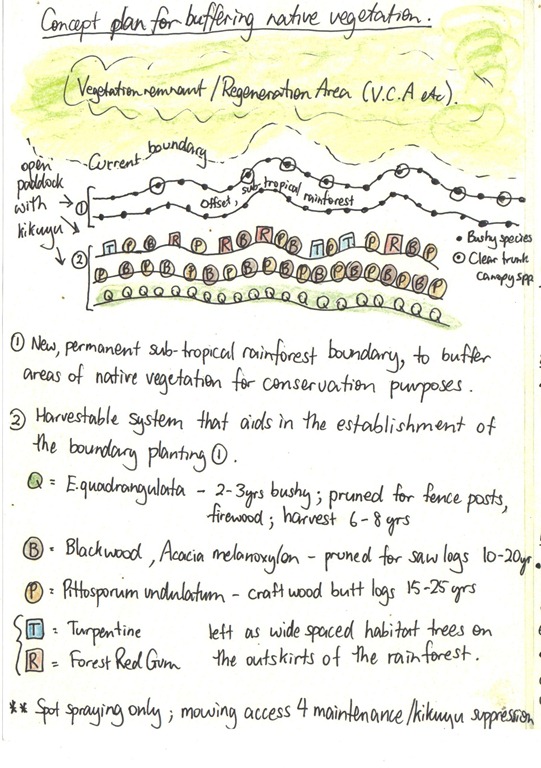
Richard has drawn this diagram to show us the SMART way to plant trees to achieve the best outcomes for the landscape, the native animals and the farm animals.

Concept Plan for bufferring Native Vegetation

In our region Richard on behalf of Landcare Illawarra is conducting the Illawarra Woodland and Rainforest project which means locals have a wide diversity of tree species to pick from. A wide diversity of trees means a variety of food sources for wildlife and that’s a very good thing indeed.

Richard tells me rainforest tress DO NOT need a pioneer canopy and its very important not to use wattles in this capacity. Why you ask?  Well wattles are very fast growing and will compete with the rainforest trees for nutrients and water

So if you want to use Eucalypts and wattles Richard says its important to segregate them and create competition free niches for rainforest trees.

If you follow Richard’s clever strategy  you will have wattle and eucalypts for farm timber, furniture making and fence posts and superb rainforest trees for eternity.

Here is a tip:  Rainforest species will grow faster in response to light competition and its ideal to plant the trees far enough apart to allow slashing with a tractor or ride on mower.

Stages of development

Thanks Richard for sharing.  You are a natural treasure

Also check out this video which showcases some other people who are inspiring their neighbours and pooling their skills for the beneift of the natural resource base and the wider catchment

Local knowledge for local problems

Last Saturday we hosted a field day at the farm on behalf of Landcare Illawarra. The event was organised by the delightful Megan Rowlatt from Conservation Volunteers Australia

Megan

Megan Rowlatt at the farm

It was a great day. The weather was kind. The experts were all there to share their knowledge and the participants engaged and fun to be with.

IMG_2891 a

Participants were engaged and ready to learn

IMG_2948

On the home run – Picasso Corner Laneway

I shared with the participants the challenges, the mistakes and success stories of our journey to enhance and manage our native vegetation alongside improved farm production outcomes

A range of representatives from organisations such as Landcare Illawarra, Southern Rivers Catchment Management Authority, Conservation Volunteers, Small Farms Network as well as local project officers, bush regeneration officers, and landholders were be on hand to discuss the range of techniques used and the funding available to landholders to help them work with and manage native vegetation on private land. See details below

I am confident the highlight of the day was the waterfall  tour which took the participants deep into our untouched and pristine rainforest country to one of our many magnificent waterfalls.

Waterfall  

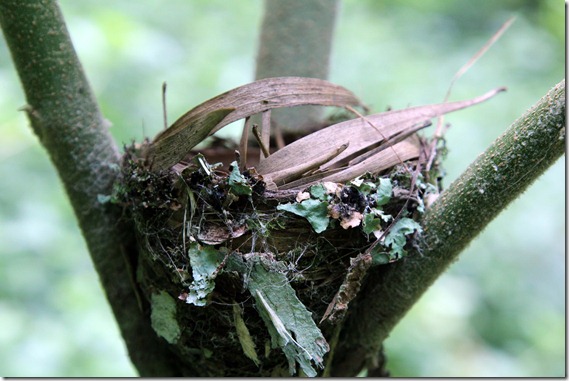
Birds Nest

Clover Hill Rain Forest

IMG_2942

One and a half hours later the hardy participants climbed there way up from the bottom of the rainforest 

If you live in my region (Southern Rivers CMA) here is a short blurb on the natural resource management bodies who can help you ensure healthy landscapes and clean waterways on your farm

Landcare Illawarra

Richard 1

Richard Scarborough, delivers the Illawarra Woodland and Rainforest project

Landcare Illawarra is a community-based organisation which helps Illawarra residents living in the 3 local government areas of Wollongong, Shellharbour and Kiama on the NSW South Coast to get involved in a broad range of environmental activities.

The Landcare Illawarra Management Committee assists groups and individuals involved in environmental activities. Its objectives are to:

  • Coordinate information and support for groups and the community involved in environmental activities in the region
  • Support applications for environmental grants
  • Apply for and direct funds to selected activities
  • Provide a connecting voice between the community and the Southern Rivers Catchment Management Authority
  • Provide a linkage between state government authorities, local councils and the community

The Landcare Illawarra project officer, Richard Scarborough, delivers the Illawarra Woodland and Rainforest project. Part of his role is providing landholders with a range of advice on native vegetation management, tree planting activities and weed management.

Native tube stock is available to landholders in the region who would like to extend the diversity of rainforest or woodland tracts on their properties free of charge as part of this project thanks to funding from the federal government and SRCMA.

For more information visit www.landcareillawarra.org.au or contact Richard Scarborough on 0438 988 387 or email richardscarbrough@dodo.com.au

Small Farms Network

Andrew Britton

Andrew Britton from the Small Farms Network

The Network’s primary role is to organise and deliver training/workshops on sustainable land management, including weed control, pasture and livestock management and the deliver of on-ground incentives to landholders on behalf of the Australian Government, Southern Rivers CMA and the Sydney Catchment Authority. Membership exceeds 800 landholders with weekly email updates keeping all landholders informed about a range of training events, funding opportunities and members activities.

The Small Farms Network currently provides support to all rural landholders in the Wollongong, Shellharbour, Kiama and Shoalhaven Council areas.

For more information visit www.smallfarms.net.au or contact Andrew Britton at abritton@southerncouncils.nsw.gov.au p. 02 4232 3200 m. 0437 134 736

Escarpment to Sea program – Southern Rivers Catchment Management Authority

Michael Andrews

Michael Andrews delivers the Escarpment to the Sea program

This program can offer a number of biodiversity conservation services to landholders within priority corridors or for those with remnant patches of rainforest or woodland vegetation present on their properties. Increasing the connectivity of vegetation, especially at the landscape scale, improves the prospects for sustaining long term biodiversity and helps maintain habitats and protects animals that may be affected by the effects of climate change.

For more information about this program visit http://www.southern.cma.nsw.gov.au/htmleditor/documents/Escarpment%20to%20Sea%20flyer.pdf

Contact Michael Andrews at michael.andrews@cma.nsw.gov.au or 02 4224 9715

Conservation Volunteers Australia

Renee

CVA  co-ordinators Renae Riviere and Jess Zickar.

Conservation Volunteers recruits volunteers from Australia, New Zealand and around the world to join important environmental and wildlife conservation projects. Founded in 1982, this non-profit organisation has grown to become the largest practical conservation organisation in Australasia with offices in most capital cities and many regional centres across Australia and New Zealand.

In the Illawarra, Conservation Volunteers has supported a number of landholders in the region to carry out a range of restoration activities including weed removal from creek lines, tree planting and fencing activities to improve biodiversity on private land.

For more information about regional projects contact Wollongong regional manager Renae Riviere at rriviere@conservationvolunteers.com.au or call 02 4228 9246 or for more information about Conservation Volunteers visit www.conservationvolunteers.com.au

Where possible these organisations will work in partnership with each other to deliver a range of projects which aim to deliver the best outcomes for the catchment and the wider community.

Some further great info can be accessed in this brochure “Working with Landcare”

Permeate a thing of the past is good news for NSW dairy farmers

You might remember I posted the following blog “Permeate -What’s all  the fuss” – reprinted at the bottom of this post a few months ago – when the ongoing “permeate saga” reared its ugly head

Well I must say this media announcement ( see summary below ) today by all the major milk processors who supply the domestic milk market in Australia certainly caught my eye.

Whilst the addition of permeate to standardise milk did not overly concern me as a consumer. The fact that it was, I am given to understand in the main carted all the way from Victoria (note this is anecdotal  and not officially confirmed or denied by processors ) to add to NSW farmers milk did rattle my cages.

“Chair of the Dairy Farmers Milk Co-operative, Ian Zandstra, says the decision means companies like Lion will have to buy a little bit more fresh milk from dairy farmers”. 

I believe this outcome is a win for NSW dairy farmers already under far too much pressure from things outside their control.  For consumers it once again shows “people power”. For industry its a reminder of the pivotal need for transparency at all levels of the supply chain. 

Dairy processors say no to permeate

By Sarina Locke

Monday, 25/06/2012

Milk processors have bowed to consumer concerns about the by-product permeate and say it won’t be added to their branded products.

Lion, which produces Dairy Farmers and Pura brands, and Parmalat, which sells Pauls brands, have announced their milk will be permeate free.

Permeate is the liquid left behind after milk is separated into cream and low fat milk, and mixing it back into the milk was seen as an unnecessary additive.

Chair of the Dairy Farmers Milk Co-operative, Ian Zandstra, says the decision means companies like Lion will have to buy a little bit more fresh milk from dairy farmers.

“That’s a good thing. That buffers the nervousness about a cut in contracts,” he said.

“Price-wise, I can’t see it having much effect.

“Clearly, if more milk was needed in regions of milk shortage, there’d have to be a price response and an increase in prices.

“But generally Lion is needing less milk from our farmers in virtually all the regions.”

Dairy Farmers Co-op represents 750 milk suppliers around eastern Australia, from far north Queensland to Victoria. The co-op is in price negotiations today with the processor Lion.


Permeate what’s all the fuss?

Posted on April 21, 2012

I wasn’t going to write a post about this topic but people I respect are now  concerned about the addition of permeate to milk and one of Art4agriculture’s Young Farming Champions wasquizzed about it and wasn’t confident answering the question when she gave a recent presentation. So I decided it was time to debunk the misconceptions and get it out in the open

Permeate so why all the fuss?

As always controversy sells newspapers and attracts viewers in droves for TV shows and apparently food controversy does this better than any other topic.

In fact it’s become so popular that we could have controversy food isles and controversy free food isles in supermarkets and food products and brands would be moving backwards and forwards like yo yos as long as the issue continued to improve ratings .

This week its milk and how it is standardised. Below is a nice simple diagram of how milk is standardised. Standardisation means you can put accurate fat and protein percentages on milk product labels.

clip_image002

Fairly straight forward stuff wouldn’t you say? What the labels don’t say is how the milk was standardised and this is causing controversy because the word permeate now emits “controversy”

So how did permeate fall into the controversy isle of the fridge. My opinion is lack of transparency. Transparency within food systems refers to full disclosure of information about rules, procedures and practices at all levels within a food production and supply chain. Transparency ensures that consumers have detailed information about production of a given food item.

When permeate first appeared in the media the reaction from the big milk companies and industry bodies was “no comment”.  Not the wisest decision they ever made.

Milk companies it’s time to fix this mess. If the milk is standardised with permeate put it on the label. Australian shoppers are not known as most discerning in the world, the statistics say we buy on cost and convenience and take 7 seconds to make a food item purchase decision in the supermarket. It’s a pretty fair bet that the word permeate on the label won’t even make a dent in sales but the consumer has a right to know and it’s time to show them that respect

Let’s hope this is a lesson learned “truth in labelling” should be nothing to fear. After all if you are not proud of what goes in your product and you can’t talk about it don’t add it.

Back to permeate – Let’s get fair dinkum I can confirm for milk consumers permeate is nothing to fear. It’s just a milk by product just like cream is but I won’t be whipping to put on my dessert any time soon

Food Myths Everywhere

Splendour in the Rainforest

Fountaindale Dam is a beautiful area bordering our farm but was sadly suffering from benign neglect and we have taken it upon ourselves to build community partnerships to help rectify this.

Erin Lake with the support of Tay Plain from Clearcut Productions and Ann Burbrook have created this superb video to show you the magnificent  outcomes .


It is so rewarding to have played a role in this fantastic project

I documented the journey in an earlier post which I have reproduced here


IMG_7909

This important community area covers diverse environmental zones including the headwaters of Fountaindale Creek which flows into Minnamurra River and wetlands.

Fountaindale Dam 10001

Red circle indicates area of Fountaindale Dam at Jamberoo

Whilst the dam borders our farm it is actually owned by Kiama Council who built it a long time ago in the hope of supplying Kiama with water. An expensive pipe dream as it turned out.

IMG_0139

Lots of farm generations have had fun playing under the dam wall

Above the dam are a number of hobby and lifestyle farms and many small mountain streams which bisect significant areas of high conservation value remnant rainforest feed into the dam. The hobby and lifestyle farms unfortunately in the main don’t fence their cattle out of the waterways and this has led to considerable degradation of the upper stream beds during the drought.

The region is also habitat for the spotted quoll – a beautiful little native animal (which also has a penchance for chooks)

Spotted quoll

Spotted quoll cute and endangered but don’t let him near your chickens

Zieria Granulata is an endangered shrub found only in the Illawarra region of NSW and also thrives here.

Siannon CtG 0008

With the support of Kiama Council and funding from a Community Action Grant and Erin’s expertise we cleared the invasive evil lantana from the banks of the dam.

IMG_6357

Lantana is considered to be one of the ten worst weeds worldwide but it is so entrenched in the Australian landscape its thickets now provide a substitute habitat for a range of animals, including bandicoots, whipbirds, quail, wrens, birdwing butterflies and brush turkeys, where it has replaced the natural understorey vegetation.

IMG_0230

Every wise landholder knows removing Lantana is a waste of time unless cleared areas are revegetated with native trees or pasture immediately and regular maintenance is a must until the vegetation is well established.

Fountaindale Dam Jan 18th 2011  (8)

Once we had cleared the Lantana we sowed ryegrass in the open areas and did spot spraying of secondary weed nasties in the rainforest understory.

Jack's Paddock

We ensure all our paddocks around the dam have a permanent pasture coverage which helps keep the nutrients on the pasture where they should be and not washed into the waterways during major rainfall events. 

This weekend Erin and her eco warriors have planted a further 400 rainforest tree species such as Black plum, bleeding heart and myrtle ebony as part of a new wildlife corridor.

IMG_7821

Petrol powered plant auger makes light work of digging the holes

IMG_7809

We even landscaped the backyard of our friendly neighbourhood wombat

IMG_7886

Michael bravely put his hand up to plant all the Giant Stinging Trees (Dendrocnide excelsa)-

The purpose of these plantings is to strengthen the existing wildlife corridor that links the lower rainforest to the rainforest around the dam. Once the trees in the wildlife corridor are established we will be planting rows of native grasses to act as a nutrient buffer zone between the pastures and the dam. This will ensure minimal farm runoff can get into the community waterways and help reduce the nutrient load on the waterways.

IMG_7903

All the rainforest trees that have been planted here have been provided by Landcare Illawarra as part of the “Illawarra Rainforest and Woodland project”.

This project aims to increase the genetic diversity of plantings in the Illawarra which has the potential to increase the level of fruiting of individual species. This is an important project as it aims to ensure genetic variability in the many species selected. Landcare Illawarra has collected seed from multiple locations to guarantee this.

IMG_7799

Many hands make light work and another great effort from Next Gen Eco Warriors

IMG_7852

Well done Erin

Ausagventures Steph Coombes First Day at the Dairy

Our guest post today is from Stephanie Coombes who has come to the rescue in our hour of need. Refer previous post

Posted on June 19, 2012

Hello from Clover Hill Dairies!

Yes, i am in Jamberoo (NSW) working on a dairy farm! Does this girl ever sit still i hear you ask? Clearly not!

My friend and industry mentor Lynne Strong gave me a call last week and said they were a bit short staffed, as her son and daughter in law were on their honeymoon, and seeing as i was due to come to the farm for a workshop in a few weeks, how would i like to come early to work? Well that was that, i jumped on an aeroplane the next morning, and caught the train down to the south coast of NSW.

Paradise. Lynne always says that Mandelyn Holsteins (home of Clover Hill Dairies) is her little piece of paradise and she is not wrong. The farm is superb, lush green rolling hills. natural rainforest, and ocean views. Shame it’s a bit on the cool side (oh Bahrain and your hot weather how i miss you!).

IMG_2595

IMG_2569

So… my job at the dairy. Lucky girl i am, i get to look after the BABY COWS!1 Yes… BABY COWS! Oh gosh, haven’t i already posted enough videos and blogs about baby cows? Trick question, because the answer is no! You can never post enough about baby animals (I’m planning to go visit some lambs next).

Anyway, so at the farm the babies are looked after from a very young age. Between birth and moving to the grown up (teenagers) paddock, they go in 5 different areas around the farm, which have been designed to cater to their social, health and nutritional needs during the different stages of growth.

First up is the ‘colostrum’ shed, where the iddy biddy little babies go. They are all bottle fed cow milk, including fresh colostrum. Colostrum is the very first milk the cow produces after birth, and it is filled with all sorts of goodies, which give the babies immune system a kick start. It is essential that the babies have the colostrum, as it reduces their chances of getting sick.

P1050360

After a couple of days they go into the ‘duck’ shed (i have no idea why it is called that!). They have these adorable individual little stalls with heaps of wood shavings to make it all warm and comfortable. They also have see-through walls, so they can see their mates and talk to each other. It is here in the duck shed that the babies are gradually weaned off of cows milk and onto powdered milk. The process takes around 9 days, and is taken in small steps. This isn’t just to get the babies used to the taste of the powdered milk, but to allow the microorganisms in their stomach to adjust to the new formula.

After the duck shed they go into the ‘hay’ shed, where they are still fed powdered milk, but are also introduced to pellets and hay. There are a couple of pens in the hay shed, all in a row, so as they get older they move up the shed. Sort of like a primary school, you move from kindy to the junior block, to the middle block, and then to the senior block.

P1050416

Now i have to write about this awesome piece of technology that allows the dairy to raise these calves efficiently, without having to spend all day every day hand feeding. It’s an automatic milk feeder that works with the electronic tags in the calves ears. So every calf has a tag, and it is put into the software system. When the calf comes up to the feeder, the machine reads its tag, and knows how much it has had to drink that day, how many times it has come up looking for a feed, how much it drank yesterday, and how aggressive it was during feeding.

IMG_2674

Louise show me how to operate the computer and check the data

What is really cool though is that you can go through the computer and see how much every animal has had, so you can pick up if anything is starting to get sick, or needs more help learning how to use the machine etc., because you cant run 24 hour CCTV on the calves!

P1050434

Robotic Calf Feeder

After the hay shed, the “pre-teen” heifers go out into a grass paddock, where they are supplemented with hay and pellets. Then once they are big enough to have babies, they go out to another paddock to do that (gosh from the size of these babies, i think a human baby doesn’t look so bad now!).

IMG_3076

So my job is to feed all the babies each day and make sure they are comfortable and healthy. I love feeding the little little ones, as they can get quite curious and eager to play. They suck on anything and everything, so never wear half decent clothes around them! On my first afternoon i was having a lay down in the pen with them, and they were all crowding around me trying to figure out why i was laying on the floor. I thought it would be funny to let them chew my hair…. so i did. I mean, they were chewing all my clothes too, so what more was a pony tail?…. WRONG. That night as i washed my hair, a good chunk of it fell out in matts! Yuck! They actually chewed my hair off! Now I’m already down half a head of hair from the boat trip, so i couldn’t believe i was losing more!!

Playing with baby dairy calves

IMG_2687

IMG_2694

Stay tuned for more about life on a dairy farm!

Farmers Angels – The Alison Fairleigh story

During the last ten years I have met some very special people who I refer to as #angels.

They are knowledgeable, stimulating and inspiring people who have influenced me in a positive way. They have taught me that true leaders encourage and shape future leaders, not followers. They have helped foster the way I am in the present and what I will be in the future. They are people I can look to for advice in the ‘sticky’ times and the good times. They give me words of wisdom, a shoulder to cry on and a swift kick if I need it!

I have also had the pleasure of working with amazing,inspiring and selfless people who don’t farm and chose to spend their non working hours lobbying and supporting  and AGvocating on behalf of all Australian farmers.

I will be inviting a selection of these people who have crossed my path to write guest blogs to share their stories over the next 12 months.

Sadly I have found some farmers (too many) see themselves as victims and fail to acknowledge the wonderful networks of people who support them, appreciate them and fight for them every day.  

I am starting with the angel of all angels Alison Fairleigh  

Alison is founder of the “Farming is the New Black”  Facebook site

Some examples of Alison’s campaigns AGvocating for farmers  

The Great Cafe Challenge

More Questions than Answers

and one from the heart

What ANZAC day means to me

The Alison Fairleigh story………..

13 Feb 2012

I was born and bred on a farm in SE Queensland and into an entire extended family of farmers – from beef cattle production to dairying, poultry and cropping – but I wasn’t your typical farm girl. I did not relish growing up on a farm … in fact, I couldn’t wait to leave, which I did as soon as I was old enough: heading to uni and then, as a teacher, to discover the world.

Like the majority of Australians, I became very complacent about farming and agriculture as a whole, and my attitude didn’t begin to shift until a few years ago when I took up a position with the Australian Agricultural College and moved to north Queensland. While working for AACC I saw, learned and experienced things about our farming sector that caused me to become extremely concerned about Australia’s future food security. Things that the average Australian is completely oblivious too:

  • Once thriving agricultural colleges closing down due to lack of enrolments, lack of support from industry and government policy that just “doesn’t get it”.
  • Farmers encouraging their children to do anything BUT farming because they don’t see any future for them in the industry.
  • Male farmers and male farm workers having one of the highest rates of suicide in Australia.
  • Agricultural workers being drawn away from farming to the high wages available in the mining and construction sectors.
  • Urban-based young people who are eager to work in agriculture but who cannot find support from industry.
  • Governments, both state and federal, de-investing in agricultural research and selling off valuable research facilities and land.

What is the future of food production in Australia if we do not have family farmers growing it?

Do we want multi-national corporations and foreign governments to own and operate our agricultural lands and be responsible for our food production? Some see no problem in that. I on the other hand do. I want to see sustainable agriculture and I don’t trust multi-national corporations to do anything sustainably other than whatever it takes to make mega profits. At the end of the day, farming is a business but at least the majority of family owned farms throughout Australia operate ethically. I want to be able to buy food that I know is produced with the highest degree of environmental stewardship and animal welfare standards.

One of the things that frustrates me so much about campaigns against Australian farmers by certain animal welfare groups is that we can encourage and legislate for the ethical treatment of animals in Australia. If our farmers are forced to leave the industry and we do become a net importer of food, we have no control over how animals are treated in other countries. People are not going to stop eating meat or seafood. If they see it in the supermarket, whether it is Australian or otherwise, they will buy it. While restrictions have been placed on the live export of Australian animals to Indonesia, this does not improve the treatment of animals in Indonesia – in fact, as Indonesia seeks to go it alone, conditions may get far, far worse: Indonesia tests “breedlots” as self-sufficiency solution. That is not a win for animals.

I guess what I’m trying to say is that people who have little understanding of agriculture and farming systems, should be very careful about the long-term consequences of what they campaign for. If we don’t have farmers, we don’t have food; and unless people have had their heads in the sand the past year or so, Australian farmers are being expected to feed a large proportion of the world. What happens to farmers in Australia has global consequences. We need to take care of them and listen to them.

I would never have thought to become an ‘AGvocate’ except for social media. I have used it to speak about the things that concern me and to raise awareness for rural mental health. To my utter surprise, people have listened. If you were to meet me in person, you’d find a woman that country people call a ‘city-chick’ and a woman that city people call ‘country’. I have the best of both worlds and I feel comfortable in either setting which has given me the opportunity to be a ‘bridge’ between the two. It’s been frustrating at times because farmers are not the easiest people to advocate for: they are stubborn and self-sufficient, which is why they are so good at what they do. But I have a vision of an Australia that sees, loves and supports its rural communities as a valuable part of a whole. It’s not easy, but it’s absolutely, 100%, definitely worth it!

(Alison now works for the Mental Illness Fellowship of NQ as a Rural Development Officer. You can learn more about her advocacy by visiting her blog: ( www.talkingfairleigh.blogspot.com.au )

Alison tweets at @AlisonFairleigh

A chance to catch up with the special people in our lives

The recent wedding of Nick and Emma gave Michael and me the ideal opportunity to catch up with our special friends who have enriched our lives in so many different ways

The wedding was small, which meant careful consideration of who we could include on the guest list

Over the years Michael and I have gathered 4 different set of friends from different times in our lives who in most cases had never met

Friends who have been around forever, friends who we met through Nick growing up and his school activities, friends we have met through our farm related activities and friends who I have met through Art4agriculture

There was a significant gap between the wedding service and the reception for those special   lifetime memories of the special day to be recorded through the lens.

This opened up a unique opportunity for Michael and me to have a pre reception party for our friends and close relatives which opened the door for them all to meet 

And wow thanks to the generosity of the gorgeous Robin we had access to perfect venue to to do this and a great time was had by all

The gorgeous grounds

Magnificent spot for a party

Bev and Don and Branco and Rosy  

Friends since forever – Bev and Don and Rosy and Branco

Dave and Sandra

Lots of wonderful memories of great ski trips and great time with Dave and Sandra

Jenny John Neil Ros and VL

Toasting the past and the future with John and Jenny and Neil and Ros and Victoria

David 

Terry and David two of Michael’s brothers

Nathan and Ellie

Ellie ( best man’s fiancée) and Nathan ( Nicks cousin)

Neil and Annie and Ros

Neil and Annie and Ros

Nathan and Pop

Nathan with his grandfather Bruce

Sisters In Law

Mel and Cathy and Trish ( Michael’s sisters in law)

Wendy In the Shower

Wendy checks out the outdoor shower

John and Jenny

John and Jenny our gorgeous neighbours who scored some of the flowers and great Coolangatta wine to remember the event by

Emma and Flowers

Some of the amazing flowers from Wendy O’Malley of MossNest 

Kerrie HT and John

My sister Kerrie HT and my dad John

Taylors

Victoria with Craig and Wendy

Next stop reception

Next stop reception

IMG_2470

Kirsty was a late starter and joined us for the after party

Lynne & John

A blast from the past Me with my dad on my wedding day

Special thx to Robin ( venue) and Wendy O’Malley ( flowers)

A breath of fresh air

A breath of fresh air blew in from Perth this week in the from of one of Art4agriculture’s Young Farming Champion  Steph Coombes who wrote us this very popular blog earlier this year.

Steph’s arrival was celebrated by all the farm team as firstly we are short staffed with Nick and Emma on their honeymoon and secondly she has such a bright bubbly personality and is all smiles just like Louise

On her first day even the sunrise welcomed her in a spectacular way

Clover Hill Dairies at Sunrise

Which turned into a very misty morning

Cow in the Mist

Steph has never worked on a dairy farm before but she was right into from the start. When she discovered the baby cows as she calls them she was in seventh heaven

Steph and her new best friends

And they seem pretty fond of her too.

Steph will be blogging about her time at the farm on this site as well as her own site  Ag-ventures of a city girl gone country and we are all looking forward to her Clover Hill Dairies Diary musings

The hidden costs of Private Label Milk

This morning I had a call from ABC Radio National looking for comment on behalf of our regional dairy farmers on this story National Foods cutting fresh milk contracts.

This story is a very sad reflection on state of the fresh milk industry in this country and the ongoing ramifications of the supermarket milk price war

For many farmers in our region like those in the Bodalla region it is time to sign new milk contracts with Lion ( National Foods) but there has been no communication from our milk supply company (Dairy Farmers Milk Supply Company) who supplies Lion as to price per litre being offered nor contract volumes on offer .

Can you imagine how difficult it is to make smart business decisions in this situation.  Dairy farmers need to make decisions about our cows, our people, equipment and environmental investment twelve months in advance. So to make the best business decisions for everyone on our team we are looking for clear market signals at this time from our processors

Dairy Farmers Milk Tanker at Clover Hill

However, the processors are not able to commit to supply arrangements with farmers until the processors have finalised their contracts for private label milk volumes with the supermarkets.

As currently these contracts are only for short periods of time processors are second guessing supermarkets and the farmers are second guessing how the processors will respond if they don’t get the private label contract and as you can imagine all this second guessing leads to a third rate supply chain model and undermines farmer confidence in the whole milk supply sector

The latest Dairy Australia survey show 85% of dairy farmers in NSW see milk prices as the biggest challenge to the survival of their businesses.

MichaelNickStrong1

So you may well ask why processors continue to supply private label milk to supermarkets. Well they have been asked that at several Senate inquiries so I have an answer (or 3) for you.

In confidential evidence provided to the ACCC Grocery Inquiry 2008 * (see reference at bottom of post) by processors indicate that the main reasons they pursued private label contracts were:

  • overhead recovery—generating revenue through private label sales to contribute to fixed costs of running the business
  • supply relationships with retailers—supplying private label product provides a stronger relationship and possibly improves processors bargaining position in relation to branded products
  • volume—the volume of milk supplied through private label contracts provides some stability to the business

The first national contract for supermarket private label milk was given to National Foods (now Lion) by Woolworths in 2002  The ACCC remarked in 2008 that the change in tendering arrangements by Woolworths in 2002 had a clear impact on the returns farmers received

National Foods (Lion) like all processors tenders for private label milk contracts to maintain relationships with the supermarkets and gain shelf space for its own brands

When the volumes of private label milk were relatively small compared to their own brands then the milk processor could recover the costs associated with supplying this milk at the low price

This is no longer the case. There has been an 11 per cent increase in the sales of private label milk in the last 12 months alone and now private label milk sales are 72% of all fresh milk sales

Fresh Milk Sales

As you can imagine this is putting a lot of pressure on both farmers and processors. In fact I believe whilst all supermarkets in this country compete on price alone the entire fresh food sector in this country is at risk

Already 85% of products in a typical supermarket trolley are either imported or are supplied by foreign owned companies. This will only increase as more and more private label products are introduced so the supermarkets can compete with each other and continue to make profits.

At the moment milk processors have been the first line collateral damage in the supermarket milk price wars, farmers are starting to feel the brunt of it now and it wont be long before it impacts on consumer choice in the supermarket

At the moment shoppers have three choices “Will I buy a local product, will I buy an imported product, will I buy private label?” Unless we all stand up and be counted the only choice will be private label (imported from overseas)

So this is not just about the farmers, families who buy the Dairy Farmers brand are making an investment not just in the future of their community but in the future of Australia

kids 171

Lets all get together and make an investment in the future of this great country

Further commnet on this story in this interview by Sarina Locke found here 

*Australian Competition and Consumer Commission, Report of the ACCC inquiry into the competitiveness of retail prices for standard groceries, July 2008, pp. 234–5.