Déjà Vu Is Getting Expensive.

Last night six women from six decades stood up and told stories about the older women who shaped them.

The format was thoughtful. The decades spoke to one another. The diversity on stage reflected the diversity in the room. The stories were strong. Entertaining. Moving. Generous. The audience listened.

We have become very good at this.

Across the country there are TEDx talks, Ignite nights, storytelling salons, leadership breakfasts, panels, keynotes, lightning talks, lived-experience spotlights. Five to ten minutes. A tight narrative arc. A personal story. A moment of recognition. Applause.

We have perfected the short-form epiphany.

 A well-told story shifts something inside a room. It connects strangers. It honours experience. It reminds people they are part of something larger.

Last night did all of that.

YES a well-told story can move a room. The question is whether it moves anything beyond it.

That was the question that followed me out the door – where does this go?

We have become fluent in describing the problem. We gather and name what is broken. We articulate the gaps. We platform lived experience. We elevate voice.

Then everyone disperses.

Across the country there are organisations devoted to women’s leadership, mentoring, storytelling, social change. Capable people run them. They apply to the same limited funding pools. They build parallel programs. They host adjacent conversations.

What I see far less often is a serious mapping of who is already doing what. A decision to strengthen an existing framework rather than create another one alongside it. A willingness to consolidate instead of duplicate.

Do we really think we are the first to recognise this pattern? Do we imagine history disguises its repetitions so completely that each generation encounters them as new?

I spend my time recording the lives of women in their eighties and nineties. They recognise repetition quickly. They have watched enthusiasm surge and fade. They have seen institutions splinter and reassemble. They have lived through periods when cooperation was survival. They spent decades holding families and communities together.

They want to see something built that gives them confidence their lived experience is valued

The operating system is what determines whether insight moves anywhere.

Here is what that operating system looks like.

Governance — who is accountable to whom, and for what.
Coordination — who is already doing this work, and how efforts align.
Funding architecture — whether we are duplicating grant applications instead of pooling bids.
Infrastructure — shared platforms, shared administration, shared databases, shared back-end support.
Decision pathways — how stories influence policy, practice, or program design.
Succession and continuity — what lasts beyond one charismatic founder or one funding cycle.

If intergenerational storytelling is to carry weight beyond an evening, it has to shape how we build, how we fund, how we collaborate.

Otherwise we are collecting wisdom and leaving it where we found it.

The gap is turning insight into action.

Strategies to balance your drive with patience and empathy so you can continue to make meaningful contributions.

Navigating the world of community advocacy and leadership can be both incredibly rewarding and deeply challenging. As passionate advocates, many of us find ourselves driven by a relentless desire to make a difference, to push for change, and to ensure that our voices—and the voices of those we represent—are heard. However, this unwavering commitment can sometimes lead us to go one step too far, especially when faced with opposition that isn’t listening. If you’ve ever felt the frustration of trying to win the unwinnable battle or the compulsion to prove your point against all odds, know that you’re not alone.

To help me understand the roots of this drive and learn how I and others like me can harness our passion more effectively and maintain our well-being I invited guest blogger Alex Reed to provide advice on how can both navigate these challenges and continue our advocacy with renewed focus and resilience.

This is Alex’s advice for me

Here are some points to consider about your situation and potential strategies to manage your drive to win the unwinnable or prove your point when the other side isn’t listening:

Understanding Your Drive

  1. Passion for Change:
    • Your strong desire to make a difference likely stems from a genuine passion for the community and the issues at hand. This passion can be a powerful motivator but also a double-edged sword when it leads to frustration.
  2. Need for Validation:
    • Proving your point might also be tied to a need for validation. You want others to recognise the importance of what you’re advocating for and the validity of your perspective.
  3. Persistence and Resilience:
    • These are critical traits for any leader or advocate. Your persistence shows that you are not easily deterred, which is essential for driving change. However, persistence must be balanced with strategic patience and emotional intelligence.

Potential Challenges

  1. Unyielding Stance:
    • An almost uncontrollable desire to win can sometimes lead to an unyielding stance. This might close off opportunities for collaboration and compromise, which are often necessary in community engagement.
  2. Emotional Burnout:
    • Continuously pushing against resistance without seeing progress can lead to emotional burnout. It’s important to recognise when to step back and recharge.
  3. Perceived Aggressiveness:
    • Others might perceive your strong advocacy as aggressiveness (an issue strong women often face), which can create additional barriers to communication and collaboration.

Strategies to Manage Your Drive

  1. Choose Your Battles Wisely:
    • Recognise that not every point needs to be proven immediately. Focus on strategic wins that can build momentum over time.
  2. Active Listening:
    • Practice active listening to understand the other side’s perspective. Sometimes, acknowledging their concerns can open up new pathways for dialogue.
  3. Mindfulness and Reflection:
    • Engage in mindfulness practices to stay grounded. Reflect on your motivations and the potential impact of your actions on yourself and others.
  4. Build Alliances:
    • Instead of trying to win over opponents single-handedly, build alliances with others who share your vision. Collective voices often carry more weight.
  5. Set Realistic Goals:
    • Break down your larger goals into smaller, achievable steps. Celebrate these small victories to maintain motivation and demonstrate progress.
  6. Seek Constructive Feedback:
    • Invite feedback from trusted colleagues or mentors who can offer a balanced perspective and help you refine your approach.
  7. Emotional Regulation:
    • Develop techniques for emotional regulation, such as deep breathing, journaling, or talking with a confidant. This can help manage frustration and maintain a clear head.

Conclusion

Your drive and determination are significant assets, but balancing them with strategic patience and empathy can enhance your effectiveness.  Remember, progress often comes from persistent, collaborative efforts rather than a single, decisive victory. Keep your passion alive but channel it in ways that build bridges and foster sustainable change.

Unlocking Life’s Playbook. Embracing the Wisdom in Every Lesson 🚀

Last week, I had an epiphany that changed the way I approach pitching ideas.

As I strolled along Elizabeth Street in Sydney, I noticed a guy talking animatedly  on his mobile carrying a backpack loaded with four pieces of wood. The backpack seemed on the verge of spilling its contents and I was immediately concerned that if it did some-one could get hurt. Waiting at the traffic lights, I intended to tap him on the shoulder and advise him to secure his backpack before some-one got hurt.

Two other young guys at the lights beat me to it. They turned to the guy, still engrossed in his phone call, and casually told him, “Hey mate, you’re gonna lose your wood.” Surprisingly (😊to me), he didn’t hang up but asked them to zip up the backpack. The crucial lesson was clear: to get someone to act, the pitch must resonate with them, not just to others.

I then asked a marketing guru about an image I could use to enhance the point. They suggested an image of two friends casually helping someone zip up a backpack filled with four pieces of wood, all while the person on the phone remains engaged in the conversation? This visual emphasises the idea that the assistance is seamlessly integrated into the person’s ongoing activity, making the pitch about the person being helped rather than the helpers or the onlookers. It captures the essence of making it matter to them in a relatable and non-intrusive manner.

It made me see how if I wanted to successfully pitch I needed to rethink how I think

A few lessons learnt here:

🤔It’s always valuable to reassess our perspectives, especially when it comes to communication and influence.

🤔Recognising the importance of framing your message in a way that resonates with the listener can be a game changer.

#LifeLessons #TuesdayTakeaways #LearnAndGrow #DailyInsight #MindsetMatters #GrowthMindset #WordsOfWisdom #LifeSkills  #ReflectAndGrow #LessonsLearned #PerspectiveShift #SelfDiscovery #LifeWisdom #ExperienceTeaches

Successfully pitching – do you need to rethink the way you think?


Don’t leave it too late to follow your dreams

My recent decluttering on my house unearthed a number of things I had forgotten about.

One thing that caused great reflection, was a series of house plans, one for the 1st acre block we purchased in Jamberoo for the princely sum of $16,000 when I first got married. An acre block that would be worth millions now. Other plans were for houses I never got to build either.

Regrets I have had a few.

The dream – that could have been

We sold that acre block to fund our first foray into farming. I wasn’t happy but that’s what women who are bought up in the patriarchal world of farming did in those days.

I did buy houses, for other people to live in. I even bought a house for my sister. The others became investment properties that we later sold to fund farming expansions and even the purchase of two farms that both got sold to fund the expansion of our milk business so it would support our son to join the business.

I found this picture of the Lotus my brother built. My father ( fully supported by our mother) insisted that me and my sister help fund the purchase of the car kit. Its seemed a perfectly logical request to him – after all that’s what farm women do.

We don’t inherit farms, we fund the dreams of men apparently.

It took me a long time to change that mindset and I am so glad I have ( it was a big shock to my family)

In 2012 an opportunity arose to decide what dream I could fund for me and I took it.

Now its time for new directions and I am very excited.

Are you making the same mistakes as me – are you funding others people dreams.  If so, this post is a request from me to not leave it too late to follow your dreams


People have very long memories

My experience with Dairy Australia happened a long time ago. 

Why am I talking about it now.

Its because I am not a one off. I am one of a possible class action  of many, many undervalued people who have passed through their doors.

This was hammered home to me recently. I was part of a team who put together a successful National Careers Institute Grant Round 3.

A model that had the potential to turn agriculture on it head and genuinely empower the sector to drive real profitability for its farmers.

When we launched the campaign to sign up the changemakers, I found roadblocks within my circle of dairy influencers

“You are kidding me Lynne – there is no way in the world I am going to promote something that will make Dairy Australia look good when they have nothing to do with its success”

It was then I knew we needed a serious culture change. The culture at Dairy Australia isn’t a one off.    Not enough of  our research and development corporations are not fit for purpose

How do fix this?


Agriculture solving two of its biggest challenges together – greater adoption of precision agriculture and gender balance

In August last year following a number of conversations I wrote my first post announcing the launch of the Wise Women Project that would bring together big picture thinkers to support women and their allies to solve some of agriculture’s biggest challenges.

In the first instance we see an exciting opportunity to reframe gender balance as one of the century’s most obvious business opportunities. But first we have to acknowledge, understand and maximize the complementary differences between men and women. The challenge here is not to treat everyone equally and the same, but to treat everyone equally and different, with a deep understanding of what those differences are.

We need to look at the blueprints of our workplaces, to understand how the policies, processes, structures, employee behaviours, leaders, and culture in our workplaces can value women and their contributions

We started looking at ways we could tap into that as yet great untapped resource in agriculture – women

Women comprise 32% of workers in agriculture (ABARES, 2021). Women are 51% of the Australian population and bring valuable skills to a workforce, such as building empathetic innovation driven systems and early adoption of technology.

And we took on this challenge

And I know that a lot of people who have done the hard yards on this are going to be very excited to learn we are going to get a chance to see if we can make it happen

Watch this space

FYI

Books I am reading and referencing

  • Brandsplaining by Jane Cunningham and Philippa Roberts
  • The Fix by Michelle King
  • Seven Steps to Leading a Gender-Balanced Business by Avivah Wittenberg-Cox


Of all the sectors looking for workers agriculture is the only one that gets its own subject in the school curriculum. How cool is that. 

Job vacancies rose 18.5 per cent to hit a record of 396,100 in the three months to November 30 as employers embarked on a hiring spree at the end of the delta lockdowns in NSW, Victoria and the ACT, the Australian Bureau of Statistics reported.

How is agriculture ensuring we are front of mind when young people make career choices?

How are we helping young people explore and connect with our sector.?

How are we supporting them to thrive when they get there?

At Action4Agriculture we have created an Action4Youth Workforce Strategy and Roadmap. It looks like this.

This slideshow requires JavaScript.

Forever grateful to Professor Felicity Blackstock for helping us create our Action4Youth model

We have also identified there are numerous pain points on the journey that need addressing by the agriculture sector and the education system

There are a number of exciting people and organisations working in this space

One of those is  Scott Graham the current winner of the Prime Minister’s Prize for Secondary School Science Teachers

Scott is head of agriculture at Barker College. He is undertaking a PhD under the supervision of Emeritus Professor Jim Pratley et al

Last Monday I was one of 21 people who had the opportunity to listen to Scott’s HDR endorsement

This was a new opportunity for me and what I learnt gave me a lot to ruminate on

It reminded me to celebrate the advantages we have in the world of agriculture

There is a huge labour shortage out there “Employers wanted 400,000 workers before omicron hit”

And of all the sectors looking for workers agriculture is the only one that gets its own subject in the school curriculum. How cool is that. 

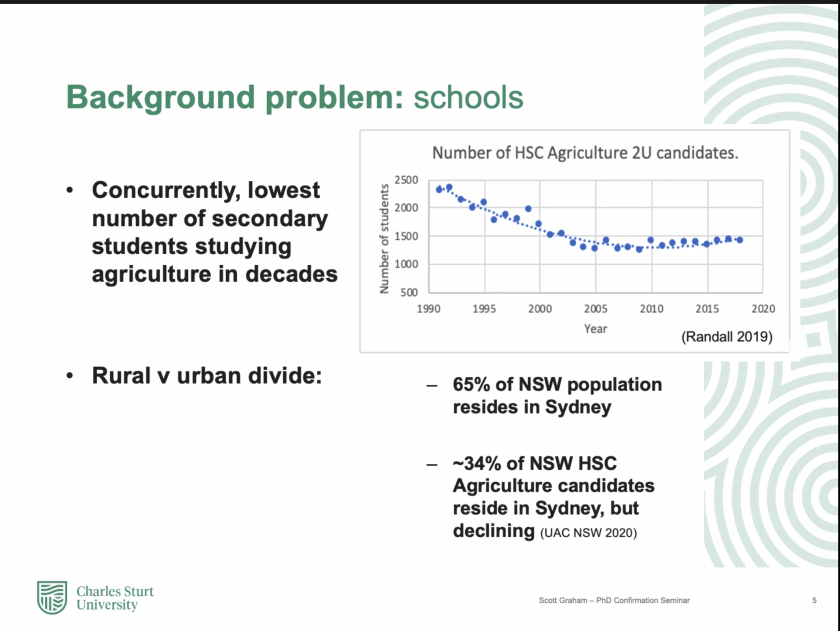
What Scott’s PhD is looking at is how do to we encourage more urban students to select agriculture as a subject with the ultimate aim they choose agricultural career pathways. Scott is ideally placed to research and report on this as he and Barker College have done a phenomenal job of the former and are keeping a close eye on the later

Barker College appears to be well and truly bucking the trend

Scott has identified the issues. Here is a few of them

At Action4Agriculture  we are complementing the work Scott is doing by tailoring our school programs to teachers and students NOT teaching/studying agriculture.  We are using similar principles to Scott and Barker College

Our programs are student-centred, individualised, contextual and culturally sensitive.

They involve key influencers, are accessible to all, can be targeted at specific groups when required and all evaluated for their effectiveness.

Students are mentored by our Young Farming Champions young people working in agriculture who are debunking stereotypes

  • Agriculture is not all Akubra’s and moleskins or mud and flies
  • 80% of jobs are off farm, 40% are in cities

Our Young Farming Champions represent the diversity of people in the agriculture sector. Students can see they are young people like them – they can be confident that they will fit in- that agriculture is a place where you feel identity safe.

What a great time to be on this journey with Scott with his research complementing our two year project with UNSW uni students working with BCG 

#action4youth #AGSTEMcareers

Agriculture and the “Leaders are Born Mindset” – why has it become part of our identity?

Its been a week of getting my confidence back by stepping up and saying yes to podcasts and interviews

Tonight I get to share my thoughts on leadership

Here is my leadership thought dump of other people’s ideas that resonate with me

Leadership is a process of influence to drive change

We can’t do it alone and we can do it in silos

We must join forces, share resources, skills, knowledge and experiences. Source Julie McAlpin RDA Sydney

I workshopped below with a number of bright minds who came to agriculture from the world beyond and put their toes in the water and went wow the disruptors are very brave people

Agriculture tends to have a “Leaders are Born Mindset”

This has been driven by agriculture’s traditional patriarchal culture where the first born son inherits the farm. This concept has been perpetuated for centuries.

It is a very deep-seated generational identity culture.

In this country women were not allowed to call themselves farmers in the census until 1994

In a sector where you are rewarded for learning to fit in and NOT challenge the status quo we are asking people to re-identify who we are as an industry and as people

Asking people to embrace the concept of “Leaders are Made” will be frightening for a lot of people

This has led to our traditional leadership programs being one off events with no clear pathway of what could be next

These programs are seen as “vehicles” to expose the “born leaders” and position them to fulfil their birth destiny.

and now to the work of the team from The Practice of Adaptive Leadership – Harvard Kennedy School 

How glorious is this concept

Leadership is an experimental art. We are all at the frontier.

Think of your life as a leadership laboratory. In that laboratory, you are continuously facing opportunities for learning how to be more effective in living a meaningful existence, and for making more progress on life’s deepest purposes and leading meaningful change.

Seeing life as a leadership lab enables you to try things out, make mistakes, strengthen your skills, and take pleasure in the journey as well as the fruits of your labour.

This from conversations with our wonderful Young Farming Champions

There is no one size fits all

Young people are doing it differently, the business model has changed

We don’t want to be part of “Old codgers organisations”

We want to ensure young people have a seat at the table

We want to ensure their voices are heard and valued

We can be shapers of “what might we be together”

Back to the brains trust that is the Adaptive Leadership team

The tools and tactics for leading adaptive change should be treated, we believe, in the same spirit as open source technology, made broadly available, so that people who lead adaptive change can learn from each other and improve their skills, and all of us improve our insights into practice.

Leadership for change demands inspiration and perspiration.

We present tools and tactics to lead and stay alive, to build up a sweat by inspiring others, to mobilize people to tackle tough problems while reaching high.

Our work begins with the assumption that there is no reason to exercise leadership, to have a courageous conversation with a boss or a spouse, for example, or to take a risk on a new idea, unless you care about something deeply. What outcome would make the effort and the risk worthwhile?

Trying to create something better from the current reality.

Growing tomorrow’s leaders today moving from reactive to future focused leadership

The practice of leadership, like the practice of medicine, involves two core processes:

  • diagnosis first and then
  • action.

 And those two processes unfold in two dimensions: toward the organizational or social system you are operating in and toward yourself. That is, you diagnose what is happening in your organization or community and take action to address the problems you have identified.

But to lead effectively, you also have to examine and take action toward yourself in the context of the challenge. In the midst of action, you have to be able to reflect on your own attitudes and behaviour to better calibrate your interventions into the complex dynamics of organizations and communities.

You need perspective on yourself as well as on the systemic context in which you operate. The process of diagnosis and action begins with data collection and problem identification (the what), moves through an interpretive stage (the why) and on to potential approaches to action as a series of interventions into the organization, community, or society (the what next).

Typically, the problem-solving process is iterative, moving back and forth among data collection, interpretation, and action.

Adaptive challenges can only be addressed through changes in people’s priorities, beliefs, habits, and loyalties.

Making progress requires going beyond any authoritative expertise to mobilize discovery, shedding entrenched ways, learning from mistakes, and generating the new capacity to thrive anew.

Just love people who wake up everyday to help us create a better world 


Advocacy at its worst – when agriculture chooses the divide and conquer route to market

When I got my latest email from the Australian Farm Institute this week  advertising their upcoming conference I couldn’t take it anymore and hit the unsubscribe  button

Our agri-politicans are a great example of how broken our political system is. Like our federal politicians they tend to follow the Allan Jones model and appeal to the prejudices of the masses

“The argumentum ad populum used in democratic political rhetoric can make political argumentation appear to be reason-based when it is not and subvert and undermine reason-based deliberation in democratic political argumentation.”(Douglas Walton, “Criteria of Rationality for Evaluating Democratic Public Rhetoric,” Talking Democracy, ed. by B. Fontana et al. Penn State, 2004)

Its the “them and us” model where farmers are pitched as victims,  and our state farming organisations are our white knights.

As an example when Agforce deleted their data  and lost their credibility in government they decided a roadshow with Peter Ridd was their advocacy model

Its too easy and so lazy to choose to pander to audiences by telling them what you think they want to hear.

This is not advocacy, this divide and conquer and it makes me cringe. Its time to rethink what advocacy looks like because Australian agriculture has some very serious human rights issues we should have addressed a long time ago.

We do have a choice

We can all work together and build a better world or we can focus on bettering our world

Who would you put on the podium if you wanted to hear from people who do advocacy well?

Beside the three very courageous women in the video above some names that come to mind for me

Cows Milk without cows. The birthplace of the Australian dairy industry is stepping up to answer the big questions.

The birthplace of the Australian dairy industry is stepping up to answer the big questions.

What will our rolling green hills look like in 50 years time if cellular agriculture means we can have all the nutrition cows’ milk provides without the cows ?


What will the view from my front verandah look like without the cows?

As a sixth generation dairy farmer this concept seems so far fetched but then so did the smart phone twenty years ago

We have a new council. They plan to make protection of rural lands a pillar. But what are we protecting the land from?

Is the science going to decide for us or are the property developers with deep pockets?

Where does the native flora and fauna fit into all of this?

We have an amazing opportunity to have our voices heard as part of the community consultation process for the new Local Environmental Plan.

I look forward to hearing the community’s hopes and dreams for the future

And what of our dairy farmers and the cows. What does Just Transition look like?

Me – I feel so passionately about Sam Archer’s vision I nominated hm for the 2014 Bob Hawke Landcare Award. Sam was runner up and like me retired from farming. Does that allow us to have the best of both worlds – inside and outside perspectives?