Agriculture on the Menu

Agriculture has an image problem. Sadly this is a statement I can make and non-one will contradict me. What is interesting is the silver bullet solutions that our sector puts forward to fix this.

The first one is always the TV campaign. First and foremost as mentioned numerous times in my blog, we (the agriculture sector) don’t have the multi-million dollar budgets required to run TV campaigns.

Secondly I am flabbergasted how many people in the agriculture sector think that the Stephanie Alexander Kitchen Garden program will solve all our woes.

Now don’t get me wrong this program is a great concept but lets put it into perspective with regards to agriculture and get a clear understanding of the role of the program.

Lets start with some things you might not know. The SAKGF ( Stephanie Alexander Kitchen Garden Foundation ) receives around 16 Million dollars in government funding. On top of this the big corporate GPT group have poured significant funding into the program

The vast majority of government funding comes from the Department of Health and the foundation has DGR (deductible gift recipient) status with the Australian Tax Office as a health Initiative.

The program is for students in years 3-6 only. The emphasis on the program is growing, cooking, sharing ( i.e. Sitting down and eating at a set table). In reality its frightening that the later even needs to be taught at school. We don’t sit at the table too often at our house either.

Each schools receives an initial grant of $70K-$90K to establish a kitchen and a garden. Thereafter costs are borne by the school, including for a part-time gardener/kitchen aid. This is approx. $45K to $60K pa for a school to raise themselves.

The primary purpose appears to be fighting childhood obesity and introducing new foods to children.

If we then look at the program as an “awareness raising” and “interest generating” activity for agriculture here are some of the messages I believe its sending. In the first instance its subsidised “agriculture” at its highest level. After the first round “subsidy” is spent then the school soon finds out farming costs you a lot of money. Then there is the lack of triple bottom line messages. What I mean by this is where does natural resource management come in, or lessons on agriculture’s contribution to the GDP or images and perceptions about career pathways in agriculture? Or innovation, technology and efficiency gains for that matter?. I could go on forever.

I am pretty confident Stephanie Alexander doesn’t see the program as an introduction to agriculture. Why does agriculture?

My role on the National Agribusiness Education, Skills and Labour Taskforce (NEST) has shown me and all other participants that whilst agriculture has over 1000 activities in schools there are less than 4 organisations whose core business is “awareness raising” and “interest generating”and they get a minimal amount of government funding.

We do however have quite a few organisations that are government funded in the participation (Tertiary education, skills and labour) space.

Yes agriculture, we have do have an image problem and that is because we haven’t got our priorities right.  The Stephanie Alexander Kitchen Garden program is not our magic bullet but the program is great example of when you get your act together and get smart you can access a considerable amount of public good money to get your story out there.


A DAY OF TALKING, EATING & DOING.

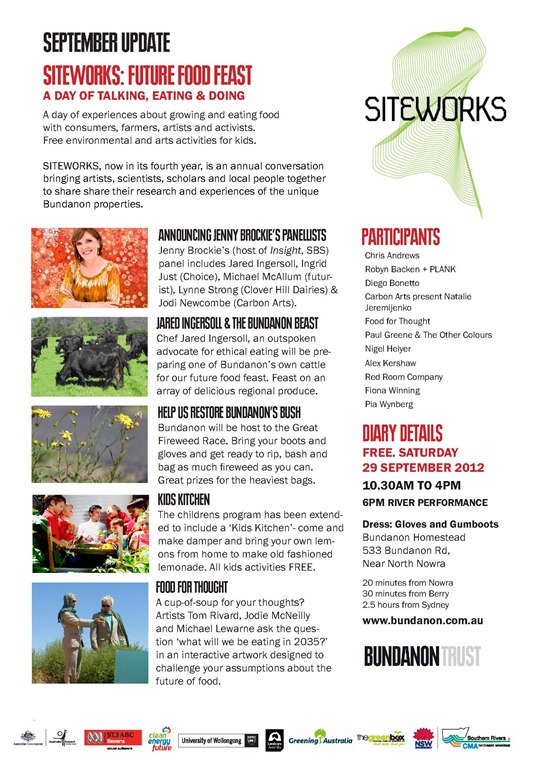
This Saturday my diary will see me on a 2.30 pm panel discussion led by Jenny Brockie of Insight  fame as part of the Siteworks event  FUTURE FOOD FEAST A DAY OF TALKING, EATING & DOING. The event is billed as a day of experiences about growing and eating food with consumers, farmers, artists and activists at the Bundanon Trust.

My fellow panellists are:

John Crawford – Scientist

Jared Ingersoll – Chef

Ingrid Just – Consumer Advocate

Michael McAllum – Futurist

Jodie Newcombe – Economist

and yours truly  Lynne Strong – Farmer

Siteworks_September 2012 update

I have done a little research on the philosophies of my fellow panellists and DR GOOGLE tells me we are a diverse group indeed.

I have also done a a little background on the ethical shopping habits of Australian consumers

Thanks to the Australian Food and Grocery Council and Net Balance report of 2010 there is an interesting report that sheds some light on the attitudes and behaviour of Australian urban shoppers.

It is particularly relevant to us farmers as the report focuses on the decisions customers make about selecting GREEN products.

By “GREEN” they mean environmentally friendly – but there is quite a bit of crossover in consumers minds about these products being good for animal welfare and for social reasons as well.

For example ‘Barn laid’ eggs are seen as a ‘green’ product by consumers when in fact they have a higher environmental foot print than caged eggs.

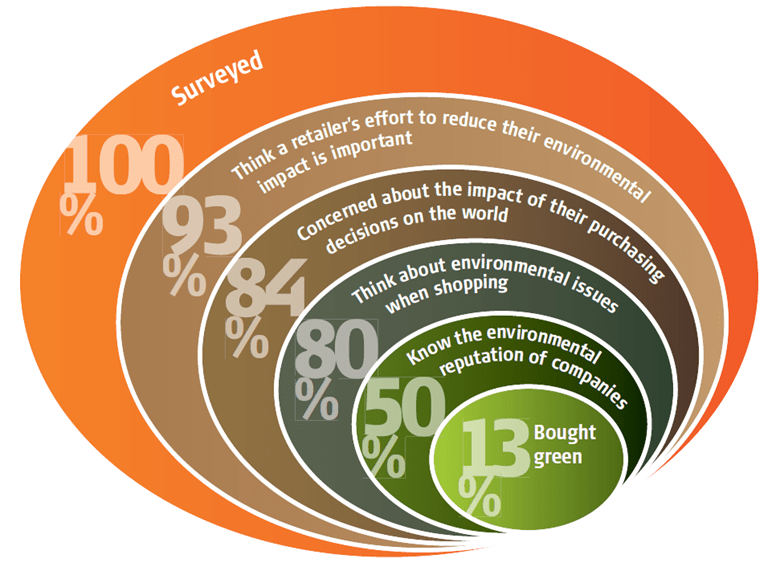
The report sheds some light on the differences between what consumers SAY they want… and what they actually DO. That is shoppers were asked about their ‘green’ product preferences and then their shopping trolley was actually examined to see what they had actually done.

And this is what our urban customers say..

.

image

Most people surveyed (93%) think that it is important for the retailer to make an effort to reduce their environmental impact and most are concerned about the impact on the environment of the products that they buy. I.e.… everyone else should be doing something!

  • 80% said they think about environmental issues when they buy
  • And 50% have taken the time to inform themselves of the green credential of at least some products….

But here is the killer – when their shopping trolleys were examined – only 13% had actually knowingly made a ‘green’ purchase

Personally I feel just as strongly about sustainable food consumption as I do about sustainable food production. I don’t seek out green products but I do strive to only buy what I need and waste as little as possible of what I buy

This Saturday I am looking forward to both listening to what my fellow panellists and the audience say and having my opportunity to share agriculture’s story and then sharing it all with you.

Living like the Packers

Michael and I don’t go away very much. In fact I am having trouble remembering  when we last had a break. I think it was 18 months ago when I was asked to speak at an MLA workshop and we took a few days and went up the Sunshine Coast. In fact I don’t think we have been anywhere in the last 5 years that didn’t involve me speaking at a conference. Sad but true but then we do live in paradise so I am not complaining too much. 

When we do go away we like to pretend we are the Packers on the first and last day. So we booked into the Crown Towers Melbourne on the way to the conference and finished the week at the Blackman Hotel (part of the Art Series of Hotels) in St Kilda Rd and what a contrast of extremes that proved to be.

Maybe it is the fact that the Packers own the Crown Towers and really know how to give you the Packer Experience. It was magnificent, from the man opening the front door, to service at the front desk, to the room service to the choice of all those magnificent restaurants along the Yarra to the shops.

Where I didnt shop 

The shopping experience at the Crown Towers.( FYI I left my credit card in the room)

The Blackman on the other hand couldn’t be a more ordinary experience. The cost of the room was 50% more, no-one opened the door, the person at the front desk is the concierge, the “Guest Experience” person ( still to figure out what that is) and from what I could see doubles as a waiter in the restaurant conveniently located next to the check in desk.

Let me show you a few classic so you can the gist

When I saw this machine in the cupboard of our room at the Blackman I go you beauty I can make an espresso. Now to do this you have to put the machine on the washing machine ( yes that was the only power point where you could actually reach the espresso machine) but there were no instructions, no cups small enough to fit under the spout let alone a jug to froth the milk. Oh well nice idea just impossible to execute

The Coffee Maker  

Then there was the bathroom!!!! it was so small I couldn’t get an angle to get a picture to show you what it was like, unlike the Crown Towers where you could even watch TV in the bath

Crown Towers TV Set in the Bath

Luxury Packer Style. The bathroom at the Crown Towers

I am beginning to think you can tell the quality of a hotel by the flowers. Yes you guessed it there was plenty of art at the Blackman matched only by vases and vases of plastic flowers.

Plastic Flowers Blackman Hotel

The Blackman Hotel where all the plastic flowers go to party

Flowers

The Crown Towers on the other hand looked like Floriade had come to party. Divine

It goes without saying we wont be visiting the Blackman again but I will be praying for another conference gig in Melbourne where we can have our first and last night in bliss at the Crown Towers.

Note to self when you book the hotel don’t just ask for them to put REAL milk in the fridge, ask whether the flowers are real or lifetime polluters 

We like to eat like the Packers every now and then so my next post will share with you the culinary delights of Melbourne

Dreams that are good for the Planet

As part of our Great Ocean Road sojourn we spent a night at The Great Ocean Rd Ecolodge.EcoLodge

Our hosts Shayne, a former dairy farmer with a Science degree majoring in natural resource management and his partner Lizzie, a zoologist have fulfilled a dream to create an Ecolodge that celebrates our natural resources and what a great way to be reminded just how special our natural environment is.

Shayne and Lizzie have also established the Cape Otway Centre for Conservation where their flagship project is the search for the highly vulnerable species the Tiger Quoll

Tiger Quoll 

The Tiger Quoll had not been sighted for over a decade in the region however recent physical sightings confirmed through identification of quoll scats have caused much excitement. The Tiger Quoll is mainland Australia’s largest, and the world’s longest living carnivorous marsupial and is also rumoured to be living in the rainforest at Clover Hill with local lifestyle farmers saying they are killing their chooks.

Quolls are vulnerable to decline for a number of reasons.They require certain climates and habitats and tend to live in low densities, and don’t have long lifespans  It is believed the biggest threat to the quoll is habitat destruction. Conservationists like Shayne and Lizzie are using population monitorings and public education to preserve the species as well as a dedication to preserving their habitat.

Some quoll populations have common latrines and this had led to innovative techniques to locate them. 

Shane

Shayne Neal trades cow poo in search of Tiger Quoll poo

Shayne is currently training dogs to locate quoll latrine sites, including this guy below who was determined not to let me photograph him. Apparently the dogs will become obsessed by latrine sites and Shayne is currently waiting on research permits to test out this technique which will hopefully locate and provide opportunities to put collars on the quolls for monitoring and research and help protect this native endangered species 

IMG_6212

Guests are also invited to assist with the rehabilitation of injured and orphaned wildlife and believe me they are very happy to get involved.

“Conservation begins with just one tree planted, one child instilled with a passion for the natural world, and one little orphaned koala rescued”

Feeding the Koalas 2 

German research intern Sabina feeds what I believe is most divine animal on the planet one of its 3 daily milk feeds.

IMG_6191

Friendly kangaroos enjoy the short sweet grass on the lawn in the early mornings and late afternoon.

IMG_6312

When I was about 8 I had my first visit to Taronga Park Zoo and my parents bought me a soft toy Koala just like this one and I still have it

IMG_6276

It was an incredible experience to get so close to these little orphans who will be released back into the National Park when the are big enough. They are fed milk 3 x daily and feast on the leaves of the Eucalypt Vinimalis otherwise known as the Manna Gum.

We also had the opportunity to feed the Silver Gliders who are very happy to lick a mixture of honey and ants directly from your fingers

IMG_6171

Dinner and breakfast at the Ecolodge is cooked by the gorgeous Kylie and it is a great opportunity to engage with the other guests

Kylie 

Our chef Kylie

During our visit we met three very fit friends who have been enjoying walking tours together for 25 years. A delightful mother and daughter originally from Sri Lanka and a young couple with a very unique story. Jesse and his gorgeous wife are also camera fanatics a bit like me 

Jessee

Jesse who is American met his Australian wife via the internet after three years of playing each other on the video game World of Warcraft. Jesse an IT specialist was originally  a bit peeved to find his clever opponent was a woman but is one happy man now.

I took a little video footage of Sabina feeding the Koalas – so cute

Thanks for the hospitality Shayne, Lizzie, Kylie and Sabina. Michael and I found the Ecolodge and its treasures a very special experience indeed.

Find out more here www.greatoceanecoldge.com.au

One of those days that makes your heart sing

We used to host lots of school visits which was pretty full on when you are milking 500 cows three times a day.

These these days we restrict the tours and host extra special children. Sometimes that’s preschool tours for children of our staff and friends and overseas visitors with children. Today we hosted an extra, extra special group of students and they were super excited as Win 4 was coming too and they knew they were all going to be on the news

On top of that yesterday we got 18 mm of much needed rain and today we all woke up to perfect sunshine.

There were some really special moments

IMG_5719

As you can imagine Peena the lamb didn’t just fascinate the cows

Look at this shot of the cow licking Peena

IMG_5728

The kids had a great time feeding the very well behaved calves

IMG_5683

IMG_5736

Peena assisted the camera man whose name was Attila and yes he got teased at school

IMG_5760

I got interviewed

IMG_5777

We visited Picasso Corner and Megan and Renae got interviewed

IMG_5789

and the cows on the hill made a superb backdrop

Well done Emma who does a great job of making all this happen smoothly and here is the WIN 4 footage

.

How will I spend $50K

This week I was honoured and humbled to receive agriculture’s newest and most prestigious accolade The Bob Hawke Landcare Award in front of 850 people at the Sydney Convention Centre.


As you can see from this picture I was pretty chuffed

_DSC0096

Me with National Young Landcarer of the Year and Young Eco Champion Megan Rowlatt

_DSC0127

The adorable John Carter from South East Landcare and Megan

_DSC0070

It was Michael’s first outing since his big op and he was determined to be there and he was pretty pleased that he pulled that off

The award comes with two extraordinary opportunities. Firstly I will receive a prize of up to $50,000 to develop my  knowledge and skills in sustainable land management and secondly I will also have an honorary position on the Australian Landcare Council for a period of two years.

So you may ask what am going to do with $50K. Well firstly I wont be spending on me .

What I would like to do is look at change and what drives change and what hinders change. I would like to look at this from three different angles. Firstly young people, secondly my generation and thirdly farmers in my region. My project will be cross industry and I look forward to meeting lots of new and exciting and dynamic thought leaders and doers in the agrifood sector.

I firmly believe farmers of today do not have the opportunity to access and develop the skills sets that will allow them to survive and prosper in 21st. Firstly we have to acknowledge that producing great food and fibre just isn’t good enough any more. Secondly we have just got to get out there more and build relationships with all the key players and pivotally get intimate knowledge and understanding of how the supply chain works.

We have got to be able predict what our customers are thinking before they think it.  We have to be able to predict what the processors and manufacturers are thinking before think it and we have to be able to predict what the supermarkets are thinking before they think it. We have to be at least one step ahead of the curve every step of the way. This will require expertise farmers have not traditionally had access to and my commitment to my fellow farmers is to change this paradigm in my lifetime.

My vision is for an exciting, dynamic, innovative and PROFITABLE agrifood sector that our next generation best and brightest see as a  career of first choice. My mission is to turn my vision into everyone’s vision and this will require government, industry, the community and farmers, in fact the whole of supply chain working side by side.

First stop for me is the Bush Capital next Tuesday where I have meetings with policy and decision makers as well as the opportunity to attend the DAFF Youth in Ag Think Tank and hear what the bright young minds see as the way forward for agriculture in this country

Let me re-share this reflection with you on why I farm and why I live and breathe my mission

I am often asked why I like being a farmer and to be honest it was never my lifelong dream to farm. I farm today because the people I most care about in the world farm and they are in it for the long haul.

I grew up on a farm and even though I enjoyed being hands on in the day to day running of the farm and the lifestyle that comes with it the idea of being a farmer was most definitely not on my list of top 10 professions.

I have been back on the farm for ten years now and I will be the first to admit farming is a highly rewarding profession for a multitude of reasons.

Today I will list just a few

Firstly farmers are an essential service, they feed people and whether people admit it or not everybody wants to be needed.

Secondly farming today is a very risky business and I like the mental intensity, the constant review process, the drive to get up each day and do it better. The fulfilling challenge of balancing productivity, people, animals and the planet

Thirdly inspirational people farm. Feeding, clothing and housing the world now and in the next 50 years is going to require an extraordinary effort. This means we need extraordinary people to take up the challenge. When I work with inspirational people, they light my fire, feed my soul and challenge me to continue to strive to make a unique contribution to agriculture and the community.

and then there is this

the satisfaction you get when you have managed to farm in a way that balances the needs of the rainforest and the animals who live there

Lynne In The Rainforest

with farm productivity that allows you to supply 50,000 Australians daily with milk whilst at the same time ensuring your cows cow remain happy and healthy.

AYOF  (3)

the buzz you get when next gen share the passion and commitment

Nick  (3)

the fascination of watching generations of cows tread the same path each time they walk into the paddock

IMG_7331

the amusement you get when the cow who detours to the water trough

IMG_7312

then charges down the paddock like a teenager to ensure she doesn’t miss out on the sweetest grass

IMG_7319

and the special relationships you develop with the people and the animals in your team

Emma Fav  (7)

the satisfaction of working with next gen

View album

Why I farm

VIEW SLIDE SHOW

to turn this

Picasso Cows Arboretum 07 Aug IMGP2068

into this

reveg east laneway

then this

IMG_7383

and today

IMG_7384

Picasso Corner a triumph for community partnerships, biodiversity and the farm

and then the raw reality of watching the circle of life each day. When the chickens you nurtured  from eggs are killed and eaten by a goshawk (thanks to twitter verse for identifying my nasty bird) and wake up next morning and remember the chickens got three weeks of a great life they wouldn’t have had without you interfering with nature. Even if in the end it was nature who decided they would play a different role in the food chain .

IMG_7301

I love to farm because its real, there is a true sense of place and time. There is an purity and an innocence that comes with a respect of the land that feeds us that living and working in the city will never deliver.

BTW Thank you so much to everyone for the emails, phone calls, flowers, twitter you have all been so wonderful with messages of congratulations. Totally overwhelming xoxoxo

IMG_5662

Ag Youth Think Tank

I am looking forward to attending this event next week immensely. All those bright young minds with a positive vision for the agrifood sector.

Ag Think Tank

Taking of bright young minds how proud was I too be sitting next to the National Young Landcarer of the Year winner at last nights award ceremony.

What an absolute angel Megan Rowlatt is and how exciting is it to have her as part of our team of Young Eco Champions . You can read her story and be inspired here

Megan Rowlatt 

Megan with her award at the NSW Landcare Awards

When you love what you do

In reality is there anything better for the soul than getting up every morning loving what you do. Check out this exceptional video by Young Farming Champion Tom Pearce

These days I live and breathe working with young people to turn my positive vision for agriculture into everyone’s vision

As a result I spend a lot of time working with Gen Y and yes every now and then you get one or two that reinforce the generation’s negative image of spoilt brats and make you rethink why you bother. 

According to Wiki

Gen Y

  • You’re entitled.
  • You’re narcissistic.
  • You have a tendency to job hop.
  • You have no work ethic.
  • You need constant affirmations of your overinflated self-esteem.
  • And you’re afraid to abandon the sanctuary provided by your helicopter parents.

But I am very pleased to report there are many young people in agriculture like Tom Pearce and the young people on our farm team debunking the stereotype and doing us all proud. Perhaps that’s the legacy of Gen Food and Fibre who have found a purpose and a direction and know they are making a real difference every day. 

Defining Excellence

Today is Father’s Day and it is the simple things in life Michael is enjoying today. Now that the infection in his knee is gone just to see him being able to walk without pain is a joy to behold.

Michael’s eyes lit up when Nick arrived at the back door and suggested he join him on the gator to round up the cows for the midday milking.

Then he spotted her, his favourite cowIMG_5266

This is Mandelyn Damion Simola. She has this fancy moniker like all our cows that is made up of three parts. The first part is the name of our stud ‘Mandelyn’ (Mike and Lynne) the second part is a reference to her father who is called ‘Erbacres Damion’ and the third part is in honour of her mother who was Parabel Broker Simola. Before we started milking 3 times daily in 2005  we used to show our cattle quite a bit and we did very well with the Simola family.

Now Damion Simola ( we call her Damion for short) is result of the technology known as Embryo Transplant which is explained rather impressively here.

In the dairy industry we have two ways of getting our cows acknowledged as setting a standard of excellence

You can take them to beauty pageants aka shows and/or you can participate in the classification system (explained here

Michael puts Damion Simola under microscope  

IMG_5276

From the front

IMG_5278 

Comparing Damion to a herd mate “Don’t look at her, look at me I’m the best” says Damion

IMG_5289

From the side

IMG_5290

What do you think Lynne. “Am I the best one”

IMG_5360 

Damion has made Michael’s day and he climbs back in the gator and yells out to me ‘ Nick is going to ring the classifier I am positive she is going to go ‘Excellent’ (highest accolade)

I hope so Michael you deserve a few wins, things have been pretty tough lately BTW Happy Father’s Day  

Milk comes from thistles or is that coconuts

This post is in honour of International Bacon Day which just happens to be today (now I bet you didn’t know that) 

According to Wiki ‘Bacon Day celebrations typically include social gatherings during which participants create and consume dishes containing bacon, including bacon-themed breakfasts, lunches, dinners, desserts, and drinks’.

Bacon Day was conceived in  Massachusetts in 2000.  International Bacon Day has now spread to Canada and other countries where it is often held at different times of the year   The record for the number of different bacon dishes belongs to Thomas Green, of Ottawa, Ontario who created ( I don’t think he ate them all ) 12 bacon dishes. This list included candied bacon, maple bacon and chevre points, bacon screwdrivers jell-o style, bacon vodka gazpacho, chili bacon vodka, pork stuffed with bacon, apple and sage, bacon donuts, chocolate bacon brownies, banana bacon cookies, bacon martini, bacon burger sliders and bacon and egg sliders. A veritable pork smorgasbord

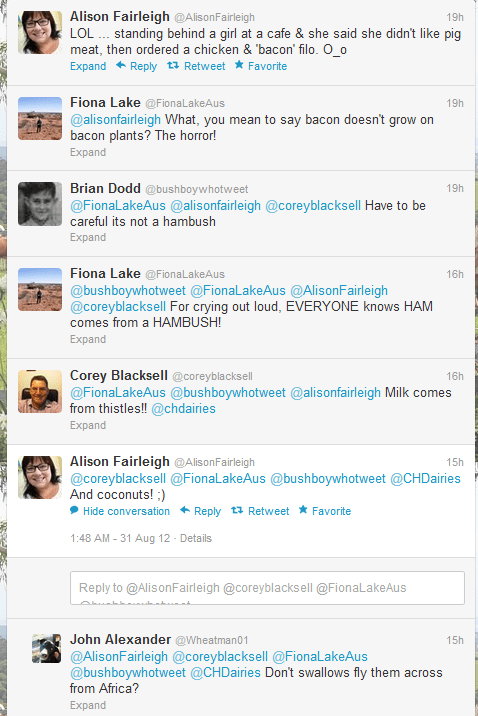
The post is inspired by this twitter conversation instigated by Farmers Angel Alison Fairleigh yesterday that believe it or not revolved around bacon and its origins

Bacon 

This reminded me of this picture and then of course who can forget that frightening statistics from the @OZPIEF study that found that too many kids think yogurt grows on trees

Cat milk

Now as you know it breaks my heart that farmers don’t have the marketing power and financial might to tell the real story of agriculture but as you can see there is one hell of a great opportunity out there if we can just get it right.

This week I spoke at the ABARES regional conference in Bega. This is part of what I had to say and a couple of my key messages    

I have a vision for agriculture that is full of promise.

I want an innovative exciting dynamic and profitable agrifood sector. A sector that our next generation best and brightest sees as a career of first choice

I see my role is to turn my vision for agriculture into everyone’s vision

We need smart and articulate and capable people working in agriculture so we can take it to the next level?

We need a supply chain culture that values our farmers

We need government and industry programs that believe in our farmers and invest in them?

We need to identify our young people in agriculture, nurture them and promote them and ensure we retain this talent.

There was a lot of questions from the floor about how we best tell Agriculture’s story with the limited resources and funding we have. It was very clear that the Young Farming Champions program concept truly resonated with everyone in the audience.

But there is nothing more powerful than a living breathing example of the program in action and no-one was more proud than me to see Young Farming Champion Jess Monteith in action on the ABARES panel which rounded off the conference  

Jess Sonia and Lana IMG_5196 

Jess Monteith, Young Farming Champion with Sonia Muir and Lana Mitchell  on the ABARES Bega Panel 

Now this isn’t an easy gig for a young person. Check out the panel topics which included demographic change, agricultural trade and markets in an Asian century, water, energy, trade and efficiency, future producers, labour and skills, future industries (& foods), new technologies and regional development  futures, Agri-tourism, Urban-rural relationships, land-use (conflicts).

When Dr Anna Carr from ABARES asked me to put forward a name that fitted the brief “Non farming background, young face – someone who has energy to burn and ideas in abundance who will show agriculture in a new context” Jess’ name sprang instantly to mind.

Like me fellow panellist Sonia Muir believes creating a community which is engaged with, & informed about agriculture is our most important job and the way to do this is to ensure we have articulate, well educated, charismatic young farming people telling our story for us.

The question was asked of Jess how do we get the real story of agriculture out there into the wider community

She answered “Engagement is the key, we need a nationwide network of young farming champions like the group I am part of, professionally trained to go into schools and tell our story and agriculture’s story to young people and the community” 

Jess is so right. Who better to tell the real story of food than the farmers, the hands that grow it and the caretakers of the land that produces.   

Its time to get smart agriculture we have a few skill sets to hone but if Jess is an example of what can happen with the right skills sets we could make no better investment