The spirit lives on

I am on a roll, five posts in five days and with a sudden do or die rush to hospital shortly before Christmas I have plenty of time to think as I recuperate and reflect 

Today with 2012 coming to end here is a little reflection from me on Australian Year of the Farmer which started with a bang and sadly closed with a whimper.

I know co founders Philip Bruem and Geoff Bell had all the best intentions and invested their heart and souls into their baby so I am not going to talk about all the things that went wrong but I do want to talk about some of the ways we as farmers can leverage the momentum going forward of what was a great idea executed with too little money and not enough grass roots involvement .

I’ve seen many things change for the better over the last 12 months. Colin Beetles reflects on the big picture here. I want to talk about what I see is happening at grass roots level and in particular the social changes 

I am noticing more and more farmers are less indignant. We know we cant afford to sit back and say people should appreciate us because we feed them. We know it is our role to build the relationships beyond the farm gate with our communities and our customers and the decision makers and start those two way conversations. Gone is the idea  that the community should wake up everyday and say “thank a farmer” and more and more our farmers are saying “ thank a consumer”

We are looking at new and innovative ways to raise awareness and build a sense of pride and support for our committed, caring and professional  farmers. I for one salute our farmers on their growth in 2012.

We are seeing a new type of AGvocay leadership working side by side with our agri- politicians and they are taking on the tough issues like Live Export. Its going to be a long road but they are cutting through 

There are now a lot of damned good grass roots initiatives out there stepping up to the plate and building the farmer to consumer value chain partnership and letting industry take a back seat and concentrate on what they do best  Whether it be quirky things like the Great Cafe Challenge, using social media like Ask an Aussie Farmer, sharing our stories like Fleur McDonald’s 52 Farming Stories in 52 Weeks, starting campaigns or writing petitions or just great photos like this one. A great example of its not what you say but how you say it that delivers the goods

Sheep On Verandah

Sheep on Andrew Irvine’s verandah during Murrumbidgee Floods, Wagga Wagga in March 2012. | Photographer: | Andrew Irvine

We know farming today has moved to a new dynamic. It is all about relationships, about values and about people – its all about selling the sizzle not the steak (whilst appreciating and respecting the cow that produces it ).

We know that selling the sizzle is very often out of our area of expertise and it we want to do it well ( and we must our future depends on it)  we need new skills sets.   In particular it is the women in farming who are seeing this new way of farming as their area of expertise and its the grass roots who are putting together the programs and providing the training and our women in agriculture are chafing at the bit to get involved and they are en masse.

Yesterday I mentioned Women Influential, there is the great work of Georgie Somerset and the QRRRWN network, Art4Agriculture’s Young Farming Champions Network and between us I am positive we could list another 50.

And back to Australian Year of the Farmer, Art4Agriculture has been very lucky to come to the attention of one of their celebrity ambassadors Sara Leonardi McGrath. I am very excited to tell you that for Glenn and Sara celebrating our farmers and the great food and fibre we grow is NOT going to finish at the end of 2012.

274822-mcgraths

Sara is a little dynamo and since I first met with her in January this year her mind has been ticking over looking at some clever ways she can use her talents and connections in the art world to build city country relationships and take them to a whole new level via a partnership with Art4Agriculture. She is great fun to work with and the team and students and schools involved are loving it 

The partnership starts with an exhibition of 8 of our Archibulls at Sara’s MCLEMOI GALLERY in Chippendale in the last two weeks in January Read all about it here.

Sara is also supporting us to launch another new concept which I hope to be able to share with you in early February. The Art4Agriculture team have been investigating ways to enable all Australian farmers to be in driving seat and ensure the success of the Art4Agriculture vision and programs and with Sara’s support we think this concept is goer

So fellow farmers whether you have #hadagutfull are #proud2farm encouraging the community to support #duopolyfreefriday ringing the bell on #agchatoz telling your story on #AskanAussieFarmer or are proud #youthinag the Year of Farming Families is just around the corner so lets work together and keep up the momentum and in the words of Connie Ross

Despite droughts, floods and bushfires, the spirit lives on.

Most farmers just never give in! ‘

Cause, despite the frustration, we’re feeding the nation

And that’s a great battle to win!

and remember its our “battle” – lets do it our way

Who’d be a farmer I hear you say

I love this poem by Connie Ross from Henty in NSW I am sure you will too


‘Who’d be a farmer’, I hear you say.

Well, it’s really quite hard to explain!

While we scan the sky and the weakest stock die …

We’re hoping and praying for rain!


So many decisions just have to be made;

What to sow, when to plough, what to cull.

Unreliable markets for livestock and grain,

Indeed, life will never be dull!


Long hours in the paddock and office as well.

The seasons dictate what we do.

Custodians only of this fragile land,

Demanding the best we can do!


Yes, prescription farming’s the name of the game,

For cropping’s a whole new frontier.

Alone, on a tractor, the moon coming up,

No chance for a sleep now, it’s clear.


Mustering sheep, marking calves, spraying weeds or whatever,

There’s always more work to be done.

But despite the long hours, there are many rewards,

And farming can also be fun!


A sense of achievement… a job well done,

When you’ve put up a brand new fence.

Or sinking a dam, maybe sowing a crop,

Well, its hard work … and yes, common-sense!


When you pull a live calf and the odds were not good,

Then he takes those first steps to his mother.

Well, it makes it worthwhile and you can’t help but smile,

Farming’s a life like no other!


It’s a joy to be tailing a big mob of sheep

When the land wears a mantle of green.

On a horse, or a bike, with a good dog in charge;

 Other farmers will know what I mean.


At the end of the day when the light ebbs away

And the quick pulse of life seems to slow.

 In the hush of the night all the cares of the day

Seem to melt with the sunset’s warm glow.


Despite droughts, floods and bushfires, the spirit lives on.

Most farmers just never give in! ‘

Cause, despite the frustration, we’re feeding the nation

And that’s quite a battle to win!


Makes you soon realise, what matters in life.

‘Who’d be a farmer?’ you say.

Well, if I had a fresh chance to do it all over …

I still would choose no other way!


By Connie Ross,  Henty


Nick & Tractor B & W view

Sue Middleton nurturing people who feed people

I recently was lucky enough to catch up with the remarkable Sue Middleton twice in a period of four weeks.  Sue was the “RIRDC Australian Rural Woman of the Year 2010” and farms with her husband Michael in the Wongan Hills In WA.

Sue and I share a similar passion and commitment to drive change in agriculture. Sue is particularly committed to building capacity in rural women and me in our young people.

Sue is heavily into making a difference, where it counts, at policy level. According to Sue ‘Policy is a dark beast, untraceable. to influence policy and make a difference you have to learn the skills – it takes patience and tenacity.’ Mentored by Cathy McGowan who Sue’s says ‘taught me the value of pinpointing what makes a difference to the people you want to convince to help you solve your particular issue. If you want results, discover what engages your audience, find where that intersects with what you’re after and speak to that.’

Sue’s commitment runs in the family and her daughter Lizzie Brennan together with Catherine Marriott has recently set up Influential Women to ‘recognise the inherent power women have as natural communicators and seek to nourish their infinite potential’ Lizzie and Catherine custom design training to draw upon the strengths of women and build their skills and confidence in communicating their unique story.     

Sue Middleton Jenni Hawkins Lynne Strong and Lucinda Corrigan

Sue Middleton, Jenni Hawkins, me and Lucinda Corrigan at CCRSPI conference in November 2012

We first featured Sue as part of our Art4Agriculture case studies in 2010. See here. Today I want to share with you what she had to say when asked the question ‘What do I wish non-farmers and the Australian Government understood about farming?” as part Fleur McDonald’s 52 Farmers in 52 Weeks series for Australian Year of the Farmer. Read it in full here  

What do I wish non-farmers and the Australian Government understood about farming?” 

Sue answered …….

Firstly that what we do is really risky and we are at the mercy of weather.  That means that not every product we produce will look the same. Oranges with a blemish on their skin are just as good as fruit without a blemish on it.  Blemish is caused by wind – it’s a very natural part of fruit.  Learn to eat fruit and food that doesn’t look perfect but is identical in every characteristic that impacts your health!   This one shopping habit alone will save you dollars in your pocket.

We are wasting 50% of the food we produce in Australia. We don’t need cheaper food – we need to stop taking good productive energy and turning it into waste!  If people focused a little bit more on reducing the food waste from their homes, they would find their food bills dropping dramatically.

Buy as direct as you can- each week take one product that you consume and find a way of purchasing it as directly from a farmer as possible.  Start reading labels  – be ferocious in your food stores – demand locally produced food where you know the food production standards are high.  You have all the power – exercise it – start reading food labels and start checking where food comes from.  We do supermarket checks regularly and supermarkets frequently label fresh food incorrectly and say it comes from WA when it really comes from interstate – check the labeling and challenge the stores to be more accurate.

The government needs to understand the huge impact of policy changes.  The banning of live trade to Indonesia has rippled through WA agriculture and caused huge impact not just on northern Australian cattle farmers.  We now have $500k of straw in our paddocks we can’t sell because the bottom fell out of the pellet market.  The knock on effect of decisions like the cessation of the trade has been gigantic.  The government doesn’t pick up that tab, and they need to be VERY cognizant of the impact of their decision making.   We do not need them to add to our market risks.

Finally I would like people to know we are in a very technical game. It is very science driven and we utilize all knowledge we can to improve our sustainability constantly.  Looking after the land and our animals is a priority for us.  But we are in a marginal game and we are unprotected in the world markets competing against countries that are highly subsidized.  It is not a level playing field in this globe!  To keep our noses ahead we need more investment in research, development and most importantly extension so we can keep learning and driving our businesses productivity and profitability further.

And what does Sue love about being a farmer?

It is great to drive around the crops doing a crop-run when they are growing well.  There is no greater pleasure than growing a great crop.  Conversely in the dry years it can be tough when the rain doesn’t come and the crops get compromised.  It is also very satisfying to see our animals grow well and we love to see them in good condition. 

Growing things is what we love.

The line in the sand

I was recently asked to speak at the CCSPI Conference ( Climate Change Research Strategies for Primary Industries) by my good friend Esther Price who is the guru of agricultural conference event management in this country and I said no

I said no because

  • Firstly it was the last session of the day on the last day of the conference and everybody knows no-one hangs around for the last session of the day on the last day of the conference.
  • Secondly because I had a hell of a lot happening in my life and I was starting to spread myself way too thinly and felt I wasn’t delivering to the level Art4Agriculture deserved, our Clover Hill Dairies business deserved, my family deserved and I what I deserve. Recently my wise friend Victoria and I spent a Sunday putting together a strategic plan for me. Wow how organised is that.  So I ran this conference through “is this conference core business A to Z scenario?” and its screamed “NO NO NO – this is not the best use of your time Lynne”
  • And thirdly farmers rarely get paid to speak at conferences and in the majority of cases I think its because we don’t ask and this has got to stop.  So for the first time I drew my line in the sand and emphatically said no.

Well Professor Snow Barlow head of the CCRSPI conference committee is a bit like me in that ‘no often means almost yes’ and the next thing I know he is on the phone giving me 20 reasons why I should be there. I happened to mention that I would like to hear Bernard Salt speak as well as Sue Middleton and Dr Jude Capper. Snow then had a light bulb moment, though he couldn’t promise anything, but would breakfast with Jude, Sue and Bernard tempt me.? Did I ask to be paid for speaking you ask.?  NO ( hang my head in shame) I crossed my line in the sand. BTW This is firmly on my New Years wish list for 2013 and I see a Farmers Speakers Network looming on the horizon.

Having breakfast with Sue Middleton was easy – we are already good friends, but Snow did not deliver Bernard nor Jude – but he did put forward a very exciting proposal at the end of the conference and I look forward to catching up with him on that.     

My gig was on a panel and to Snow’s credit he did get a lot of people to hang a round. Panellist members were Lynne Strong wearing my  farmer hat , Dr David George (National Climate Change Adaptation Research Facility), Caroline Brown (Department of Primary Industries, Parks, Water and Environment Tasmania), Professor Tim Reeves (Tim Reeves & Associates) and Dr Mark Howden (CSIRO).The audience in the main was researchers and government and policy makers and some farmers

The brief “ A discussion on climate change needs into the future: in light of the knowledge exchanged at this conference, what are the climate change research and capacity needs for the sector into the future? Perspectives from a leading farmer, research manager, policy analyst, research director and leading researcher. Panellists will provide their own perspectives on the topic, before opening the floor to audience questions and open discussion”.

So what did I have to say? 

Here is the guts of it ………

The most immediate threat to agriculture in this country is I believe not climate change, not drought and not water restrictions. It is the disconnect between farmers and their customers and consumers’ lack of understanding and discomfort with modern farming practices

This has led to whole new playing field for both farmers and researchers. Consumers today are 5 x more interested in knowing that you care about the environment and your animals than in knowing that you have the knowledge to look after to them. That is values outsell science 5 to 1

My work in the community shows me the social environment that farmers find themselves in today is totally foreign to most of them and they in the main don’t have the skills sets to engage in two way conversations with the community and build the bridges that will address this

Whether we like it or not farming today is under more scrutiny than ever and increasingly accountable to the public 

Farming today

  1. Is all about people
  2. Is all about relationships
  3. Is all about values

It’s a marketing exercise. Today our farmers have to sell the sizzle, not the sausage. Delivering the sizzle is what drives me ( I love this analogy but cant take credit for it)

I have been asked to represent ‘farmers’ on this panel and what they want with respect to Climate Change research & capacity.

If I asked a group of 100 farmers this question I know I would get at least 100 different answers.

If I asked a group of 100 scientists this question, I would probably get 300 different answers – and I probably wouldn’t understand any of them!

Seriously the point I am making here is

•          We need to remember that ‘farmers’ is really a collective noun for a diverse group of individuals that happen to produce food and fibre. Every individual in this group has different perspectives and opinions about what Climate Change means to them

•          researchers have a major problem in communicating what they do

What farmers and researchers do have in common is they both have a product to sell  and everybody in business knows you go broke fast if you are selling a product nobody wants to buy  So we have a great opportunity to work together here to keep all of us in business  

So today I am going to try and tackle all of these points through a partnership model.

I will do it from my personal perspective but I hope the insights I have gained as a farmer, a climate champion and from the broader community through our Art4Agriculture programs will prove useful to you.

Point 1

Let’s consider the needs of farmers first. Generally farmers are practical people and they want the SAUSAGE. Most think that the research is pretty well covered.

Personally – I am a Champion of targeted research I get excited by the possibilities but sooner rather than later. I want a tangible product that I can apply on my farm… when I am ready for it (i.e. the sausage).

Slide1

The product (technology or technique) has to directly relate to satisfying my needs. If it ticks any of the following it will go on the list of things to consider

Slide2

Note that this is not the list of things that ‘get done’… just the list of things to consider at this stage! The list of things to get done is a completely separate list, kept securely on the fridge between my husband and his breakfast. (see footnote)

Slide3

Get on this list and you have it made – Poor man no wonder he has indigestion He is lucky to get time to sit down for breakfast.

Your Climate Change product must in this orderSlide4

Slide5

Point 2

Let’s now look at the most important person in the value chain – the consumer

Now – Has anyone eaten raw sausage? I don’t recommend it. For your Climate Change SAUSAGE to be palatable you need to cook it i.e. add some SIZZLE.

So whilst some of you are busy translating research into tangibles for farmers, we really have some work to do selling the SIZZLE to consumers in the broader community.

Slide6 

Remember that farmers are a part of this broader community too.

Our customers today have a very poor understanding of modern agricultural systems and have become distrustful of the way we manage our natural resources and care for our animals. We have to admit – we seriously have some work to do!

Farmers and researchers need to engage with the wider the community so they are comfortable with what researchers and the farming community are doing to tackle climate change – we can’t build extra value in our food and fibre products unless our customers KNOW and are COMFORTABLE with the core values of the product.

People want to make the decisions to buy they don’t want to feel they have been sold something that doesn’t fit with their own values. It is all about TRUST and you build trust through engagement and communications.

My Art4Agriculture programs have been directly and very successfully targeting these issues but there are plenty of other ways to reconnect using Climate Change as a common issue both communities have an interest in.

In conclusion – if you ask me about what the key Climate Change needs are for the farming community then I would advise you to crank up the barby and get those sausages sizzling…

Provide me with Climate Change SAUSAGES that are tangible – preferably with bread and tomato sauce so they target my needs and I add them to “the List”.

Make sure your sausages are well cooked – with plenty of SIZZLE. I want to make sure everyone around me can smell how delicious they are, and know what a great product you have developed. Particularly the broader community needs to know what I am eating – and why I am doing it for them. 

Engagement is the key and there is no-one better positioned to kick goals in this high priority area than a collaborative and cohesive partnership between farmers and researchers.

The time is now – Let’s do the sizzle together like its never been done before

Slide7

Bon appetite!

Footnote: This list is wearing my farmer hat, my other hats have different priorities – no wonder I need a strategic plan

Martin Place like you have never seen it before Our sheep and cattle farmers bring the farm to the city

As a follow up to my post yesterday on Brand Australia and how Australian farmers must find innovative ways to tell our story. I have some exciting news for you today, Meat and Livestock Australia are doing just that  

As you know the Art4Agriculture team pour their heart and soul everyday into promoting our farmers and are  successfully rolling out in school programs using art and multimedia  to tell agricultures story to the 3.5 million school children in Australian schools ( well with more money we could reach that many)

Today Meat and Livestock Australia (one of Art4Agriculture’s partners) have taken their sheep and cattle farmers stories to the Sydney CBD via their Target 100 initiative to turn Martin Place in Sydney into a virtual farm and how impressive it is

Sydneysiders beamed onto Aussie farms via the giant screen 2 (1) 

This has been done before overseas but I believe it is a first for Australia. In May 2010 the Young Farmers Union of France transformed the famous avenue in Paris the Champs Elysées, or Elysian Fields into a massive celebration of French farmers .

The-Champs-Elys-es-in-Par-006

By bringing in 8,000 plots of earth and 150,000 plants to the city and installing them, amid sheep and cattle, along three-quarters of a mile of the thoroughfare, farmers were attempting to highlight an aspect of French life which they believe is too often overlooked by Paris.

Organisers of the event, which cost private investors €4.2m to stage and ran for 2 days said they hoped to attract up to two million people to the newly bucolic avenue running from the Arc de Triomphe to the Place de la Concorde.

From wheat and mustard to grapevines and Limousin pigs, the avenue’s pavements have been carpeted with lorry-loads of produce from all over France, among it 650 fully grown trees and a vast array of flora intended to symbolise the country’s biodiversity.

Gad Weil, an outdoor events planner coordinating the Nature Capital event with the young farmers’ union, said the spectacle had brought people together in order to showcase Gallic agriculture.

“Lorry drivers, truck drivers, farmers, woodsmen, events planners: these men don’t usually work together, but here everyone is doing so with a smile,” he said during the night-long operation that transformed the Champs Elysées into a long strip of greenery. Visitors were able to buy plants and produce for themselves, as well as tasting regional specialities and took part in a mass barbecue organised by Paris butchers. ( borrowed from  http://www.guardian.co.uk/world/2010/may/23/french-farmers-champs-elysees)

Australian cattle and sheep farmers last night transformed Sydney’s Martin Place into a cattle and sheep farm complete with live animals, native bushland and farmers beamed in via a giant screen to talk directly to the people of Sydney.

Farmer, Stuart Austin from Katherine Northern Territory (1)

Farmer Stuart Austin in Martin Place

For today and tomorrow only, members of the public will have the unique opportunity to speak directly to cattle and sheep farmers without leaving the city. The giant screen will project them into Aussie farms using virtual technology and by doing so will help bridge the gap between urban and country Australia. Sydneysiders can also enjoy a free lunchtime barbeque and have the chance to win meat trays worth $50.

Sydneysiders visit the Target 100 Virtual Farm in Martin Place

As shown in a recent research survey*, more than half (58%) of urban dwellers are interested to know about the process undertaken to produce the beef and lamb they consume. The Target 100 Virtual Farm presents an opportunity for open discussion with Australian farmers leading the charge in sustainable farming practices.

“This is a great opportunity for Sydneysiders to meet and talk to real Aussie farmers and gain a better understanding of how beef and lamb get from the paddock to the plate,” said Queensland beef cattle farmer, and Target 100 spokesperson, Kara Knudsen.

Farmers, Kara Knudsen and Stuart Austin in Sydney's Martin Place (1)

Farmers Kara Knudsen and Stuart Austin in Martin Place

“I anticipate people will be surprised to find out what actually goes into managing a farm. It’s not just about mustering cattle or shearing sheep; it’s a full-time job that requires knowledge of botany, hydrology, geology, entomology, zoology and meteorology. We’re excited to give our city friends a sneak peek into what we do,” Knudsen added.

Popular journalist, blogger, qualified health coach and Target 100 ambassador, Sarah Wilson will also be on hand at the Target 100 Virtual Farm, sharing tips on why beef and lamb are an important part of a healthy and sustainable diet.

“I’m keen to encourage people to gain a better understanding of where their beef and lamb comes from. My eating philosophy is one that encourages a diet that’s high in protein, so beef and lamb are often on the menu. The Target 100 Virtual Farm will give us the chance to ask the farmers all we want to know about the practices that go into farming the beef and lamb we love to eat”, said Sarah.

Art4Agriculture event director Kirsty John will be joining the buzz and connecting up with the Target 100 team in Martin Place tomorrow and I am looking forward to hearing all about it 

Time to get our act together and tell it like it is OZ farmers

Today’s blog post is in the main a refection on this article by Mick Keogh (reprinted below) from the Australian Farm Institute “Australian Food is probably better and cheaper than US Food but Australian farmers just don’t tell anybody”

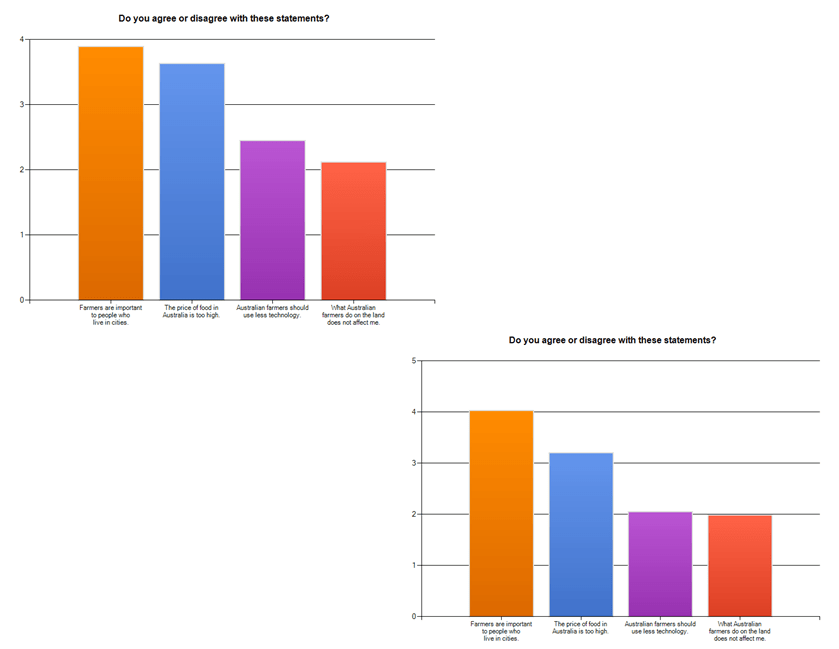
As part of the Archibull Prize we undertake entry and exit surveys to get an understanding of what young Australians today think about agriculture and farmers 

As part of the survey we ask the students if they think food in this country is too expensive. We use content like this post to raise awareness and then ask the question again in the exit survey

As you can see from these graphs (entry survey on top left and the question do you think food in this country is too expensive is in blue) we are cutting through slowly but surely.

Slowly we believe is because the misconception that food in this country is too expensive is not rebutted by farmers and promoted by individuals with an agenda that says food at rock bottom prices ( and to hell with the consequences to farmers, their livestock and the environment) is a birth rite in this country  .   

image 

Food as a percentage of income in Australia is 10% according to http://cironline.org/reports/map-world-food-statistics-2971

Food for 9B OZ 

  In the US on the other hand food as a percentage of income according to the same source is 6.4%

Food for 9B US

Mick Keogh in this article challenges the accuracy of the US stats

While travelling through the USA and talking to both farmers and agricultural policymakers, it is not uncommon to hear the claim being made that US farmers produce the cheapest and the best food in the world, and for that reason US consumers should be grateful, and the US government should maintain current farm support policies. Given the unfailing generosity and courtesy of people involved in US agriculture it would be rude to challenge that assertion, but it does raise the question of whether such claims are valid. 

A careful comparison of US and Australian food prices would be a major task, and no doubt the comparison would vary depending on seasons and relative abundance of different products in different locations. However, a quick and dirty (and statistically invalid) comparison reveals an interesting result. 

Using the online prices advertised by one major Australian retailer for a select basket of basic grocery items and comparing those with the prices charged in-store for (as near as possible) identical items in a major US grocery retail outlet, and including adjustments for sales tax (not included in US grocery shelf prices) and relative exchange rates, the following graph displays the differences in prices per standard unit (Kg, Litre, dozen, standard weight loaf) in percentage terms. 

Grocery prices

Meat items were generally cheaper in Australia, fruit was generally cheaper in the US (although that varies by location), vegetables were mixed, and milk and home-brand white bread was markedly cheaper in Australia.

For the full ‘basket’ of items, assuming a consumer purchased one unit (Kg, Litre, dozen, loaf) of each item, the total cost in Australia was 14% less than the cost for the US consumer.

As noted, this is not in any way a statistically valid comparison, but as a quick snapshot it seems to indicate that food prices in Australia may in fact be marginally cheaper than those in the USA. And when it comes to quality of fresh produce, first impressions are that the quality of trim, packaging and products are generally better in Australia than the product on offer in the USA. This applies in particular to dairy and meat products (and to coffee, which is absolutely atrocious in the US!).

One of the major differences observed between farmers in the two nations is that Australian farmers are generally more reticent about proclaiming how good they are at what they do, and seem less willing to make claims about how cheap and good food is in Australia, compared to other nations. 

Perhaps its time Australian farmers and the agriculture sector started to more actively promote the benefits they provide for Australian consumers, and the advantages more generally for consumers who buy Australian farm products.

Another great article by Mick on how we could do promotion better can be found here

First rule of negative social media Woolworths

Its interesting isn’t it? There is lots of wise advice out there about how to handle negative social media and one would think Australia’s biggest employer could afford access to the right expertise in this area?  Apparently not. Case in point my post yesterday on the fallout from Woolworths CEO Ralph Waters insensitive comments about Queensland dairy farmers  See here.

Now I am confident there is not one person out there me included who hasn’t said something or done something they later regret especially when it affects innocent people en mass. A recent and horrifying example of this is the death of the nurse involved in the Prince Edward Hospital debacle kick-started by a prank by a Sydney Radio station

Now one-one is suggesting Ralph Waters comments fall into this category but they definitely were insensitive and unnecessary and kicking farmers in the guts who are doing it tough through no fault of their own  and especially when it is a campaign heavily supported by Mr Waters company Woolworths that he is Chairman of the Board of  that is significantly adding to their pain

So Woolworths any Google search will elicit the first rule of negative social media

Be honest. If your brand makes a faux pas, apologize publicly to your fans. Ignoring the issue often makes it bigger, adding fuel to the fire”.

Ignoring the issue or hiding the  fallout in this case see here has launched a campaign that is the brainchild of one very passionate young dairy farmer and super AGvocate Stephanie Tarlinton @duofreefriday and @proudlydairy

Stephanie is a young lady people listen too and I would not be the least bit surprised if Duopoly Free Friday doesn’t build to a point where it does impact on Woolworths sales on Fridays such is the innovative thinking behind the idea and the passion, genius and support networks of the founder

Hello world meet Stephanie Tarlinton

Steph and her parents

Stephanie with her #soproud parents at the recent Dairy Research Foundation Symposium where the audience voted her their favourite speaker.

This what Stephanie had to say at the symposium that reduced many in the audience to tears


Slide1

Today I’d like to have a conversation with you,

But firstly so you know who you’re talking to, I’ll tell you a little about myself

I am

  • Firstly a proud dairy farmers daughter
  • The 2011 Land Sydney Royal Showgirl Runner Up
  • An Art4Agriculture Young Farming Champion
  • A National Junior Dairy Judging Final winner
  • A Woolworths Agricultural Business Scholar
  • A Royal Agricultural Society of NSW Rural Achiever
  • A NSW Holstein Youth Exchange Awardee

And a young women who has a degree in Agricultural Business Management, loves to travel and feels just as comfortable in a pair of high heels as I do in my gumboots

My story started growing up on my family’s dairy farm which is located on the far south coast of NSW just outside of the township, Cobargo. My family has a long association with the region and in particular the dairy industry.

I have the deepest respect for the humble dairy cow which has provided for my family and wider community over the last 148 years we have been dairying.

So you ask with five generations of dairy farmers behind me what is it exactly that I am going to talk to you about.

No it’s not the quickest way to move a strip graze fence nor is it the best way to dry out the inside of your gumboot when you misjudge the depth of the creek (however Mum’s good hair dryer can perform this task if she isn’t home)

Slide2

In fact the reason I am here today is to share my experiences of having conversations of change;

Conversations that inspire & engage.

Conversations which have the ability to empower another individual by sharing knowledge and experience.

Such conversations we all have the capacity to have as a way of connecting with those in the community who have not experienced a business/way of life, which is common to us all in room, dairying.

I’m referring to what is more commonly known as a way to help bridge the rural – urban divide.

The Bridge has been built however we need to open the pathway for consumers on either side to be able to connect with those involved in producing our food and fibre products.

With a considerable amount of Australia’s population living in urban centres, those classified as rural including the country’s farmers have an important role to play in reducing the separation between communities.

Engaging in a conversation with someone who has little knowledge of how their food moves from the farm gate to their plate has the potential to give them insights into the real story of modern agriculture.

Connecting with consumers on shared values increases the possibility of forming trust in farming and those whom participate in agricultural business.

Sharing personal stories allows consumers to gain insight and confidence in farming systems, ultimately building connections and breaking down barriers in society which further decreases the divide.

Members from either side of the divide consume food in order to survive and this is a fundamental feature of unity and mutual dependency. A simple discussion on the origin of a food product has the potential for rural person A to connect with urban person B to produce an outcome of greater understanding C.

A + B = C highlights the impact a single conversation can have if society will allow itself the simple pleasure to connect and challenge perceptions.

To quote Ghandi, “be the change you want to see in the world” reinforces the challenge that in order to create ways in which to build relations between the two sectors of society one must accept their role and be prepared to create opportunities for conversation.

For the agricultural sector to develop positive images and perceptions of farming practices and lifestyle, individuals who align themselves with this segment must be prepared to participate in the dialogue.

This is something that after hearing on numerous occasions the comment “oh you don’t look like a farm girl” I regularly seek out opportunities to participate in the dialogue others may see as a waste of time. As the quote behind me states I am the being the change I would like to see and that is having a greater number of consumers with an understanding of just who is putting the milk in their latte and the process it took to get it from the cow to the city cafe.

Slide3

One opportunity I recently had which allowed me to participate in conversations with next generation of consumers was through the Art4Agriculture Archibull Prize program as a Young Farming Champion. In September last year I made my way to a primary and then to a secondary school in Sydney which saw me become their face of farming.

A face which they were not expecting which was clearly indicated to me “oh so YOUR the farmer” with an intrigued look up and down at my business suit and heels, with a laptop and mobile phone in hand.

I see dairy farmers as business people who work in the food supply sector and although we spend time in gumboots they are what I call “tools of the trade” much like my heels I guess!

I took this role on as it allowed me to challenge the stereotype of farmers which is so often poorly portrayed in the media, and provided me with an opportunity to share my experience of growing up on the dairy with children who do not have such a luxury and to share the great story that is dairy.

I would now like to share with you one tool I used which has allowed me to engage in conversations;

This is a conversation I have not only shared with you here today and at my schools last year but it has also been shared with the rest of the world via YouTube, In fact my video has been viewed by over 2500 hundred people, an audience I would have not been able to reach with my messages if it had not been for my desire to connect with others in the community who have been labelled on the urban side of the divide.

I believe that challenging stereotypes through highlighting our connections has the ability to show that as people we both have a mutual dependency on food and therefore on one another as a producer and a consumer

I am proud to come from a dairy farm, to be a small town girl, a rural consumer and I see this as one of my greatest assets, I have firsthand knowledge and experiences of food production and therefore I have something to share through conversation with those whom are classed as being from the bright lights of the city.

Slide5

One girl who calls the bright lights of Sydney home is Year 7 student Sophia, standing second from the left in this photograph. I would now like to take a moment to read you an email I received from this young girl after being to her school

Dear Stephanie,

My name is Sophia and I met you when you visited our school. I am writing to you to tell you how inspiring and amazing your visit was.

My sister Olivia and I both attended your visit and it truly was a life changing experience. As we both live in a very suburban area we don’t get to see a lot of Australian Farmers. What was so incredible about your visit was that you taught our school that farmers are real people too. Your visit and video showed us just how important Australian Farmers are and just how much farmers are like us.

So I am writing to say Thank you. My family and I are originally from NZ however we moved here 5 years ago. I feel like I now understand that the foundation of Australia is made up of Farmers. You have really changed the way I think about farmers and I will now make it my mission to help spread the word, “Farmers are real people too” oh and that “farm girls love their shoes”

Regards Sophia

After reading this email I was touched at how my simple video which showed nothing more than my life on the farm, our girls aka the cows, a few pairs of shoes and some creative dance moves had the ability to inspire a young woman. I was touched at the response I received as for me I was just having a conversation about the everyday things that form life on our farm however for this particular girl my ordinary wasn’t so ordinary.

Slide6

I chose to share Sophia’s story with you as I believe it is an example of how it only takes a small conversation or connection to create big outcomes. For me knowing I had planted a seed in one person’s mind regarding the way she thought about farmers provided me with the greatest sense of satisfaction and determination to then tell others about my story and encourage them to tell theirs.

In my dealings with people in the agriculture sector I have often found farmers to be very humble people, my parents are a great example of this, however I challenge you all to be inspired by the words of William James –

“Act as if what you do makes a difference. It does”

I believe as dairy farmers we make a difference, everyday. Everyday there is fresh, safe healthy dairy products available to consumers which have all originated from the only true white gold, milk. It does make a difference to people’s lives that is because the nation’s dairy farmers got out of bed this morning that have food on their table, jobs to go to, communities to live in, someone to call a neighbour, a friend.

I am confident there are many other ways which you all make a positive difference to someone’s life simply due to your actions as a dairy Farmer.

As farmers if we would like others in the community to acknowledge this difference we make to their lives we must be prepared to share with them, to build trust by finding common values and to firstly acknowledge and be proud of the role we play.

I see no easier way to do this then by having a chat with someone. Whether its a taxi driver, the person next to you on the plane, the person at the supermarket checkout, your hairdresser, or your child’s teacher. Share with them your story, challenge the stereotype, leave them with notion that today they met someone who is PROUD to be a dairy farmer or working in the dairy industry.

Conversations provide a key to reducing the disconnect between the farmers who grow the food and the people who buy and consume it. By acquiring education from individuals like ourselves who have firsthand knowledge in agricultural fields, it will enable those divided by urban boundaries to have informed opinions and increased understandings of what it is exactly that you do.

Actively participating in the conversations is essential for progress to be made in reducing the disparity of knowledge because if we don’t take the initiative to stand up and tell our own story someone else will. And I personally know I’d rather tell my side of the story then have someone with extreme views or uninformed opinions reaching the consumer of a product I’m proud to say I produce.

Slide7

So I would now like to ask those in the audience who are proud to dairy to raise your hand…

Congratulations! I too, am proud to dairy, proud to be a part of a great industry and proud to have such a long family history associated with dairying.

I would now like to ask you all to have a conversation of change, to share your experience and wisdom

And remember every individual has the power to share knowledge regardless of which side of the classroom divide, they take a seat during story telling.

So I challenge you all to be the change we need to see to bridge the divide,

To seek opportunity to engage and educate,

Act as if what you do makes a difference as it does to the consumers of Australia

And finally

Be proud to Dairy, Always.

So in 140 characters “Stephanie stepped out in her black business shoes and her pink lipstick and wowed them with her #proud2dairy message” and she bought many in the audience to tears including me.

Farm Girls Wear Shoes too

Those shoes

This wont be the last time you will hear from Stephanie Tarlinton.

Disappointed Woolworths

Even as a kid I was pretty vocal and I always remember this little saying my dad would flick my way from time to time “ if you cant say something nice don’t say anything”

Well, it well and truly appears Woolworths Chairman Ralph Waters needs to have a conversation with my dad. 

Mr Waters has copped the wrath of dairy farmers, their supporters and the wider community who despise “big business” tramping on the small business when he apparently made the suggestion that Queensland dairy farmers should “get out and do something else”, or be “weeded out” as impractical

You can read the story in Australian Dairy Farmer Magazine here

Now when one makes comments like this, one would expect if you are a caring, sharing person that you would upset a few people and that these people would get quite vocal and these people have taken to social media to tell Mr Waters exactly how they feel

Comments like this on the Woolworths Facebook site.

Lisa Claessen

You can like this post or make a comment here https://www.facebook.com/woolworths/posts/420710038001133

and this

Steph Tarlinton

You can support Stephanie’s comments here

https://www.facebook.com/woolworths/posts/420703384668465

What is disappointing is Woolworths have removed these comments from public view. Picked up by the ever vigilant Kylie Stretton of Ask an Aussie Farmer fame See here

Kylie Stretton

You can comment on Kylie’s post here 

https://www.facebook.com/woolworths/posts/421133374625466

Now hiding is not a smart strategy Woolworths because articulate, well educated, passionate people will find other ways to air their views and this is exactly what is happening

Woolworths have not ventured into the twittersphere space yet but everyone else who wants to get their message out has

Twitter is now abuzz with @Duofreefriday which is the Twitter handle of Duopoly Free Friday campaign and they wont be able to hide this from public view. 30 followers in 10 minutes and climbing  

Duopoly Free Friday 

Own up Mr Waters you made some comments that you must have known would be red rag to a bull. Wear the consequences. Hiding from them will only do the Woolworths brand more damage.

Duopoly Free Friday tweets

Twitter reveals all

Coles no-one but you believes the spin anymore

I have been quiet on the milk wars saga of late. This is in main because I am finding it hard to keep up and its exhausting me. All in all the whole debacle is just bizarre. One minute large numbers of NSW and QLD dairy farmers are being paid just 12c/litre for large volumes of their milk known as T2 milk. The next minute they are being told all their milk will be paid at T1 price (full price) from February to July 2013. Then they have just being told they will be paid at T1 price  as of 1st December 2012. Fantastic news if cows where machines and you could just turn their udders on and off but it appears that whilst the rest of the world knows they aren’t machines but living breathing things the milk processor Lion doesn’t

Then the Xcheque newsletter lobbed into my in tray this morning and allowed me to share with you a reasonably uncomplicated update on the milk price situation and farmer exits. Xcheque is owned by the very insightful and bright mind that is Jon Hauser. The newsletter directed me to this excellent article penned by Kai Tanter and titled “Let them eat cake – the ongoing saga of T2 milk price and a Lion in winter”

So for all the fabulous dairy farmers supporters out there here is an update on the situation at the farm gate from the experts

Let them eat cake - the ongoing saga of T2 milk price and a Lion in winter

“Let them eat cake – the ongoing saga of T2 milk price and a Lion in winter” by Kai Tanter

What kind of responsibility do processors have to their farmer suppliers? The fight around tier two (T2) milk payments in Australia is one where domestic processors, and their supermarket customers, seem to want to have their cake and eat it too – flat milk all year round but at a market benchmark price that has no relevance to this requirement. This has resulted in a commercial and public relations mess. It also appears to have triggered another wave of farmer exits from the Australian dairy industry.

Lion is the processor who has copped the most flak over this issue from farmers recently. They may be moving into their good books after announcing a price rise for the first half of next year. Their NSW, Queensland and Tasmanian suppliers, many of whom claim they have been treated unfairly by Lion, will no longer be subject to T2 milk prices from February to July next year. The T2 price is currently 15 cents per litre (averaging around 12c/litre ). This will be replaced by the T1 price for all milk – currently 47.5 cents per litre for northern NSW and southeast Queensland.

The most recent round of T2 prices were introduced in July of this year. The price is for milk that exceeds Lion’s requirements for their domestic fresh dairy product business. Many farmers were in uproar and said that they could not produce milk at those price levels, or at the effective average price of tier one (T1) and T2 milk. This however seems to have been the point. Lion said that they had too many farms in NSW and Queensland and that they didn’t need the milk, and especially during Australia’s peak production period across spring and early summer.

“Basically there needs to at some point be a rationalisation of the amount of farms that are in those two states,” said Lion’s director of procurement, Murray Jeffrey.

Things seem to have changed over the last couple of months, hence the removal of T2. But why? Australia’s pasture based milk production is highly seasonal and it is normal for more milk to be available in some months than others. Lion says that it is the recent decline in milk production that has allowed them to make the change.

“Given that there’s been a steady decrease in volume over the last two or three months it’s allowed us to purchase Tier 2 milk at Tier one prices in South East Queensland and NSW,” said Mr Jeffrey.

Figure 1. Central / North New South Wales + Queensland milk production.

nsw-qld-milk-production


Less now, maybe more later – but at what cost?

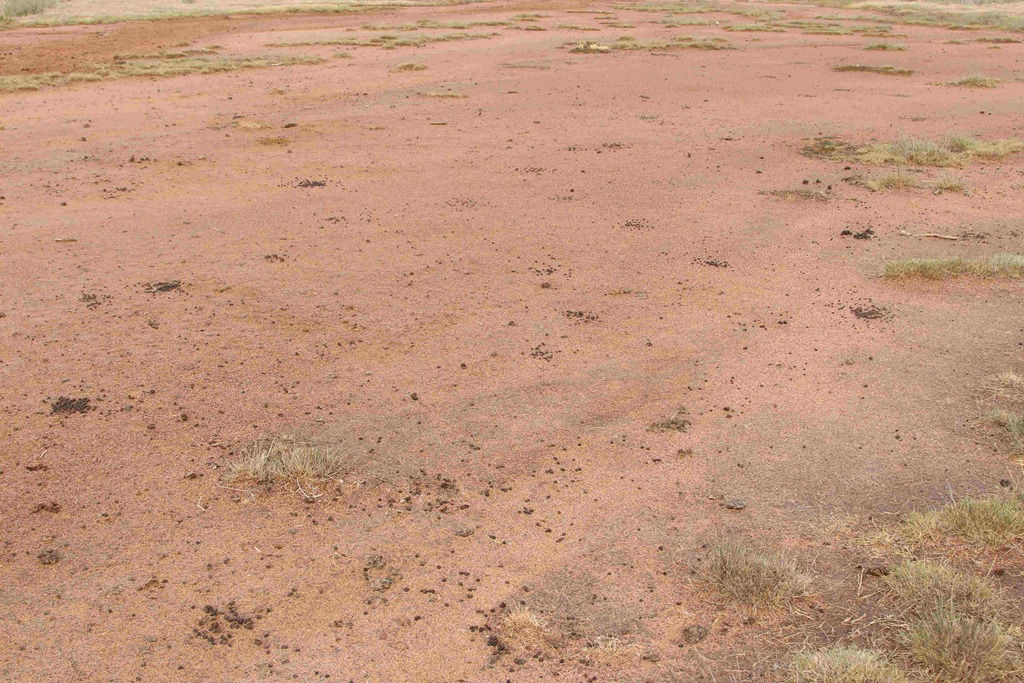
Lion’s price attack on surplus milk might have given them more than they bargained for. The Land recently reported that since the introduction of T2 pricing in July, Lion’s milk receivals have decreased by 15 percent relative to two years ago. This is much more than a normal season decrease, especially against the background of relatively good rainfall and low prices for irrigation water.

It’s not just in the last three month’s that Lion’s receivals have fallen. Ian Zandstra, president of Dairy Farmers Milk Cooperative (DFMC), who are Lion’s major supplier of fresh milk, estimates that Lion’s milk pool from DFMC suppliers has decreased by 20 percent in the last two years. He attributes this to the low milk price.
The seasonality of Australia’s milk production is in part responsible for this situation. There is a lack of fit between the demand for dairy products, which stays the same all year round, and the supply of milk, which varies depending on the season. Processors like Lion want to be guaranteed a set supply of raw milk all year round, but if a traditional dairy tries to meet this demand, it results in surplus milk during high yield months.

The two tier milk price system has been devised to send a clear message to supplier about how much milk the processor (=supermarket and consumer) wants and when they want it. It is not a bad idea in principle but the brutal and uncommercial value that has been placed on T2 milk completely undermines the overall value of the dairy enterprise.

The justification for the low T2 price is that this is the effective return to the processor when they transport it to Victoria and sell it to a commodity processor. In other words “It is not our responsibility to add value to this milk … and by the way you will have to pay for the cost of getting rid of it”.

The supermarkets are just as culpable in their denial of responsibility for this milk. From an earlier article:

Coles claim that they have no effect on T2 prices, saying that their retail and farmgate milk prices have been decoupled. “Coles’ house brand milk contract with Lion is based on tier one milk pricing… [and] Coles has no influence on Lion’s decision to reduce tier two milk prices,“ said a Coles spokesman.

They might be one step removed from the buying process but in our opinion the supermarket chains cannot divorce themselves from the economic reality of the dairy industry.

The underlying assumption in the argument presented by the spokesmen for Lion and Coles is that the price for T1 milk is fair and reasonable compensation for the flat milk production profile they require. According to Murray Jeffrey:“We already pay NSW and Queensland suppliers a premium on the world price.“

But do they, and what is the world price? It turns out that the world price is the price that export processors can extract from world markets for commodity dairy ingredients. It bears no relationship to the price that farmers are paid for fresh milk in other developed countries, and it certainly bears no relationship to the cost of producing milk on a flat production basis all year round. Discounting T2 milk well below cost and its intrinsic value is just rubbing salt into an already festering wound.

So the reality for Australian farmers that are servicing the domestic consumer market is that they either need to cop a huge penalty for producing surplus seasonal milk, or move to flat production with a tier one milk price that is inadequate to support this production system.

In the southeast of Australia ( Victoria and Tasmania ) farmers at least have a choice. They can choose to supply an export ingredient processor where they have half a chance of matching the milk price to the lower cost of a seasonal pasture based production system.

What choice do farmers in the northern half of NSW and Qld have? Ship their milk south? Sell milk at the local farmers market? We don’t think so. The choice seems to be: accept this milk payment system or get out of milk production. From the recent reduction in milk supply it looks like the second option has been a popular choice.

This has been a year full of contradiction and irony for the Australian dairy industry. “Down Down Down” has been the catch cry from the supermarkets. In association with this has been the supermarkets call of “Me Me Me” when it comes to allocation of shelf space to product brands. “No No No” has been the consumer cry regarding the inclusion of permeate in milk – with the effect that removal has increased the cost of fresh milk production. “Down Down Down” has been the message to farmers on milk price. “Up Up Up” has been the cost direction for the purchased feed that is so essential for a flat domestic milk supply.

Just about the only thing that makes sense at the moment is “Out Out Out” which has been the farmer response in those regions where there is nowhere to go with this unsustainable economic equation. It looks like Lion may have come to the same conclusion. The last word goes to outgoing Chief Executive Rob Murray:

“We don’t make any money [on milk],’’ Mr Murray  said. ‘‘The simple truth of that is nobody is making money and you can’t make money if [consumers] buy milk at $1 a litre, it physically can’t be done.’’

Mr Murray described Lion’s dairy division as a “charity”, saying that “in fact a lot of charities do better”.

The dairy industry sings for its supper

Back to me

If Lion think they are a charity where does that leave the farmers supplying fresh milk in this country?.

davesview_77

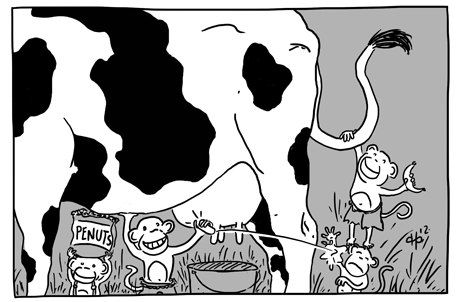
On dole queues?. Not good enough Coles. Its time to take responsibility. When you pay peanuts you get monkeys and farmers aren’t stupid and they are voting with their feet big-time . And where does that leave consumers? Milk from China?   

New gig takes me to Western Australia and salt country

Part of my prize for winning the Bob Hawke Landcare Award is an honorary position on the Australian Landcare Council.  

I will be the first to admit winning Australia’s newest and most prestigious award for sustainable agriculture does not make me an expert on sustainable agriculture everywhere and paradise is a long way from the salt plains of WA for example and has very different issues and needs.

So when I found out this board gets out of the boardroom and visits every state and goes on farm ( commercial and lifestyle ) and talks to people and has two way conversations I knew this was for me  

My first board meeting was in Katanning the home of host  board member Ella Maesepp 

Ella is one of those people I labelled instantly as a “doer” First and foremost Ella is a broadacre farmer. She is the District Landcare Officer with the Katanning Land Conservation District Committee as well as the winner of the Environment Category of the 2004 Western Australia Youth Awards. 

What a champion she is. We took a small bus from Perth to Katanning with a number of stops along the way and Ella managed to arrange “great coffee” at just right moment everywhere we went. #legend    

In this part of the world salinity is a huge and heartbreaking problem.   

The first stop was Wagin the home of the Big Ram

IMG_7227

This ram certainly has some assets that make him stand out don’t you think?

IMG_7222 

Here is some background

We learnt about this region’s endangered species the Red Tailed Phascogale. We have a similar marsupial in Paradise that likes to eat my little chickens. So cute but very pesky   

The Red Tailed Phascogale

As you can see from this map this little guy was once quite prolific

The decline of the Red Tailed Phascogale 

We also got a first hand report on the community driven Wagin Food & Fibre Hub an excellent  example of the risk that comes with a pilot project, and the struggle for funders to balance innovation against that level of risk. ,

Our first farm stop was “Tamar” the property of Adrian and Jill Richardson. Jill also happens to work with Ella in the Landcare Office

Adrian Richardson sharing his story

Adrian Richardson sharing his story

Located 20kms northwest of Katanning, Tamar runs approximately 3000 Merinos and crops mainly oats, barley and wheat.IMG_7297

This property has got to be seen to be believed. Amazing. They work with the guru that is Ron Watkins.  

Ron Watkins runs “Payneham” farm, 15km north of Franklin in south western WA. Ron has looked beyond the traditional farming practices of the area, toward sustainable and integrated farming systems that work within the local ecosystem. He isolated several factors to address but gave priority to turning a salinity problem into an asset.

Ron set out to fully utilise the natural shape of his terrain and harvest surface and sub-surface water flow, aiming to store a large volume of water to combat waterlogging, salinity and erosion. He installed drains along the contours of the property, planted up to 1,000 trees per kilometre protected by electric fencing and fenced off all remnant bushland. Ron also had the foresight to include his neighbours in his projects early on, enabling a complete sub-catchment plan to be implemented. His initiatives have been such a success that he has around 60 farmers nationally seeking his advice on landcare best practice strategies.*

This is what using Ron Watkins farming principles looks like at Tamar

IMG_7309

Tamar Farm showed the benefit of whole-farm planning, and implementing according to the plan. IMG_7313

Then it was on to Ella’s farm – Dunbar Farm

IMG_7336

Ella and her husband David Potter. Firstly we were treated to a tour of Ella’s house which  was designed by Solar Dwelling and owner built between 2010 and 2012. The external walls are straw bale and with two stone mass thermal walls. All stone, timber and  straw have been sourced from the property  

Ella's house

A feature is the room with a view

Room with the view

accessed via this spiral staircase

Spiral staircase

From the distance the problems are well hidden by good farming practices.

DElla's property

Up close we saw the devastation caused by salinity and the use of saltbush to help manage the problem Saltbush.

At Dunbar Farm perennial pastures, mainly Lucerne and saltbush have been introduced to the system since 2005 with improvements in salinity and productivity. Tall what grass and puccinellia have since been added with 4 paddocks currently under a perennial phase, and 6 areas of saltbush have been established and fenced out from the paddocks since 2005

Ella's property2   

Next up was Craigmore Farms the property of Ian Knapp.

Craigmore Farms

an has also made extensive use of saltbush with excellent results as shown below. Craigmore had a large, flat expanse of bare, eroding, salt affected land.

Before 

Before

Following on from the success of saltbush planting of their neighbours ( Ella and David) next door at Dunbar a massive saltbush establishment program was undertaken in 2010 with 20,000 seedling alone planted in that year. Drainage lines were fenced off and planted with tress the following year.

After

After

The result has been a significant stabilisation of the soil, visible increase in grasses, and a massive splash of green across a once bare area as pictured above. Impressive isn’t it   

Adrian Richardson and Ian Knapp however have completely different views on trees, as a result of their different landcare approaches and financial capacity. As Ella commented when there are such different views locally, how do you communicate a shared view to the wider community? Methinks this is a fairly standard issue in all regions. Nine out of ten farmers learn from other farmers and as long as you have farmers like the Potters, the Knapps and the Richardsons prepared to open their doors and share their successes and failures progress will be made

All the farmers highlighted that it is relatively easy to get funding for trees & seedlings, but support for salt-tolerant species is hard to get.

This is because

a) salt tolerant are not the plants that grew there originally, but have to adapt because the soil & groundwater conditions have changed

b) there is often a production benefit to salt-tolerant species e.g. saltbush for grazing.

The majority of the content for above is part of a report by Ella on the field trip and there are at least two more blog posts in this report that I will leave for later. Both are an excellent opportunity for guest blogs posts from the key stakeholders who I know would do a very entertaining job

Ella made the following insightful observations on Drought-proofing

  • There is a marked contrast between the outcomes that the Drought Reform Pilot was aiming for and actual on-the-ground drought proofing. The Pilot was more concerned with economic / business planning and identifying viable alternatives for when the drought happens, than actually establishing whole-farm systems to prevent on-farm water shortages in the first place.
  • ‘Drought-proofing’ is a diverse term, and the language surrounding it needs to be better defined. It could be interpreted to mean ‘storing water’, or ‘providing sufficient water to crops & livestock’, or ‘building resilience into a farm business’ or many other things!
  • Full drought-proofing of a farm (improving water capture, store and use) costs big money! (and from me  in most cases the kitty just ain’t big enough when the community wants quality food and fibre at rock bottom prices) 

Priorities

  • Salinity still exists and is still a major issue that landholders are struggling with in WA!
  • Opportunities could be facilitated to share learnings regarding salinity adaptation and management across Australia eg WA, SA, Vic, NSW.
  • Solutions to problems are diverse and it is important that government / funders / policy makers are prescriptive.
  • Assessment panels etc need to be aware that their decisions affect people (not just projects) and therefore need make sure there is clear information as to why decisions are made, so volunteers et al understand and feel valued.

Well said Ella

* Extract from http://www.stepcommunication.com/images/pdfs/2004%20National%20Landcare%20Awards%20Booklet.pdf