Only at Coles

This takes the cake. Funniest thing I have seen in a long time and I thought calling The ArchiBULL Prize and sending schools fibreglass cows was sending mixed messages

Coles

Is it  lamb? Is it beef? Is it even Grass fed?  Whatever it is, its a stuff up Coles.  Ht to Jasmine Nixon

Spanish Sausages

What meat indeed ??? Ht to Andrew – rider not sure we can pin this one on Coles?

Some other gems courtesy of Andrew

Andrew 1 Blueberries and Strawberries

Andrew 2 Lowe fat milk

Andrew 2 Asparagus

Andrew 2 Vegan Fairy Floss

Now for anyone who doesn’t know how you make fairy floss. Yes its sugar, sugar, sugar, sugar and more sugar. No animals where harmed in the making fairy floss and there is no gluten in sight

How To Make Fairy Floss

Ingredients

1kg Sugar,

100g Corn Syrup,

5g vinegar,

500g water

Instructions

Step 1: Pour all of the ingredients into a large pot in the order listed above, making sure to pour the water around the sugar

Step 2: Cook from 0 to 133ºC (bringing the temperature up slowly) for 20-25 minutes. If you have a conventional stove top, try medium high or high heat and just watch it closely

Step 3: When it’s boiling DON’t stir it (that will increase the chances of it crystalizing). Take a wet brush and wipe the crytals downs off the side of the pot

Step 4: Let it cool down to around 100ºC and then pour the cooked sugar into small containers (the size of a hockey puck). Pour enough in each container so it is about twice as thick as a regular hockey puck

Step 5: Let the containers sit until they are completely cool

Step 6: Pop the fairy floss candy base (hockey puck) out of the container (gently squeeze the container as you rotate it… patience young grasshopper)

Step 7: Pour a little bit of oil over the fairy floss candy base to stop it from sticking to your hands and then use your thumbs and forefingers to mold the puck into a donut shape (making sure it is an even thickness all the way round)

Step 8: Lay some corn flour on a bench and dip your cooked sugar donut into it, then keep pulling it slowly until the donut gets bigger and bigger

Step 9: Keep dipping it into your corn flour at regular intervals as you pull it bigger, and stop once your donut is about half the size of a car wheel

Step 10: Now you have 1 stand. Fold it into a figure 8 and then with both your hands over the 2 strands keep your front hand still, while the back hand pulls and stretches the strands to become bigger

Step 11: Keep switching hands while making the sure the bottom of your candy always stays in your corn flour mixture

Step 12: Once your 2 strands are long enough, make another figure 8 and repeat with 4 strands, doing this 14 times in total until you have 16,384 strands!

Done. Break it apart, wear it as a moustache, eat it and have fun with it!

Is it realistic for everyone on the planet to go vegetarian?

I hear patron numbers peaked at 115,000 at the 2016 Sydney Royal Easter Show (SRES) yesterday and there were still 100,000 people on the showground at 8pm. This year the show is not in school holidays and not surprisingly the public holidays has been busy, very busy indeed

For the next three days the crowds will reach their peak at SRES, the biggest event of its type in the southern hemisphere that attracts close to one million people over 14 days

On Thursday I had a request for names of two highly credible, articulate women in the beef and pork industries for a segment on the radio discussing what messages they would like the public to take home about farming from the 2016 Sydney Royal Easter Show (SRES).

I have been attending SRES for over fifty years and I know why I go and the take home messages I would like it to convey to city people have changed a great deal over that time.  I look forward to hearing what women from the pig and cattle industry hope the show delivers for their livestock industries

There is no doubt the show is a great opportunity for city and country to connect – how you do that effectively is not always as easy as it might sound?

IMG_6210

Cotton Industry advocate Laura Bennett shares her love of the cotton industry with primary school students in the Food Farm at the 2016 Sydney Royal Easter Show 

Every single person who pays to walk through the gates has their own problems and in the main want an experience that brightens their day. Farmers hope that part of that experience reminds the community of the importance of farming and farmers

In the wider press and academic community, I watch with dismay as people pitch one agricultural system against the other whether that be organic vs conventional farming, vegetable farming versus livestock farming or going vegan as the panacea to saving the planet

Too often this research and resultant media articles muddy the waters and it is paramount that farmers lobby for robust research and development for farming as a whole as ultimately; these arguments go away if research delivers a win:win solution for people and the planet.

Somehow our farmers have to find ways to work together to go beyond once a year events like the show and become active participants in the food and fibre production debate 365 days. Only in this way  can we ensure there is a balanced representation of all interested parties. A pivotal key to success is ensuring agriculture’s “bright, charismatic representatives” are equipped with sophisticated, considered, agreed and sound rebuttals to the more extreme lobby groups and unrealistic arguments.

When I saw this recent article in The Conversation Global food production threatens to coverwhelm efforts to combat climate change I put a call into Australia’s guru in this space. This is what Professor Richard Eckard had to say

I think the analysis is correct, but the simplistic conclusion is wrong “Opportunities for mitigation in this sector are plentiful, but they can only be realised with a concerted focus.” I agree there some opportunities for energy efficiency and sequestration (not much in soils however), but cost-effective net mitigation options are still a way off i.e. options that allow further growth in productivity with less total emissions.

The energy and transport sectors have viable alternatives emerging, they just need a price signal to make them fully cost-competitive. However, there are no ‘alternatives’ to food production. There is no alternative food industry that can produce the volume required. Organic agriculture certainly cannot and it typically comes with a higher carbon footprint anyway.

This does lead to a debate about livestock versus other crop sources of food, but there are some solid arguments that show:

  1. removing livestock from the world food equation just makes an impossible task that much harder;
  2. livestock are the only mechanism we have for generating food from the vast rangelands of the world that are unsuitable for other types of food production;
  3. livestock are not just for food in developing countries – they are the banking system (Africa), religious system (India and Africa), transport, power etc
  4.  it is really only the privileged minority that have the luxury of choosing a vegetarian lifestyle. The rest of the world just eats what they can afford
  5. Rising vegetarianism will not affect the growth in the livestock industries, as there is clear evidence that the worlds rising middle class (predicted to be 4.9 B by 2030) demand more animal protein with their rising affluence. Supply and demand will mean livestock continues to grow, even if  all the privileged urbanites become vegetarian.
  6. The real solution to livestock methane is continued research to develop low methane animals and livestock systems.


If we are going to communicate the real facts perhaps farmers need to have more conversations with each other first and ensure we have a cohesive, consistent, open and honest story to share

Perhaps some questions we could ask ourselves are:

  • Is the farming sector ready to drive the conversations required?
  • Are we ready to become part of the wider conversations that influence policy change and incentives?
  • Are we ready to partner with government and the community to get the best outcomes for farmers and the communities we support?

Back to the SRES and where the conversations about farming are taking place today

If you are going to the show here are a few tips from me

Say G’day to the Archies at the front gate

Archies at the Front Gate at SRES

If you have children under 12  the Food Farm is a must visit. You can meet a farmer at the NSWFA stand, climb a huge tractor,  make tabbouleh, have some delicious Aussie Apples,  learn how to wash your hands properly, make flour and pastry,  meet the George the Farmer team and join in their show, which runs on the hour and heaps more

This slideshow requires JavaScript.

Want to learn the real facts about egg production visit the Chook Pavilion and take sit in on Greg Mill’s presentation on the hour

Greg Mills

Visit the Natural Fibre Showcase Pavilion and watch the fashion parade

Natural Fibre Showcase

Visit the Wool and Sheep Pavilion – plenty to see and buy here. A crowd favourite is always the shearing competitions

Shearing

and every-bodies favorite – the District Exhibits
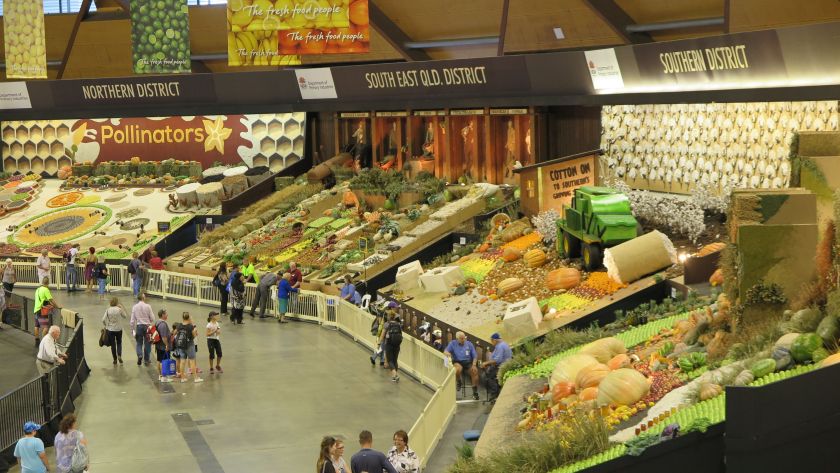
District Exhibits 2016

Don’t miss the Schools’ District Exhibits – this competition was won by Hurlstone Agricultural High School with their very thought provoking take on the Wizard of OZ – Yellow Brick Road

Hursltone Agricultural High School

If you want a permanent reminder of your visit to the show and the sheer beauty of outback Australia stop in and say G’day to renowned rural photographer Fiona Lake

Fiona Lake

and a big shout out to all the farmers at the show carrying the advocacy flag on behalf of us all


If a bullet should enter my brain, let that bullet destroy every closet door.

Harvey Milk

Yesterday I just happened to be in the right place at the right time to hear 19-year-old Dayna Duncan speak at the Western Sydney University   youth Agvocate forum at the Sydney Royal Easter Show

I stood there with my mouth open as this young girl drew me into her world with one of the most polished and inspirational presentations I have ever witnessed.

Dayna’s background and a lot of what she had to say can be found here

A former South Australian Young Citizen of the Year and listed as one of the most 50 Influential Women in SA, Dayna has moved to Sydney to do a degree in medicine at UNSW. I spoke to her afterwards and she said to me that her special passion going forward was  rural mental health

I have heard a lot of people speak and I can’t remember ever been so impressed with not only how Dayna moved and inspired me to take action but the techniques she used to do it

Dayna Duncan

Dayna Duncan Source

Dayna is a graduate of both the Heywire and Foundation for Young Australianss’ Nation Building programs.  I have seen firsthand how Heywire works and met other graduates of the Foundation for Young Australians Social Pioneers program and wow are they on a winning formula of a pathway of engaging and nurturing a new generation of Movers and Shakers and Future Influencers

Inspired by Harvey Milk’s quote “If a bullet should enter my brain, let that bullet destroy every closet door.” here is the background behind Dayna’s  ‘Breaking Down the Door Day’ initiative which  promotes understanding, acceptance, equality and diversity in rural and regional areas.

Dayna was funded to attend the national summit for young change makers entitled, ‘Unleashed’, on 9-10 November 2013, at the Sydney Opera House. While there, she recorded her video ‘Breaking Down the Door’ for the Foundation for Young Australians (FYA) program. Please take the time to watch it

Dayna’s take home message yesterday was

“You don’t have to change the world but you can change some-one’s world”

Kudos also to Western Sydney University Education & Engagement Coordinators, Christopher Vella and April Browne. who run the Youth AGvocate forum where Year 10 students over 3 days experience university life and get behind the scenes at the Sydney Royal Easter Show.

The students then take up the challenge to design and pitch a strategy to the Royal Agricultural Society’s (RAS) Youth Group.

Over the past two years Young Farming Champions Ben Egan and Felicity Taylor have had the opportunity to speak to and inspire the students and work with them on their pitches

This year I attended with Young Farming Champion Keiley O’Brien as an observer/mentor. We timed our arrival to catch the presentation by Dayna and what a smart  move that was

Keiley Chris and Dayna

Keiley O’Brien, Chris Vella and Dayna Duncan

Putting on your big girl pants and crawling out of the black hole

Crawling out of the Earthship Septic Hole, image by Monica Holy

As my regular readers will have noticed I have been furiously blogging for the last three months and that is because I have been struggling to hold it together and doing everything in my power to pull myself out of this emotional rut I have found myself in and I find blogging is cathartic.

Cows in Front of House Fav .jpg

When you find sitting on the veranda and watching the girls and thinking how lucky I am to live in paradise just isn’t enough to help you put your public brave face on  

I was starting to dread the phone calls that just seem to relentlessly deliver bad news that lead me to think I am losing control of my life. It was starting to get a bit serious and I was starting to feel like a victim  and I don’t do victim. It got to the point where I recognised I needed professional help. Good professional help I discovered can require making an appointment 6 weeks in advance so I have been surrounding myself with people who inspire me. When I woke up this morning to this blog post from one of those people the truly incredible Megan Rowlatt  I thought I too would use today’s blog to pay tribute the women in my life who inspire me.

But the first person I want to thank is my current mentor who just happens to be a man. Thank you Mike you have kept me on track reminding me that self sabotage is not good for the soul. A special thank to Greg who is the most divine sounding board for my next big idea that requires detail

The women who inspire me all have one thing in common, they are all selfless – they want to do good first

A noble intent is the essential part of leadership. The future is only sustainable when we learn that we’re all in this together. WE not ME. Source 

Working with me is not easy. According to Megan my strength is

I have never met someone with so much passion and enthusiasm for the future of an industry and the planet.I have also never met anyone who has a farm ute equipped with lipstick and perfume and kick arse gumboots, what a total boss.    

but it can be exhausting keeping up with me

She has a collective of creative ideas constantly being pumped out of her mind, that I often find myself scratching my head wondering where the hell it all comes from and where I should be up to in the conversation at the time because she moves so fast! 

My mentor keeps me under control with the rule I can only discuss one thing per phone call. If I have something I want to discuss I email him first. He emails me back with the reminder ” Focus on the strategy ( what you want to achieve) not the the tactics How you are going to achieve it) . Write me your strategy”

“Competitive strategy is about being different. It means deliberately choosing a different set of activities to deliver a unique mix of value.”

Strategy is the “what” part of the equation and helps you answer the question, “What are we trying to accomplish?”

Every business has limited resources and deals with a competitive landscape. The more it does of one thing, the less it can do of another. This concept leads to tactics, or the “how” part of the equation. Your tactics help you answer the question, “How are we going to accomplish our goal?”

Ultimately, a good way to think about the difference between the two is that strategy acts as a guide to a set of actions  teams will undertake.  Source 

Our Art4Agriculture journalist the adorable Bessie Thomas deals with me by have 5 writing pads she always puts in front of her because the story I ring her to ask her to write inevitably turns into five stories

I am always looking for people who share my ethos and are successfully putting it into practice. Last week I was inspired by an article I read about Pip Job  and I just went wow

Pip is focused on building social and cultural capital.NAB’s head of corporate responsibility strategy Sasha Courville admires the work Job has done in breaking down the social barriers for farming families to help achieve productive and sustainable environmental outcomes.

“The only way to have a strong agricultural industry into the future is that we recognise the importance of people, the importance of mental wellbeing, the importance of the environment and these are all key elements in strong businesses and strong communities.

Whilst I know of Pip I have never had a conversation with her and was keen to learn more and knowing Megan had worked with her I sought Megan’s assessment and Megan was wax lyrical with the advice “call her Lynne talk to her – she is amazing -she is a doer and she so kicking goals” I am looking forward to our conversation immensely

I am also very lucky to work with a number of selfless young women in agriculture who make up the Young Farming Champions network

All of these young women first and foremost have the future of agriculture as the foundation of everything they do. They know that the key success is cross sector engagement and understanding only when you have a world view and compassion can you build a resilient network of colleagues.  They are know that being being communicate and connect effectively is a critical leadership skill and they are all undertaking personal and professional development to help themselves and each other be courageous and outgoing future influences and innovators.

I also want to acknowledge the female members of the Art4Agriculture team who each selflessly contribute to the future of agriculture and my well being

I am also very grateful to the three women I have work with in wool ( Emily King),grains ( Belinda Cay) and cotton ( Sophie Davidson) who all have a great passion for their industry and work tirelessly with my team to grow The Archibull Prize to deliver world class outcomes for farmers and the student participants.

Thank you to Erika who supports me when I let the frustration show and “react rather than respond”. and reminds me to not sweat the small stuff and tells me her door is always open and there is always a her house

I also want to thank my best friend Bev  – I have no idea what I would do without you.

I am also grateful to Amazon, my Kindle and Apple TV who always manage to recommend a good feel movie or a book that make me laugh

So please if you find yourself like me sinking into a black hole and putting on your big girl pants just isn’t doing it for you, learn to say no, fill up your own well until it overflows, surround yourself with inspiring people, get professional help, let your friends know you are struggling and most of all keep believing in yourself, focus on the good your life and being the best version you can be .

and thank you John – i don’t think I have ever heard of a more bizarre career pathway but I am glad you  took the journey  

Understanding the risk of cancer requires an understanding of mathematics

Confusion of ingredient labels in grocery store.
Confusion of ingredient labels in grocery store. Source 

Maths was not my strong point when I was at school and when I became a pharmacist I spent a lot of time double checking my calculations. There is one hell of a big difference between a gram and a micro gram  

I also had a great deal of empathy for front of shop staff and their bewilderment with the concept of percentages. Understanding the basics of markup and markdown and margins are pretty fundamental to the profitability of any retail business. It is a skill that can be taught so it was important  to identify a potential problem from the start and it became standard practice of the staff interview process to ask the question

‘If an item retailing at $3.50 has had 50% added to its cost price. What did the item cost ? ”

It was extremely rare to get an answer of $2.33 and sometimes no matter how hard a person tried they just couldn’t get the concept that if you add 50% to a number X to get number Y and in turn take 50% off number Y it does not give you the number (X ) you started with .

This is a great article in The Conversation today Interactive body map: what really gives you cancer? 

But when scientists alternate between talking about cancer risk in percentages and whole numbers I can see why the world is very confused.  Let alone the concepts of relative and absolute risk

Relative risk

Relative risk compares the risk of cancer in one group of people to that in another group.

The chance of a group with a common risk factor (such as obesity) developing cancer can be compared to the chance of another group of people with a healthy weight. This relative risk ratio will remain constant across the world. But absolute risk will vary depending on how common a cancer is in a particular region.

Relative risk may sometimes be quite high and lead people to believe the absolute risk of developing disease is higher than it actually is.

For instance, a woman from a Western country has a 2 in 100 chance (2% absolute lifetime risk) of developing cancer of the endometrium (lining of the uterus) by the age of 85.

If the woman is obese, her risk of endometrial cancer is twice that of a woman of ideal weight. That is, a relative risk of 2 or 100% greater chance of developing endometrial cancer than a woman who is not obese.

This 100% figure may sound like obese women have a very high risk of endometrial cancer. But, in fact, the risk is still quite low, since doubling the 2% population risk still only makes the absolute risk of endometrial cancer in obese women around 4%. This is still a low probability of cancer.

Be careful not to confuse relative risk with absolute risk and remember the time-frames over which absolute risk can apply. Source 

I know I get exhausted doing the maths in my head whilst reading these articles and maybe its one of those things where a little bit of information is dangerous and causing unnecessary concern and its time to focus on helping people understand the basics of a healthy diet.

Vegetarian

Source  

and dont forget your 30gms of fibre per day

'It says, 'If you want more fiber, eat the package.'
‘It says, ‘If you want more fiber, eat the package.’ Source 

Agriculture and PETA – the folly of countering outrage with outrage

I think we can all agree humans are flawed race. We are not all perfect and when it comes to bad behavior all industries and organisations do their very best in the recruitment process to weed out the bad apples.

When bad apples are discovered its how they are dealt with by the organisation/industry that show the world the mettle of the organisation/industry. A few bad apples are in the media at the moment and you all know who they are and we are all watching with interest how their industries/organisations handle in the first instance the fallout out. In the second instance the pivotal strategies to mitigate further outrage and weed out the bad apples in a way that ensures the bad apples do not view their industry/.organisation as one that has a culture of sweeping the bad apples under the carpet and hoping a miracle happens

Where agriculture seems to stand out is its seemingly bizarre desire to give oxygen to the bad news stories. This post is making me guilty of this and I acknowledge that.

But I am hoping it might help to generate a conversation to change the way we handle bad press.

PETA is currently doing what it does best and that is using shock jock tactics in its never ending campaign to bring down the wool industry

Our state farming organisations are doing what they usually do and that’s go into outrage mode which involves joining the feeding frenzy to spread PETA’s campaign.Which in this case is another video campaign that feature’s a model I have never heard of getting naked and being made up to looked battered and bruised and seemingly using this imagery to align shearers and farmers with domestic violence.

Now the majority of people look at PETA campaigns and just shake their heads and put PETA in the nutcase element

Agriculture on the other hand takes them very seriously and it begs many questions why and does us no favours

Like this – Who on earth thought it was a good idea to put this comment on Facebook under the PETA video

Crack whore comment

Especially in light of this very impressive ( for all the right reasons ) video currently getting a lot of traction on social media.


We all know farmers are just as outraged by the behaviour of the bad apples as the wider community. Agriculture has a lot to be proud of.  We will continue to weed out the bad apples and continue our commitment to giving the animals in our care the best whole of life experience we can.

A couple of thoughts from me on PETA

  1. PETA  – using naked woman  (and a few men) to make a point is an outrage in itself. I don’t know about you but to me that reduces their credibility rating to zero.
  2. The above video too is calling out bad behaviour  When we see this we dont think all boys are bad. Yet PETA is inferring that everyone in the Wool industry is cruel . Again their credibility is zero. The answer is not shutting down the wool industry. The answer is the same in both cases. Its getting the culture right and I can assure you the wool industry is very determined to do this.
  3. and if your still think PETA has the moral high ground – this might make you rethink . According to this expose More than 93% of the animals in PETA’s care are killed each year. Get the full report here

This slideshow requires JavaScript.


How does agriculture ride the highs and lows successfully

Dairy farmers are not alone in having to grapple with the vagaries of supply and demand.

Season of lost hope as milk rise evaporates

Sue Neales reports today in The Australian on Australian milk price woes 

Farmers have little control over both their input costs and their output returns – in fact the volatility index of agriculture at 300% higher than the retailers they supply would in most cases scare off even the big risk takers – the share market volatility is child’s play compared to the risks involved with farming.

Most farming businesses cope with the financial and emotional stress by having multiple incomes streams such as

  • at least one partner in the business having a second off farm income.
  • diversification – ensuring you dont have all your eggs in one basket – usually not an option for dairy farmers

In light of the December 2015 Paris COP21 climate change agreement do commitments from companies like AGL to transition away from fossil fuels to clean energy open the door for farmers to get a new passive income stream  from renewable energy?  Is harnessing Australia’s natural resource assets of being the sunniest and one of the windiest countries an opportunity for farmers to do what they  love plus maintain the 60% of the landscape they manage and get a fair return on investment?

Archibull Connections

Can farmers power our communities with clean energy technology – the science  and technology says we can but Australian government policy is yet to provide the necessary enabling power   

As Mick Keogh highlights in his comments in the Australian Farm Institute February newsletter     farmers must and can be part of the solution to meet emissions reduction targets.

The Australian agriculture sector, contributes approximately 15% of total national emissions, is likely to be included in policies that are developed with the aim of achieving Australia’s future emission targets.

This will however require smart policy from government.

As Mick reminds the government

 While it is possible to project some future scenarios for agriculture, a major uncertainty is likely to be the confusion created by overlapping Australian and state government policies. Unless these are better coordinated, they will make Australia’s emission target much harder to achieve  

Government is starting to see the light

Australian and state government policies are at long last starting to create systems to pay landholders for the environmental services they provide for the community, and addressing the well-recognised inequity that has been inherent in legislation for the past 20 years. It would be a great shame if a lack of coordination between governments simultaneously removed some of potential benefits available to landholders, and at the same time made Australia’s already challenging Paris emissions commitment even more difficult to achieve.  

But there are challenges from within. Getting the best outcomes for farmers and Australia is going to require farmers to be actively and visibly part of the conversation in the community – not something we have traditionally done.

Never before has it being so pivotal that our leaders look at new ways to identify and build partnerships with the powerful voices. Do we (farmers) have the will to get out of our silos and work both together, and with the community to enable us to change the culture of how we have traditionally done business.

It is an exciting new era with huge potential for farmers. There will shortly be an announcement of a new public facing farmer group who will be working with the powerful voices to investigate and advocate for farmer opportunities and incentives to harness the potential of our most bountiful asset – nature without doing her any harm. Lets continue to build the win:wins but this will require more than farmer voices at the table