Definition of Fair Food open for discussion?

I recently presented at the Australian Landcare Conference and must admit I walked away quite sad. The conference itself was awesome ( and so wish I hadn’t missed this presentation) but I was so frustrated by the mixed messages that at times came both from the stage and the audience. There was the woman in the audience who was very lucky I wasn’t standing directly behind or beside her when she stood up and said the only ethical farmers are those using organic farming principles. Anyone who reads my blog knows this is rubbish for a number of reasons but in this case once again I reiterate its not the system that determines “ethical’ farming practices its the management of the system.Lets get it right madam its the people not the concept. See Footnote for my definition of “ethical”

People who market their produce by degrading others make me so cranky. Its so wrong and so desperate and its damaging the reputation of agriculture.  If your product cant stand on its own feet and have its own compelling value proposition why customers should purchase it over another then you are wasting your time.

The other thing that caught my attention was the growth of the “produce less be paid more” farming philosophy. I have no problem with this philosophy at all and there is a definite market for genuine differentiation from a small but growing group of people who are willing to pay for food produced according to their values.

But lets put the facts on the table and the proof is not there that it is a more sustainable model than the ‘produce more with less’ known in agricultural circles as sustainable intensification ethos that the majority of Australian commercial farmers follow. The proponents of the ‘produce less and and be paid more’ model suggest Australia and other first world countries should produce only enough food to feed their own countries and assist third world countries to be self sufficient.

This is very noble indeed and I too have no problem with the values behind this. But is it realistic?. If you look at the fact there are very few countries who are happy to trade and our little country sits about 4th on the world list that’s a bit scary. Our grains generally go to third world countries and our livestock products supply the growing demand for protein by the upper and middle classes in Asian countries. Bringing developing countries up to a level where they can feed themselves is a very complex problem. Interesting article here. Only small farmers and agroecology can feed the the world.

It is well recognised this will not happen until women in these countries are educated and who is going to pull that one off when women are too often the contribution of women is so undervalued in many of these countries.

It is also well recognised in countries like ours we have had cheap food for so long we think its a birth right. We have to ask ourselves the question. Will we not only be prepared to pay more for food and also pay more taxes to support people in other countries to become self-sufficient?????

On top of this every year the amount of arable land worldwide decreases by 1%. There is a worldwide water crisis. As the per capita use increases due to changes in lifestyle and as population increases, the proportion of water for human use is increasing. Together with the mismanagement of water resources world wide this means that the water to produce food for human consumption, industrial processes and all the other uses is  very scarce. world_water

Source Water Woes See here

BTW Did you know Australia is the largest consumer of freshwater globally?. See what we (CSIRO) are doing to address this here. Hopefully this research hasn’t been affected by the massive government budget cuts to the CSIRO

This week I am off to the Primary Industries Climate Challenges Centre Think Tank on Sustainable Intensification where I will hear from world experts on this model. Whilst our business followed the sustainable intensification model I would be quite happy to join the group of people farming to ‘produce less to be paid more’ but I wouldn’t be spruiking that its more environmentally or animal friendly until the science tell me it is. I have invited the Fair Food Farmers United to share what drives them, their vision and their mission and I am thrilled they have agreed. I look forward to sharing that blog with you as well as what I learn next week.

Update Tammi Jonas free range pig and cattle farmer has now written a follow up blog that shares what drives her found here . Tammi is an advocate of the ‘produce less for more’ model and walks the talk. I love the way she has summed up her blog. If you have some thoughts on the question she poses please go to her blog and share them

Don’t produce more for less, produce less for more.

By that I mean we must value the land, animals, and workers and ensure their health is paramount in every agricultural system and then ask eaters to pay a fair price for our efforts.

All of which is easier said from a farmer in a miniscule supply chain selling direct to eaters. The bigger challenge is for the majority who are under pressure from centralised market power and long supply chains…

What do you think? How can we address the serious structural imbalances between farmers, processors, distributors and supermarkets in Australia? How can we support all farmers to make a living growing food in the fairest ways possible?


My last thought on this today “How genuinely committed is the world to getting Saving the Planet right and are we all prepared to walk the talk?

Tomorrow I will blog on the big NGO’s who support the sustainable intensification model.  Many farmers will be surprised and may do a big rethink on who they partner with. Maybe not – one of agriculture’s problems is we don’t get out enough. We do a lot of talking and not enough listening. After all if we don’t listen how can we expect to be heard

Footnote Please note I am not anti any type of food production system as long as it fits my “ethical” values – i.e. food produced in a way that respects animals, people and the planet and provides a fair return for the farmers.

Creating communities with essential fabric, heart and soul

Last week it gave me great pleasure to present on the Future of Landcare with a focus on engaging youth at the Australian Landcare Conference in Melbourne.

lynne Strong Landcare

Thanks to Peter Piggot who snapped this shot of me on the stage

In today’s post I would love to share with what I had to say in words and pictures. I hope it gives you food for thought and I welcome your feedback

Slide1

I do what I do because I love this country

Slide2

I care deeply about the farmers who look after 60% of its land mass

Slide3

I am very proud that those farmers produce 93% of the food that Australians consume.

I am however very concerned that in this country we waste a whopping 4.5 million tonnes of food a year yet 2 million people can go to bed hungry every night. That is almost 10% of the population

Most of us take for granted that Agriculture feeds, it clothes us and it puts a roof over our heads

Yet very few people are aware of how challenging it is to do this when every year you have

1. Declining natural resources – less land and less water and on top of this

2. Increasing consumer expectations about how food and fibre should be produced

Slide4

As a farmer I am very concerned that so few people recognise the ramifications of this country being the hottest and driest continent

AND the consequences of scarce water resources and poor soils meaning the other statistic that really worries me is less than 6% of this country is suitable for growing crops.

Slide5

I am also passionate about youth. Some people would say I am almost obsessed about youth, identifying talented youth and engaging them and nurturing them.

Slide6

There is a pool of great young people keen to play their part in Landcare.

I know this because I have the pleasure of working with a number of these wonderful young people every day

We need these young people and we must value their contribution

We need to work at developing new and exciting opportunities where these young people can make a positive and expanding contribution.

This may mean a rethink of how Landcare operates and what Landcare is and does.

I believe Landcare can have a pivotal role in regenerating communities at the same time as regenerating the land.

To do this we need to support our young people

Slide7

If they are to continue stepping up to the challenge and putting themselves out there and we do not support them when they have a negative experience then we may lose them.

It we get it right it’s not just the environment that benefits – our people our communities – the health, wealth and happiness of this great country – are the big beneficiaries

To get it right our young people need training, mentors and supportive networks if this is to be a success

Today I want to share with you one such success story

The Young Eco Champions project was funded by Caring for our Country support in 2012

Slide8

The project saw us saw shining the light on a highly innovative and exciting partnership of young farmers and young people in natural resources management who were working together.

Together they undertook

  • Self and Professional development
  • Project development and implementation of on ground works
  • Community engagement activities
  • Developed multimedia communications strategies and delivered them to share the story with the community

What did this look like?

Slide9

We bought together Young Farming Champions and Young Eco Champions and provided them with training including high level media training, leadership and communications skills to deliver their story to community audiences.

Slide10

Slide11

They delivered Landscape scale conservation activities through a mentoring partnership between Young Eco Champions and farmers.

They promoted conservation information to wider community through:

Slide12

· visiting Schools

Slide13

· holding Field days

Slide14

· Creating Case studies

Slide15

· Writing Blogs

Slide16

· Writing scripts and starring in videos

· And putting masterpieces on the web like this

But wait there is more

The Young Farming Champions and the Young Eco Champions were then able to go into schools as part of the Archibull Prize which uses creativity to teach sustainability

This slideshow requires JavaScript.

The aim of the project was to

1. Raise awareness of, and a passion for landcare principles in young farmers, in schools and in the community and equally

2. Raise awareness and understanding amongst young landcarers and the community of the challenges and constraints of modern agricultural systems

What we hoped do achieve was threefold

1. Firstly we wanted to cement the idea that sustainable food & fibre production is reliant on collaboration between farmers and landcarers and the community

2. Secondly we wanted to secure innate/inborn partnerships between NRM professionals & our food and fibre producers.

3. And thirdly we wanted to increase the participation of young people in managing natural resources.

DID WE SUCCEED – OF COURSE WE DID

As Eve Sawyer said ”Never underestimate the power of passionate people”

Slide29

Now as I said at the beginning – Most of us take for granted that Agriculture feeds us, clothes us and puts a roof over our heads

Yet very few people are aware of how challenging it is to do this

As you have seen the Young Farming Champions and the Young Eco Champions program in partnership with the Archibull Prize is an innovative and fun way to bring together our farmers and school students to work together to

  • address the challenges of today and
  • develop a road map for a bright future

Increasingly in the future IF our farmers are going to be able to continue to supply safe, affordable, nutritious food and quality fibre – agriculture has to be a partnership with the community.

Slide30

We all want to lead a life that matters but we also want to enjoy the process and feel a connection and feel like we belong.

I am a passionate believer that Landcare is a wonderful role model of a community with that essential fabric, heart and soul

If Landcare is to have a solid foundation and to retain its share of budget it too has to have strong community partnerships and broad support.

It’s time to prioritise theses connections. We can’t afford to let them get lost in the crowd.

Like a lot of Agriculture it is time for Landcare to marshal its troops and start telling its story more often and in new and exciting ways.

And the best people to start this conversation are the young people in Landcare who may not be fully engaged in traditional activities.

Each of us needs to ask ourselves the question

If I do nothing different now, what will be the result in a year from now….. And is that okay?

Slide29

My vision for agriculture

I have a vision for agriculture I hold so strongly and I am totally unwilling to accept defeat.

Slide32

Would you agree with me that if we are going to attract the best and the brightest young people we have to find innovative and creative ways of doing it?

Would you also agree if we are going to retain these people we have to deliver value for them?

The good news is as you have seen there is a solution

I would invite you all

  • Everyone in the room
  • Everyone right across Australia

To join me in investing in the people of the future!!!!!!!.

Lynne Strong  Landcare Conference

I enjoyed the following Q&A panel session and being on the stage with some of the wonderful people who have supported Art4Agriculture from the beginning ( PIEF and Landcare Australia) 

Thank you to Landcare Australia and the committee for giving me the opportunity to showcase some of agriculture and the natural management community’s wonderful young people. They are definitely out there and its my generation’s role to invest in them 

The dangers of farmers choosing to live in a bubble

A lot of farmers I know who grow and produce for the commodity market (i.e. producing food or fibre that is functionally indistinguishable from that of your competitors) live in a self imposed bubble. They farm because they like it, they are good at it and they love the isolation from the rest of the world that it allows them .

Over the last few months I have had this increasingly emotional desire to wrap them all up in cotton wool and protect them even further from the world. There will of course be a lot of them who will say they can look after themselves thank you very much and so they can

I am beginning to think I get out too much or I think/care too much but my gut is telling me its not going to get any easier and more people need to get out of the bubble and have conversations with the people who buy the end products made from what they produce

Let me give you just one of multiples of questions I get asked. Just last week I had a conversation with some-one that I spent 3 days with at a workshop at the Melbourne Business School  who was very knowledgeable on a hell of a lot of things except the ins and outs of grain feeding cows. What he wanted to know was why we don’t say on the milk cartoon/bottle labels whether the cows have been grain fed or grass fed..I was bit ( a lot) shocked by this question. Well to start with it would be very difficult because as you can see from this slide we have a huge variation in cow feeding production systems in the Australian dairy industry

Feeding systems

  This chart describes the range of production systems operating across Australian dairy farms – & how farmers are increasingly becoming more flexible and opportunistic.

The reason being is smart farmers take advantage of what’s best for their farm system and their cows at any given time. The more supplementary grain you feed the more milk you should get remembering this is only cost effective when all the moons align.

When I asked why he thought this was important he said grain was bad for cows and consumers should be able to make ethical choices. Indeed consumers should be able to make ethical choices. The trouble is more and more consumers are making very ill-informed ones. Yes too much grain is bad for cows just like too much sugar is bad for kids. But smart parents like smart farmers are very diet conscious and control the amount  of sugar they give to their kids. Grains (or supplementary feeding as farmers call it) is a great option for cows as its higher in sugar aka energy than pasture and if you can buy it cost effectively it provides the opportunity to produce more milk per cow and this helps to keep milk affordable as well as a highly nutritious staple for families in Australia.

As you can see from the graph 50% of dairy farms in Australia supplementary feed their cows grains to generate 52% of milk production. I can assure you that the 2% that feed their cows a diet of all grains really know what they are doing and their cows are healthy and firing on all cylinders. Its also very important to remember that cows are feed grains not suitable for human consumption and this option can mean life or death for cows in a drought and we have a lot of them in Australia..

I am very reliably given to understand that a lot more is now known about cow nutrition than human nutrition and its safe to say dairy cows in this country have a much healthier diet than a lot of humans. Do we need to remind ourselves that over 50% of people in this country are overweight  You will also be interested to know that the smart farmers employ nutritionists to advise and monitor cow diet.

.Last week I wrote a very popular post on Art4AgricultureChat because I was very concerned (furious) about some other misconceptions that keep cropping up everywhere I go. See here.

Shares

I am glad it  resonated because its more and more critical that people make informed food choices not only for them and their families but also for the planetI

We have got to stop  this ever growing propensity to demonise certain types of agricultural systems out of hand

The media and websites are full of stories about the perils of conventional, large-scale agriculture, pointing to simpler ways of producing food that appear to be more in harmony with nature.

Large vs. small, family farms vs. corporate, organic vs. mainstream, free range vs. housed, grass fed vs. grain fed.The reality is it’s not the system it is how it is managed that really counts.

When it comes to the best approach to natural resource management and animal well-being we need to focus on measurable results that, in turn, will generate innovation and solutions to some of our most pressing problems on this planet. Not the least of which is to provide affordable, nutritious, ethically produced food that allows a reasonable return on investment for farmers that will allow them to feed a future 9 billion people and maintain life on Earth as we know it.

It is not just the community that is putting pressure on farmers. Some farm businesses and major retailers have taken to denigrating other farm management systems as a marketing tool to promote their own.

Judicious use of scientifically validated technology is one of the great advantages developed food producing nations like Australia has over many other countries. We have rigid and well regulated systems and safety checks in place that make our food some of the safest in the world, irrespective of whether it has been derived by conventional or non-conventional methods. If we read the labels and play by the rules we can be confident that the technologies that we use on farm are safe and the food that we produce is superior and as safe as any in the world.

Our farming systems can not be locked into a religious type paradigm of what we think is best .We must continue to adapt to our changing resource base, the seasons and climate, the economy and our markets. We also know that nature does not always get it right and some times we need to use technology to tip the balance back in favour of the farming system and the ever increasing people we need to feed.

We must acknowledge this if we are going to keep feeding our world from an ever shrinking resource base with a market place that continually wants to pay less for food that costs more to produce we must always use technology and innovation smartly. Equally we must consider the collateral effects of its use ensuring that our management and farming practices are at best practice rather than just reaching for the key to the chemical shed or the drug cabinet.

The majority of Australian farmers big and small, boutique or commodity will always aim to produce the best quality and safest food that is grown with the best interest of the environment and animals that it comes from.  Its time to salute everyone of them.

Thank you to the wonderful Deb Brown for sending me this great image to sum up my blog

Deb Brown

Forests are the lungs of our land


Channeling Franklin Roosevelt this morning

‘Forests are the lungs of our land, purifying the air and giving fresh strength to our people. ” ― Franklin D. Roosevelt

My heart sang this week when I had a chance to make a quick visit to my latest bush regeneration project and wow is the the bush regeneration team doing a great job.

With over 90% of the prime agricultural land in my region being  owned by lifestyle farmers who in the main don’t produce food on their farms its pivotal that they form strategic partnerships with people with the local knowledge to help them overcome the challenges they face. . One major challenge is our high rainfall ( av 2000 mm in my part of the world) encourages the rapid proliferation of nasty invasive weeds in our beautiful rain-forests and woodlands. The majority of our lifestyle farmers  are very keen to rid their farms of these weeds and get the best outcomes for their native vegetation but don’t have the knowledge,time or access to the necessary expertise

This where I come in. I source funding and connect the farmers with each other and the experts. This particular project is 30% funded by a Community Environment Grant ( sadly all this type of funding has now disappeared under the federal coalition government ) and 70% funded by the 3 lifestyle farmers who own the adjoining project sites

The three properties are independently owned and two are leased to dairy farmers for raising their young stock. I am managing the project which is a partnership between the owners,South East Local Land Services, Conservation Volunteers Australia, Landcare Illawarra and local bush regeneration contractors to restore native vegetation and link fragmented rainforest remnants

Site Map

The vegetation community at this site is Illawarra Dry Subtropical Rainforest (MU4) which is recognised as an endangered ecological community (EEC) under the Threatened Species Conservation Act 1995. The vegetation is dominated by a canopy of Maidens Wattle (Acacia maidenii), Guoia (Guoia semiglauca) and Whalebone Tree (Streblus brunonianus) with a variety of native shrubs, vines and groundcovers in the understorey. The rainforest remnants have become degraded due to infestation of Lantana, Wild Tobacco and other weeds and this project aims to treat woody weeds to assist revegetation and regeneration.

This site has a high diversity of dry rainforest species occurring within the work boundaries.

The objectives are:

  • To protect and enhance the remnants of the vegetation community – Illawarra Dry Subtropical Rainforest
  • To reduce the area of natural areas impacted by Noxious, weeds of national significance (WoNs ) and environmental invasive weeds.
  • To improve connectivity between fragmented local remnant bushland through weed control activities and revegetation.
  • Assist regeneration by removing weeds and maintaining the site over a period of 18 months
  • Assist volunteers with planting of the primary weeded areas and maintenance

The following management issues have been identified

  • Evidence of deer rutting has been noted within zone 3
  • Lantana density at the western extent of the work site is very high and primary weed control has been slightly slower than expected due to this high density

One of the identified threatened species is Illawarra Socketwood (Daphnandra johnsonii) and five distinctly separate populations of the Socketwood occur within zones 2 and 3. Very excitingly the  Illawarra Socketwood at the time of writing is currently producing seed at these sites. Many populations of Illawarra Socketwood tend to produce seed that is not viable due to attack by galls and various other environmental factors. The population at these sites are producing viable seed which makes this population significant from a regeneration and preservation perspective. The staff from ‘Plant Bank’ at the Australian Botanic Garden have subsequently shown an interest in collecting seed from this site and storing it at plant bank. Germination tests will also be carried out to test the viability of the seed stock and no doubt plants will be ultimately grown from this seed to be planted out at the gardens.

The following table lists the weeds that have been treated at this site and the control methods used:

Common Name Botanic Name Treatment Method
Crofton Weed Ageratina adenophora Spray
Mist Flower Ageratina riparia Spray
Moth Vine Araujia sericifera Cut and Paint, Spray
Cobblers Pegs Bidens pilosa Spray
Fleabane Conyza albida Spray
Cape Ivy Delairea odorata Cut and Paint, Spray
Lantana Lantana camara Cut and Paint
White Passionfruit Passiflora subpeltata Cut and Paint, Spray
Cape Gooseberry Physalis peruviana Cut and Paint, Spray
Inkweed Phytolacca octandra Cut and Paint, Spray
Blackberry Rubus fruticosis Scrape and paint
Fireweed Senecio madagascarensis Spray
Cassia Senna septentrionalis Cut and Paint
Paddys Lucerne Sida rhombifolia Spray
Wild Tobacco Solanum mauritianum Cut and Paint

The work in progress in pictures

IMG_0869

Many hands courtesy of Conservation Volunteers Australia make light work of clearing the lantana in Zone 4 – the front gully.

IMG_6440

Zone 4 secondary weed control follow up. Note the regeneration of native trees.

IMG_6465

Great to be able to see the rainforest without the weeds.

clip_image020

Zone 3 The boundary fence line before we started the project

IMG_6451

The same fence line 8 months later

IMG_5671

Even the heifers are impressed with the work in Zone 1

Primary Control

Primary Control in Zone 1

IMG_5661

Extensive tree planting in Zone 1

Truly amazing outcomes are happening in Zone 2 in the back gully which was heavily infested with Lantana

clip_image016

Zone 2 looking down the slope prior to the commencement of works

clip_image014

The same view after primary and secondary weed controlclip_image004

Zone 2 looking up the slope prior to the commencement of works

 clip_image010

Post primary weed control

IMG_6276

Zone 2 planting native species

Illawarra Socket Wood  (1)

The endangered Illawarra Socket Wood which is seeding in Zone 2

Great outcomes indeed for the farmers, the natural landscape and the beautiful Illawarra region. Lets hope the short sighted choices by the current federal government don’t find us in a situation where we lose forever the gains we have made. See previous post here. Again I say

Lets appreciate what we have before it becomes what we had

Why is the doing what we have always done mindset so difficult to change.

Today I would like to share with you this impressive article from Steve Spencer of Fresh Agenda.

The article looks at the challenge of changing attitudes towards action (or inaction) on climate change. According to the article findings from recently published PCCCS report  aren’t very complimentary to climate change scientists – pushing their arguments and beliefs in the form of charts, data and weighty studies but generally missing the mark and lacking traction. 

The PCCCS says the major barrier to influencing change is not about the quality of the scientific data or the compelling no-brainer facts, but that many people denying or resisting their arguments simply have a different world view, and often different political values.

This is not the first time this has been said and to their credit the smart people in the scientific community widely acknowledge they are part of the problem. But (and please correct me if I am wrong) we don’t seem to be getting much traction in moving away from the squiggly diagrams loaded science and moving towards a community based we are all in this together mindset and giving the community ownership of the mantra

What’s good for the planet is good for us. 

climate change cartoons_better world

This is the image that bought it all into perspective for me   

This is what Steve has to say

Engage for change

The recent release of a paper by a bunch of British academics into the challenge of changing attitudes towards action (or inaction) on climate change has some interesting and sobering suggestions for communities pushing change agendas in food and agriculture.

The report by the Policy Commission on Communicating Climate Science (PCCCS) was published in May this year by the University College, London.  The findings aren’t very complimentary to climate change scientists – pushing their arguments and beliefs in the form of charts, data and weighty studies but generally missing the mark and lacking traction. 

The PCCCS says this is because they are often ill prepared to engage with the emotionally, politically and ideologically-charged public debate on the issues, and the use of their science.  The major barrier to influencing change is not about the quality of the scientific data or the compelling no-brainer facts, but that many people denying or resisting their arguments simply have a different world view, and often different political values.

The PCCCS recommends the scientific community needs to take a totally fresh approach and equip themselves with a new suite of skills. It should band together through a professional body, get training in effective communication and seek better engagement with the community and policymakers.  It also says they should stop resorting to alarmist, world-destructive consequences of inaction.

This is not just about the climate. 

The suggestions are highly relevant in a wider context, where researchers try to “push” change through methods they believe are best.

The challenges ahead in sustaining the world in nutritious food will continue to run into many fights that challenge ideology. And they will continue to be tackled by armies of passionate people trying to sway with swathes of facts or sponsored evidence.

When trying to enlist the farmers into the adoption of business improvement programs, don’t drown them in data and glossy paper.  Finding out what will engage people. Unlocking an appetite for change should be the highest priority in landing an effective message, rather than investing in better ways to present facts and package more compelling data.  Investments in benchmarking for the sake of it run headlong into this risk area.

The same applies to arguments on the either side of debates about food production from the use of GMOs to organic methods, and even through to the evils of certain nutrients and ingredients in food processing.

People hold beliefs because of who they are, what their social value set defines in them – but not what they read or don’t read.

Steve also has some interesting thoughts on the recent PETA ‘expose’ into very isolated shearing practices in the wool industry. See Are we buying the PETA yarn?

Kermit isn’t the only one proud to be Green. Farmers are too

Wearing my “I am very proud Australian farmer hat” and I am in a room of farmers and the question is asked  “Who of you considers yourself a bit of an environmentalist?”…  I would like to be confident, that like mine, every single hand in the room would go up without a moments thought ( or checking out what everyone else is doing). I fear however that this may not be the case

According to Wikipedia

Environmentalists advocate the sustainable management of resources and stewardship of the environment through changes in public policy and individual behaviour. In its recognition of humanity as a participant in (not enemy of) ecosystems, the movement is centred on ecology, health, and human rights.

Is there any more noble cause than ecology, health and human rights? With over 60% of Australia’s landscape being looked after by farmers its goes without saying ( or it should) all Australian farmers are environmentalists

Web

Yet environmentalist seems to be one of those words that farmers shy away from using in case they get labelled “greenies’ or ‘tree huggers’ or heaven forbid ‘friends of Green Peace or WWF’  

Stand tall stand proud fellow farmers we aren’t just talking about it we are walking the walk .Shout it from the rooftops “ I am a proud Australian farmer and I am an environmentalist” After all have you ever met a farmer who aims to leave their land worse off then when they arrived?.

For those of you who would like to see what some of our proud Australian farmers who are self declared environmentalists are up to there are some great blogs and websites for you to visit

Gus Whyte and family http://wyndhamstation.com.au/

Seven Aussie Farmers I am very proud to be sharing my story with here 1Million Women

Marian MacDonald  as selection from the wonderful Milk Maid Marian blog

http://milkmaidmarian.com/2013/12/01/for-our-children/

http://milkmaidmarian.com/2014/05/05/why-landcare-matters/

http://milkmaidmarian.com/2012/07/20/finding-pleasure-in-the-small-stuff/

http://milkmaidmarian.com/2012/05/10/caring-for-our-country-requires-a-team-effort/

http://milkmaidmarian.com/2011/12/28/our-green-investment-already-begins-to-grow/

http://milkmaidmarian.com/2011/11/26/a-beautiful-set-of-numbers/

http://milkmaidmarian.com/2011/10/05/intensified-farming-good-for-the-environment-sometimes/

Check out the work of the Montrose Dairy team of Gillian Hayman and Graeme Nicol http://montrosedairy.com/category/environment/

Clover Hill Dairies Diary http://cloverhilldiaries.com/category/environment/

Young Eco Champions http://archibullprize.com.au/teachers/yec/yec2013.html

and lots of great stories at the Target 100 site about our Cattle and Sheep Farmers including the Young Farming Champions team

clover-hill-one-day-in-paradise


Thank you proud and loud environmentalist  Bessie for inspiring this post

Lets appreciate what we have before it becomes what we had

I live in a very special place. When I wake up early in the morning and watch the sunrise its shear beauty often moves me to tears.

Sunrise at Clover Hill

Every three weeks the view from my front verandah looks even more nutritious and delicious when the real cows come to visit.

466366_601156536561479_1123130479_o

I just don’t know how I could cope if I woke up every morning to watch it slowly bleaching and dying in front of me which is what is currently happening to our World Heritage listed  Great Barrier Reef

Can you believe that despite the Great Barrier Reef being one of the healthiest coral reef ecosystems there has been a 50% decline in coral cover since 1985.

Last weekend at the invitation of the Camp Earth Hour Retreat my front verandah on Heron Island looked like this.

Heron Island Jetty IMG_6182

IMG_6028

IMG_6045

IMG_6002

IMG_5998

IMG_6013

IMG_6025

IMG_6001IMG_6052

IMG_5978

IMG_6034

IMG_5991

IMG_6136

IMG_5992

IMG_6107

IMG_6189

As you can imagine it was hard to leave but then not everyone is like me and gets to live some-where just as special.

I am a great believer in the adage

Appreciate what you have before it becomes what you had.

This brings me to the question “why is the reef dying?” Well lots of reasons and most of them are man made areas including catchment run-off, degradation of coastal ecosystems and direct-use activities such as shipping and fishing. Why has it become a burning bed issue and crucial  we act now. Dare I say it CLIMATE CHANGE

And boy am I sick of the energy wasted on the climate change debate “is it or isn’t happening?”. In reality you don’t need people’s opinions on a fact.

You know what I dislike most about the people who say it isn’t, they are the type of people who don’t take responsibility for anything. Thank goodness they are just a small minority albeit a noisy one. I care very much that it even might be a possibility.

Professor Lesley Hughes ( who I was lucky enough to meet this weekend) sums up why we should all care beautifully in this slide

Lesley Hughes energy-five-slideshow

To borrow this quote from Time magazine

Science is hard—which is why not everyone gets to do it.

More than 97% of the people doing the hard yards say the science is in. Lets get with the times, lets care and act now

Tony Abbott – Nature has a longer memory and a sterner set of justice than we all do

Whether people like my style or not – I am confident one thing they will all say about me is I am action oriented.

I love doers. I admire people who can connect other like minded thinkers and take them with them on their journey for the greater good. And I have never met and worked with a movement that does this more effectively than Landcare.

Nature

For me 25 years on Landcare is an internationally recognised social and environmental movement

I have worked with Landcare in urban spaces and in peri urban environments. I have worked with Landcare on lifestyle farms and on commercial farms, with youth and in schools.

Landcare transcends traditional boundaries to do what nobody else in Australian agriculture has ever been able to successfully achieve in great numbers. That is getting farmers to partner and work together and with the community

Landcare is the perfect model and a shining example for agriculture of what a connected cohesive group of people can achieve together

And thanks to the efforts of Landcare we are reminded that we (as farmers) operate in a broader landscape than just our farms

Farmers who work with Landcare think about their properties as part of the broader catchment which has led to incredible environmental achievements.

I also admire the very bright mind that is Andrew Campbell whose  knowledge of all things land and water and his ability to express his thoughts and opinions verbally and on paper is quite possibly unparalleled in this country

This recent paper he wrote ( with Ian Rutherfurd) for the Conversation on the government’s recent budget decisions on Landcare is a great example

Some of the text that resonated with me on the budget

It  also repeats a pattern of reduced funding and weakened delivery started under former Prime Minister John Howard, and confuses improved agricultural productivity with improved environmental management.

Bait-and-switch is a retail trick where you advertise a product at a good price, pull the customers in, and then switch the product at the last moment for an inferior and/or more expensive version. Under the budget, the bait is Landcare, and the switch is the Green Army.

Funding that would have been gone to seasoned community volunteers, multiplying local efforts, will now go to projects done by inexperienced young people on less than the minimum wage.

No doubt many Landcare warriors would appreciate a hand from some willing young workers, but will the soldiers of the Green Army continue to maintain these projects into the future like the Landcarers would? Unlikely. They will bus in, do the project and leave.

Governments need to be careful about white-anting the business models of existing private sector environmental contractors, and disenfranchising passionate volunteers.

Landcare is about building social capital in rural communities and helping communities to promote sustainable land and water management and more effectively tackle common problems that cross farm boundaries.

I filtered all the content I had put in the category under  The Environment on my blog and I am honoured that I have had the opportunity to work closely with the Landcare movement on my farm and beyond and introduce its ethos and philosophies and goals to so many others.

You have been very short sighted Tony Abbott – our landscape is such an integral part of the health,wealth and happiness of every Australian how can you not value it and the people who nurture it so much more than this budget shows

Ron Boswell get over yourself. Oz farmers are proud of what we and we are confident we will stand up to scrutiny

From The Australian this morning

Beef initiative ‘green thuggery’ SID MAHER APRIL 23, 2014 12:00A


A LEADING Australian trade expert has warned farmers that an environmental sustainability initiative for the beef industry, being promoted by the World Wide Fund for Nature (WWF) and backed by the Cattle Council of Australia, risks tying farmers up in green tape and is a move designed by environmentalists to “control farming’’.

I just don’t get why people like Ron Boswell et al seem determined to undermine partnership initiatives like this between beef farmers and NGO’s like WWF. Senator Boswell et al please don’t try to tell me Australians farmers aren’t dedicated to striving to achieve the best outcomes they possibly can for people, animals, places and a fair return for their efforts doesn’t underpin everything they do 

PPP-w-Circle2

Doing the right thing is not an impost its an honour and a legacy ( see footnote for explanation of the graphic )

Surely Senator Boswell et al you will agree all committed Australian farmers who are in it for the long haul are aspiring for excellence . Setting voluntary goals that the Cattle Council and WWF are working towards allows us to take it to the next step and have some measurables to back up our claims. Measurables are not an impost they are claims Australian farmers can make with integrity.

I judge organisations like WWF on their ethos and  people they employ to help deliver it. Backing up my point please take the time and listen to this fantastic TED talk by WWF’s Jason Clay 

I have worked with the WWF in this country and I am comfortable with what they are trying to achieve. In fact I will be showcasing former Cattle Council Rising Beef Champion, beef farmer and now WWF team member Ian McConnel and WWF’s Change the Way You Live campaign  to students as part of the Archibull Prize this year   

Well done Cattle Council and well done to Dairy Australia who are holding similar talks and throwing this brilliant piece of work on the table for comment by all parties.


Footnote – Some food for thought –  source

Create Value

At the top of the equilateral triangle, representing economic growth, is the effective pursuit of “profit”. In order for sustainable agriculture to achieve its goals, it must fully embrace the profit motive. This motive requires that developments deliver maximum present and future value to stakeholders by being driven by market demand, and that they do so in the most efficient means possible within the holistic triple-bottom-line perspective.

Accept Responsibility

The “people” leg of the equilateral triangle represents the social responsibility of industry professionals to recognize that project design affects a broad level of human well-being. Society requires and benefits greatly from gaining a greater sense of connectedness; having greater access to quality food, shelter, health care needs, as well as work, creative, recreational and educational opportunities; preserving its cultural and biological heritages; being safe; accessing cultural enrichment opportunities; respecting the diversity of its people; and participating in its own governance. Within the context of natural laws, it is every individual’s right to maximize these social opportunities, and it is part of agriculture’s responsibility to foster the culture to enable these opportunities to more readily occur.

Model Nature

The pure “planet” leg of the triangle recognizes the ultimate value and supreme intelligence of our natural world. Our environment offers an infinite number of time tested and successful patterns, designs and structures from the most minuscule particles, to expressions of life discernible by human eyes, to the greater cosmos. We must not only respect our natural world for its power to sustain us, but as we change and modify it, understanding its workings will lead us to the ultimate solutions we require to sustain ourselves. Make no mistake, the earth will survive. It is our societies which may be in peril. Using an ecological standard to judge our innovations will help us determine which solutions will work, and which solutions will withstand the difficult and ultimate test of time.

Eliminate Waste

Emanating from the creation of economic value is the concept of eliminating waste. Waste reduces profit, and as a result must be eliminated, but it won’t be easy. Eliminating waste requires strong visionary leadership that can transform a liability into an asset. It requires team-building, the development of greater trust, and getting a previously fragmented group of people working more effectively together. That is indeed a challenging task, but its relentless pursuit is absolutely necessary if we hope to achieve sustainability.

Quality of Life

Building from our social responsibilities is the understanding that the values our society espouses, and in fact, the spiritual “lift” we gain are more important than the material items we can own and consume. We must value and focus on the “soul” of our lives, for it is the root of true happiness and quality of life.

Energy Flows

Emanating from nature’s model is our understanding of the natural long-term energy flows which emanate from the sun, and are captured by plants, some of which are eaten by animals, which then (along with plants) cycle the energy into the earth, which stores it and ultimately feeds our plants again. Our short-term oriented consumption of these energy stores is seriously disrupting the cycle, and we must learn how to respect, protect and utilize these natural energy flows.

Share Knowledge

Between the “profit” and “people” ideals is the recognition that, as we progress deeper and deeper into sustainable land development, we must be willing and able to share the knowledge we gain with the other stakeholders throughout the world. Our industry has many areas of specialization, and in order for anyone to effectively develop the requisite holistic perspective, we must seek to better understand and address the needs of all the stakeholders throughout the process.

Humans and Nature Co-exist

Rather than man dominating nature, or man being required to avoid nature, there must be a recognition that man and nature can and do co-exist. With this recognition comes an understanding that man must benefit from nature, but that nature must also benefit from man.

Recognize Interdependence

Between the “profit” and “planet” ideals, and stretching to the very epicenter of the triangle is the understanding that we must recognize – in fact maximize the effectiveness of – our interdependent relationships. This interdependence exists not only among industry professionals, but with society as a whole – as well as cause and effect in the natural world. This principle of interconnectedness, inseparability and union provides us with a continuous reminder of our relationship to the whole, a blueprint for the sustainability of our work.

The solutions we seek reside within this fractal model. As we dig deeper and deeper, the model replicates itself, becoming infinitely complex, yet always maintaining the necessary holistic, triple-bottom-line perspective.

Government is a Partner, But Private Industry Must Lead

As we move forward, we must do so in partnership with government, but ultimately, solutions must emanate from the bottom up, not the top down. History has proven that top-down solutions rarely solve the problems they purport to address, and they often create new ones in their wake. It is the private, profit-driven members of the industry itself that can and must take advantage of the opportunity to not only reverse the negative image the industry has been given, but to become the absolute heroes of our time. It’s a momentous opportunity, and the time is right to seize it.

Today’s reality is that the “people” are driving demand for practices that steward the “planet.” To date, the single-minded pursuit of “profit” has been an impediment to truly sustainable development, but as adopters continue to pave the way by incorporating more holistic new – yet proven – practices, the time is rapidly approaching that supply will begin to meet demand.

Are you ready to participate in the bold new world in which we live – where socially responsible and eco-friendly practices not only boost your bottom line, but are required for survival? That world is closer than you may think, and our goal is to help you achieve it. There are a host of emerging technologies, products, perspectives, knowledge assets, and other resources necessary to enable professionals throughout the industry to make it happen. Stay tuned, as they say. There’s much more to come.

Republished from the May, 2007 issue of Sustainable Land Development Today magazine

* Note have replaced the word ‘development’ with ‘agriculture’  to put into context

Meet Danila Marini a city kid who loves sheep and is doing some amazing research to enhance their welfare

I am a big fan of Meat and Livestock Australia’s Target 100 program concept.
 
Target 100 initiative demonstrates the long term commitment of Australia’s cattle and sheep farmers to advance sustainable practices – from an environmental, animal welfare, social and economic perspective – and ensure a sustainable food supply for generations to come. Target 100 outlines 100 research, development and extension activities covering soil, water, energy, pests and weeds, biodiversity, emissions and animal welfare.
 
 
In fact I am a big fan of any industry initiative that allows farmers to play an active role, communicate with each other, share stories, collaborate and feel proud of themselves, their fellow farmers and their industry.


This initiative also has some great sustainability study guide resources for schools and I was fascinated by an animal welfare Target 100 research initiative for sheep that I came a cross reading Food for the Future which has just been released

This  particular project looks at the role of technology in improving animal welfare
and in this case the opportunity to make pharmaceutical and drug delivery systems, including needle-less injectors a more feasible proposition for farmers

You can imagine my excitement when I discovered that Young Farming Champion Jo Newton actually knew one of the researchers involved in this project  

Meet Danila Marini

clip_image002

Originally I’m a city kid; I hadn’t gone near anything remotely like a farm until I was 9 when my Dad bought a small property and started a little hobby farm. I had always loved animals but being on this little farm increased my love for livestock animals and sparked my interest in agriculture.

Me getting my sheep ready for measurements for the first experiment of my PhD

I decided working in agriculture was my calling, so I applied for Urrbrae Agricultural High school, even if it meant travelling 2 + hours a day just to study. I made use of the school’s farm and applied to study in as many agricultural subjects as I could and as a result I received the Urrbrae Agricultural high school “Majorie Bowes Prize”, which is awarded to the highest achieving female in agriculture, as well receiving the Animal Science certificate for participating in animal related subjects. Throughout the years I had a million ideas of what I could be when I finished high school, a livestock veterinarian, a jillaroo, a stud breeder, a farmer, the list was endless, everything sounded exciting.

clip_image004

My year 12 Ag class that attended the South East Tour, where we learnt about different agricultural practices in the South East of South Australia

In year ten I went on an excursion to Adelaide University’s Agricultural campus, Roseworthy and to CSIROs Waite campus. I saw some amazing projects on animal nutrition, animal/plant production and animal/plant health. I was completely fascinated and from that point I decided I could do some interesting work in the agricultural field if I became a scientist. It was a hard choice between animal and agricultural science but in the end animals won and I went on to do a Bachelor of Animal Science at Adelaide University.

clip_image006

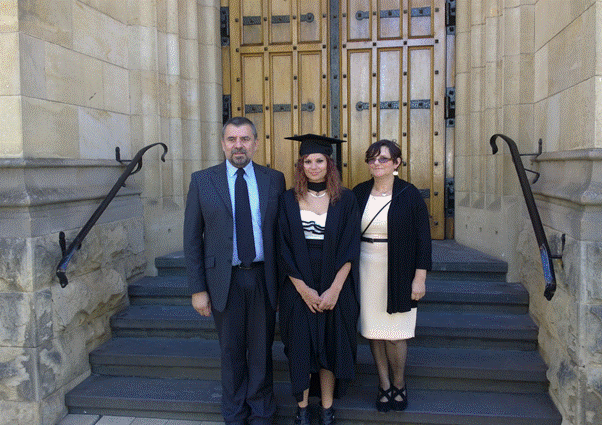
My Dad, my Mum and me at my graduation day in 2012 for my first degree a Bachelor of Science (Animal Science)

Like most undergrads I still had no definite idea what I wanted to do when I finished my degree. When it was time to graduate, I thought “why not give research a go?” I mean research was one of the main reasons I decided to go to uni. So with that I went and did honours, for which I was awarded first class. During my honours year I learnt a lot about research, I had a lot of fun and I grew to love sheep.

clip_image008clip_image010

How can you not love those faces!

As the year began to wrap up I knew I wanted to work in animal welfare and if it involved sheep even better! I thought that one of the best ways I could help improve animal welfare was through research so I went looking for PhD projects that had an animal welfare focus. Luckily enough I found a project with CSIRO and the University of New England on self-medication in sheep, which was a double whammy for me! There was a catch though, I had to move from little ol’ Adelaide to an even littler Armidale.

clip_image012

Research sometimes means early starts, late finishes and very long days but I’m not complaining!

The aim of my PhD project is to incorporate pain relief in food, so that sheep and cattle that undergo painful husbandry procedures, such as castration and tail-docking, can eat this food and be relieved of pain. I will also try to train sheep to self-administer the drugs (non-addictive of course) in order to provide pain-relief, this will give us some interesting insight into pain states in animals. I think it will be the most interesting part of my research! In my first year I identified a non-steroidal anti-inflammatory drug (this is what our panadol is) that works at relieving pain in sheep.

clip_image014

clip_image016

My sheepie minions! Together we shall take over the world with great animal welfare practices!

I have just started my second year and I am really enjoying my work, I currently have some interesting experiments planned for this year. They include adding the drugs to food and seeing if it helps to relieve pain in lambs that have been castrated and tail-docked and training sheep to self-medicate.

As you can imagine I’m getting pretty excited about my work. Many think I’m mad having gone on to do a PhD, some days I think I am too but thanks to the support from family, friends and my supervisors at CSIRO and UNE, I am so glad I have started this journey. So here’s to a future of research, helping the agricultural sector and helping animals!