Rick Farley A life with a lesson for us all

I am a person who needs to be surrounded by good friends to truly relax and find it almost impossible to take 5 when I am left to my own devices

So this Christmas I am determined to break that mould. My front verandah has become my new best friend along with Amazon Kindle and Netfix and Crackle and iTunes

A Google search told me the best TV series of the Year was House of Cards.

I have been fascinated by Rick Farley since I read his 2003 Australia Day address so on my iPad Kindle I am reading his biography ‘A Way Through’

What a contrast my choices of verandah entertainment has been

House of Cards is indeed brilliant but so dark. Kevin Spacey as Congressman Frank Underwood Machiavellian personality is just so evil.

I wish he was an anomaly but we all know there are people in the real world just like him with no empathy, conscience or remorse and believe everything should revolve entirely around them and their quest for power no matter who or what they have to crush to quench their thirst.

Some eerie quotes from the series

Power is a lot like real estate. It’s all about location, location, location. The closer you are to the source the higher your property value.

Choosing money over power is a mistake almost everyone makes. Money is the big mansion in Sarasota that starts falling apart after ten years. Power is that old stone building that stands for centuries. I cannot respect someone who does not see the difference.

Now according to the web President Obama has said of House of Cards and Frank Underwood (who will resort to murder, sexual impropriety, blackmail, fraud and a litany of evils to grease the legislative process).

“I wish things were that ruthlessly efficient….. this guy’s getting a lot of things done”

I would prefer to think the President has been misquoted or spoke in jest

The most poignant part of the series1 for me is the last episode when Frank’s wife Claire (who can do evil pretty well herself) asks Frank what legacy will they leave on the world and he can’t give her an answer.

Such a contrast to Rick Farley who also spent a considerable amount of time in the world of politics.

“In this era of adversarial politics and campaigning there are lessons to be learned from his life, his capacity to get everyone talking to one another, and to agree on a compromise” Natasha Mitchell ABC Radio

“Farley brought competing interests together, listened deeply and patiently, worked from clear principles, helped people to understand each others’ perspective and to find common ground, and often delivered results that everyone could live with. Farley usually negotiated deals that represented real progress, but more importantly, that left a legacy of better relations between competing interests. Invariably, he earned the respect, trust and admiration of those he worked with.” Andrew Campbell

Rick was a city boy who is his own words was

shaped over a long time by a very diverse group of Australians – cattlemen, farmers, conservationists and Aboriginal and Torres Strait Islander people. I thank them all for the education they have provided me. It also has been shaped by over 25 years in the political and public policy arena, which represents both the best and worst of our national endeavour.

As his 2003 Australia Day address shows, Rick had a big picture vision for agriculture in this country and was 100% committed to Australia being the great country it deserves

So I perceive my country now to be a bit lost; still not managing change equitably; searching for its place in the world; looking sometimes for simple truths and solutions which no longer exist – in the middle of a cultural vortex and not quite sure of the exit point.

In that situation, it seems sensible to me to look to the bedrock of our nation, the points that can ground us and give us stability. In my view, these distil down to our country – our land and waters – and the nature of our relationships with each other.

Unless we use natural resources in a sustainable way, we are mining the future. Unless the relationships between our citizens are respectful and inclusive, we are a divided and diminished society.

To me, these are the defining features of Australian culture and identity. Together, they can unite our communities, build resilience, and create a firm foundation from which to meet the ever-increasing challenges we face.

By any measure, we are not caring properly for our natural resources.

We automatically imported European systems of agriculture, based on wet, fertile landscapes, and unsuited to our fragile soils and rainfall patterns. Australia’s wealth depended on agriculture and mining for a long time, and without sufficient knowledge about the long-term results, we went hell for leather……

The tasks before us obviously are enormous. Farming systems will have to change; further adjustment in the farm sector is likely; rehabilitation will take decades and will be impossible in some areas; public and private costs will be huge; new regulatory systems will have to be introduced; and a vast amount of political and social capital will need to be invested.

But unless we do it, in my view we will limit our future as a nation and as a society. Our economic, social and even our spiritual security will inexorably be diminished.

Sadly Rick Farley is no longer able to grow his legacy but eleven years later what Rick said in 2003 is just as relevant today

There is a golden opportunity here – to come together in an act of national will to create a priceless legacy for future generations; to cement part of the foundation for a modern Australian culture and identity. One that builds on the past, but can deal with the new realities we face.

I never met Rick Farley but I am honoured to be working side by side with people who knew him and respected him and I for one will be working hard in 2014 (25 Years of Landcare) to celebrate both his vision and inspire others to make it their mission.

In Andrew Campbell’s article “Whatever happened to brave leaders” he says

Rick Farley … was gifted in speaking truth to power, in cogent language that political leaders and their constituents could “get”. How we miss those clear, far-sighted voices in debates over how best to share the water resources of the Murray-Darling Basin. How we miss their ability to understand and empathise with all sides and cut to the essence, to find a way through to a better place.

In Rick Farley we lost a real national leader, one of the most significant Australians of the late 20th century.

There are indeed lessons to be learnt from his life. Rick Farley may be a “one of” but surely a team of people who aspire to achieve his vision could have a red hot chance This makes me ponder perhaps the most pressing thing wouldn’t you agree is that we (agriculture) identify and nurture the next generation of Rick Farleys?

Sadly I know too much about drought

Bessie Blore is a wonderful journalist, a girl from the city who married a boy from the the bush and I am so proud to know and work with her as one of Art4Agriculture’s Wool Young Farming Champions

Our place “Burragan” is 110km from the nearest town, 200km from the nearest supermarket, and 330km from the nearest major centre – Broken Hill. When I’m not out in the paddock helping with sheep work, I like to write, keep up with global issues, and uncover the strange secrets of our beautiful bush landscape.

Bessie writes a wonderful blog Bessie at Burragan where she shares the highs and lows, the laughs and the not so funny moments with her readers

I have been away for a week and the drive up the hill on Friday tugged at my heart strings.

The front paddock tells it all, the cows rotate around the farm every 14 days. It is 14 days since they were in this paddock and whilst it has a green tinge there is nothing for the cows to eat.

On my travels last week I went through Tamworth on my way to Gunnedah – there is no feed in the paddocks for the cattle there either. It was depressing and unfortunately those  farmers are not alone. Much of NSW and a great deal of Queensland are once again in drought.

Unlike me Bessie is new to the ravages of drought but she tells it so like it is in this wonderful blog post

I don’t know much about drought. Even when I saw her face, I didn’t recognise her.
Years before I moved to Burragan, we visited ST’s mum and dad one summer. Their house yard was a true oasis in the middle of a desert, in every sense. Outside the confines of the garden fence, they were feeding hay to cattle and saving animals from of empty, muddy dams. At the time, I didn’t realise that was what she looked like.

I don’t know much about drought. But I know that she’s inevitable.
I am lucky – or perhaps unlucky and lulled into a false sense of beauty and romance – to have moved to Burragan in the middle of several great seasons. This year, we’ve already had our annual average 11-inches of rainfall. We are thankful for that. And yet it’s dry. It’s dusty. It’s only getting hotter.

I don’t know much about drought. But I can feel her creeping up on us.
The signs are there. Selling stock. Buying hay. Blowing bores. Boggy dams. Empty tanks. Moving stock. Fierce winds. Thunderstorms that are no longer viewed as salvation, but instead, as fire threats. Those afternoons that smelt like rain; but when they came, they looked, and felt, and taste, like dust. Perpetrations for a dry summer.

I don’t know much about drought. But I know she’s more than a lack of rain.
She’s stress. She’s suffocation. She’s the haunted eyes of men whose strength is buckled by the weight of the world, and women who wish they could take the load off.
I don’t know much about drought. But I wonder if we will recognise each other, when we meet again.
I know we can’t be friends, and yet, to survive in this environment I cannot view her as the enemy.
We might have to learn to get along for quite a while.

Clover Hill one day in paradise

How I long for the farm to look like this again and for farmers everywhere to see drought pack its bags and go into hibernation

How the cows bring life to the landscape

I call my little piece of the world paradise and for good reason. If gives me great pleasure to wake up very early every morning and breathe it all in.

These days the wonder of it all starts to bring joy to my heart around 5.30am and I spend many mornings on my front verandah just trying to capture the sheer beauty of it all with my camera

This week I was reminded just how much the cows add a whole new dimension to the word ‘landscape’ 

Clover Hill Jamberoo IMG_6043

Whatever my legacy it will always give me great pride to have spent the last 35 years of my life enhancing and sustaining this very special part of the world.

And just to reinforce my point this incredible photo was taken (not by me) just ten minutes from the farm 

BUiXdc-CYAAvwyM

The Milky Way above the coast of Kiama

Yogurt is just a small part of the story

I am a 6th generation dairy farmer who knows quite a bit about the dairy industry, a bit about the beef, sheep and wool industry and these days I am proud to say I know much more than the average person about the cotton industry.

I will also quite readily admit I probably know little more than the average Joe Blow about forestry, fisheries, rice growing, milking goats, growing avocados, oranges, olives or grapes and many, many of the other paddock to plate and field to fabric processes

This slideshow requires JavaScript.

Dairy farmer Rob McIntosh’s shares the cow to carton story with local school students

So when the Primary Industries Education Foundation released their now legendary survey results that showed some very interesting origins for yogurt I wasn’t overly surprised

clip_image002

But is not the lack of paddock to plate knowledge that is of most concern, its the lack of knowledge about the environmental and health impacts of society’s food choices that will have the most serious long term ramifications.

As a farmer I get this knowledge by understanding what it takes to sustainably produce milk and it doesn’t matter what food or fibre you produce the key principals are the same.

This slideshow requires JavaScript.

There is so much more to farming than producing food and fibre. Dairy farmer Rob McIntosh shows teachers and students how he is looking after his scarce natural resources at Woodside Park, Berry

In the broader non farming community the end result of this disconnect from the food system is that those of us lucky enough to live in first world countries where food is bountiful, belong to a society that surveys show is only interested in price and convenience. This focus on price is not only devaluating our farmers and all the people and industries who support our farmers, it is devaluing our health and our scarce natural resources

Neilson research presented by Courtney Sullivan at the Australian Dairy Conference a couple of years ago showed that most Australians have little knowledge of where their food comes from, that they are aware of their ignorance and that, to put it bluntly, ignorance is bliss. Price was the main driver. Quality was taken for granted. Source here

So way back before the Archibull Prize when I first coined the Picasso Cows concept the aim was to use fun and innovative ways to teach kids where their food comes from. However most importantly it was to motivate them to think seriously about the environmental impacts of their food choices and how their health is affected by the way food is produced

And of course the long term legacy of sending our Young Farming Champions into schools to share their farm stories and experiences is we are reconnecting students with the experts – the farmers

Now I mention Picasso Cows because way back in 2007 there was a local dairy farmer called Rob McIntosh who signed up to host the schools involved in the on-farm visits in his area and he had phenomenal  impact.

In the following 6 years I have had a lot of media training and I don’t think Rob has had any!!!  Yet after seeing him interviewed on both the ABC and in schools recently he reminds me there are a very small proportion of people out there who just innately “get it”.

Authenticity and honesty are highly valued in communications and who better to tell the real farmer story than the ones who live it daily and can share genuine stories from their  farms.

Good communication is also about portraying consistent messages. More consumers want to know where their food comes from and how it was produced. Food safety, quality, animal care and the environment are of paramount importance in the 21st century and so they should be.

What I do want to reinforce to farmers everywhere, it has never been more important to get out there and tell your story. I for one can assure you that it is something you can learn to do and its very rewarding to have the confidence to talk to and get feedback from the people who buy our food and fibre.

Lets not forget farmers do a lot more than produce Food and Fibre, they help underpin the health, wealth and happiness of our great country and that most definitely is the greatest story ever told

Interesting thoughts on the big picture here Global agriculture towards 2050

Water water everywhere. Just who are we kidding

This year we have been able to send Young Eco Champions as well as Young Farming Champions into schools as part of a Department of Agriculture Fisheries and Forestry supported Archibull Prize

This has been particularly rewarding for me as I know just how much our farm has benefited from working with natural resource management professionals and it has given me great joy to be able to partner our Young Farming Champions and the next generation of consumers and decision and policy makers (school students) with these bright young minds.

This slideshow requires JavaScript.

Clover Hill paired with Next Gen to look after the farm’s scarce natural resources

Whereas our Young Farming Champions have their individual food and fibre industries behind them our Young Eco Champions don’t have an umbrella organisation that supports them financially and/or provides them with the type of personal and professional development Art4Agriculture offers and it’s been mind-blowing for me to see how they have flourished under the Young Eco Champions program.

Going into schools the Young Eco Champions have discovered that the knowledge base of students about natural resource management varies widely from school to school from almost nothing to exceptional and seems dependent on the culture within the school with some primary schools in the Archibull Prize 2013 leading the way.

They have found in the main that urban schools have their heads around sustainability in the context of reducing personal carbon footprint through recycling, reduced waste etc. because that’s what is driven through a lot of local council initiatives and some of the students with a rural background understood weed management issues and why it is important to manage weeds however knowledge of what it takes to farm sustainably and wider catchment management issues where almost non-existent.

Last week I joined Young Eco Champion Megan Rowlatt who returned to one of her schools to conduct a bush regeneration workshop with the students.

This slideshow requires JavaScript.

Young Eco Champion Megan Rowlatt and students attacking the evil asparagus fern 

I was recently reminded just how important it is for us all to have a wider knowledge of what is happening to our scarce natural resources beyond our front fences when I came across this article Where the world’s running out of water, in one map by Brad Plumer in the Washington Post

Brad asks the question

And with the global population soaring past 7 billion, this is one of the biggest questions the world is now facing. Can better conservation practices and new technology enable farmers to keep feeding the planet without depleting its most important water resources?

Its pretty scary to know that approximately 1.7 billion people rely on aquifers that are rapidly being depleted and would take thousands of years to refill, according to the study in the journal Nature.

The report, “Water balance of global aquifers revealed by groundwater footprint,” identifies aquifers in the U.S., Mexico, Eastern Europe, the Middle East, India and China as crisis zones where groundwater resources and/or groundwater-dependent ecosystems are under threat because the use of water vastly exceeds the rate at which aquifers are being refilled by rain.

The underground reservoir in north-western India, for instance, would need 54 times more rainfall to replenish the water that’s currently being used by farmers and the local population.

In the map below, the blue areas mark where rain can replenish the amount of water being used by humans. Orange or red areas indicate places where people draw out more for irrigation and drinking water than rain can refill.

The grey areas show the extent of the “groundwater footprint” by representing how much water people are drawing from the aquifers compared with how much water each holds.

Water map

When we know Australia

  • is the driest inhabited continent on earth, with the least amount of water in rivers, the lowest run-off and the smallest area of permanent wetlands of all the continents.
  • and one third of the continent produces almost no run-off at all and Australia’s rainfall and stream-flow are the most variable in the world.

And then you see the big picture problem the world is facing due to an ever increasing scarcity of our precious natural resources its very rewarding to be able to work with and share our Young Farming Champions and our Young Eco Champions and their knowledge diversity and expertise with our school students

Its also very rewarding to be able to provide the schools they visit with the amazing resources our food and  fibre industries are creating to show how farmers are doing their bit and striving to do it better and inspiring the next generation to look beyond their front door and get actively involved as well

Examples of some great industry resources can be found on our web page here

In particular

Target 100 http://www.target100.com.au/Tips-resources

Cotton Australia Education Kit http://cottonaustralia.com.au/uploads/resources/Cotton_Australia_Education_Kit_-_Secondary.pdf

A Wool Growers Guide to Managing Streams and Creeks

http://www.wool.com/Content/en-GB/lww_Rivers_Managing-rivers-creeks-streams.pdf

Tarantula venom believe it or not a new selective effective edible insecticide

Insecticide resistance is the quieter, lesser-known relative of antibiotic resistance. Anyone who has been to a hospital recently knows about antibiotic resistant bacteria. But how many people think about insecticide resistance when they spray their home garden with insecticides?

A research group has published the first directed-discovery research program for a new, environmentally-friendly insecticide from the venom of a native Australian tarantula.

Check out this scary video on milking Tarantula venom

On my recent visit to Narrabri I was lucky enough to join Sophie Davidson and the Cotton Young Farming Champions’ Richie Quigley, Ben Egan and Martin Murray on a tour of the Australian Cotton Research Institute

Our tour guide was Trudy Staines who is the Science Educational Officer Primary Industries Centre for Science Education (PICSE).

IMG_4780

Trudy also undertakes research at the centre with her focus being identifying and management of Bt Cotton boll worm resistance

SIT plus transgenic cotton expressing the Bt transgene suppresses the growth of the pink bollworm population

Use of the Sterile Insect Technique (SIT) together with transgenic cotton expressing the Bt transgene suppresses the growth of the pink bollworm population and facilitates management of resistance to Bt toxin.

Pink bollworm feeds only on cotton bolls and does not damage other tissues.

(a) Sustainable use of Bt cotton to control pink bollworm populations is threatened by the emergence of resistance.

(b) Although costly, repeated release of sterile pink bollworm moths (red) in vast excess to the number of wild moths (brown) can suppress the growth of pink bollworm populations.

(c) Combined use of Bt cotton and SIT ensures that the release of fewer sterile moths can suppress the growth of pink bollworm populations while preventing the emergence of resistance to Bt toxin.

Source http://www.nature.com/nbt/journal/v28/n12/fig_tab/nbt.1718_F1.html

The development of insecticide resistance is a major limitation to successful
pest control in crop production in Australia. Resistance at the field level
results in reduced efficacy of insecticide applications, leading to increased spraying
and reduced chemical options. Insecticide resistance represents a significant economic
cost to growers particularly when more expensive chemistries and mixtures
become necessary for control. Increased spraying also represents an environmental
threat, and has social implications, particularly in areas close to towns.
The Australian cotton industry has been supporting insecticide resistance monitoring
and associated research for over 25 years in an effort to manage insecticide
use and maintain the efficacy of all available chemistries. Helicoverpa (boll worm) is also a major pest of grain and pulse crops

This slideshow requires JavaScript.

Testing for Helicoverpa insecticide resistance at the ACRI, Narrabri.

The Young Farming Champions had fun testing their skills sexing boll worms. I was hopeless at it but Richie had obviously done this before and had picked the boys from the girls in no time

This slideshow requires JavaScript.

Field collections of Helicoverpa eggs are reared in the laboratory and larvae are
tested with doses of insecticide that are known to kill susceptible insects. Survivors
are considered to be resistant. Eggs are collected from all available hosts including
sorghum, maize, chickpeas and other pulses, sunflowers and cotton. This data
is used to determine regional resistance frequencies to identify any changes in resistance.

This slideshow requires JavaScript.

There are many methods used to control insects to ensure high yields and good quality cotton is produced. Using a combination of these methods is known as Integrated Pest Management (IPM), a widely recognised best practice in agricultural insect control.

Some of the methods used to control insect pests include:

  • Encouraging beneficial insects into the crop, such as ladybirds, spiders, wasps and ants, to eat the pests
  • Regular monitoring of insect populations and crop damage
  • Use of transgenic cotton such as Bt cotton (Bollgard II) that is resistant to heliothis
  • Alternating pesticides to reduce the chance of pesticide resistance
  • Crop rotation to kill the Heliothis pupae living in the soil
  • Ploughing the field after harvesting to destroy the Heliothis pupae (pupae
  • busting)
  • Biological sprays containing viruses or the naturally occurring soil bacterium Bacillus thuringiensis (Bt) that produces proteins toxic to heliothis
  • Management of crops to promote early maturity.
  • Keeping non-crop areas free from weeds, volunteer cotton and other crops

As an example this is the treatment of cotton stubble

IMG_4736

Cotton Stubble 

 After picking the cotton is slashed to break up the quite woody plant. Because it is machine picked, there is some left over cotton on the ground. It looks a lot more than it is and it is not economic to pick up the last bits Once the cotton is slashed it is then mulched into the soil. This is done for 2 reasons.

Firstly to break the resistance cycle of insects. If an insect is resistant to the GM technology it will survive and climb down to the ground to pupate over the winter. In the summer it will fly out as a moth and then breed more resistant larvae. The soil is worked to incorporate the cotton trash and the breaking the cycle and any remote possibility that the insects may be resistant to the GM (or other) technologies.

The second reason  the cotton stubble is mulched back into the soil is to increase the organic matter.

A combination of all of these things has seen a reduction in insecticide use of 87% since 2003, with some cotton crops not sprayed at all these days.

Pest control is a major focus of the cotton industry’s environmental program called myBMP, which sets out the latest research and best practice guidelines for controlling insects.

The cotton industry very innovative as you can see and I learnt a lot and it. Thanks Trudy for showing us around

Source http://www.ausgrain.com.au/Back%20Issues/183sogrn08/44_Helicoverpa.pdf

Successful Research Outcomes at Lemon Grove – Working with the best is good for people cows and the planet

For those of you interested in the lasted R&D&E happenings on NSW dairy farms I am highly confident you will enjoy this article

This video shares Dr Neil Moss’ full presentation on our pasture trials at the recent Sydney University Dairy Research Symposium. See full report (pages 21 to 39)  here 

Why we did the research at Lemon Grove

Surveys tell us 9 out of 10 farmers learn from other farmers and they want to see research that is relevant to them and their business i.e. they want to see the research working in their own backyard. They want to see research that we deliver a good return on investment in the shortest turnaround time

1st pix for Activity two

Lemon Grove Research Farm

Aim

To explore pastures that could potentially reduce Carbon footprint whilst improving productivity, profitability, and management (resilience)

Objective

To grow productive (quantity) and nutritious (quality) pasture that will be

  • Resilient through extremes of climate (floods and droughts)
  • Water and fertiliser efficient
  • Able to fill the feed gaps
  • Tolerant to captured dairy effluent irrigation

What we did

The trial was conducted at Lemon Grove Research Farm, located on the Minnamurra River floodplain just to the east of Jamberoo, NSW. Control and treatment paddocks were identified in December 2010 and soil tests were taken. One paddock was to be identified as the “trial/treatment” paddock and was to be prepared for the new pasture; the other “control” paddock was to be farmed as per the rest of the property, retaining its kikuyu base and being sown down to oats and Italian ryegrass in early autumn.

The trial paddock was sprayed with 6L/ha of Roundup Powermax (540 g/L glyphosate (present as the potassium salt)) on 17.2.2011. Pasture trash was mown and removed and the trial paddock sown down to 110kg/ha of Cooba oats on the 19.2.2011. A small area was topped up in early April following flooding in March. Grazing of the oats commenced shortly after and continued until the 5th of August when the paddock was sprayed again with 6L/ha of Roundup Powermax on 5.8.2011. The paddock was then direct drilled with a disc seed with the trial seed mix of:

  • 8.5kg/ha Stamina GT6 Lucerne
  • 4kg/ha Bulldog red clover
  • 1.5kg/ha Kopu II white clover
  • 1.5kg/ha Will ladino white clover
  • 2kg/ha Tonic Plantain
  • 2.5kg/ha Puna Chicory

The trial paddock was treated with 150ml/ha of Verdict (520g/L haloxyfop present as the haloxyfop-r-methyl ester) selective grass herbicide on the 20.2.2012 to control grass weeds. It was not over sown in the autumn of 2012.

c Treatment paddock of herbs and legumes (2)

Cows grazing the treatment paddock

The “control” paddock was sprayed with 200mls/ha of Roundup Power Max on the 1/3/2011 to suppress kikuyu growth and facilitate early planting of a mix of 35kg/ha of Feast II ryegrass and 60kg/ha of Cooba Oats. Grazing commenced 16th April 2011. It was resprayed with 225mls/ha of Roundup Powermax on the 16/42012 to suppress kikuyu prior to autumn planting with a similar mix

Neil Moss Ryegrass

Researcher Dr Neil Moss SBScibus in the control paddock of Ryegrass and Oats

Fertiliser was applied to both control and trial paddocks as deemed necessary by the farmer. This include urea, some mixed blended fertilisers and an application of liquid dairy effluent. Pastures were grazed only by the dairy herd and no fodder was conserved during the trial on the two plots. Pasture dry matter was estimated pre and post grazing using a C-Dax towable pasture metre and pasture yields determined. Yield data was validated using pasture cuts and estimation of dry matter during the trial. The nutritive value of the trial and control pastures were tested by NIR at Westons Laboratories, NSW.

Where we did it

clip_image002

Results

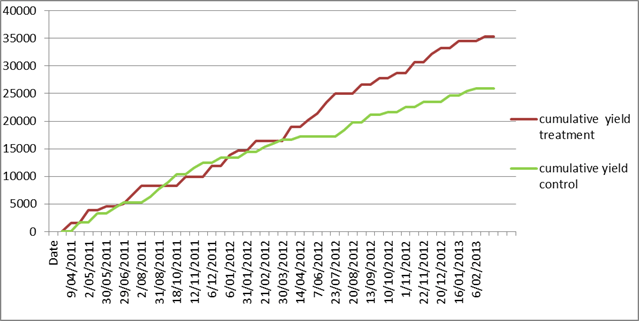
Total yield for the first 12 months of trial, including oats, and control pasture was 16413 and 15310 kgs of DM/ha respectively. Total yields in the six months following removal of the oats were 8134 and 6407 kgs DM/ha respectively. Total 2 year yields from trial and control paddocks was 35365 and 25989 kgs of DM/ha respectively. Cumulative yield data is presented in Graph 1.

Graph 1: Two year cumulative yield data: herbs and legumes (Treatment) v’s kikuyu and ryegrass (control)

clip_image004

The  results blew us away

Two-year nitrogen application rates were 289kgs of N for the trial paddock in total and 85kgs of N after the oats and 726kg of N in total and 476kg of N per hectare after the oats in the trail paddock were removed. In the second year of the study, only 30kg per hectare of N was applied to the herb and legume paddock compared to 188kg of N per hectare in the control.

Feed quality data from two samplings in November and February are presented in Table 1

Table 1 Comparative feed quality of herb and legume pasture (treatment) vs. spring ryegrass (control test 1) and kikuyu (control test 2)

Components: Treatment Test 1: Control Test 1: Treatment Test 2: Control Test 2:
% NDF 30.7 46.3 30.4 51.4
% Crude Protein 32 24.1 33.1 27.5
% Ash 13.33 11.34 11.35 10.41
Lignin % NDF 12.4 3.9 16.8 5.6
% Calcium 1.23 0.58 1.37 0.53
% Phosphorus 0.45 0.42 0.45 0.43
% Magnesium 0.36 0.3 0.36 0.26
% Potassium 3.28 3.13 3.18 3.16
% ADF 23.6 26.3 23.1 26.7
% Lignin 3.8 1.8 5.1 2.9
% NFC 25.2 18.6 27.6 14.4
Relative Feed Value 214 138 217 123
ME (MJ/kg) 11.63 10.8 11.76 10.97
ME CPM (MJ/kg DM) 10.16 8.58

Fertiliser Efficiency Outcomes where excellent

The trial paddock proved very nitrogen use efficient and responded well to effluent reuse from the dairy (2)

Pasture trial proves to be good news for people,cows and the planet

Challenges

  • Adverse climatic conditions with four major flood events and one very pronounced dry period during the trial certainly made for an interesting times and showed the trial pasture mix’s resilience to vagaries of the Australian  climate

Trial pastures were very resilient to adverse weather events events (2)

Trial pastures were very resilient to adverse weather events events (1)

Flood water pooled at the top end of the trial paddock however where the water was able to get away fairly quickly the pasture was very resilient to these extreme weather events

  • Accessing personnel in the region to do soil testing proved very difficult and we have been unable to have the final soil test undertaken at this point in time

Discussion

This farm based trial has provided useful evidence of the potential for alternative pasture systems based on legumes and herbs on coastal dairies in NSW. The trial pastures have provided at least as much dry matter in the first year as the conventional system with the yield data in year 2 being substantially higher in the trial paddock. The trial pasture appears to have performed very well in the autumn of its 2nd year and did not suffer a planting lag as per the conventional system. It also appeared to continue growing very well off a one off significant rain event in October 2012 during what was a very dry spring and summer in the region.

Nitrogen inputs were significantly reduced in the trial compared to the conventional plots with potential here to reduce fertiliser costs as well as nitrous oxide emissions and exposure to volatile nitrogen pricing. Full soil test data is not available at the time of writing.

Feed quality at all times on the trial was excellent with the farmers reporting anecdotal improvements in milk production when grazing trial pastures, particularly between November and March.

Weeds have been troublesome including both broadleaf and summer grass weed invasion in summer of 2012-2013.

These pastures have significant potential for NSW grazing based dairy systems. There has been considerable success with similar systems on the mid north coast and inland areas, however, problems with both stem root nematode and water-logging have been encountered on some properties. Soil characteristics, particularly, potential for poor drainage, underlying weed burdens and regional pasture pathogens need to carefully considered, when selecting alternative pasture systems as part of a pasture “portfolio”. However, there is considerable flexibility within both pasture species and cultivars in the group of pasture species under investigation to further explore these systems on a region by region basis. Farmers and scientific organisations can successfully partner to produce useful field based research.

What we learnt

  • The power of the two way conversations – farmers and natural resource management personnel working side by side to understand each other’s challenges and constraints
  • The value of cross community partnerships to improve NRM and sustainable farming outcomes and improve skills, knowledge, attitudes, and innovations,
  • That investment in people and on the ground activities that bring them together is critical for long term sustainability, fostering continuous improvement and creating opportunities to learn and grow together.
  • That communication is more than just sending information. It is a two-way process which creates demand for information delivery, is responsive to audience needs, and provides content in a way which is timely, relevant and understandable to target audiences.

Where to from here

Adoption of research, innovation and practices are critical to attaining long term goals

  • 9 out of 10 farmers learn directly from other farmers or through appropriate delivery of extension based on in field experience of other farmers in familiar and recognisable farming situations.
  • Farmers want to be able to ask questions in an non threating environment but need highly skilled facilitators who understand both the technical aspects of what they are presenting as well as the people they are working with
  • This project has produced extremely valuable and measurable results that have important and deliverable environmental and economic benefits for farmers. There is a need funding for extension projects that capture this research and other alternate forage system research. This could be delivered through regional farm discussion groups looking at  .

i) Triple/ double forages which increase yield per ha. See work on farms in the Hunter Valley here by Sydney University Future Dairy project

ii) Alternate strategies to annual and perennial pastures – showcasing the work at Lemon Grove Research Farm and farms in other regions doing similar trials.

iii) Developing fodder production portfolios to manage risk and season

This video is a 4 minute summary of the project

The project was supported by funding from the Australian Government’s Caring for our Country Initiative

caring for our country logo

Looking at the lighter side of doing more with less

With prime agricultural land getting gobbled up by houses and mining the challenge for Oz farmers is to produce more food using fewer resources to generate less waste and reusing/recycling that waste whenever we can

For dairy farmers that requires us to grow more grass per hectare (ha) so we can graze more cows per ha to produce more milk per ha which also means we are reducing CO2 emitted per ha.  Here is a very novel way of increasing stocking rate. Love it

Stocking rate

Thanks @peterholding for sharing

By the way other ways Oz Farmers are looking after our scare natural resources and getting more food and fibre from less

  • soil testing and nutrient mapping to allow them to use less fertiliser per ha. 
  • getting more crop per drop
  • Placing nitrogen fertiliser at depth in cooler times in wet soils to maximise nitrogen efficiency (and thus minimise losses to the atmosphere)
  • Planting water use and fertiliser efficient, drought tolerant perennial pastures
  • Assessing and optimising nitrogen fertiliser use and use of alternative sources such as legume rotations.
  • Using lower emissions machinery and assessing and improving existing machinery and irrigation pumping performance and investigating alternative fuel sources.
  • Improvements in soil management through stubble retention, reduced tillage and reduction in spraying operations

Measures of success

Farmers are able to increase their productivity:
• per hectare of land
• per unit of nitrogen fertiliser
• per ML water
• per unit of CO2 equivalent emitted

Far too much crawling on Easter Sunday

As you know I lay claim to living in paradise. Yet there is so much of paradise I am yet to visit. So this weekend I decided it was time to start to tick of that bucket list and enlisted the assistance of my neighbour Jenny who is building up her stamina to do a week’s trekking in Morocco.  

Over 50% of our farm is rainforest and it is very steep. Much of the the region’s ecological communities are endangered and we follow the RRR principles of bush regeneration and work closely with Landcare Illawarra who collect seed from farms all around our region to help increase the genetic diversity of our magnificent rainforest.

So off Jenny and I went where not too many people have ventured over the last 200 years

Jenny Hammond

and how gorgeous was it

IMG_2575

Clover Hill Dairies Rainforest

Jenny Hammond 2

and an hour later it was time to come back to 21st century

IMG_2589

thanks to our forefathers and lantana that proved to be quite tricky.

 IMG_2583

There was a lot of this

Clover Hill Dairies view to Bass Point

We were pretty happy when we found the paddock

Erin and Megan Wildlife Corridor

and just to show you what RRR principles can achieve in 12 months

Picasso Wildlife Corridor March 2013  (2)

It was pretty rewarding to see these trees grown from locally collected seed flourishing 12 months later

Bringing Arthur Boyd’s vision to life

I just love working with bright young minds who grab life with both hands and run with it. Rachel Walker is one of those young people

I have reblogged this from Art4AgriculutureChat as I am confident Rachel’s journey will inspire you just as much as it does me

Background

Art4Agriculture’s Young Eco Champions have each identified a farmer they want to work side by side with to get best environmental outcomes for Australia’s natural resources 226A5485.JPG.Still001_HIres

Art4Agriculutre Young Eco Champions (right) with some of our Young Farming Champions and members of the Art4Agriculture network

We were very excited to have the opportunity to pair Rachel Walker with Bundanon Trust.

Rachel’s shares this wonderful opportunity with you today through her guest blog post …

Bringing Arthur Boyd’s vision to life – by Rachel Walker

As a Young person with a love for Australia’s wonderful landscapes and a deep respect of how scarce our natural resources are and the opportunity that young people have to pay an active role in protecting and enhancing them

IMG_0218

Rachel left participating in a Face to Camera to camera workshop at a recent Young Farming Champions/Young Eco Champions workshop 

I also believe that Australia can play an integral role on a global scale by setting good examples in the management of our scarce resources.

I have learnt that the majority of the Australian landscape and its resources, are managed by our farmers, and much of that includes privately owned areas of native bushland. Hence our farmers also have a very important environmental role to play

As a Young Eco Champion, I have been able to spend some time with the Bundanon Trust in the Shoalhaven. The trust has the unique challenge of rehabilitating and maintaining a large area of native bushland as part of Arthur Boyd’s gift to the Australian people.

The 1,100 ha of river front land was generously left to the people of Australia in 1993, by renowned Australian artist, Arthur Boyd, and featured in much of his artwork. Since the gift the properties have been under the care of the Bundanon Trust, which has preserved the natural and cultural heritage, and developed a fantastic artistic educational experience that is adaptable and applicable to all levels of knowledge. It hosts school children year-round, as well as artists in residence

clip_image002

The Riversdale Property regularly hosts workshops for young people

clip_image004

As well as guests from all over the world who see views to die for

riversdaleview1

and enjoy fine Shoalhaven Produce prepared by local chefs

clip_image008

Including local wines

clip_image010

And beef grazed on the property

bundanon beef1

On Friday I was fortunate enough to be taken on a personal tour of the four properties that together form the Bundanon Trust. A stipulation of the bequest was that Bundanon was to always remain a working property in some capacity, and to be accessible to the people of Australia. Today the properties have reduced their beef cattle production in favour of restoring native forest, a tribute to the inspiration in many of Arthur Boyd’s artworks.

96-0163-0001-01_small

Arthur Boyd, Peter’s fish and crucifixion, 1993 Copyright Bundanon Trust Reproduced with permission of Bundanon Trust 1993


During my visit to Bundanon, Riversdale and Eearie Park it became apparent to me what a fantastic job the Bundanon Trust has done in caring for and managing this magnificent resource combining farm, education and culture, and also what an enormous responsibility they have for the environmental management of the properties for the people of Australia. This is particularly so given the length of Shoalhaven riparian zone (boundary between the land and river) that the properties border.

My ever-enthusiastic guide and Bundanon’s education manager, Mary Preece, has been utilising her photographic skills to catalogue the diverse plants species present across the properties, in order to contribute to the understanding of the biodiversity across the 11 vegetation communities in the landscape.

clip_image016

Mary Preece Bundanon’s Education Manager works with local school students at Riversdale

However the management of 1,100 ha of diverse, native landscape has its challenges, and the Bundanon Trust is using theirs as an opportunity to learn and educate others by setting a great example of natural resource management.

clip_image018

Mary Preece is photographing and cataloguing the diverse plant species on Bundanon in order to contribute to the understanding of the biodiversity across the 11 vegetation communities in the landscape.

One of the most apparent ongoing battles that the Bundanon landscape faces is the infestation of Lantana, particularly along the 15km riparian zone.

Haunted-Point-100_4507Pulpit Rock viewed from Bundanon Property

.As luck would have it, Bundanon’s caretaker Gary, who is also the longest serving resident of the properties, was happy to take me up to a place called Haunted Point, where the battle against invasive Lantana has been ongoing for a few years, and threatens the properties’ biodiversity and ecosystem health.

clip_image020

This aggressive weed has been removed from the properties once before, and so there is a strong push to remove it again – this time for good! Landcare Australia, Greening Australia and the Southern Rivers Catchment Management Authority are partnering with the Bundanon Trust to orchestrate the enormous task of removing Lantana from all the properties. Even from my brief tour around Haunted Point, the difference between cleared and uncleared areas was incredible! The cleared areas looked unburdened in contrast to the dense weed that seemed to be choking the understorey of the uncleared zones.

clip_image022

This task is expected to take 3 years and to be completed by 2015. The removal of Lantana however is not a once off job, and will require constant management once the initial removal is complete, to prevent reinvasion. With so many knowledgeable people on hand, and the enthusiasm of the people that I met on my trip to Bundanon, I’m sure it is a labour of love that will lead to the eradication of this weed and the rehabilitation of the region. I am looking forward to seeing the progress as it continues.

clip_image024

As we drove down the rocky road away from Haunted Point, we were able to identify a variety of vegetation that is inherent to the Shoalhaven region – red cedars for which the area was first colonised, figs, gums, banksia’s and bush lemons were all found along the way, not mention some petrified wood from a rock that had recently been split in half by a falling tree!

clip_image027

Another environmental issue that Bundanon faces is the threat of bank erosion, which is unfortunately exacerbated by the removal vegetation (yes, even lantana) from the riparian zone. The property has taken many steps forward in reducing the impact of their practices on the riparian zone, by fencing off livestock and reinforcing vulnerable areas with local rocks to slow erosion rates. The awareness of such issues and the dedication of the Trust towards developing management strategies not only benefits the local region, but by sharing these experiences with visitors and students as part of the educational experience, Bundanon sets a great example of achievable goals, and such knowledge is passed on to the public where is has no boundaries!

clip_image029

Bundanon Homestead

To add a great end to a fantastic day, I was shown around the sandstone homestead of the Boyd family, completed in 1866. Walking through the homestead was quite a personal and unique experience, with no ropes or barricades to keep you from getting a close up look at the displayed art collection, which includes artworks from Arthur’s childhood and throughout his life, and from all members of the family.

studio pick

Arthur Boyd’s studio at Bundanon

My favourite things were that children were allowed to play the family’s grand piano, and that the studio light switches were still covered in paint!

clip_image031

Bundanon Trust is in a unique position where they have the opportunity to involve the public and educate students on the impacts that they are having through their natural resource management choices. It was a great day in the Shoalhaven, and a a great example of how the team are integrating the exploration of the artistic heritage of Arthur Boyd and his family with response to landscape and immersion in the natural environment.

Riversdale BEC1

Riversdale – Spectacular scenery teamed with an award winning building designed by Glenn Murcutt in association with Wendy Lewin and Reg Lark