A Little Ray of Sunshine

Every new day on the farm brings new life and new hope

I remember being upset a few of years ago when we lost a special cow and a well meaning person in the room making the pragmatic statement “when you have live ones you will have dead ones”. Lets say I didn’t find it very comforting.

As yesterday’s post alluded a bit of good news wouldn’t a stray. Sadly not only did we lose Simola in the flood we lost our beautiful princess the Divine Eileen to what the vet believes was snake bite. That was devastating for everyone on the farm

IMG_8417

Eileen now has a paddock named after her

So you can imagine the excitement yesterday when the world famous Magpie calved and had a little girl

IMG_0511

Watch her first steps here – just adorable

My first steps–how clever am I

Magpie is destined for fame with her mum attracting widespread media attention over the last couple of years

KIama Independent 10th march 2010 Emma Udderly Fantastic

She also stars at the end of this video which won Emma the Heywire Competition

Emma and Magpie

and then her sister with Emma last year

01-08-2011 09;42;12AM

and then there is her grandmother the most bizarre cow on the planet

Till death us do part

The trials and tribulations of the last 18 months have left us questioning our resolve to get up every day to help feed the world. See previous post

2011 started with a supermarket price war instigated by Coles that used “free” milk as a customer traffic driver with a laughable promise by Coles that this would not affect farmers

In March we had the 1 in 50 year flood and the heartbreak that brings including being utterly powerless to save one of our most adorable cows when she was swept into the floodwaters and found herself stuck in a drain with no chance of survival.

Dolman CL SIMOLA

Simola (pictured with Emma) lost her life in the March 2011 flood

Then all the Dairy Farmers (who supply National Foods) suppliers in our region felt the impact of the milk price wars with a 30% drop in their allocated quotas as well as a drop in farm gate milk price

Always looking for the opportunity we rose to the challenge and managed after much haggling to convince Dairy Farmers to allow us to bring both our Dairy Farmers contracts to the Clover Hill farm. In the first instance this required a $170,000 investment in a new milk vat. We were then able to grow our business, keep the staff we had and employ one more by supplying Parmalat from our Lemon Grove Farm.

This also required the purchase of 100 more cows and the need to grow enough pasture to graze 6 cows to the hectare which is almost three times the industry average. This is very doable in paradise but along came the 1 in 25 year flood with us now finding ourselves 4 weeks behind with pasture sowing and feeding our cows twice a day on bought in feed with the help of the mixer wagon which adds two hours to Michael’s day .

Michael uses the mixer wagon to supplement the milking cows feed when pasture levels are low

We have pushed the boundaries in the last twelve months at all levels and it isn’t just the landscape feeling the pressure. Every night Michael comes in and spends two hours with his knees elevated wrapped in ice doing his best to give everyone who walks in the door that big smile he is so famous for and it breaks my heart to see him in so much pain from the rigors of his job

On Friday some-one on twitter shared this article with me and this breakout piece so resonated with me.

Why don’t farmers retire?

“Agriculture is notorious for having a skewed age structure,” says Dr Matt Lobley, of the Centre for Rural Policy Research, University of Exeter.

“Unlike any other profession, there is not much separation between what somebody does for a living and their whole personality.

“They can literally go outside and walk around the farm and see the products of their labours written into the landscape – in the shape of the walls, the hedges and in the fields.

“It can be very difficult to face up to that time when they have to let go either partially, or fully.

“These farmers are also socially embedded into their communities, and they have an intimate knowledge of the land.

“They understand micro-climates of individual fields – which are the last to warm up, where you get frost pockets or flooding. That knowledge is often under-estimated, even by the farmers themselves.”

My family is proud to farm. We are committed to supplying affordable, nutritious, ethically produced milk to over 50,000 Australian everyday but we cant do it for free

In the words of Louise Fresco “Food is as important as energy, as security, as the environment. Everything is linked together.”

All Australians must value food at its true value and be prepared to pay for it.  Yet we continue to ignore this at our peril and we are denying these young people a future as part of the noblest profession and this wont happen either Julia if we don’t have the farmers to fuel the agribusiness sector.

Stand up Australia and be counted. May I suggest we all start with a signature on this petition to send to the Victorian Government to try & stop the National Centre for Farmer Health from closing. http://www.change.org/petitions/state-government-of-victoria-stop-the-national-centre-for-farmer-health-from-closing

Testing day at the dairy

Today was a very busy day at Clover Hill. We hosted 10 Argentinian vets and cattle consultants who are touring the South Coast looking at different dairy systems before heading off to the huge event in Rockhampton next week that is Beef Australia 2012 .

In between this we used the midday milking to herd test and record the Clover Hill cows.

Whilst Clover Hill has a very modern dairy we haven’t got milk metres installed so we have someone come every 4 weeks to measure how much milk each cow produces. I have pictured it below and please note this is a fairly old fashioned way of doing this. The dairy at Lemon Grove is fully computerised with milk metres built in and we daily get milk records. It would cost us almost $40k to upgrade the Clover Hill dairy to do this and with milk selling for the ridiculous price of $1/litre there isn’t enough in the kitty and until Coles get over this marketing stunt I cant see an upgrade coming anytime soon     

IMG_1409

The girls come home for their 4 week herd recording

IMG_1367

Herd recording apparatus

IMG_1364 

Nick installs the milk metres and gives his mum a big smile 

IMG_1368

Emma collects each cow’s herd recording number and writes it on each milk metre

IMG_1382

Whilst the other girls wait patiently for their turn

IMG_1393

Nick explains the process to the Argentinians

IMG_1422

The herd recorder measures the amount of milk each cow produces

IMG_1414

and records the details on a spreadsheet

IMG_1411

Then a sample of each cow’s milk is collected in small bottles and this is sent to the herd recording test centre where the following data is measured

  • volume of milk
  • fat and protein percentages
  • individual cow cell counts (SCC) – this helps determine the udder health 

We receive a herd test report after each test day and an annual report which summarises the performance of the herd for the season plus masses of other data which help us make decisions on breeding and management of the herd.

Over the years we have had some very high producing cows indeed .

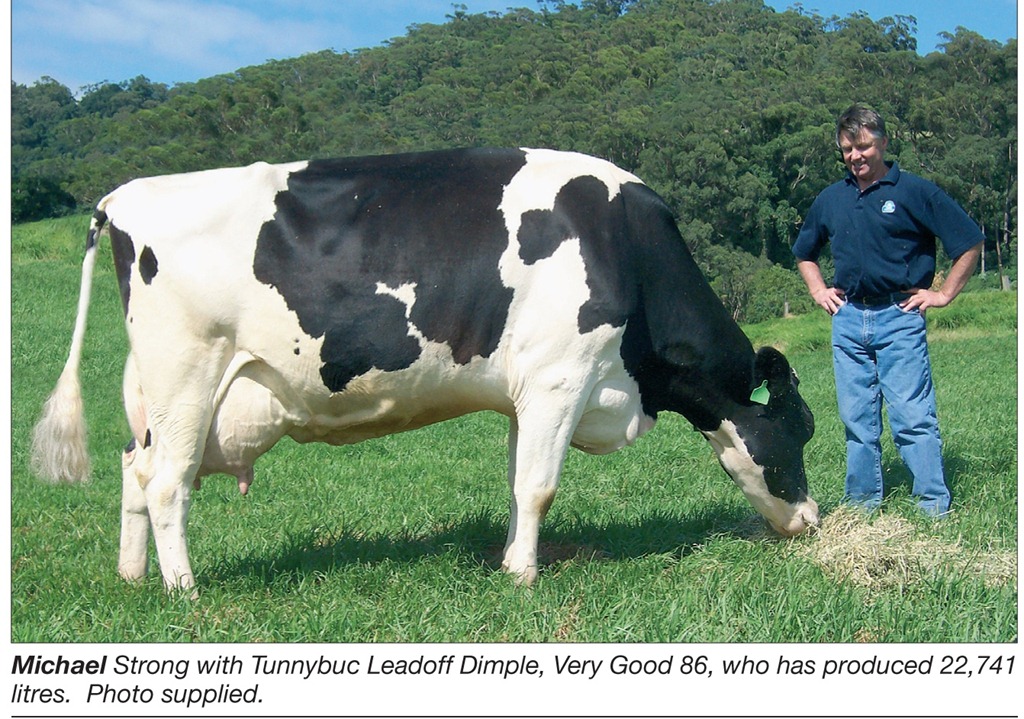
This is Dimples who holds the Australian record for both the most amount of milk and kilograms of protein in 305 days with a whopping 22,734 litres of milk and almost 700kgs of protein .   

Dimples .

This is Tangalla Leduc Fond 2EX who holds the record for the most amount of milk and protein produced by a three year old cow. Fond is also a bit of a looker and is one of our top show cows. Fond produced 17,214 litres of milk and 541kgs of protein when she was just three years old  

Tangalla Leduc Fond 

And the world renowned Tina who has produced the most amount of lifetime milk by any cow in Australia has just calved again  See previous story here http://wp.me/p22l8m-b2 . On top of this Tina has just turned 17 and recently featured in Holstein International 

Tina IMG_7706 

Tina just before she had her thirteenth calf. Wow she looks pretty sprightly doesn’t she?

Farmers holding positions of influence

Today Clover Hill Dairies hosted a visit by Natural Resources Commissioner Dr John Keniry and A/Executive Director Bryce Wilde. As always we take every opportunity to share farming stories and farmer commitment to people, animals and the planet with the wider community and people of influence.

Can you imagine how excited I was to find out the commissioner is also a sheep farmer from Cumnock running lambs and producing wool.

With farmers at less than 1% of the Australian population you don’t tend to run into people of influence with a strong farming background who know as much about growing pasture as you do

IMG_0995

Dr John Keniry and the SRCMA team at Clover Hill

As it turns out Dr Keniry has worn many hats in his lifetime including a degree in chemical engineering with first-hand experience in the food and sugar industries. He is Chairman of the Pork CRC and Sheep Innovation CRC and Chairman of the Board of the Australian Farm Institute so he comes to the Natural Resource  Commission with an understanding of the everyday challenges of farming and managing on farm issues and that’s very comforting to this farmer.

IMG_0975

The pasture was looking pretty impressive. I can see the cows licking their lips already when they see this. Erin’s wildlife corridors were looking equally good. Look at those trees grow Erin. What about the Persicaria a vulnerable species that has taken a liking to our creek beds. How rewarding is it that we have been able to link, enhance and establish additional populations of this native herb around the farm  

IMG_1006


Not been able to join us for lunch Michael is not complaining as there is plenty of Panacotta left over to keep him dairy indulged over the next few days

IMG_1003 


Decrease Text Size

Something in it for everybody!

Todays post is by guest blogger Dr Neil Moss our farm consultant and one of the great team of experts who shared their vast experience and knowledge with the participants at our recent Field Day

Neil shares his field day banter with you ……….

One of the great privileges of working in dairy consultancy is being able to observe and collect innovations and exciting ideas from successful farmers in one location, and then mould, adapt and apply these to a wider variety of situations with other farmers that are also willing to innovate and try new things.

Dr Neil Moss and Dr Richard Eckard share the benefits of planting legume pastures with Field Day particpants

Dr Neil Moss points out the stoloniferous habits of some his pasture

Our recent field day at Lemon Grove Research Farm was a great example of just this concept. For many years I have been working together with clients on their farms  developing pastures that break away from the norm and start to cover some of the gaps in their pasture production and risk management systems.

IMG_9752

It was a colourful and diverse group of farmers who stood in Neil’s pasture salad bowl 

The field day wasn’t just a great chance to showcase some of these great pastures and how we go about getting them. It was also a great opportunity to explore how farmers’ ideas and observations can be captured and developed into farming systems, and how individuals that think “outside the square” and challenge conventional wisdom can shift “out of the box” concepts and techniques into the mainstream with benefits for many.

IMG_9663

The participants got some backgrounding from Lynne Strong

Using some concepts and techniques that I originally observed on a farm owned by David and Audrey Moxey on the Mid-North coast of New South Wales (Thanks guys!!) we are now working in just this way. Some great on-farm ideas based on Dave’s experience and a little innovation have now been morphed into a widely adaptable pasture system that may have substantial production and environmental benefits for those that can apply them. David had successfully negated some of the production challenges posed by low summer feed quality by including lucerne, chicory and plantain- tap rooted legumes and herbs with great summer growth and feed-quality, in his planting mixes. We had been sowing these with ryegrass to drive more winter and spring growth but this system was still exposed to summer grass invasion and the need to use significant amounts of nitrogen fertiliser to get the most out of them.

Now it was time to think and adapt! What if we used more winter active chicory cultivars dropped the ryegrass out and started to control some of the summer grass weeds with selective herbicides! It worked a treat.

Farmers network

There was plenty of discussion and networking opportunities

The run-up to the GFC saw a near tripling in price of nitrogen based fertilisers. Linked closely to the petro-chemical industry, it was clear to see that one of the key future “risks” we were facing was “nitrogen shock”- and believe me, many were shocked at how high the prices went and how exposed their systems were. Coupled with this, a growing understanding and acknowledgement of the potential environmental and greenhouse effects of high nitrogen fertiliser use was raising eyebrows – it was clearly time to observe, adapt and act!

Audience at Lemon Grove

Tracey Bob and Vicki thought it might be worth a try in Berry and Pyree

The Strong’s at Jamberoo are fantastic innovators and have been great clients to learn and grow with over the last 12 years. When we discussed these new pasture strategies and some of the benefits they may bring, they could not wait to give it ago. Taking considerable risk they dedicated 12 hectares to some new plots and away we went. For two years we worked to refine the system, adding clovers and modifying our winter agronomic strategies to see where we could shift the feed production curve to. We had what we thought were some great successes and picked up a few lumps and bumps on the way.

Michael in Lucerne @ Lemon Grove

But now we needed validation. We needed to be more certain that what looked, felt and seemed good was actually delivering! Testimonials and feel good stories (has anyone out there ever read a bad testimonial????) were and should never be enough to persuade farmers to drop what is tried, tested and true and expose themselves to even more risk! We needed a bit of data. Here’s where we were lucky enough to apply for and successfully receive some research funding through the Caring for our Country grants program.

Daff and Martin Royds

Marcelle from DAFF interviews Martin Royds

We could now put some numbers to what we thought was happening allowing farmers to make better decisions based on observations with real infield “controls” for comparison.

IMG_9712

We still had a few weeds to tackle

So what have we found so far? We have appear to have a resilient pasture system that is giving us as much feed (this year anyway) as the traditional kikuyu based pasture system commonly utilised on the coast. The feed quality is dramatically improved and most importantly, our nitrogen fertiliser usage has dropped by over 50% at this stage. Weeds can still be a challenge! This linkwill take you to the presentation of our full results to date.

Feed quality0028

Farm field days are a great way to present information and stimulate cross pollination of ideas. We had many farmers there, some from dairy, some from beef and small holdings, some with conventional farming backgrounds, others pushing in different directions with organic and biological ideologies. The great thing was that the barriers that seemed to exist between these farming “churches” appeared to subside allowing all to ask question and share ideas- farmers learning from farmers, picking out what may or may not work in their farming system!

The day was all about interaction. Interaction between farmers and those from the services sectors, between representatives from government and environmental bodies and the educational institutions. Personally, I really enjoyed the interaction with all the attendees.

Stephen Weidemann and Dr Richard Eckard

Stephen and Richard in the dairy at Clover Hill

I also got a buzz from bouncing off the other guest speakers attending the day including Richard Eckard and Steven Weidemann who were only too happy to step into the fray and openly share their knowledge and experience as well! I hope everyone enjoyed the day as much as I did!

Back to Lynne

IMG_9691

Let’s not forget the gorgeous man who always not only brings the lunch he cooks it too

Phil Monoghan

and serves it. Big shout out to Phil Monaghan and Weston Animal Nutrition

IMG_9753

and special thanks to Phil Duncan from Bishops Nowra and Carl Pratten from NAB Nowra who sponsored the drinks. This is Carl talking to Albion Park dairy farmer Craig Tait

Using the power of poo to save your farm, no bull

Guest post today By Justin Huntsdale ABC Illawarra

It’s not cheap, but you won’t be ‘wasting’ your time – a Jamberoo farming conference has been told using the nutrients from livestock dung could help lower your fertiliser bill and help the environment.


IMG_9661

Justin Huntsdale ABC Illawarra gets the lowdown on Dung from Steve Weidemann

Where we see livestock dung, agricultural scientist Stephen Wiedemann sees a great source of nutrients for your crop or a way to power your home.

Animal dung is rich in nitrogen, phosphorous and potassium – all fertilisers a farm spends significant money on – and much of the time it ends up biodegrading in the paddock or in a sewerage system.

“We like to see waste as a liquid fertiliser,” Stephen said.

“In a dairy or any livestock farm the animals only use a small proportion of the energy they consume, so you can improve sustainability if you can then cycle those nutrients around the farm.”

The Toowoomba-based scientist was speaking yesterday at a conference on ‘Clearing the Carbon Confusion’ held at the Lemon Grove farm near Jamberoo on the NSW South Coast.

The day also involved talks from Dr Neil Moss and Associate Professor Richard Eckard who were trying to help local farmers manage their environmental responsibility while still making money.

And while he’s a bit sheepish about being known as the resident livestock ‘poo expert’, Stephen Wiedemann is serious about making a farm more efficient, starting from the backside.

Putting manure on your domestic garden is something we’ve been doing for decades, but applying that principle to a broad acre crop is a different (and significantly more expensive) story.

“It’s a little bit difficult and expensive but it’s easier if you’ve got a larger farm,” he said.

“Infrastructure is a concern because you’re looking at dams, ponds and other treatment facilities and also irrigators so there is a high capital set-up, but once it’s established, it’s not too hard to manage.”

Balancing a farmer’s books and social conscience is not a new problem, but it’s something that is easier with the advice of experts like Stephen.

He describes his specialty as making the point of connection between the environment and farming.

And as farms become bigger as the demand for primary produce increases, the environmental strain grows too.

“Across the industry there’s a trend to expanding farm sizes, which means more cows on less area and one downside to that is you’ve got an issue with how to manage their waste.”

Stephen says, just like we’d use cow manure to fertilise our garden, livestock effluent can be used to replenish paddocks that are depleted from grazing or foraging.

In Germany, effluent management systems that recycle waste are commonplace, and sometimes used to trap methane which then powers households.

He says these additional benefits are some of the carrots that will sell the message to sceptical farmers.

“It’s a challenge for the industry because it’s capital intensive and you’re looking at longer payoffs, especially when farming’s recently been full of tight margins.

“I know a lot of farmers would like to push it off to the corner, but you have to look at other benefits beyond the cash benefits.

“There’s a positive kickback in terms of lower fertiliser usage, but the overall payback may be more in the realm of six years, and that doesn’t look attractive to a farmer.”

Stephen Weidemann talks to Justin Huntsdale from ABC Illawarra

Will it put money in my pocket

Tomorrow we open the doors of our research farm so the local farmers can see what’s been happening over the fence.

Our consultant Dr Neil Moss will be taking our visitors on a farm walk where he will share our pasture trial results that increase pasture protein and energy, lift milk production by up to two litres a day and use less fertiliser.

The farmers will be asking lots of questions and the first thing they will want to know is what’s it for them and their cows. That is exactly the question they should be asking because farmers are just like the rest of the world their first priority is to feed their families and just like everyone else their work and commitment should be valued at its real price. ( Ditto for their cows)

Neil is using his presentation tonight to set the scene. Would his slides entice you to come?

Lemon Grove Research Farm Field Day 0001 

Lemon Grove Research Farm Field Day 0002

Lemon Grove Research Farm Field Day 0003

Lemon Grove Research Farm Field Day 0004

Lemon Grove Research Farm Field Day 0005

Lemon Grove Research Farm Field Day 0006

Lemon Grove Research Farm Field Day 0007

Lemon Grove Research Farm Field Day 0008

Lemon Grove Research Farm Field Day 0009

Lemon Grove Research Farm Field Day 0010

Lemon Grove Research Farm Field Day 0011

Lemon Grove Research Farm Field Day 0012

Warts and All

Two more sleeps and we open the farm gate warts and all for our Field Day.

IMG_9293


A huge amount of work has gone into getting both farms ready (or as close as we can with all the major rainfall events) both on farm and at the regional Landcare facilitator’s office at the Southern Rivers Catchment Management Authority.

I have three presentations to get ready which is bad enough and now I hear the Department of Agriculture Fisheries and Forestry is going to film the entire event.

Research shows 9 out of 10 farmers learn from other farmers. We know we push boundaries and we don’t always get it right so its important what you share.

So I have decided to focus one of my talks on what we could do better.

This started by listing 10 things we do well and then listing 10 things we want to do better and second list was frightening

Firstly I wrote down what I thought, then I asked Michael and then I got Nick’s opinion and OMG did I end up with a long depressing list. So I think the first thing we need to do better is not be so hard on ourselves   

So here is the list of what we do well

  • Very focused on doing what it takes to stay in business and employing young  people and contributing to local economy
  • Animal well being and environmental stewardship focused
  • Chase knowledge and implement technology
  • Outsource the expertise we don’t have
  • Push the boundaries
  • Grow pasture well
  • Engage with the community
  • AGvocate
  • Monitor inputs and outputs
  • Share/communicate our story with the farming community
  • Whole of industry vision and we partner and collaborate

Now I am off to whittle down that long list of things that we could do better

IMG_9578

Meanwhile David and the dry cows get on with seeding season. See previous post here http://cloverhilldiaries.com/2012/03/08/seeding-season-begins-with-a-bang-and-a-whimper/

I never thought of it like that

Today’s post has been written by the amazing Stephanie Coombes creator of the Careers in Australian Agriculture website who also blogs at the laugh a minute  Steph’s Agventures

Steph was born and raised in the suburbs of Perth, Western Australia. She has just graduated with a degree in Ag Science with First Class honours and is passionate about the beef cattle industry and ultimately wants to work in the live export industry, in animal welfare, training, education and supply chain management. She is now honing her skills as a jillaroo just about to start work for Annabelle Coppin on the huge Yarrie station at Marble Bar in WA

Steph first told me this story on the couch at the National Press Club in Canberra and I was fascinated. I have watched the cows going to the paddocks backwards from the dairy for years and must admit they way they do it intrigued me but never understand the “science” behind it

IMG_4149

Here is the “science” told like I will guarantee you have never heard it told before ………  


There are countless times I have said “I never thought of it like that”, and it always makes me think that well… I don’t think enough. How could I not pick up on something so fundamental? The skill of observation often sets people apart in this industry, if you have it, you’re one up, if you don’t, well… awkward! However, sometimes I tend to focus on particular things, and stop observing the bigger picture.

One example of when I have said “I never thought of it like that” was when the intricacies of cattle pads (tracks) were explained to me.

Question time! Cow pads… are they straight… or meandering?

IMG_8599

If you answered meandering, two points to you! Next question… why do they meander?

IMG_8601 

Are the cows drunk? Are pastoralists all over Australia spiking the lick for a laugh? Are cattle just not blessed with the gift of balance like the Australian gymnastics team? Nope. Is my imagination in overdrive? Yes…

The answer is to do with livestock senses. In the short time I have been working with beef cattle, I have had two main teachers who have bestowed a lot of knowledge upon me. Well I don’t know if I have said that quite right, because it is not as if they dropped a bomb of knowledge on me. I suppose it was more not just what they taught me, but also how they taught me. It wasn’t just facts and figures from a book, it was about using my skill of observation, and asking myself questions about what I was seeing and why I was seeing it.

It should come to you as no surprise that both of these people are well respected in the beef industry, and very good at what they do. They are Doug “Dougie” Jenkins, and Boyd Holden.

There is a whole spiel on livestock senses I could go into, but I’ll cut to the chase about meandering cattle pads.

IMG_8709

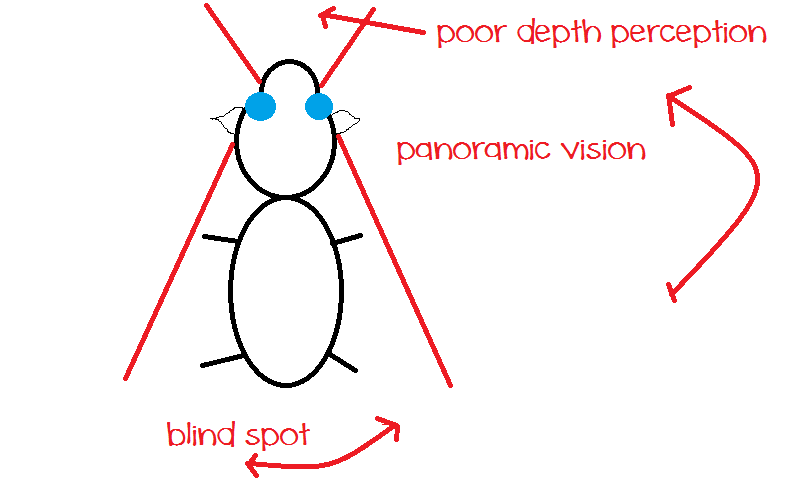
Cattle have peripheral vision. That means they have a wide angle vision, like a panoramic camera shot. They also have poor depth perception directly in front of them. Humans, on the other hand, have binocular vision, so we can see directly in front of us, but not so much to the side, and certainly not behind us!

One theory entertains the idea that our vision is dictated by our predator- prey status throughout evolution. Cattle are herbivores, they are the prey. Furthermore, they are grazing animals. Like that game we played in primary school “heads down, thumbs up”, drive past a paddock of cattle, and you will see them playing “heads down, bums up”.

Now, if the cattle are busy playing “heads down, bums up”, who is on the lookout for predators sneaking up in the grass?

If cattle had binocular vision, it would serve zero purpose to them as they had their head in the grass, munching away. They’d just be looking at grass. However, with their panoramic vision, they have poor vision directly in front of them (the grass) but good vision side to side.

cow

Now first things first- that is an awful picture, yes I am aware! It looks more like a pig than a cow.

Now back to business. So can you see in this picture, with the panoramic vision, the cattle can be scanning for predators while they are grazing? Why it is more useful for them to be able to see around them, than directly in front of them?

Next, take note of the blind spot. Even with their panoramic vision, cattle, like us, are not blessed with being able to see directly behind them, which means they are also susceptible to people running up behind them yelling things like “boo” or “RAHHH”, things other people think are funny, but as the person with no eyes in the back of our heads, things we do not think are funny…

IMG_4093

So imagine you are a cow walking around. You have poor depth perception directly in front of you, (I’m not sure if that is near or far sightedness?), good vision side to side, but then you have this annoying blind spot. That one spot which leaves you open to a dog or another predator, sneaking up behind you. Of course, being in the “prey club” as opposed to being a predator, I would be a bit paranoid on top of that if I was a cow.

So, you need to check behind you, to make sure nothing is eying you off as dinner (unless you are in a hoof and hook class and then you should be eying off that human on the other end of your lead rope!).

IMG_4095

Now, we all have that annoying friend who bumps into us when we’re out shopping, they keep looking at window displays, cute boys walking past etc… Fact is, when you turn your head, you often wander off your pathway. That’s why we have mirrors on our cars, especially those add ons which show you your blind spot! Wandering out of your lane is far worse than bumping into your friends!

That is why cattle pads meander. Cattle need to check their blind spot as they go on their way. They have fairly short, inflexible necks, so when they bend them to play peek-a-boo, it affects their whole body, sending them off course ever so slightly.

image014

Horses on the other hand, have longer, more flexible necks, are able to look behind them without such an obvious effect on their balance and as a result, their tracks aren’t as meandering.

I love learning bits of information like this. It is such an important concept to me, to be able to understand livestock senses, and why they do what they do, to be able to work with them effectively. Sometimes we are so focused on awesome research and discovering new things, we don’t discover what already is.

…. and a great night was had by all on the couch at the National Press Club as you can imagine with story tellers like this for entertainment. Thanks Steph I must admit my life is re-energised since I met you   

BTW Some more interesting stuff here via Emma http://www.slideshare.net/LandLearnNSW/cattle-whispering-emma-kay

IMG_4111

The wounds are still raw

It is now 7 days since the double whammy of one farm being covered in flood water and the other the scene of a spine chilling tractor accident. Read the original post here

Today is the day that the tractor recovery session begins

We got off to an early start with the sun shining, the birds singing and some very VERY fit people braving the Clover Hill mountain on their bikes.

IMG_9228

I was exhausted just watching them

IMG_9240

By 7 o’clock the team of experts were in place.

IMG_9243

By 7.30 everyone was starting to get very nervous with the recovery truck now bogged and a second tractor called in to pull out the truck failing to do so.  

IMG_9244

That then required more machinery to un-bog the truck

Nick was starting to think we should call the whole thing off and Michael and I were quick to agree. A quick call to our insurance broker and he was on the scene. After a long conversation with the recovery team we were assured this was a piece of cake compared to the places these experts often find themselves in such as recovering semi trailers that had gone over cliffs. So we reluctantly agreed to let the process continue and we all busied ourselves doing whatever it took to keep our minds off the task at hand and let the experts handle it.

IMG_9248

We were all very relieved to see 4 hours later not only had the tractor returned to the top of the hill so had the gator which had been bogged at the bottom of the hill with the tractor for 7 days.

So the next trick was driving a tractor with one operational tyre onto the tow truck.

IMG_9253

Its soon became obvious backwards wasn’t going to work

IMG_9260

Finally the tractor is loaded

IMG_9271

As you can imagine a lot of people will be very pleased when that tractor incident is just a faded memory