Successful Research Outcomes at Lemon Grove – Working with the best is good for people cows and the planet

For those of you interested in the lasted R&D&E happenings on NSW dairy farms I am highly confident you will enjoy this article

This video shares Dr Neil Moss’ full presentation on our pasture trials at the recent Sydney University Dairy Research Symposium. See full report (pages 21 to 39)  here 

Why we did the research at Lemon Grove

Surveys tell us 9 out of 10 farmers learn from other farmers and they want to see research that is relevant to them and their business i.e. they want to see the research working in their own backyard. They want to see research that we deliver a good return on investment in the shortest turnaround time

1st pix for Activity two

Lemon Grove Research Farm

Aim

To explore pastures that could potentially reduce Carbon footprint whilst improving productivity, profitability, and management (resilience)

Objective

To grow productive (quantity) and nutritious (quality) pasture that will be

  • Resilient through extremes of climate (floods and droughts)
  • Water and fertiliser efficient
  • Able to fill the feed gaps
  • Tolerant to captured dairy effluent irrigation

What we did

The trial was conducted at Lemon Grove Research Farm, located on the Minnamurra River floodplain just to the east of Jamberoo, NSW. Control and treatment paddocks were identified in December 2010 and soil tests were taken. One paddock was to be identified as the “trial/treatment” paddock and was to be prepared for the new pasture; the other “control” paddock was to be farmed as per the rest of the property, retaining its kikuyu base and being sown down to oats and Italian ryegrass in early autumn.

The trial paddock was sprayed with 6L/ha of Roundup Powermax (540 g/L glyphosate (present as the potassium salt)) on 17.2.2011. Pasture trash was mown and removed and the trial paddock sown down to 110kg/ha of Cooba oats on the 19.2.2011. A small area was topped up in early April following flooding in March. Grazing of the oats commenced shortly after and continued until the 5th of August when the paddock was sprayed again with 6L/ha of Roundup Powermax on 5.8.2011. The paddock was then direct drilled with a disc seed with the trial seed mix of:

  • 8.5kg/ha Stamina GT6 Lucerne
  • 4kg/ha Bulldog red clover
  • 1.5kg/ha Kopu II white clover
  • 1.5kg/ha Will ladino white clover
  • 2kg/ha Tonic Plantain
  • 2.5kg/ha Puna Chicory

The trial paddock was treated with 150ml/ha of Verdict (520g/L haloxyfop present as the haloxyfop-r-methyl ester) selective grass herbicide on the 20.2.2012 to control grass weeds. It was not over sown in the autumn of 2012.

c Treatment paddock of herbs and legumes (2)

Cows grazing the treatment paddock

The “control” paddock was sprayed with 200mls/ha of Roundup Power Max on the 1/3/2011 to suppress kikuyu growth and facilitate early planting of a mix of 35kg/ha of Feast II ryegrass and 60kg/ha of Cooba Oats. Grazing commenced 16th April 2011. It was resprayed with 225mls/ha of Roundup Powermax on the 16/42012 to suppress kikuyu prior to autumn planting with a similar mix

Neil Moss Ryegrass

Researcher Dr Neil Moss SBScibus in the control paddock of Ryegrass and Oats

Fertiliser was applied to both control and trial paddocks as deemed necessary by the farmer. This include urea, some mixed blended fertilisers and an application of liquid dairy effluent. Pastures were grazed only by the dairy herd and no fodder was conserved during the trial on the two plots. Pasture dry matter was estimated pre and post grazing using a C-Dax towable pasture metre and pasture yields determined. Yield data was validated using pasture cuts and estimation of dry matter during the trial. The nutritive value of the trial and control pastures were tested by NIR at Westons Laboratories, NSW.

Where we did it

clip_image002

Results

Total yield for the first 12 months of trial, including oats, and control pasture was 16413 and 15310 kgs of DM/ha respectively. Total yields in the six months following removal of the oats were 8134 and 6407 kgs DM/ha respectively. Total 2 year yields from trial and control paddocks was 35365 and 25989 kgs of DM/ha respectively. Cumulative yield data is presented in Graph 1.

Graph 1: Two year cumulative yield data: herbs and legumes (Treatment) v’s kikuyu and ryegrass (control)

clip_image004

The  results blew us away

Two-year nitrogen application rates were 289kgs of N for the trial paddock in total and 85kgs of N after the oats and 726kg of N in total and 476kg of N per hectare after the oats in the trail paddock were removed. In the second year of the study, only 30kg per hectare of N was applied to the herb and legume paddock compared to 188kg of N per hectare in the control.

Feed quality data from two samplings in November and February are presented in Table 1

Table 1 Comparative feed quality of herb and legume pasture (treatment) vs. spring ryegrass (control test 1) and kikuyu (control test 2)

Components: Treatment Test 1: Control Test 1: Treatment Test 2: Control Test 2:
% NDF 30.7 46.3 30.4 51.4
% Crude Protein 32 24.1 33.1 27.5
% Ash 13.33 11.34 11.35 10.41
Lignin % NDF 12.4 3.9 16.8 5.6
% Calcium 1.23 0.58 1.37 0.53
% Phosphorus 0.45 0.42 0.45 0.43
% Magnesium 0.36 0.3 0.36 0.26
% Potassium 3.28 3.13 3.18 3.16
% ADF 23.6 26.3 23.1 26.7
% Lignin 3.8 1.8 5.1 2.9
% NFC 25.2 18.6 27.6 14.4
Relative Feed Value 214 138 217 123
ME (MJ/kg) 11.63 10.8 11.76 10.97
ME CPM (MJ/kg DM) 10.16 8.58

Fertiliser Efficiency Outcomes where excellent

The trial paddock proved very nitrogen use efficient and responded well to effluent reuse from the dairy (2)

Pasture trial proves to be good news for people,cows and the planet

Challenges

  • Adverse climatic conditions with four major flood events and one very pronounced dry period during the trial certainly made for an interesting times and showed the trial pasture mix’s resilience to vagaries of the Australian  climate

Trial pastures were very resilient to adverse weather events events (2)

Trial pastures were very resilient to adverse weather events events (1)

Flood water pooled at the top end of the trial paddock however where the water was able to get away fairly quickly the pasture was very resilient to these extreme weather events

  • Accessing personnel in the region to do soil testing proved very difficult and we have been unable to have the final soil test undertaken at this point in time

Discussion

This farm based trial has provided useful evidence of the potential for alternative pasture systems based on legumes and herbs on coastal dairies in NSW. The trial pastures have provided at least as much dry matter in the first year as the conventional system with the yield data in year 2 being substantially higher in the trial paddock. The trial pasture appears to have performed very well in the autumn of its 2nd year and did not suffer a planting lag as per the conventional system. It also appeared to continue growing very well off a one off significant rain event in October 2012 during what was a very dry spring and summer in the region.

Nitrogen inputs were significantly reduced in the trial compared to the conventional plots with potential here to reduce fertiliser costs as well as nitrous oxide emissions and exposure to volatile nitrogen pricing. Full soil test data is not available at the time of writing.

Feed quality at all times on the trial was excellent with the farmers reporting anecdotal improvements in milk production when grazing trial pastures, particularly between November and March.

Weeds have been troublesome including both broadleaf and summer grass weed invasion in summer of 2012-2013.

These pastures have significant potential for NSW grazing based dairy systems. There has been considerable success with similar systems on the mid north coast and inland areas, however, problems with both stem root nematode and water-logging have been encountered on some properties. Soil characteristics, particularly, potential for poor drainage, underlying weed burdens and regional pasture pathogens need to carefully considered, when selecting alternative pasture systems as part of a pasture “portfolio”. However, there is considerable flexibility within both pasture species and cultivars in the group of pasture species under investigation to further explore these systems on a region by region basis. Farmers and scientific organisations can successfully partner to produce useful field based research.

What we learnt

  • The power of the two way conversations – farmers and natural resource management personnel working side by side to understand each other’s challenges and constraints
  • The value of cross community partnerships to improve NRM and sustainable farming outcomes and improve skills, knowledge, attitudes, and innovations,
  • That investment in people and on the ground activities that bring them together is critical for long term sustainability, fostering continuous improvement and creating opportunities to learn and grow together.
  • That communication is more than just sending information. It is a two-way process which creates demand for information delivery, is responsive to audience needs, and provides content in a way which is timely, relevant and understandable to target audiences.

Where to from here

Adoption of research, innovation and practices are critical to attaining long term goals

  • 9 out of 10 farmers learn directly from other farmers or through appropriate delivery of extension based on in field experience of other farmers in familiar and recognisable farming situations.
  • Farmers want to be able to ask questions in an non threating environment but need highly skilled facilitators who understand both the technical aspects of what they are presenting as well as the people they are working with
  • This project has produced extremely valuable and measurable results that have important and deliverable environmental and economic benefits for farmers. There is a need funding for extension projects that capture this research and other alternate forage system research. This could be delivered through regional farm discussion groups looking at  .

i) Triple/ double forages which increase yield per ha. See work on farms in the Hunter Valley here by Sydney University Future Dairy project

ii) Alternate strategies to annual and perennial pastures – showcasing the work at Lemon Grove Research Farm and farms in other regions doing similar trials.

iii) Developing fodder production portfolios to manage risk and season

This video is a 4 minute summary of the project

The project was supported by funding from the Australian Government’s Caring for our Country Initiative

caring for our country logo

Looking at the lighter side of doing more with less

With prime agricultural land getting gobbled up by houses and mining the challenge for Oz farmers is to produce more food using fewer resources to generate less waste and reusing/recycling that waste whenever we can

For dairy farmers that requires us to grow more grass per hectare (ha) so we can graze more cows per ha to produce more milk per ha which also means we are reducing CO2 emitted per ha.  Here is a very novel way of increasing stocking rate. Love it

Stocking rate

Thanks @peterholding for sharing

By the way other ways Oz Farmers are looking after our scare natural resources and getting more food and fibre from less

  • soil testing and nutrient mapping to allow them to use less fertiliser per ha. 
  • getting more crop per drop
  • Placing nitrogen fertiliser at depth in cooler times in wet soils to maximise nitrogen efficiency (and thus minimise losses to the atmosphere)
  • Planting water use and fertiliser efficient, drought tolerant perennial pastures
  • Assessing and optimising nitrogen fertiliser use and use of alternative sources such as legume rotations.
  • Using lower emissions machinery and assessing and improving existing machinery and irrigation pumping performance and investigating alternative fuel sources.
  • Improvements in soil management through stubble retention, reduced tillage and reduction in spraying operations

Measures of success

Farmers are able to increase their productivity:
• per hectare of land
• per unit of nitrogen fertiliser
• per ML water
• per unit of CO2 equivalent emitted

Permeate when will it go away? Clover Hill Dairies on Talk Back Radio

Earlier this week I had an email from ABC Radio’s Dan Glover producer of ABC Radio Overnights which again highlighted the confusion around the label PERMEATE FREE in huge letters on a number drinking milk products

Dan said “We were thinking that milk plays a role in most of our lives and yet most people understand so little about it. We’re hoping to learn more about the dairy industry and the milk production process as well as issues like proteins and fat content, permeate, diet and seasonal variation in milk, milk additives and intolerances”.

The show is in talk back format and I jumped at this great chance to have an extended chat and two way conversations with listeners all over the country.

So this morning I was proud to be interviewed on the ABC by host Rod Quinn who gave me an hour to share my understanding of the topics.

If you would like to listen to the interview you can find it here 

I did quite a bit of research consulting the experts at Dairy Australia, milk nutraceuticals guru Jo Davey and our farm consultant Dr Neil Moss.

IMG_6967

Michael and I did a bit of research tasting product ourselves. Look what he bought home last night as a treat. The Chocolate Chip Cookie Dough is my favourite  and its goes without saying Michael is a Chocolate Fudge Brownie man.  

I didn’t get a chance to share everything I learnt on the radio this morning so I am now taking the opportunity to share my research findings with my blog readers

Lets start with the one that is probably most unfamiliar to my readers – Nutraceuticals .

Nutraceuticals

Milk is is full of all sorts of goodies which is one of the key reasons processors separate it into its components and of course part of this process results in the by product known as permeate

The nutraceutical milk market segment accounts for 18% of the world market of dairy proteins. This demand is constantly increasing especially in Europe, with a growing demand from consumers for improved health, and at the same time, an increasing awareness of the link between nutrition and health.

This explains in part the rapid growth in the markets for healthy foods; functional yogurts, enriched cereals and milk, nutritional supplements and sports drinks have all laid the groundwork for the development of a large and global nutraceuticals market.

Dairy-Nutraceutical-ingredients-market

This image shows you just how many healthy goodies are in milk and the opportunities to value add at the processing level by extracting these components from milk

Cow’s milk Allergy

A food allergy is a condition where the body’s immune system mistakenly identifies a food ingredient, usually a protein as harmful to the body. Thinking that the body is under attack, the immune system triggers an allergic reaction and such symptoms as hives and swelling around the mouth, vomiting or diarrhoea, difficulty breathing, collapsing, or anaphylaxis (a very severe allergic reaction). Total avoidance of the problem food is the only solution to a food allergy.

feat_allergies_intro_zoom

Whilst all the language used in this diagram is pretty complex I think it gives you a good idea of the allergic pathway

Food allergy is most commonly seen in early childhood, and occurs in around 5% of children. Food allergy is usually ‘outgrown’ during childhood, except for allergies to nuts, seeds and seafood.  About 1% of adults have a food allergy

People who are allergic to cow’s milk react to the protein components of the milk. In Australia, the true prevalence of cow’s milk allergy is hard to ascertain.

It is believed that less than 2% of children younger than 2 years of age are truly allergic to cow’s milk with cow’s milk allergy much rarer in adults.

Fortunately, most children grow out of cow’s milk allergy by the age of four years. It is very rare to develop a true cow’s milk allergy as an adult.

It is also extremely uncommon for cow’s milk allergy to cause asthma and any one who says it does is just spreading an urban myth.

If you think you have an allergy ALWAYS CONSULT YOUR DOCTOR

Lactose intolerance

Lactose a natural component of both human and cow’s milk. Another name for lactose is milk sugar. Lactose breaks down in your body to provide an energy source. To digest lactose your body contains the enzyme lactase. Some people don’t produce enough of the lactase enzyme to break down all of the lactose. The undigested lactose ends up in the colon where natural bacteria ferment the lactose and produce acids and gas. This combination of events can cause the symptoms of lactose intolerance, which may include abdominal pain, bloating or diarrhoea.

lactose-intolerance-mapLactose intolerance tends to be higher in countries where milk consumption is not a readily available  The green shading indicates very low levels of lactose intolerance and red as high levels.

Lots of dairy foods don’t contain large amounts of lactose – cheese for example and yogurt has its own bacteria which break down the lactose

Tips for people with lactose intolerance that will allow you to get your 3 serves of dairy every day:

  • Drink milk with other foods and not on an empty stomach
  • Regular fat milk may be better tolerated than low fat or skim milk. Fat slows the passage of lactose through your digestive system giving you more time to digest it
  • Yogurt is often better tolerated than milk; and
  • Cheese is low in lactose and is well tolerated.

Remember although the symptoms can be similar to a food allergy being food intolerant such as lactose intolerance is not an allergy. It is a separate condition where the body is not able to completely digest the food

lactose-intolerance

Bit of fun

A2 Milk

Milk is a powerhouse of nutrients for growing kids and adults. There are a variety of milks available for people to choose from and please remember they are all nutritious.

A2 is essentially niche market milk. There are a number of different proteins in milk including the A2 and A1 Beta Casein. In regular milk , the milk protein ratio is approximately 60 per cent A2 and 40 per cent A1. However, this can vary between the different breeds of dairy cattle.

var-protein-chain

Diagram of A1 and A2 beta-casein proteins showing the amino acid difference at position 67. This difference can be detected easily by a non-invasive DNA test which indicates accurately which beta-casein genes a cow carries.

There is no convincing scientific evidence to indicate that milk containing only A2 protein is better for health than regular milk (milk containing both A1 and A2-beta casein).

Variation in fat and protein content of milk throughout the seasons. 

Australia has a very diverse geography and climate and innovative dairy farmers adapt their farm production systems to the resource base they have to work with

The fat and protein percentage content of milk is a direct reflection of the type of pastures and grasses and grains et al the cows are fed and their genetic makeup e.g. Jersey cows tend to have higher fat and protein levels than Holstein cows

The types of pastures that are available depends on the time of year, soil type, the weather, how steep the farm is, was there a flood or a drought when you were trying to plant the winter or summers pastures – its very complex as you can see.

As a general rule the amount of milk the farm produces tends to peak late winter/ early spring and start to drop off in November

Fat tends to decline in early winter through to August with increased energy levels in pasture resulting in increased volume of milk

Butter fat levels tend to rise into summer as we get higher levels of fibre in the pasture

Protein tends to increase in autumn and winter and fall in spring as milk volumes rise

Another thing that tends to affect the protein percentages in milk for example is the weather.  Very hot weather can cause heat stress for cows and they usually eat less and this will drop protein % levels

Milk Protein Nad Fat percentages by state

This table show the variation in fat and protein over a calendar year and highlights the differences in the calendar year between NSW and Victoria 

NSW vs. Vic and why farms in the two states supply different milk markets 

NSW East Coasthas good summer/ autumn rain and reasonably reliable rain in spring leading to good pasture growth all year round. This means cows can produce milk all year round – good for drinking milk market

Victoria and Tasmania and parts of South Australia has a more Mediterranean climate with  late autumn/spring rain which means farmers can utilise a low cost pasture production system with large volumes of milk being produced in spring . This model suits a manufactured milk market where you have the opportunity to make longer life dairy products like cheese and skim milk

Permeate

Under the Food Code the standard for packaged whole milk requires that it contain at least 3.2% of fat and 3.0% of protein.

The Code allows manufacturers to add or withdraw milk components to standardise the composition of milk sourced from dairy farms, as required, to produce nutritionally consistent and safe products.

Why the new labelling? With  A Current Affair and Today Tonight turning permeate into a dirty word food controversy story and don’t forget they have an agenda here as food controversy stories are great for ratings. Permeate then became a point of difference to small boutique processor who standardise their milk by putting cream in or taking it out .

As the branded milks lost market share the big processors where looking for a point of difference and they decided to stop standardising their milk with permeate and undertake huge marketing campaigns to tell everybody and that really threw a spanner in the works and put milk front and centre in the controversy food isles –

History now shows this strategy was not well thought out and not smart marketing at all as consumers have become very confused and I don’t blame them.

As an aside however branded milk sales have clawed back 1% of the market in recent months.  I personally think this is consumer outrage at Coles $1 a litre milk  loss leader “down down down” campaign of milk and consumers voting with their wallets

What is permeate

Milk is made up of lots of nutritious goodies as I showed earlier in the post. When you push something through a filter like you do milk when you want to extract fat and protein. The fat and protein get left in the filter and they call that retenate

Permeate is just a term that describes what passes through the filter and note permeate is not a term specific to milk. Anything that is pushed through filter can be called permeate. As an example  a short black coffee could be called permeate as it is a result of water and coffee beans being pushed through a very fine filter

This little animation shows the process for milk in pictures

In the case of milk the permeate contains  water, lactose and minerals and some very special water soluble proteins

Lets look at some of these milk components that come together and get labelled permeate

Calcium is one of the important minerals in permeate and we all know how important calcium is to bone health

Lactose The growing trend of standardising milk powders using lactose has boosted trade and supported global lactose prices. In fact lactose prices have increased around 50% in the last 12 months

Water soluble proteins like lactoferrin, and lactoperoxidase

Water soluble proteins like lactoferrin, and lactoperoxidase have antiviral and antimicrobial properties These two water soluble proteins are found in high levels in human breast milk so they are very valuable to extract for use in baby formula

Future of the Industry

There is no denying the industry is in crisis but the industry does have significant support from the NSW state government and key stakeholders but unless Coles stops selling milk at $/litre a lot of dairy farms and I mean a lot of NSW and QLD dairy farms will shut down

How could they not –  right across NSW farmers are supplying from 0% to 95% of their milk to their processer Lion and being paid as low as 10c/litre.

From a consumer perspective think of it like this

You are currently being paid for 38hrs per week @$30/hr and you have based your living expenses budget around this for day to day necessities such as paying the loan on your house and car as well as y our ability to educate your kids and feed your family and pay electricity and all those other things you need to survive.

Then one day your employer comes to you and says. “I am going to pay you for 20 hrs a week @ $30/hr.  You can still work the other 18 hrs but I am only going to pay u $10/hr for those hours and remember your contract says you cant go and work for someone else and this includes the 18 hours I am paying you $10/hr . And it doesn’t stop there on top of this I am going to back date it.

The milk processor Lion (formerly National Foods) has been doing something similar to this to their milk suppliers for the last 3 years and they are blaming this strategy on the milk price wars

Parmalat on the other hand have a different model that reflects the biology of the industry and acknowledges that both farmers and cows are living breathing things. They set their peak milk intake on a spring business plan that means they buy milk in winter if they need it and pay a blended milk price across the board and you can grow and shrink your business as long as you give them notice you wish to to do this

Lion on the other hand expect their farmers and their cows to operate like machines. They give you the supply curve they want and you have to fit into the box they give you and you get punished severely if you don’t. This is because Lion base their milk intake model around the amount of milk they need in the autumn and have no capacity to manage any excess in spring. Their good dairy farmers can’t grow their business and realistically for long term survival and cow health they can’t afford to shrink their  business. A no win situation for farmers now and consumers long term.

I think Coles has a lot to answer for.

Watch Coles executive John Durkan squirm in this interview with Pip Courtney

http://www.abc.net.au/news/2012-10-26/coles-executive-says-supporting-farmers-critical/4335996

What can you do 

Please vote with your signatures on Lisa Claessen’s petition here. It needs 8,000 more signatures to have an impact on the Coles board

Lisa Petition Coles

You can also follow me on twitter @chdairies
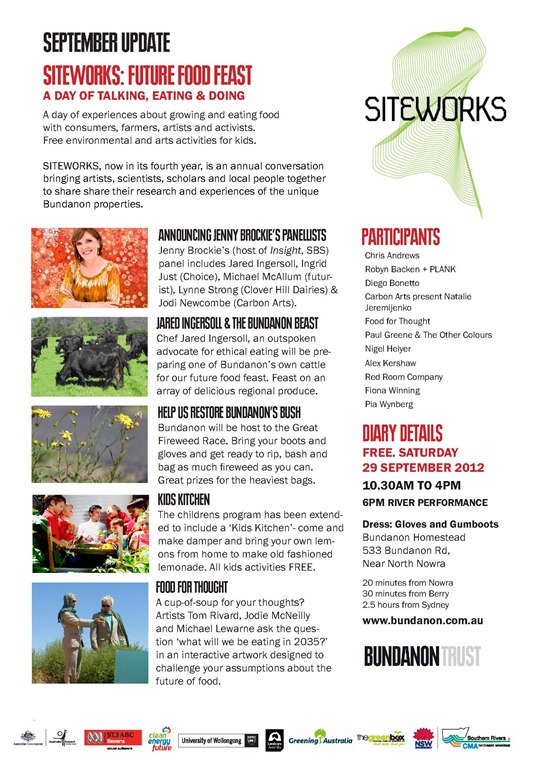
A DAY OF TALKING, EATING & DOING.

This Saturday my diary will see me on a 2.30 pm panel discussion led by Jenny Brockie of Insight  fame as part of the Siteworks event  FUTURE FOOD FEAST A DAY OF TALKING, EATING & DOING. The event is billed as a day of experiences about growing and eating food with consumers, farmers, artists and activists at the Bundanon Trust.

My fellow panellists are:

John Crawford – Scientist

Jared Ingersoll – Chef

Ingrid Just – Consumer Advocate

Michael McAllum – Futurist

Jodie Newcombe – Economist

and yours truly  Lynne Strong – Farmer

Siteworks_September 2012 update

I have done a little research on the philosophies of my fellow panellists and DR GOOGLE tells me we are a diverse group indeed.

I have also done a a little background on the ethical shopping habits of Australian consumers

Thanks to the Australian Food and Grocery Council and Net Balance report of 2010 there is an interesting report that sheds some light on the attitudes and behaviour of Australian urban shoppers.

It is particularly relevant to us farmers as the report focuses on the decisions customers make about selecting GREEN products.

By “GREEN” they mean environmentally friendly – but there is quite a bit of crossover in consumers minds about these products being good for animal welfare and for social reasons as well.

For example ‘Barn laid’ eggs are seen as a ‘green’ product by consumers when in fact they have a higher environmental foot print than caged eggs.

The report sheds some light on the differences between what consumers SAY they want… and what they actually DO. That is shoppers were asked about their ‘green’ product preferences and then their shopping trolley was actually examined to see what they had actually done.

And this is what our urban customers say..

.

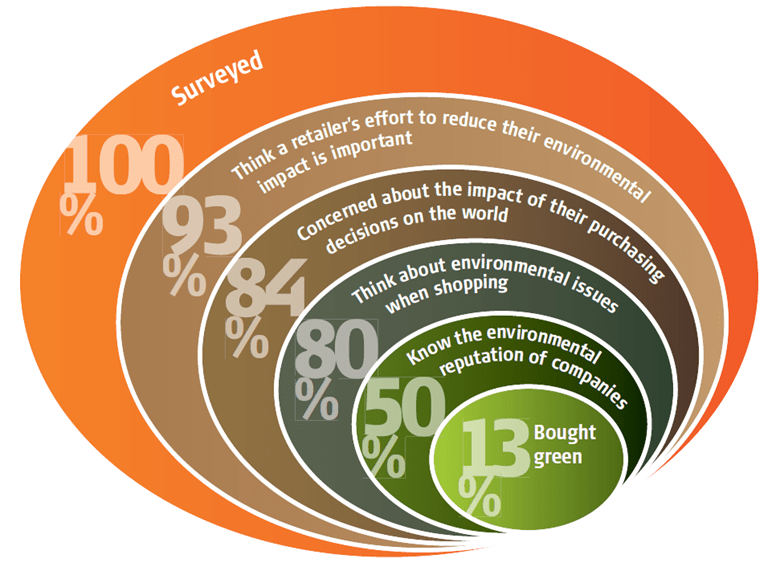
image

Most people surveyed (93%) think that it is important for the retailer to make an effort to reduce their environmental impact and most are concerned about the impact on the environment of the products that they buy. I.e.… everyone else should be doing something!

  • 80% said they think about environmental issues when they buy
  • And 50% have taken the time to inform themselves of the green credential of at least some products….

But here is the killer – when their shopping trolleys were examined – only 13% had actually knowingly made a ‘green’ purchase

Personally I feel just as strongly about sustainable food consumption as I do about sustainable food production. I don’t seek out green products but I do strive to only buy what I need and waste as little as possible of what I buy

This Saturday I am looking forward to both listening to what my fellow panellists and the audience say and having my opportunity to share agriculture’s story and then sharing it all with you.

A case of obscured vision… Guest post by Julian Cribb

One of my many hats is being a director of the Dairy Research Foundation which is involved in all sorts of exciting research which includes Future Dairy which bought Australian farmers the Robotic Dairy. You can see the trials being undertaken at the Sydney University Research Farm at Camden here

In honour of the upcoming Dairy Research Foundation Symposium keynote speaker Julian Cribb has agreed to write me a blog post

I draw your attention to this reflection from Julian on our shallow society where people like Craig Thomson take centre stage and the real issues stay in the dressing room

“Back in the 1960s, we’d clearly seen an emerging world food crisis and had launched the Green Revolution to prevent it, lifting global food output by almost 200% in barely 25 years.

Our failure to repeat the miracle in the 2030s and 40s was down to a loss of foresight – we were so obsessed with the trivia of society we simply failed to see what was going on around us. Especially, we failed to make the necessary investments – in knowledge, in skills and in sustainable urban and rural food systems.”

A case of obscured vision ……….

A Case of obscured vision

Dear Children: this is a picture of an Australian policymaker of around 2012 formulating a national food security plan.

I think he is saying something like “She’ll, be right, mate!” but it is hard to be sure, as the voice is rather muffled.

Anyway, you’ll understand that this picture explains all the famines, hunger-wars, failed states, shortages, refugee tsunamis and shockingly high food prices you are experiencing in 2050. Terribly sorry but, besides stuffing the climate, we also didn’t do enough to ensure you had a sustainable food supply. We simply couldn’t see the dimensions of the problem and we left it far too late to do enough to prevent it.

Of course, looking back from 2050 it is blindingly obvious:

– After losing 1 per cent of our farm land a year for the past half century, to degradation and city sprawl, there isn’t enough left to grow double the food

– We ran out of water to grow food in the 2030s, thanks to the megacities and giant resource companies stepping in and taking it off the farmers

– Oil prices went off the chart when the Saudis staged an ‘Arab Spring’ – and food prices went with them. Most farmers and truckers couldn’t afford fuel as we simply hadn’t bothered to develop a sustainable source of transport energy. Several megacities of 20m+ people starved.

– Ditto fertilisers. After the Moroccan revolution (and they supplied two thirds of the world’s P) most farmers simply couldn’t afford it, leading to a yield collapse, especially in high-tech cropping systems.

– After cutting back on agricultural R&D in all western nations for quarter of a century, farmers were left in a massive technology pothole – another reason yields stagnated.

– Two degrees of global warming, accompanied by greater droughts and floods made traditional agriculture much more challenging almost everywhere, cutting food output by around 20%.

This is all rather strange, as we knew that food demand would double by the 2060s, driven by growing populations and rising living standards. Back in the 1960s, we’d clearly seen an emerging world food crisis and had launched the Green Revolution to prevent it, lifting global food output by almost 200% in barely 25 years.

Our failure to repeat the miracle in the 2030s and 40s was down to a loss of foresight – we were so obsessed with the trivia of society we simply failed to see what was going on around us. Especially, we failed to make the necessary investments – in knowledge, in skills and in sustainable urban and rural food systems.

In short, we had our heads up our arses.

Those of you who are by now clutching the ejector seat handle and demanding an escape from this horrible world of the future should front up to the DRF2012symposium to find out how we’re gonna do it!

You only get to hear the good news if you take part.

– Julian Cribb

Something in it for everybody!

Todays post is by guest blogger Dr Neil Moss our farm consultant and one of the great team of experts who shared their vast experience and knowledge with the participants at our recent Field Day

Neil shares his field day banter with you ……….

One of the great privileges of working in dairy consultancy is being able to observe and collect innovations and exciting ideas from successful farmers in one location, and then mould, adapt and apply these to a wider variety of situations with other farmers that are also willing to innovate and try new things.

Dr Neil Moss and Dr Richard Eckard share the benefits of planting legume pastures with Field Day particpants

Dr Neil Moss points out the stoloniferous habits of some his pasture

Our recent field day at Lemon Grove Research Farm was a great example of just this concept. For many years I have been working together with clients on their farms  developing pastures that break away from the norm and start to cover some of the gaps in their pasture production and risk management systems.

IMG_9752

It was a colourful and diverse group of farmers who stood in Neil’s pasture salad bowl 

The field day wasn’t just a great chance to showcase some of these great pastures and how we go about getting them. It was also a great opportunity to explore how farmers’ ideas and observations can be captured and developed into farming systems, and how individuals that think “outside the square” and challenge conventional wisdom can shift “out of the box” concepts and techniques into the mainstream with benefits for many.

IMG_9663

The participants got some backgrounding from Lynne Strong

Using some concepts and techniques that I originally observed on a farm owned by David and Audrey Moxey on the Mid-North coast of New South Wales (Thanks guys!!) we are now working in just this way. Some great on-farm ideas based on Dave’s experience and a little innovation have now been morphed into a widely adaptable pasture system that may have substantial production and environmental benefits for those that can apply them. David had successfully negated some of the production challenges posed by low summer feed quality by including lucerne, chicory and plantain- tap rooted legumes and herbs with great summer growth and feed-quality, in his planting mixes. We had been sowing these with ryegrass to drive more winter and spring growth but this system was still exposed to summer grass invasion and the need to use significant amounts of nitrogen fertiliser to get the most out of them.

Now it was time to think and adapt! What if we used more winter active chicory cultivars dropped the ryegrass out and started to control some of the summer grass weeds with selective herbicides! It worked a treat.

Farmers network

There was plenty of discussion and networking opportunities

The run-up to the GFC saw a near tripling in price of nitrogen based fertilisers. Linked closely to the petro-chemical industry, it was clear to see that one of the key future “risks” we were facing was “nitrogen shock”- and believe me, many were shocked at how high the prices went and how exposed their systems were. Coupled with this, a growing understanding and acknowledgement of the potential environmental and greenhouse effects of high nitrogen fertiliser use was raising eyebrows – it was clearly time to observe, adapt and act!

Audience at Lemon Grove

Tracey Bob and Vicki thought it might be worth a try in Berry and Pyree

The Strong’s at Jamberoo are fantastic innovators and have been great clients to learn and grow with over the last 12 years. When we discussed these new pasture strategies and some of the benefits they may bring, they could not wait to give it ago. Taking considerable risk they dedicated 12 hectares to some new plots and away we went. For two years we worked to refine the system, adding clovers and modifying our winter agronomic strategies to see where we could shift the feed production curve to. We had what we thought were some great successes and picked up a few lumps and bumps on the way.

Michael in Lucerne @ Lemon Grove

But now we needed validation. We needed to be more certain that what looked, felt and seemed good was actually delivering! Testimonials and feel good stories (has anyone out there ever read a bad testimonial????) were and should never be enough to persuade farmers to drop what is tried, tested and true and expose themselves to even more risk! We needed a bit of data. Here’s where we were lucky enough to apply for and successfully receive some research funding through the Caring for our Country grants program.

Daff and Martin Royds

Marcelle from DAFF interviews Martin Royds

We could now put some numbers to what we thought was happening allowing farmers to make better decisions based on observations with real infield “controls” for comparison.

IMG_9712

We still had a few weeds to tackle

So what have we found so far? We have appear to have a resilient pasture system that is giving us as much feed (this year anyway) as the traditional kikuyu based pasture system commonly utilised on the coast. The feed quality is dramatically improved and most importantly, our nitrogen fertiliser usage has dropped by over 50% at this stage. Weeds can still be a challenge! This linkwill take you to the presentation of our full results to date.

Feed quality0028

Farm field days are a great way to present information and stimulate cross pollination of ideas. We had many farmers there, some from dairy, some from beef and small holdings, some with conventional farming backgrounds, others pushing in different directions with organic and biological ideologies. The great thing was that the barriers that seemed to exist between these farming “churches” appeared to subside allowing all to ask question and share ideas- farmers learning from farmers, picking out what may or may not work in their farming system!

The day was all about interaction. Interaction between farmers and those from the services sectors, between representatives from government and environmental bodies and the educational institutions. Personally, I really enjoyed the interaction with all the attendees.

Stephen Weidemann and Dr Richard Eckard

Stephen and Richard in the dairy at Clover Hill

I also got a buzz from bouncing off the other guest speakers attending the day including Richard Eckard and Steven Weidemann who were only too happy to step into the fray and openly share their knowledge and experience as well! I hope everyone enjoyed the day as much as I did!

Back to Lynne

IMG_9691

Let’s not forget the gorgeous man who always not only brings the lunch he cooks it too

Phil Monoghan

and serves it. Big shout out to Phil Monaghan and Weston Animal Nutrition

IMG_9753

and special thanks to Phil Duncan from Bishops Nowra and Carl Pratten from NAB Nowra who sponsored the drinks. This is Carl talking to Albion Park dairy farmer Craig Tait

Will there be more money in non-farming than farming

There was lively debate on the panel session of dinner event component at our Field Day. It is well known that Mick Keogh from Australian Farm Institute has a fairly conservative view about the benefits for farmers from the Carbon Farming Initiative. Keen to put forward a balanced  perspective we invited Stephen Wiedemann from FSA who says he sits in the middle and already has some projects for the pig industry in the pipeline that may deliver for farmers. And at the other end of the spectrum to Mick was Louisa Kiely the glass half full girl on the panel and co-founder of Carbon Farmers of Australia who have developed a trading model for soil carbon which gives farmers access to markets before the formal Emissions Trading Scheme begins.

Panel Session

Dr Richard Eckard Mick Keogh Dr Neil Moss Stephen Wiedemann and Louisa Kiely provided a lively debate

I was MC for the event and currently waiting on the photographers in the room to send me pictures so I can share some of the insights from the podium and the floor with you. Not forgetting Department Agriculture Fisheries and Forestry taped the entire event ( not sure how long that will take to be a wrap).

Dinner at Jamberoo School of Arts

Lots of questions from a diverse audience

So I thought in the meantime I would share some of Mick’s humour  on the CFI with you.

This excerpt comes from  If I get paid for not having cows, can I get paid a lot more for not having a lot more cows?

There has been a steady stream of publicity about farmers starting to make money out of carbon farming, but it seems the only way to actually generate real money will be by destocking cattle. This begs the question – if I plan to have a lot of cattle then agree not to, can I get paid more than if I just planned to have a few cattle then decide not to?!!

A rough estimate is that each adult cow generates approximately 2 tonnes CO2-e per annum, so each cow not run on a property presumably could generate $46 in offset credits in the official carbon market from July 2012 – presuming that by then a Methodology involving destocking cattle has been recognised under the Carbon Farming Initiative legislation.

ets-cows

Whether or not such a methodology will be accepted is an interesting question! Destocking cattle on one property will reduce national beef production, resulting in higher prices (all else being equal) which will encourage either Australian or overseas cattle producers to increase their cattle numbers, with the result being no net change in cattle emissions in the atmosphere (a phenomena known as ‘leakage’).

If a destocking methodology is recognised under the Carbon Farming Initiative, it raises some interesting questions for livestock producers. For example, if destocking credits are calculated based on a reduction from current cattle or sheep numbers, the best thing to do would be to absolutely stack on stock fence-to-fence, at very high stocking rates, then undertake to get rid of them all! This would generate a lot more credits in perpetuity than would be available for someone with low stock numbers.

In fact, there would be many opportunities generated by such a development. A business opportunity could quickly emerge for properties where stock from farms involved in generating destocking credits could be sent for ‘holidays’ in case the auditor was due to check that stock numbers had been reduced. Conversely, a good market could develop for rental stock – stock that could be ‘borrowed’ for a short while to prove high stock numbers prior to destocking!

Australian farmers have long been envious of their European friends, who for many years have been able to generate money by not farming. Finally it seems the Australian Government has taken up the idea!!

Using the power of poo to save your farm, no bull

Guest post today By Justin Huntsdale ABC Illawarra

It’s not cheap, but you won’t be ‘wasting’ your time – a Jamberoo farming conference has been told using the nutrients from livestock dung could help lower your fertiliser bill and help the environment.


IMG_9661

Justin Huntsdale ABC Illawarra gets the lowdown on Dung from Steve Weidemann

Where we see livestock dung, agricultural scientist Stephen Wiedemann sees a great source of nutrients for your crop or a way to power your home.

Animal dung is rich in nitrogen, phosphorous and potassium – all fertilisers a farm spends significant money on – and much of the time it ends up biodegrading in the paddock or in a sewerage system.

“We like to see waste as a liquid fertiliser,” Stephen said.

“In a dairy or any livestock farm the animals only use a small proportion of the energy they consume, so you can improve sustainability if you can then cycle those nutrients around the farm.”

The Toowoomba-based scientist was speaking yesterday at a conference on ‘Clearing the Carbon Confusion’ held at the Lemon Grove farm near Jamberoo on the NSW South Coast.

The day also involved talks from Dr Neil Moss and Associate Professor Richard Eckard who were trying to help local farmers manage their environmental responsibility while still making money.

And while he’s a bit sheepish about being known as the resident livestock ‘poo expert’, Stephen Wiedemann is serious about making a farm more efficient, starting from the backside.

Putting manure on your domestic garden is something we’ve been doing for decades, but applying that principle to a broad acre crop is a different (and significantly more expensive) story.

“It’s a little bit difficult and expensive but it’s easier if you’ve got a larger farm,” he said.

“Infrastructure is a concern because you’re looking at dams, ponds and other treatment facilities and also irrigators so there is a high capital set-up, but once it’s established, it’s not too hard to manage.”

Balancing a farmer’s books and social conscience is not a new problem, but it’s something that is easier with the advice of experts like Stephen.

He describes his specialty as making the point of connection between the environment and farming.

And as farms become bigger as the demand for primary produce increases, the environmental strain grows too.

“Across the industry there’s a trend to expanding farm sizes, which means more cows on less area and one downside to that is you’ve got an issue with how to manage their waste.”

Stephen says, just like we’d use cow manure to fertilise our garden, livestock effluent can be used to replenish paddocks that are depleted from grazing or foraging.

In Germany, effluent management systems that recycle waste are commonplace, and sometimes used to trap methane which then powers households.

He says these additional benefits are some of the carrots that will sell the message to sceptical farmers.

“It’s a challenge for the industry because it’s capital intensive and you’re looking at longer payoffs, especially when farming’s recently been full of tight margins.

“I know a lot of farmers would like to push it off to the corner, but you have to look at other benefits beyond the cash benefits.

“There’s a positive kickback in terms of lower fertiliser usage, but the overall payback may be more in the realm of six years, and that doesn’t look attractive to a farmer.”

Stephen Weidemann talks to Justin Huntsdale from ABC Illawarra

Will it put money in my pocket

Tomorrow we open the doors of our research farm so the local farmers can see what’s been happening over the fence.

Our consultant Dr Neil Moss will be taking our visitors on a farm walk where he will share our pasture trial results that increase pasture protein and energy, lift milk production by up to two litres a day and use less fertiliser.

The farmers will be asking lots of questions and the first thing they will want to know is what’s it for them and their cows. That is exactly the question they should be asking because farmers are just like the rest of the world their first priority is to feed their families and just like everyone else their work and commitment should be valued at its real price. ( Ditto for their cows)

Neil is using his presentation tonight to set the scene. Would his slides entice you to come?

Lemon Grove Research Farm Field Day 0001 

Lemon Grove Research Farm Field Day 0002

Lemon Grove Research Farm Field Day 0003

Lemon Grove Research Farm Field Day 0004

Lemon Grove Research Farm Field Day 0005

Lemon Grove Research Farm Field Day 0006

Lemon Grove Research Farm Field Day 0007

Lemon Grove Research Farm Field Day 0008

Lemon Grove Research Farm Field Day 0009

Lemon Grove Research Farm Field Day 0010

Lemon Grove Research Farm Field Day 0011

Lemon Grove Research Farm Field Day 0012

The big wet has left us a little worse for wear in more ways than one

All the details for our field day on March 26th and 27th 2012  see Future farming: research puts grass out to pasture are now bedded down. See flyer here

Jamberoo Field Day Lemon Grove Research Farm Flyer

However in typical farming fashion the weather is behaving badly and Lemon Grove Research Farm is under water

IMG_8963

The water is receding fairly quickly however with the trial paddock now reasonably water free after been totally covered in water at 6am this morning

IMG_8965

Mmh its looks like everyone will be coming to see how our pasture recovers from too much  water

The home farm Clover Hill is also waterlogged and sadly the dangers of farming are only too apparent to all the team after this accident this morning that left the tractor a write off and the driver thankfully in one piece

IMG_8996

The tractor after a long slide down the hill, an altercation with some large rocks and a couple of trees and a few double back flips.

IMG_8974

I send a special thank you to John Deere for making tractors that help save lives.