Coles under siege the choice is yours and the choice is now

I have been moved by the number of farmers from other industries and members of the community who have very vocally come out in support of Australian dairy farmers. Today’s blog post highlights the diversity of these people and shares why they are so passionate.

Firstly Queensland school teacher Lisa Claessen who publishes her own blog Telling Tales has launched this petition to get Coles to rethink the decimation they are raining down on the dairy industry through the milk price wars. Please read it and share it with your friends and most importantly sign it. You can find Lisa’s petition here

Lisa Claessen

QLD schoolteacher Lisa Claessen goes in to bat for Aussie Farmers

Secondly these thoughts from South Australian grain farmer and wheat trader Corey Blacksell

IMG_0741

We are all in this together says grain farmer Corey Blacksell

Being a grain farmer in a predominantly export orientated State; one might wonder why I have been so vocal in my support of dairy farmers.

Our property is located 295kms, by road, from the Port of Adelaide. We are predominantly grain growers, but also have a small flock of merino ewes that produce a first cross lamb, annually. We spread these operations across our 4640ha property. We began farming in our own right on July 1st, 2008.

So why does that mean I should be vocal in my support of the dairy industry? Apart from being fellow farmers, there are far deeper economic and principled reasons for my support of the dairy industry.

Firstly, I put my farmer hat on. As a grain producer in the predominantly export supply chain that is South Australian grain, it is my aim to remove myself from that supply chain. Having built on farm storage there is no point in participating in the export supply chain. In excess of $80 tonne ($40 freight and $40 storage and handling) are removed to form my farm gate price. Located on the SA/Vic border I aim to access the Victorian domestic market, a market that’s in equilibrium for supply and demand in an average season.

Dairy makes up approx 50 per cent of the cattle that consume feed grain in Australia, consuming around 1.5 tonne per head per year according to Dairy Australia. There are 1.6 million dairy cows in Australia (2010/11). This equates to approximately 2.4 million tonne of feed grain per year Australian dairy cows consume. The value adding of grain, into protein, creates a domestic demand for my grain and leaves the dollars in Australia and this is a win win for my family and my community.

Secondly, I put my consumer hat on. The permanent discounting of fresh food, by the supermarkets, is placing at risk the supply of Australian grown food, food that is universally accepted as being of the highest quality and integrity; food that the shopper can buy with confidence.

In an age when prices only go up, I ask myself how it is fresh food prices are coming “down down”. Who is paying for this deflation? Further to that, who will pay for this in the future?

The future may not be higher prices, but lower quality for the same price. Cheap food today will not create cheap food in the future. Cheap food will mean imported food, from countries with standards lower than our own. No one can demand a consumer pays for quality, but consumers must have the option. The risk is this option will be removed by the duopoly. That’s right, you will be given what Coles and Woolworths decide they want to sell you. They will want to sell you the things that make them the most margin.

“How can this be” you ask. Easily, it’s happening now and no one is even aware of it. The best eating and tasting fruit and veg do not make it to the shelf. Only the fruit and veg that creates the best value for the seller makes the shelf. One dollar milk is another example of best price, and not best quality.

Australian consumers now have a clear choice; cheap food leading to imported food of questionable quality and integrity or Australian produced high quality food.

The choice is that stark.

Perhaps a quote from The Conversation regarding the car industry can give us an insight into the future of Australian food production, minus the subsidies. You exchange manufacturing for agriculture!

If Australians want an auto industry, they must be prepared to pay for it – as ever – through the tax system. If they don’t, then they must also shoulder the consequences: a depleted skills base; a hollowed-out manufacturing sector; major job losses in every Australian state; and the decimation of a large number of regional and urban towns.”

It’s our choice now.

This great animation from the Hungry Beast opens the lid and exposes how Woolies and Coles are taking over OZ in leaps and bounds

Mirror Mirror Do you like what you see?

Last Saturday was no ordinary day in the life of this dairy farmer and the Bundanon Siteworks event FUTURE FOOD FEAST A DAY OF TALKING, EATING & DOING still has my head spinning.

Gretel Killeen was a last minute replacement for Jenny Brockie as the panel facilitator which required a green room huddle to allow her to get up to speed on who the panel was and what motivated us. What was great about this was it meant the panellists also got insights into each other. It soon became obvious the afternoon would open my mind to many new ideas and concepts that I was positive would be equally exciting to the audience.  

Gretel Killeen 

Gretel Killeen filled in as facilitator after Jenny Brockie broke her arm

Mike McCallum

I was lucky enough to share a lunch table with fellow panellist and future architect Mike McCallum who as it turns out also has an extensive background in the dairy industry

Lynne Strong and the Panel

The Panel: LtoR Gretel Killeen, Lynne Strong, Jared Ingersoll, Mike McCallum, Jodie Newcombe, John Crawford and Ingrid Just.

I was there to share my story and listen and learn and did just that. The conversation went for more than 2 hours and to do it justice I am asking each of the panellists to write a guest blog. You will be excited to know Chef Jared Ingersoll and Mike McCallum have already been asked and agreed.  

To start of off just a few thoughts from me.

  • I know there are a million things I can do to reduce my footprint and I am always saddened that people see our present and future challenges as wicked problems – i.e. too big for them as individuals to make a difference. As Jarod said “ broad scale change starts when one person does something”. By the way here are some things you can do http://www2.acfonline.org.au/
  • I am amazed that people think there is always a way to make the planet fit the the lifestyle we have created for ourselves and refuse to believe that what we think is good for us is too often not good for the planet. For example the suggestion that we protect prime agriculture land and reduce our footprint by more people living in one house or our buildings should go up rather than out and we share white goods and cars was met with shock horror by one audience participant and he was very upfront about it. 
  • I cant believe how many people must think farming is easy. There was a suggestion from the audience that the answer to prime agriculture land being gobbled up by housing was for the government to pay the people in the houses incentives to grow food on their land. Isn’t that subsidised farming and just when will these people find the time and where will they get the skills sets?  There was the idea that instead of supporting rural and regional and remote Australia everyone moves to the cities and urban agriculture will grow all our food. We then let rural, regional and remote Australia go back to the “way it was” and it be a community space. Wouldn’t the  government love that one. With farmers now looking after 61% of the Australian landscape imagine what a huge impost looking after all that land would be on taxpayers let alone the infrastructure et al required to grow all our food in and around millions of people.
  • I am always saddened by some people’s perceptions of modern farming practices and that their knowledge comes from things they had heard or read about rather than seen. There was mention of factory farmed cows being fed cement dust and the answer to everything was to farm organic. As Professor Crawford reminded people there was no evidence to show that organic per se led to better environmental or animal welfare outcomes. Poor old cows got a bit of bashing as usual. People forget or are unaware that only 2% of Australia is suitable for growing crops and what a great job cows in Australia do maintaining the thousands and thousand of hectares of rangelands in this country and no-one in Australia is chopping down rainforest to graze cows
  • I was pleased to see people do value farmers and believe we should value food at its true price and panellist Ingrid Just from Choice talked about the “heart and the hip” scenario and I look forward to her sharing that with you.
  • I was pleased to overhear that I was not the “usual angry farmer”. Its disappointing our farmers are often perceived this way. It was very obvious the community would love to work with us to achieve a value chain that really values people from paddock to plate.   
  • I was also found I had a lot to learn for the diverse knowledge of the other panellists and I am very pleased to be able to off them space to share that with you in the coming weeks

Back to “Mirror Mirror do you like what you see?”  Pam Green posed this question in her summing up of the panel discussion. Here is what Pam saw as the key take away messages

  • There is a coming storm of many ‘peaks’ – water, soil, oil, current centralised systems, biodiversity. There is only one water, one planet.
  • A functioning, healthy environment is the key to health, well being and prosperity.
  • A raised awareness/mindfulness/shift in consciousness is essential.
  • Awareness, education and making it easy and economical is key to enabling good choices.
  • There is a need to develop new traditions to support new values – real value of food in social, cultural, environmental and economic terms.
  • Growing ideas as well as food important. Artists are innovators and develop creative space for change.
  • There is a need for better awareness of true account for use of natural resources – what is the carbon or environmental footprint of food production what are the transparent trade offs in land use change for housing, mining, other uses? National environmental accounts to be viewed along side of our national economic accounts.
  • The importance of connectivity – joined up thinking about the whole web of life. Humans are part of this web but we need to manage our change of the rest of the biosphere with the future in mind.
  • We need to envision the future, map a path to it and start the journey.
  • Local leadership is critical. We are on the cusp of a new age of networked and distributed economy and society.
  • Society is the mirror of our collective humanness

Mirror, mirror on the wall, do we like what we see? We are the change we seek. Well said Pam                

By the way for those of you not familiar with the venue Bundanon is Arthur and Yvonne Boyd’s gift to the Australian people. The property managed by a Trust includes the Bundanon Homestead site and the Riversdale site and is located on 1,100 hectares of pristine bush land overlooking the Shoalhaven River, near Nowra in New South Wales, two and a half hours south of Sydney. The Trust’s Board of Directors reports directly to the Minister for the Environment, Heritage and the Arts, who in turn appoints the Chairperson and the Directors.

Bundanon

Bundanon House

Arthur Boyd's Studio. Photographer Keith Saunders._0

Arthur Boyd’s studio at Bundanon – photo by Keith Saunders

IMG_6557

We had tea at the Riversdale Education Centre in this amazing building designed by Glenn Murcutt. Yes that is the Shoalhaven River you see in the background and I thought I lived in paradise.

Riversdale

The Riversdale Exterior 

IMG_6546 

There are art forms everywhere you look

IMG_6466

There was something for everyone

IMG_6487

IMG_6485

Local foodie and cafe owner Cathy Law manned the Green Box Stand


IMG_6473

We dined on Bundanon Beef and Farm Manager Henry Goodall created a Paddock to Plate video which was available for viewing in the Bundanon Homestead.  He also tanned the hide which is the rug you see on the floor

Lynne and Henry

The farmers Henry Goodall and Lynne Strong ( proving she has a very big mouth)


There is more to come

Dreams that are good for the Planet

As part of our Great Ocean Road sojourn we spent a night at The Great Ocean Rd Ecolodge.EcoLodge

Our hosts Shayne, a former dairy farmer with a Science degree majoring in natural resource management and his partner Lizzie, a zoologist have fulfilled a dream to create an Ecolodge that celebrates our natural resources and what a great way to be reminded just how special our natural environment is.

Shayne and Lizzie have also established the Cape Otway Centre for Conservation where their flagship project is the search for the highly vulnerable species the Tiger Quoll

Tiger Quoll 

The Tiger Quoll had not been sighted for over a decade in the region however recent physical sightings confirmed through identification of quoll scats have caused much excitement. The Tiger Quoll is mainland Australia’s largest, and the world’s longest living carnivorous marsupial and is also rumoured to be living in the rainforest at Clover Hill with local lifestyle farmers saying they are killing their chooks.

Quolls are vulnerable to decline for a number of reasons.They require certain climates and habitats and tend to live in low densities, and don’t have long lifespans  It is believed the biggest threat to the quoll is habitat destruction. Conservationists like Shayne and Lizzie are using population monitorings and public education to preserve the species as well as a dedication to preserving their habitat.

Some quoll populations have common latrines and this had led to innovative techniques to locate them. 

Shane

Shayne Neal trades cow poo in search of Tiger Quoll poo

Shayne is currently training dogs to locate quoll latrine sites, including this guy below who was determined not to let me photograph him. Apparently the dogs will become obsessed by latrine sites and Shayne is currently waiting on research permits to test out this technique which will hopefully locate and provide opportunities to put collars on the quolls for monitoring and research and help protect this native endangered species 

IMG_6212

Guests are also invited to assist with the rehabilitation of injured and orphaned wildlife and believe me they are very happy to get involved.

“Conservation begins with just one tree planted, one child instilled with a passion for the natural world, and one little orphaned koala rescued”

Feeding the Koalas 2 

German research intern Sabina feeds what I believe is most divine animal on the planet one of its 3 daily milk feeds.

IMG_6191

Friendly kangaroos enjoy the short sweet grass on the lawn in the early mornings and late afternoon.

IMG_6312

When I was about 8 I had my first visit to Taronga Park Zoo and my parents bought me a soft toy Koala just like this one and I still have it

IMG_6276

It was an incredible experience to get so close to these little orphans who will be released back into the National Park when the are big enough. They are fed milk 3 x daily and feast on the leaves of the Eucalypt Vinimalis otherwise known as the Manna Gum.

We also had the opportunity to feed the Silver Gliders who are very happy to lick a mixture of honey and ants directly from your fingers

IMG_6171

Dinner and breakfast at the Ecolodge is cooked by the gorgeous Kylie and it is a great opportunity to engage with the other guests

Kylie 

Our chef Kylie

During our visit we met three very fit friends who have been enjoying walking tours together for 25 years. A delightful mother and daughter originally from Sri Lanka and a young couple with a very unique story. Jesse and his gorgeous wife are also camera fanatics a bit like me 

Jessee

Jesse who is American met his Australian wife via the internet after three years of playing each other on the video game World of Warcraft. Jesse an IT specialist was originally  a bit peeved to find his clever opponent was a woman but is one happy man now.

I took a little video footage of Sabina feeding the Koalas – so cute

Thanks for the hospitality Shayne, Lizzie, Kylie and Sabina. Michael and I found the Ecolodge and its treasures a very special experience indeed.

Find out more here www.greatoceanecoldge.com.au

How will I spend $50K

This week I was honoured and humbled to receive agriculture’s newest and most prestigious accolade The Bob Hawke Landcare Award in front of 850 people at the Sydney Convention Centre.


As you can see from this picture I was pretty chuffed

_DSC0096

Me with National Young Landcarer of the Year and Young Eco Champion Megan Rowlatt

_DSC0127

The adorable John Carter from South East Landcare and Megan

_DSC0070

It was Michael’s first outing since his big op and he was determined to be there and he was pretty pleased that he pulled that off

The award comes with two extraordinary opportunities. Firstly I will receive a prize of up to $50,000 to develop my  knowledge and skills in sustainable land management and secondly I will also have an honorary position on the Australian Landcare Council for a period of two years.

So you may ask what am going to do with $50K. Well firstly I wont be spending on me .

What I would like to do is look at change and what drives change and what hinders change. I would like to look at this from three different angles. Firstly young people, secondly my generation and thirdly farmers in my region. My project will be cross industry and I look forward to meeting lots of new and exciting and dynamic thought leaders and doers in the agrifood sector.

I firmly believe farmers of today do not have the opportunity to access and develop the skills sets that will allow them to survive and prosper in 21st. Firstly we have to acknowledge that producing great food and fibre just isn’t good enough any more. Secondly we have just got to get out there more and build relationships with all the key players and pivotally get intimate knowledge and understanding of how the supply chain works.

We have got to be able predict what our customers are thinking before they think it.  We have to be able to predict what the processors and manufacturers are thinking before think it and we have to be able to predict what the supermarkets are thinking before they think it. We have to be at least one step ahead of the curve every step of the way. This will require expertise farmers have not traditionally had access to and my commitment to my fellow farmers is to change this paradigm in my lifetime.

My vision is for an exciting, dynamic, innovative and PROFITABLE agrifood sector that our next generation best and brightest see as a  career of first choice. My mission is to turn my vision into everyone’s vision and this will require government, industry, the community and farmers, in fact the whole of supply chain working side by side.

First stop for me is the Bush Capital next Tuesday where I have meetings with policy and decision makers as well as the opportunity to attend the DAFF Youth in Ag Think Tank and hear what the bright young minds see as the way forward for agriculture in this country

Let me re-share this reflection with you on why I farm and why I live and breathe my mission

I am often asked why I like being a farmer and to be honest it was never my lifelong dream to farm. I farm today because the people I most care about in the world farm and they are in it for the long haul.

I grew up on a farm and even though I enjoyed being hands on in the day to day running of the farm and the lifestyle that comes with it the idea of being a farmer was most definitely not on my list of top 10 professions.

I have been back on the farm for ten years now and I will be the first to admit farming is a highly rewarding profession for a multitude of reasons.

Today I will list just a few

Firstly farmers are an essential service, they feed people and whether people admit it or not everybody wants to be needed.

Secondly farming today is a very risky business and I like the mental intensity, the constant review process, the drive to get up each day and do it better. The fulfilling challenge of balancing productivity, people, animals and the planet

Thirdly inspirational people farm. Feeding, clothing and housing the world now and in the next 50 years is going to require an extraordinary effort. This means we need extraordinary people to take up the challenge. When I work with inspirational people, they light my fire, feed my soul and challenge me to continue to strive to make a unique contribution to agriculture and the community.

and then there is this

the satisfaction you get when you have managed to farm in a way that balances the needs of the rainforest and the animals who live there

Lynne In The Rainforest

with farm productivity that allows you to supply 50,000 Australians daily with milk whilst at the same time ensuring your cows cow remain happy and healthy.

AYOF  (3)

the buzz you get when next gen share the passion and commitment

Nick  (3)

the fascination of watching generations of cows tread the same path each time they walk into the paddock

IMG_7331

the amusement you get when the cow who detours to the water trough

IMG_7312

then charges down the paddock like a teenager to ensure she doesn’t miss out on the sweetest grass

IMG_7319

and the special relationships you develop with the people and the animals in your team

Emma Fav  (7)

the satisfaction of working with next gen

View album

Why I farm

VIEW SLIDE SHOW

to turn this

Picasso Cows Arboretum 07 Aug IMGP2068

into this

reveg east laneway

then this

IMG_7383

and today

IMG_7384

Picasso Corner a triumph for community partnerships, biodiversity and the farm

and then the raw reality of watching the circle of life each day. When the chickens you nurtured  from eggs are killed and eaten by a goshawk (thanks to twitter verse for identifying my nasty bird) and wake up next morning and remember the chickens got three weeks of a great life they wouldn’t have had without you interfering with nature. Even if in the end it was nature who decided they would play a different role in the food chain .

IMG_7301

I love to farm because its real, there is a true sense of place and time. There is an purity and an innocence that comes with a respect of the land that feeds us that living and working in the city will never deliver.

BTW Thank you so much to everyone for the emails, phone calls, flowers, twitter you have all been so wonderful with messages of congratulations. Totally overwhelming xoxoxo

IMG_5662

Ag Youth Think Tank

I am looking forward to attending this event next week immensely. All those bright young minds with a positive vision for the agrifood sector.

Ag Think Tank

Taking of bright young minds how proud was I too be sitting next to the National Young Landcarer of the Year winner at last nights award ceremony.

What an absolute angel Megan Rowlatt is and how exciting is it to have her as part of our team of Young Eco Champions . You can read her story and be inspired here

Megan Rowlatt 

Megan with her award at the NSW Landcare Awards

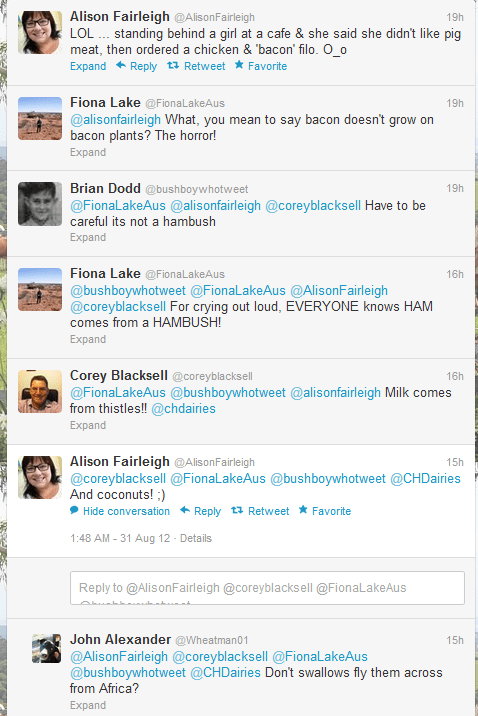
Milk comes from thistles or is that coconuts

This post is in honour of International Bacon Day which just happens to be today (now I bet you didn’t know that) 

According to Wiki ‘Bacon Day celebrations typically include social gatherings during which participants create and consume dishes containing bacon, including bacon-themed breakfasts, lunches, dinners, desserts, and drinks’.

Bacon Day was conceived in  Massachusetts in 2000.  International Bacon Day has now spread to Canada and other countries where it is often held at different times of the year   The record for the number of different bacon dishes belongs to Thomas Green, of Ottawa, Ontario who created ( I don’t think he ate them all ) 12 bacon dishes. This list included candied bacon, maple bacon and chevre points, bacon screwdrivers jell-o style, bacon vodka gazpacho, chili bacon vodka, pork stuffed with bacon, apple and sage, bacon donuts, chocolate bacon brownies, banana bacon cookies, bacon martini, bacon burger sliders and bacon and egg sliders. A veritable pork smorgasbord

The post is inspired by this twitter conversation instigated by Farmers Angel Alison Fairleigh yesterday that believe it or not revolved around bacon and its origins

Bacon 

This reminded me of this picture and then of course who can forget that frightening statistics from the @OZPIEF study that found that too many kids think yogurt grows on trees

Cat milk

Now as you know it breaks my heart that farmers don’t have the marketing power and financial might to tell the real story of agriculture but as you can see there is one hell of a great opportunity out there if we can just get it right.

This week I spoke at the ABARES regional conference in Bega. This is part of what I had to say and a couple of my key messages    

I have a vision for agriculture that is full of promise.

I want an innovative exciting dynamic and profitable agrifood sector. A sector that our next generation best and brightest sees as a career of first choice

I see my role is to turn my vision for agriculture into everyone’s vision

We need smart and articulate and capable people working in agriculture so we can take it to the next level?

We need a supply chain culture that values our farmers

We need government and industry programs that believe in our farmers and invest in them?

We need to identify our young people in agriculture, nurture them and promote them and ensure we retain this talent.

There was a lot of questions from the floor about how we best tell Agriculture’s story with the limited resources and funding we have. It was very clear that the Young Farming Champions program concept truly resonated with everyone in the audience.

But there is nothing more powerful than a living breathing example of the program in action and no-one was more proud than me to see Young Farming Champion Jess Monteith in action on the ABARES panel which rounded off the conference  

Jess Sonia and Lana IMG_5196 

Jess Monteith, Young Farming Champion with Sonia Muir and Lana Mitchell  on the ABARES Bega Panel 

Now this isn’t an easy gig for a young person. Check out the panel topics which included demographic change, agricultural trade and markets in an Asian century, water, energy, trade and efficiency, future producers, labour and skills, future industries (& foods), new technologies and regional development  futures, Agri-tourism, Urban-rural relationships, land-use (conflicts).

When Dr Anna Carr from ABARES asked me to put forward a name that fitted the brief “Non farming background, young face – someone who has energy to burn and ideas in abundance who will show agriculture in a new context” Jess’ name sprang instantly to mind.

Like me fellow panellist Sonia Muir believes creating a community which is engaged with, & informed about agriculture is our most important job and the way to do this is to ensure we have articulate, well educated, charismatic young farming people telling our story for us.

The question was asked of Jess how do we get the real story of agriculture out there into the wider community

She answered “Engagement is the key, we need a nationwide network of young farming champions like the group I am part of, professionally trained to go into schools and tell our story and agriculture’s story to young people and the community” 

Jess is so right. Who better to tell the real story of food than the farmers, the hands that grow it and the caretakers of the land that produces.   

Its time to get smart agriculture we have a few skill sets to hone but if Jess is an example of what can happen with the right skills sets we could make no better investment   

Tree Huggers Unite

Our guest blogger today is the gorgeous Megan Rowlatt who is a finalist in the National Young Landcare Leader Award and a Young Eco Champion and part of the Clover Hill Dairies eco team .  

Hi my name is Megan Rowlatt, and I hug trees

Profile Pic eroo

Jamberoo Tree Hug


No really. I do. All the time. See…

RNP tree hug

Royal National Park Tree Hug

Positano italy tree hug

  Positano Italy Tree Hug

Grand Canyon tree hug

Grand Canyon USA Tree Hug

Growing up in the NSW coastal town of Corrimal with my mum, dad and younger brother, I had a wholesome childhood. Playing with other kids in our street until the street lights came on, climbing trees, playing in the bush along the foothills of the Illawarra escarpment after school, visiting local swimming holes in the national park, and with regular camping trips and family holidays to a range of destinations, this set the foundations for a keen sense of adventure, a desire to travel the world, and a love of our natural environment.

.Nan and pop from my dad’s side resided in a beautiful little country town called Crabbes Creek on the north coast of NSW. I spent many of my first years in the crystal clear creeks with my dad and our family dog and over the years developed an emotional connection to the landscape, particularly rainforests and fresh water bodies. I’m a sucker for a rope swing and a swimming hole.

Megan and Dad

1 year old me and my dad in Crabbes Creek, NSW.

Growing up I was a keen bushwalker and still am. I love climbing things, especially mountains (even though I am secretly a little bit scared of heights. But don’t tell anyone. I like to look tough).

Path of the Gods, Amalfi Coast – Italy Austrian Alps Royal National Park


Kosciusko National Park NSW (me and my bro), Whistler Mountain Canada, Füssen – Germany

I’ve travelled the world (but not nearly enough of it) and love learning about other cultures, exploring new environments and letting my mind flow over the possibilities of where life will take me next. I love laughing, and I mean laughing hard, and I always surround myself with people who make me smile. But I always come home. There really is no place like home and travelling abroad and living away for a period of time helped to develop a deep appreciation of just how amazing our country is. Sometimes I am so awe-struck by the beauty of our landscape it gives me goose bumps. And when you love something so much and want to make sure it’s there for future generations to enjoy, you get involved.

My home…

My favourite swimming hole, Royal National Park

Megan (4)Megan (6)


Megan (1)

Exploring the creek line, Royal National Park

My home (7)Lagoon


My local beach at sunset, and local lagoon North Wollongong, NSW


My home (4)

My bike 


My home (8)

And this is the view I am greeted with every time I come home from traveling.

After finishing high school I decided that I wanted to complete a degree in primary teaching figuring the lengthy school holidays would satisfy my desire to travel and allow more flexibility in the amount of time I could take off, but soon after commencing a Bachelor of Education degree I developed a love affair with my science electives. Through my first year of study I was so torn, I was spending more time with my two environmental science electives than my education subjects and things were getting out of control. After breaking down in tears to my dad one night crying “I don’t want to be a primary teacher anymore I want to be an environmental scientist (insert sooky stressed face)” he looked at me and plainly said “why are you crying you weirdo? If that’s what will make you happy, do it” and so I did, and immediately made the leap into Bachelor of Environmental Science degree’s arms at the University of Wollongong. (See ya education, you just weren’t the right one for me).

Having spent all of my life growing up in the Illawarra I began to get itchy feet and was craving a change of scenery so I moved to the Gold Coast in 2003 and transferred to a Bachelor of Science in Ecotourism. Working with people has always been in my nature, I spent many years working in bars and hospitality. Interacting and meeting new people was the biggest attraction for me in this industry so it was only natural that I would enjoy studying a degree which offered opportunities for me to explore the tourism industry as well as develop skills and knowledge in environmental science.

After spending four years away from home and taking advantage of the beautiful warm weather QLD has to offer, I began to miss our coast line (seriously, we really do have the best coastline in the world).

My home (3)

See. It’s pretty amazing. (Me and my best friend)

I returned to Wollongong and was immediately employed as a casual Visitor Services Officer with NPWS working at Royal National Park. Being casual, I had some spare time and I wanted to continue to develop my knowledge around natural resource management (NRM), so I began to volunteer with Conservation Volunteers Australia (CVA) where I started to really become aware of regional environmental issues. A position as Landcare Community Support Officer came up during my time as a volunteer with CVA. Looking at the selection criteria I didn’t think I had a chance but I applied anyway. The next day I had an interview and the day after that I was employed! Almost five years on, I am still loving the role.

Funded by Southern Rivers Catchment Management Authority and hosted by Conservation Volunteers Australia, as the Landcare Community Support Officer for the Illawarra region, my role is to assist Landcare volunteers, private landholders and farmers, as well as the wider community to develop skills and knowledge around natural resource management. This includes delivering training to build capacity of volunteers and individuals working in natural areas to carry out quality on-ground activities, engaging new volunteers into Landcare, managing and distributing online resources through newsletters, social media and a range of websites, and applying for a variety of grants to carry out environmental projects in the Illawarra region.

This job couldn’t be more perfect for me. I get to travel around the region and meet and work with loads of wonderful people. I love my volunteers and the groups I get to work with, they are just beautiful. I also am fortunate enough to be able to travel around the state for meetings and forums where I have an opportunity to share my experiences and be inspired by other NRM professionals and volunteers. I find managing online resources and developing resources such as newsletters satisfying as I am able to apply my own creative flair to these products.

Some of the places I get to see for work…

Bermagui River

Bermagui River at sunset NSW

Little Blowhole

Little Blowhole, Kiama NSW

Dapto

Albion Park NSW

But after attending my very first state Landcare forum in Queanbeyan I was surprised to learn that there was a real lack of young people in the Landcare movement. Many existing groups were of retirement age and no significant new recruitment was occurring. So I started to question why this was the case and why I had been attracted to volunteering and what was lacking that was deterring younger people from joining.


In 2009 I set up Illawarra Youth Landcare and run the group in my own time. Illawarra Youth Landcare is a Landcare group exclusive for young people aged between late teens to early thirties. We travel around once a month and visit an existing Landcare or Bushcare group in the Illawarra and assist them with their on-ground work. This gives the host group an opportunity to share their knowledge and skills with a younger generation and volunteers are able to explore the region and develop awareness about the environmental management issues we are facing. In addition to local projects I also organise overnight expeditions to other parts of the state. We partner up with other organisations and look at what other environmental issues persist beyond the Illawarra. These trips allow for volunteers to bond and develop friendships while giving something back to the environment.

To date we have a membership of over 70 people and over 120 followers on Facebook. Volunteers come from all sorts of backgrounds and are motivated for all different reasons to volunteer with the group. The key is flexibility, variety and opportunity for a fun social experience. It’s all about having a good time because at the end of the day, if it’s not enjoyable people are not going to become involved. I wouldn’t. Landcare is just as much about the people as it is the environment, and gen Y are generally time-poor and prioritise study, career and social commitments. So it’s difficult to gain any long term commitment from volunteers of this demographic. So I simply try to cater to this.

Over the last few years we’ve been involved in some amazing projects, a highlight for me was the Hawkesbury Source to Sea paddle we did with Willow Warriors in 2010. On this extremely hot (43 degrees in fact) weekend, we paddled along the Colo River working with a range of different Landcare and Bushcare groups. The weekend was jam packed full of swimming, kayaking, more swimming, rope swings, BBQs and a few beers (which I also love), fishing and oh yeah, some bush regeneration and a whole lot of laughing!

Here’s a short video of our adventures so far…


In 2011 I was awarded the Be Natural Young Landcare Leader award for NSW and am now a finalist in the National Landcare Awards as the NSW representative under this category. This is a huge achievement and being nominated means a lot. But living in a country as beautiful and diverse as ours, I could never stand back and not be involved in making it a better place for future generations to enjoy the way I did.

You can check out more about Illawarra Youth Landcare at www.illawarrayouthlandcare.com.au

Following in their footsteps

Excitingly the recent State of the Environment report has show  Australian farmers have made some major inroads in their farm environmental stewardship outcomes through a strong commitment to Landcare principals   

Most of Australia’s land environment is managed by one of three groups: state and territory agencies responsible for public land of various tenures, family and corporate agricultural and pastoral businesses, and Indigenous Australians.

The effectiveness of management has improved for most land uses, particularly those that are most intensive. While land–management practices have improved during the past few decades, in agricultural systems the loss of soil carbon, and soil acidification and erosion, are problematic and may have major impacts on production.

However, there is a serious gap in both the professional and the technical capacity necessary for effective land management. This gap will increase and its consequences become more acute as we face the challenges that climate change will bring to land environmental values and production systems.

Obviously if our farmers are going to achieve the best environmental outcomes they must have access to the best advice and have the opportunity to work side by side with natural resource management professionals  With this in my mind Art4Agriculture have accessed Caring for our Country funding to role out the Young Eco Champion program for 2012/13 This program will train a team of 5 young natural resource management professionals from Southern Rivers region of NSW. They will be trained to develop leadership and communication skills and become local faces of sustainable primary production and natural resource management. See Erin Lake our 2011 Young Eco Champion in action here

Eco Champions will work with Young Farmer Champions to present Archibull Prize activities in 15 schools throughout the region using a range of authentic and contemporary learning tools that allow young people to explore the economic, environmental and social challenges of sustainable agriculture and biodiversity conservation activities through the ‘Archibull Prize‘ competition.

Today our guest blogger is Heather Gow-Carey one of our exciting Young Eco Champions


Here is Heather’s story ………………….

My name is Heather Gow-Carey. I am 22 years old and am currently undertaking honours in my fourth and final year of an International Bachelor of Science (Geoscience) at the University of Wollongong.

Photo 1

Me

I grew up in the rural community at Dignams Creek on the Far South Coast of NSW. Environmental and natural resource management has always played a huge part of my life. The influence of my parents’ professions in the direction of my educational career has subconsciously shaped my decisions and their support has been unwavering at every stage of my development.

Photo 2

Helping out tree planting on the Hawkesbury River when I was just learning to walk.

I was born in Western Sydney but moved to the South Coast with my parents when I was two years old. They were looking to get away from the city and pursue their goals in setting up South Coast Flora, a native bushfood nursery. It is this specialised plant propagation that first introduced me to the theories behind environmental management. As long as I can remember I have been helping out in the nursery, going to markets and assisting mum out in her botanical pursuits collecting seeds and cuttings to be used in the nursery.

Photo 3

 Out collecting seeds with Mum.

My father was involved in the National Parks and Wildlife Service for a number of years and now works as the Landcare Community Support Officer throughout the Eurobodalla Shire. Hence my weekends as a youngster were filled with farm visits, tree plantings, weed control and numerous conferences and meetings. Luckily I had my younger brother to have tree planting competitions and someone to hang out with when dad had to attend to business matters. From both of my parents I have developed a love and a respect for the environment that I value immensely. It has shaped my love for the outdoors and even though I have had to move away to attend uni, I love going back home whenever I can.

Photo 4

 Playing in Dignams Creek when I was little.

About 15 minutes away is the closest town, Cobargo. It is a small town that has earnt the name of the ‘working village’. There are around 500 residents if you include the many farms around the area and there is a very strong sense of community, with all of the locals willing to pitch in to help each other out. I was part of the swimming club, soccer club, rugby club and scout group, as well as always exhibited and volunteered for the annual Cobargo Show. The show was and still is, one of the highlights of the Cobargo calendar. Even though it is such a small town, the show always draws large crowds in competitors, exhibitors and visitors and is well known as a quality agricultural show. There were several years where I made it my goal to enter every youth section in the pavilion, and even many of the open sections. When I was about 12, a prize was introduced for the junior exhibitor with the highest overall point-score, so I busied myself making arts, crafts, jams, baking, growing fruit and veggies, even entered some prime compost to take out the top prize!

Photo 5

The Cobargo main street.

One of my other interests is art. When I was little I wanted to grow up to be an artist, but soon learnt that most artists don’t get rich and famous until they are dead! So I had to rethink my career ideas. I was lucky enough to be involved in the Jindabyne Sculpture by the Lake exhibition – a competition for local artists held each Easter Long Weekend and with  from my art teacher I first entered at the age of 14.

I had always felt very strongly about using water responsibly and hence, I made a giant plug that floated out in the middle of the lake to inform people of my water-saving message. This was a great opportunity to raise awareness about the scarcity of water and the fact that we all rely on it so much, and yet we have so little that is actually able to be consumed.

My community involvement continued throughout high school, being involved in several sporting groups, community groups, the Rural Volunteer Bushfire Service and more Landcare activities. There was hardly a weekend or week night spare in my schedule! I was recognised for my efforts on Australia Day 2009, being awarded the Narooma Young Citizen of the Year.

Photo 6

After being awarded Young Citizen of the Year.

My HSC helped to shape what I chose to study and the last three and a half years of university really have taught me so much about the different areas of physical geography, human geography and the ways in which people interact with their environments. I have all of the theory behind me; I just need to put my ideas into practice.

Even though I am not from a farm in the traditional sense, I feel as though my upbringing really has shaped the person that I am, and what I would like to achieve out of life. Through this program I hope that I can encourage and support young Australians, and especially those in rural areas, to become involved in natural resource management and sustainable agriculture.

Wow we looking forward to working with young lady as you can imagine

The Young Farming Champions program is funded through the Australian Government’s Caring for our Country program. Art4agriculture thanks you for believing in us  

c4oc-pos

A Very Wicked Problem

I am reblogging this from Art4AgricultureChat because I am very interested in what my Clover Diaries Diary readers have to say about this  

Today’s guest blog 1 is by Gerry Andersen who is the Chief Executive Officer of Foodbank NSW.

image

Gerry has also been involved with the RAS of NSW for the past 25 years and is currently a RAS Councillor and Chair of the Sydney Royal Dairy Produce Committee. I had the pleasure of working with Gerry and the superb team from the Sydney Royal Dairy Produce Show in February this year when I had the honour of stewarding in the ice cream judging section. See the post I wrote about my day here

Gerry’s work with Foodbank has perfect synergies with the ethos of the Archibull Prize where we ask participating students to reflect on sustainable food production and also their role in sustainable food consumption. I am confident like me you will be astounded by the amount of food that is wasted in this country and as a farmer producing some of this food that ends up in landfill it breaks my heart. It will also break your heart to read about the other end of the spectrum that Gerry shares with us in this post. It just beggars belief that this can happen.

Each year two million Australians will rely on food relief and around half of them will be children who often go to school without breakfast or to bed without dinner.

Are the lucky ones so self absorbed and we live in our own little worlds and forget what really matters?. I just don’t know. What do you think?

I do know that as a farmer I am very proud of my fellow farmers participating in the Waste Not Want Not program.

This is what Gerry has to say………………..

Waste not; want not

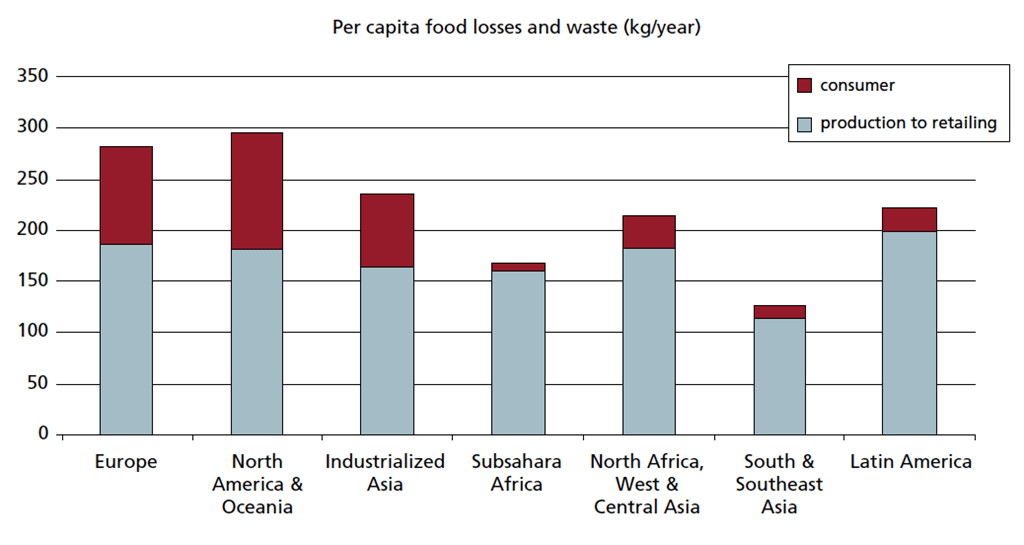
Food waste is a complex social, economic and environmental problem that is having an increasingly negative impact on our world.

wastegraph

There’s no doubt that when it comes to food production, Australia truly is the lucky country. We live in a plentiful country, with some of the world’s most abundant fresh produce and skilful, efficient farmers. Each year, Australia produces enough fresh food to feed 60 million people – that’s nearly enough to feed the nation 3 times over.1
However, recent figures suggest that 4 million tonnes of food is wasted every year in Australia.

food_waste

Of this, 1.38 million tonnes is business food waste and 2.6 million tonnes is household food waste. 2

waste

This surplus food could feed millions of Australians every day. Food gets wasted because we buy more than we need; we cook more than we need; and due to demanding quality standards a lot of produce is discarded because of appearance, despite the nutritional quality still being very good. These food waste facts are startling alone, but when coupled with the fact that 1.2 million Australians do not have access to a safe and nutritious food supply, the situation is staggering.

Many of us eat well and enjoy a varied diet, so it seems strange to be discussing food shortages for Australians; however, for many, access to food is a critical problem. Each year two million Australians will rely on food relief and around half of them will be children who often go to school without breakfast or to bed without dinner. This is where Foodbank, the largest hunger relief organisation in Australia, comes into the equation. Foodbank is a not-for-profit, nondenominational organisation that seeks and distributes food and grocery industry donations to welfare agencies to feed the hungry around the country. The food goes to hostels, shelters, drop-in centres, school breakfast programs, home hampers and emergency relief packages for people in need. Last year alone it redistributed enough food for 28 million meals.

I became involved with Foodbank in 2009 taking up the role of CEO, following retirement from the food manufacturing industry three years earlier. I enjoyed entering the workforce again, and in particular working in the charity sector. Foodbank was initially formed to redistribute wasted food products from Australian food manufacturing and retailing sectors. However, recently the focus has moved to the farming industry.

Foodbank’s Waste Not Want Not program is a unique project that delivers otherwise wasted produce from the Riverina farming community to the tables of hungry families throughout NSW and the ACT. Since the program began in 2011, over 400 tonnes of produce from the Riverina district has been donated. There are plans to roll out the program in many more areas in NSW by 2013. Farmers, including small producers, can donate their fresh fruit and vegetables products that are in excess to demand or not quite up to quality standards, as they are still nutritious and very desirable to feed needy people. Our most common donations from farmers include oranges, pumpkins, onions, potatoes and grain.

There is still a long way to go to achieve an Australia without hunger, but we, as an agricultural community, can play a part to reduce the waste and hunger that exists.

food-waste-hierarchyHeria

Waste Food Hierarchy

This is a very wicked problem that each and everyone of us has an opportunity to make a difference  

For more information on Foodbank and how you can become involved Visit www.foodbank.com.au

1 This article first appeared in RAS Times July 2012.

2 Australia and Food Security in a Changing World. Report of the Prime
Minister’s Science, Engineering and Innovation Council (PMSEIC)
Expert Working Group, 2010.

The Power of Language

Today’s post has been written by Angus Whyte profiled beautifully here by Fleur McDonald in January.

The power of Language

A Robert Brinkerhoff Illustration

The post has been prompted by two posts I wrote recently. Firstly on Art4agriculuture Chat about Young Farming Champion Stephanie Tarlinton’s recent speech at the Dairy Research Foundation Symposium which saw her voted the favourite speaker of the day. Scroll half way down the page past my background info to read Stephanie’s very powerful speech she titled the “Conversations of Change”. The other post referred to a presentation at the same event given by Dr Jude Capper that prompted this post on Clover Hill Dairies Diary “Little Golden Book Farming” 

This is what Gus has to say ……..   

Interesting that language can mean different things to different people; it can bring people together or divide them. When farmers talk about new technology they are talking about GPS technology that allows them to plant, fertilize or spray exactly where required, or telemetry systems that allow them to remotely control waters, maybe even individual animal ID systems that feed the animal its exact requirements. All technologies that have helped reduced food spend as percentage of income in Australia from 50% to 10% in the last 100 years

Applications of Computers in Sustainable Agriculture

When consumers hear new technology in agriculture they hear “triffid like” GM plants or the latest spray that will kill everything, even hormone growth promotants that will turn stock into the incredible hulk, well green anyway.

Horrors of GM

The question might be; “how can the language show the reality?” The reality is that farmers and consumers both want the same thing – healthy, nutritious, ethically produced food and fibre that was grown with the best interests of the planet in mind” 

agriculture 0012

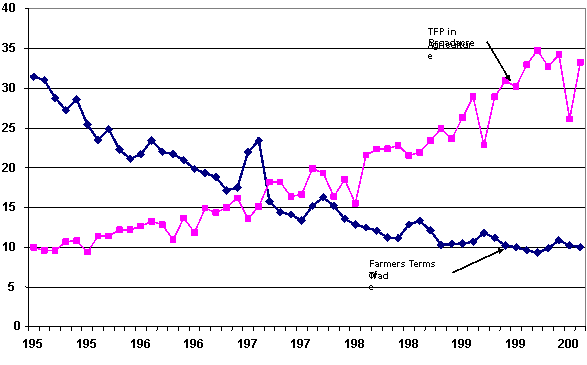
Lets have a look further at how we may be using the same language; when consumers want food produced “like the way it has always been produced, the old fashioned way”, and the farmers want to be able to produce a good product “without working 8 days a week 30 hours a day, the old fashioned way”. When farmers talk about “efficiency gains” they are talking about being able to produce the same product with less of a carbon footprint and still make a margin aware that the “terms of trade” are constantly reducing.  Remembering whilst the cost of food had gone up 40% in the last ten years (CPI has gone up about 50%), the farmer’s share has gone from 20 cents in the dollar to 17.

Total Productivity

Total factor productivity (TFP) in Australian broadacre agriculture and farmers’ terms of trade: 1953–2004.Source ABARES


When consumers hear “efficiency gains” they seem to hear “factory farms” or that farmers have found a better way to make even more money than they already do. These thoughts conjure up images of cruelty and money hungry, both traits that are disliked (and rightly so) in our community.

P1020049

To bring the language together if consumers think that farmers must invest in the environment regardless of the cost then consumers must show the environment the same respect and seek produce that is raised consistent to their values, then buy it, regardless of the cost. I put it to you that if farming was so easy and you can make so much money then why are less than 1% of our community involved and that is decreasing every year?

I must admit I know that we can produce food and fibre in a way that means consumers and farmers needs are met, even exceeded. You will notice that I will not mention money when I’m talking about needs. Consumers have no more right whatsoever to expect food at a reasonable price if they don’t believe farmers have no right to get paid a reasonable price for their produce. Everyone involved in the production of food through to eating it, should be aware of the social and ethical values of living in a community. The “carbon tax” is an attempt to place an economic value on something that we as a society should value, which is the living within our means and not having negative external impacts on the environment.

When we purchase an item we should ask ourselves: Has this been produced with respect to my personal values of welfare, health etc.? Has the item been produced without external impacts on environment, community etc.? These values can’t have an economic value placed on them and yet all talk about the long term health of the planet and the community.

When we buy food you can look to “make an investment in your health and future” or you can see it as “a cost that needs to be reduced as much as possible.” I believe that we as a society are so used to eating poor quality food that is “cheap”, if we based our decisions on food quality we would need much less and actually save money.

Count Nutrients not calores

Just so that we are all taking the same language we as consumers need to build closer relationships with our producers so we understand how our wonderful food is produced, then we can make “value based” decisions when we purchase. As you are all aware large supermarkets are service based industries that don’t produce anything and they make it very difficult to build a relationship with your farmers. So you should find vendors that can tell you who, how and where the food is grown, tell you its story, then you can make a judgment on the values of that product before purchase. This way you can ensure that you aren’t just making a good investment in your own health, also that of the broader community and the planet.

Food_System_Diagram

Remember the statement “no man is an island”, our dollars dictate our values so if we truly want to see change then we need to understand that our choices impact on others, we are all part of the same community on planet Earth.


The Author: Angus Whyte lives with wife Kelly and 8 year old son Mitchell at “Wyndham”, a 12,500ha pastoral property on the Anabranch River 85km north of Wentworth NSW.  “We consider ourselves “graziers”, in that we turn plants into money through livestock and we don’t mind what sort of livestock we run. Our attitude to farming is simply to work with nature rather than against, so we no longer have weeds, we have “plants with stories” that we can learn from and our aim is to make our business simple and our ecosystem extremely complex, the more complex the better.”

If you would like to join in the conversation on Twitter Gus tweets as @GusWhyte and farmers and their extensive and diverse networks discuss all things food and fibre under #agchatoz

Recently farmers have been concerned about how we are being stereotyped see I am not Happy Woolies and we are adding #proag to our tweets ( when there is room- I mean 140 characters is pretty tight at the best of times) to discuss this.

FYI #proag is short for professional and caring farmers