Dairy farmers knew deregulation was coming. Were they prepared for it?

I suspect our cows had a few opinions about the whole business too. Lots to think about on the hill at Clover Hill

I’ve spent the past few months researching the history of dairy co-operatives, particularly the Jamberoo Dairy Factory and the organisations that eventually became Australian Co-operative Foods.

Jan Todd’s Milk for the Metropolis, published in 1994, has been a fascinating resource. Towards the end of the book, Todd describes how Australian Co-operative Foods (ACF) was preparing for an increasingly competitive market. By 1993, its directors were examining the financial and organisational changes required to operate in a deregulated environment.

Reading about those preparations more than thirty years later has brought back memories of what happened on our own dairy farm.

Farmers knew deregulation was coming. The arguments had been going on for years, and many were determined to fight it. The partners on our farm certainly were. They had invested their lives and their money in a business that operated within a regulated system, and they saw little reason to welcome changes that threatened their livelihood.

Did change happen with farmers or around them?

Farmers are well know to err on the conservative, particularly when it comes to decisions that affect their financial security. Yet some of the most innovative and resourceful people I’ve known have been farmers. Give them an opportunity they understand, and they’ll find extraordinary ways to pursue it.

That contradiction interests me because it says something about how we approach change in agriculture.

For decades, governments regulated the marketing of milk. They established prices for drinking milk and determined which producers could supply particular markets. Farmers borrowed money, invested in infrastructure, built dairy herds and planned their businesses around those arrangements.

The prospect of deregulation challenged many of the assumptions on which those decisions had been made.

By the early 1990s, the industry’s major organisations were examining what deregulation would mean for their operations. There were consultants, feasibility studies, financial projections, merger discussions and proposals for new ownership arrangements.

Todd’s account shows how seriously Australian Co-operative Foods was examining its future. The directors understood that changes in regulation, competition and access to capital would have significant consequences for the business.

I’d love to know how those conversations translated into preparation on individual dairy farms.

The partners on our farm spent a great deal of energy opposing deregulation. Looking back, I wonder what might have happened if someone had helped us devote some of that energy to examining the possible outcomes and deciding how we wanted to respond.

What would our financial position look like without regulated milk prices? Could we reduce production costs? Would increasing herd size improve profitability, or expose us to greater financial risk? What other options were available? What information would help us make those decisions?

These were conversations that deserved time, independent advice and the opportunity to explore different scenarios with people who understood the realities of running a dairy farm.

A dairy farmer cannot change direction as quickly as a government can change policy. Milking sheds, machinery, farm improvements and livestock represent substantial investments. Loans have to be serviced. Families have to live. Decisions about breeding, infrastructure and production can have consequences for many years.

I wonder how much attention agricultural leaders gave to understanding the people they were asking to adapt.

When farmers resist change, it helps to understand what concerns them. Sometimes they have good reasons. Sometimes their assumptions deserve challenging. Sometimes they have spent so long defending the arrangements they know that they have had little opportunity to imagine an alternative.

That is where leadership and engagement become so important.

I have spent much of my professional life bringing people together to explore difficult questions, and I have seen what happens when they are given the opportunity to contribute rather than being presented with decisions that have already been made.

People bring knowledge that rarely appears in a consultant’s report. They understand their own circumstances, their communities and the practical consequences of decisions. They also bring fears, frustrations, prejudices and assumptions. All of those belong in the conversation.

The seven years between the planning Todd describes in 1993 and dairy deregulation on 1 July 2000 provide an interesting period to exam

Dear readers

When dairy deregulation arrived on 1 July 2000, NSW farmgate milk prices fell from around 37 cents a litre to approximately 28 cents (Note these figures are industry averages). A reduction of almost a quarter. Add a drought to that equation and you have a pretty powerful incentive to reconsider how you run a dairy farm.

And reconsider we did!

We went from milking 80 cows twice a day to 400, three times a day. We leased another farm, hired a consultant, conducted research trials with Sydney University, attended conferences and made some enormous changes to the way we operated.

For a farming family whose partners had fought deregulation, we certainly became enthusiastic students of change once it was upon us.

I suspect our cows had a few opinions about the whole business too. Particularly the three-times-a-day milking.

 

Agriculture wanted better storytellers. Then we blew up the model that made them


I am about to spend World Peace Day talking to a group of 10 to 15 year olds about curiosity, critical thinking, communication and collaboration. Which is slightly confronting when you start looking around at how adults behave.

Before the workshop, the students will answer a short survey. They will answer the same questions afterwards. I am interested to see what changes, and I am also realistic enough to know they are unlikely to walk out several hours later transformed into world-class collaborators who calmly interrogate every assumption before breakfast.

That is because people do not change overnight. Oddly, we seem to forget this every time we organise a workshop.

How many times have you spent a day learning some marvellous new way of doing things, walked out thinking, “This is excellent” put the folder somewhere safe and carried on exactly as before? I have.

We have somehow developed a culture where learning is treated as an event. Book the facilitator, find the room, provide lunch, learn collaboration, home by four. Job done.

I learnt the limitations of that model the long way around.

When I came back into agriculture, people decided I did not look like the stereotype of someone they expected to see representing the industry. Apparently that was useful, so I was pushed out the front and into the media.

This was all very new to me, and I was not remotely comfortable with it, so I demanded training. Then more training. Then more training.

It took me about 15 years to feel comfortable.

The other day I gave a presentation and a number of people told me it was the best presentation they had ever seen.

They should have been at my first one.

It had 127 slides.

I wish I were exaggerating.

That experience changed the way I thought about developing other people. When I started the Young Farming Champions program, I wanted people to have what I had eventually learned I needed, time, repetition, feedback and somewhere safe to keep practising.

The Young Farming Champions model was built around ongoing development. Once you joined, you could remain part of the network for as long as you wanted, continuing to build your skills over time. During COVID, we ran workshops every month, so people could say, “I want to feel more comfortable doing this,” and we could focus on exactly that. We brought in outstanding Australian and international experts, then gave people repeated opportunities to practise, get feedback and keep improving.

That is how confidence grows.

Then agricultural bodies looked at what we were doing and decided they wanted something similar. The young people were already there. The Action4Agriculture team was already training them. What changed was the desire to have the program sit inside their own organisation.

This is where I became increasingly frustrated with the way institutions behave. We talk endlessly about collaboration, but the system often rewards the person who can point to something and say, “That was my idea. I built that. That was my result.”

Once that becomes the prize, curiosity becomes inconvenient.

Nobody asks, “Why is this working?” or “What could we add to what is already here?” The question becomes, “How do we create our own version?”

And that is how duplication starts to look like achievement.

The result can be beautifully efficient.

Train them on Saturday.

Face of the industry by Monday.

It is a wonderfully efficient system, provided human beings work like software updates.

Recently I have been spending time with collaboration specialist Stuart Waters, and he has been subtly  dismantling several things I thought I knew. One of them is my GPS model.

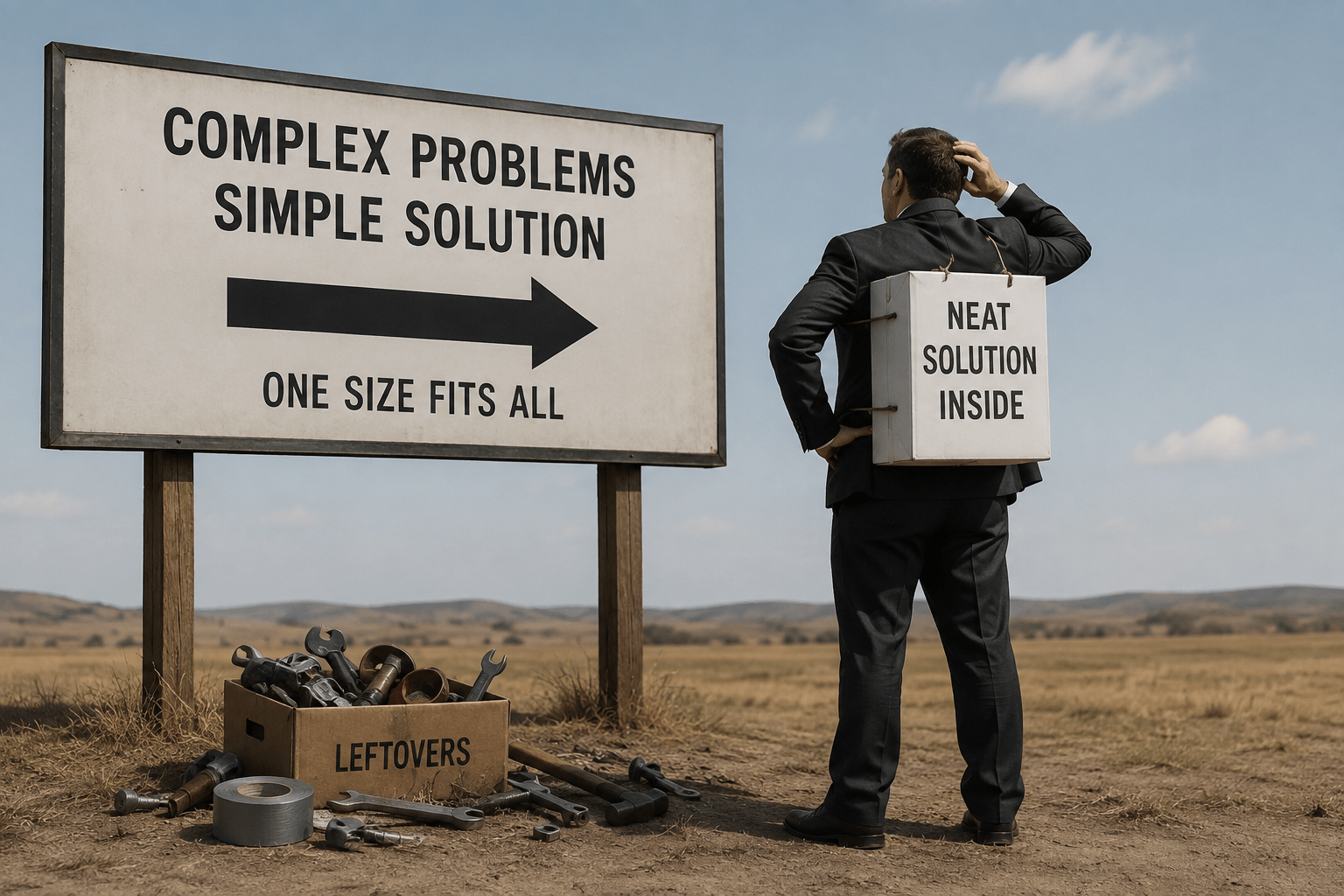
I have used it for years. Goal. Problem. Solution. Where are we trying to go? What is getting in the way? What is the solution? Perfectly sensible.

Except Stuart pointed out something rather inconvenient.

If we knew the solution, we probably would not have the problem.

With complex problems, the solution is rarely sitting there politely waiting for someone clever enough to notice it. Stuart talks instead about steps, experiments, things we can try, learn from and adjust.

So perhaps GPS survives. Goal. Problem. Steps.

I rather like that. It removes the requirement to stride into every complicated situation carrying The Answer.

It also exposes another habit we have. We are often in an extraordinary hurry to solve the problem before we have worked out what the problem actually is. Something goes wrong and we deal with the bit we can see.

People are not collaborating. Students are dropping rubbish. A community is not engaging. A candidate loses an election.

Right. Fix that.

Except those things may be symptoms. The interesting questions sit underneath. Why is this happening? What assumptions are we making? Who knows something we don’t? Who sees the situation differently?

And the question I am finding increasingly important in some other work I am doing is this.

Have we actually spoken to the people most affected?

It is astonishing how often the answer appears to be no. Reports get written, programs get designed, conclusions get reached and entire narratives develop. Meanwhile, somebody sitting right in the middle of the experience is thinking, “You could have asked me.”

And then I am preparing to stand in front of children and put this on a screen.

Stay curious. Ask before you assume. Understand the problem before you solve it. Listen to learn. Share the thinking. Try something small. Learn what happens. Keep going.

The children are not the only people who could use the reminder.

I am also going to ask them something I have found unexpectedly difficult myself.

Who do you know who does this? Who stays curious when everyone else has already decided? Who asks another question? Who listens because they genuinely want to know the answer? Who can say, “I don’t know”? Who can discover something new and change their mind without behaving as though they have suffered a humiliating defeat?

I can think of a few people. Stuart is one.

What I notice when I talk to him is that having expertise has not made him less curious. Quite the opposite. He keeps asking questions. What is the actual dilemma? Who else sees this differently? What could we try? What might we learn?

Perhaps that is what expertise should look like.

Knowing enough to know that you probably don’t know everything.

There is another uncomfortable question sitting underneath my student workshop. We spend a great deal of time telling young people they will need curiosity, critical thinking, creativity, communication and collaboration to navigate the future.

Who are they watching do it now?

Because one workshop will not do it. Not for them. Not for us.

A workshop might introduce an idea. It might give us language for something we had never noticed before. It might even make us uncomfortable enough to rethink something.

Then comes Monday.

That is when the learning starts.

Agriculture talks about the burden of regulation. Fewer talk about the licence it already holds: public trust.

FI have a rule about agricultural stories on LinkedIn. I keep scrolling, unless Karin Stark wrote them.

Last week I broke it.

The post asked why any young person would choose agriculture when farming often feels like a fight with government.

That caught my eye, because the young farmers I know are still choosing it. Succession. Land prices. The money it takes to get started. Those are the barriers in my part of the world. Agriculture here is also attracting young women from urban areas, women who have chosen farming with their eyes open.

Then came the line that sent me in a different direction.

No other industry or profession has to put up with this.

Plenty of industries do. We all live with forms of social control every day. We have licences to drive. Permits to renovate. Working with Children Checks to volunteer at the school canteen. Certificates to serve alcohol. Council approvals for sheds. Dogs are registered and microchipped. A council ranger can fine you for walking one in the wrong place or leaving its mess behind.

Most of us renew permissions all the time.

Farming is different.

A person can buy land tomorrow and call themselves a farmer. Farmers work inside rules, inspections and regulations, but the occupation itself has very little formal licensing. No registration board. No annual renewal. No professional body that can take the title away.

As a dairy farmer, I was licensed under food safety laws. That licence covers what I produce rather than me. Farmers who use restricted chemicals need accreditation. Water has rules. Chemicals have rules. Food safety has rules.

Farmers did the training. We learned the rules. Then we went further. We brought in accredited specialists, precision technology and contractors who could put the right product in the right place. This morning, a contractor’s drone was working in the paddocks outside my front window. This is modern farming too. Training. Skill. Technology. Rules taken seriously.

When a clear standard is set, farmers usually meet it. Often they go past it.

The licence still sits mostly on the product, the chemical, the water or the process. The person doing the farming carries something else. Public trust.

The public trusts us to manage land, draw water, run animals and produce food. That trust has no renewal date. It has no form to fill in. It has no annual fee.

It can feel like freedom, until public trust shifts. Anyone who watched the live export debate knows how quickly that can happen.

Before I came back to farming, I was a community pharmacist. Pharmacists renew their registration every year. They have to show they are fit to practise and prove their professional development hours. The annual renewal can be annoying, and it also keeps the profession’s standing current.

Pharmacists also pay a serious annual levy to the Pharmacy Guild. In all my years behind the counter, I rarely heard pharmacists complain about it. They could see what it bought.

The Guild has delivered five-year Community Pharmacy Agreements under governments of both colours. It has kept location rules in place in a way few small business sectors have managed. Its method is simple. A pharmacist in every electorate. A relationship with the local MP. Clear requests. Pressure used carefully.

The noise stays in reserve. That is why the threat of it counts.

A strong lobby lets its members get on with their business while skilled people handle the influencing.

I want that for farmers.

Twenty-five years ago I came back to farming, and land clearing was the argument of the day. Peak bodies answered aerial mapping with press releases. Too often, they still reach for the same tools. Press release. Rebuttal. Rally. Submission.

Those tools have their place. They are not a strategy on their own.

Influence is a skill. It can be learned. And the research is consistent: people trust people. They are wary of institutions. A farmer telling their own story will always be more convincing than a spokesperson reading a statement.

Through Action4Agriculture we spent years training young people in agriculture as their own spokespeople. We brought in experts from around the world to teach it. The skills are available. Agriculture has invested in many things before investing in its people.

Members can see activity more easily than they can see influence. A rally looks like action. Quiet influence is harder to put in a newsletter. The risk is that organisations start proving they are busy, rather than showing what has changed.

The lobbies that win in this country often make less noise. The Pharmacy Guild. The clubs. The mining industry. The property lobby. People may have strong views about whether those groups serve the public interest. They know how influence works. They know who to talk to and when to move. They know when a public campaign helps and when it harms.

Agriculture starts with something many of those industries will never have. People still have genuine affection for farmers.

Farmers are trusted in rural electorates. They have the stories. They understand the land. They can explain what is at stake better than anyone sitting in an office far from the paddock.

The decision-makers are knowable. MPs, advisers, departments, councils, agencies, journalists and community leaders can be reached when the industry is disciplined about who speaks, what is being asked for, and why it matters.

Too often, peak bodies stand between farmers and decision-makers, speaking over both.

Influence is a skill. It can be learned. I spent years running a national program that taught young people in agriculture how influence is built. We brought in experts from around the world to teach it. The skills are available. Agriculture has invested in many things before investing properly in that.

Every farmer I raise this with points to the same problem. Fragmentation. Cotton, dairy, grain, livestock, irrigators, dryland farmers, each with its own body, board, chair and table.

Farmers have seen this before. Dairy deregulation. Processor mergers. Banks leaving town. Bigger and fewer has often meant further away and less accountable. That concern comes from experience.

Perhaps the starting point is making better use of the structures agriculture already has.

The National Farmers’ Federation exists. State farming bodies exist. Commodity bodies exist. The challenge is getting them to speak with one clear voice when it counts.

Three state farming bodies recently found that voice on water. That points to what is possible.

Joining forces one issue at a time can win a round. The harder task is turning that discipline into a habit, so agriculture is heard before the fight begins, rather than once everyone has retreated to their own corner.

I do not have the full answer.

Agriculture has trusted people in every electorate, stories people care about, and a public that still wants to believe farmers are part of the solution. The question is whether our representative bodies are prepared to use all that with more discipline.

Other industries deal with scrutiny, rules, licences, audits and governments that test their patience. So does every individual. We renew proof all the time.

Agriculture has been given something rarer. A licence built on public trust.

That is the one we renew in how we farm, how we speak, and how well we use the trust we still have.