Social media gives us a choice between curiosity and cruelty


We do not have to solve world peace to start practising it

Yesterday, I put a post on our community Facebook page for a friend who had to find a new home for her little dog, Teddy.

She asked me to post it because she was petrified people would abuse her. That fear tells us something about social media before the comments even begin.

The truth was more complicated and it was also private. My friend had waited nine months to find accommodation. When they finally found somewhere to live, their circumstances meant she could not take Teddy with them. The landlord had not refused him. They were not looking for an excuse to give him away. They were making a painful decision after running out of other options.

We cannot ask children to practise peace if we do not model it

None of that was in the Facebook post because nobody should have to publish the details of their private life to avoid being abused by strangers. People could have asked a question before deciding they knew the story.

Some did. They wanted information that could help Teddy find the right family:

  • Is Teddy comfortable with children?
  • Does he get along with other animals?
  • Is he house trained?
  • Is he leash trained?
  • Is the yard fenced?
  • Can a prospective family meet Teddy and his owner?
  • Would a rescue organisation be able to help with the process?

One family said they were looking to adopt a dog and would like to meet him. Another person offered information about rescue organisations. Others tagged people who might be interested.

These comments moved the conversation forward. They gathered information, offered practical help and kept the focus on finding the right home for Teddy.

Then came the assumptions:

  • The landlord cannot refuse a pet.
  • The owner does not understand the rental laws.
  • This must be an excuse to get rid of the dog.
  • The owner should have found somewhere that accepted Teddy.
  • I could not legally rehome somebody else’s dog.

The landlord had not refused Teddy. My friend was not asking me to rehome him. I had posted on their behalf because I belonged to the Facebook group and I cared enough about them and Teddy to cop any abuse. It was also a chance to prove my community was compassionate.

People had created an entire story from information they did not have.

The cruellest comment suggested my friend was using her rental accommodation as an excuse to get rid of a beautiful dog. That person knew nothing about her circumstances, how long she had waited for accommodation or the decisions she had faced. She filled every gap with the worst possible explanation.

A few days earlier, I had spent 95 minutes with almost 100 young people at the Cowra World Peace Day Youth Forum. We practised curiosity, creativity, collaboration and communication.

I showed them a picture of a cat, a mouse and a flea. Each saw the same situation differently. The cat, the mouse and the flea had different information, different concerns and a different view of what was happening.

Then they met Pickles. The students could not discover Pickles’ story by guessing. They had to ask questions, listen to the answers and use each answer to decide what to ask next.

I also showed them someone pushing into a tuckshop line. At first, the person looked rude and entitled. Then the students learned she was collecting a first-aid kit for someone who had been injured.

The picture had not changed. The information had.

The Facebook discussion about Teddy became the same lesson played out among adults.

Some people saw a gap in the information and asked a question. Others saw the same gap and inserted an accusation.

The people who asked questions helped. They learned more about Teddy, offered advice, found possible families and identified safer ways to manage the adoption. The people who made assumptions added distress to someone already going through a painful time.

Every conversation is a chance to practise peace

Curiosity would not have required a long conversation. One question could have changed everything:

“Can you tell us more about the circumstances?”

That question leaves room for an answer. An accusation closes the door before the person has spoken.

I keep wondering what those young people in Cowra will do the next time they see something that looks wrong. Will they decide they already know the whole story? Or will they remember the cat, the mouse and the flea, Pickles and the person pushing into the tuckshop line?

Will they ask another question before they judge?

After reading the comments about Teddy, I hope they do.

Every insult aimed at One Nation is an own goal

Bogan. Cooker. Racist. Woke. Lefty. Latte sipper.

We throw these words around as though they explain people. Mostly, they put people in a box and give us permission to stop listening.

The words change depending on who is speaking.

We may believe these words make our case. They usually do the opposite.

I saw that when I spent five days handing out how-to-vote cards for the Community Independent candidate in Farrer. For much of that time, I stood beside the One Nation volunteers.

We talked, shared pastries and took turns doing the coffee run. I learnt their names and heard about their families, farms and communities.

I asked what had led them to One Nation. They talked about water, hospitals, services disappearing and decisions being made in cities by people who would never live with the results. Many had voted for the Coalition for decades and felt the party had stopped listening.

One Nation gave that disappointment somewhere to go. These people were talking about water buybacks, hospital visits and children leaving town. They were neither stupid nor aggressive. They had reasons for voting as they did.

One Nation tells people that educated elites look down on them. Call its voters stupid, backward or racist and you have helped One Nation prove its point.

It works both ways. Question a One Nation policy and you may be called woke before you have finished the sentence. Apparently, even a seventy-year-old dairy farmer can become an inner-city latte sipper without leaving the farm.

Once we put someone in a box, we stop being curious. We stop asking what happened, what changed and what might change again.

Labels end conversations. Questions start them.

If we want people to reconsider what they believe, insulting them is a very strange place to begin.

Agriculture wanted better storytellers. Then we blew up the model that made them


I am about to spend World Peace Day talking to a group of 10 to 15 year olds about curiosity, critical thinking, communication and collaboration. Which is slightly confronting when you start looking around at how adults behave.

Before the workshop, the students will answer a short survey. They will answer the same questions afterwards. I am interested to see what changes, and I am also realistic enough to know they are unlikely to walk out several hours later transformed into world-class collaborators who calmly interrogate every assumption before breakfast.

That is because people do not change overnight. Oddly, we seem to forget this every time we organise a workshop.

How many times have you spent a day learning some marvellous new way of doing things, walked out thinking, “This is excellent” put the folder somewhere safe and carried on exactly as before? I have.

We have somehow developed a culture where learning is treated as an event. Book the facilitator, find the room, provide lunch, learn collaboration, home by four. Job done.

I learnt the limitations of that model the long way around.

When I came back into agriculture, people decided I did not look like the stereotype of someone they expected to see representing the industry. Apparently that was useful, so I was pushed out the front and into the media.

This was all very new to me, and I was not remotely comfortable with it, so I demanded training. Then more training. Then more training.

It took me about 15 years to feel comfortable.

The other day I gave a presentation and a number of people told me it was the best presentation they had ever seen.

They should have been at my first one.

It had 127 slides.

I wish I were exaggerating.

That experience changed the way I thought about developing other people. When I started the Young Farming Champions program, I wanted people to have what I had eventually learned I needed, time, repetition, feedback and somewhere safe to keep practising.

The Young Farming Champions model was built around ongoing development. Once you joined, you could remain part of the network for as long as you wanted, continuing to build your skills over time. During COVID, we ran workshops every month, so people could say, “I want to feel more comfortable doing this,” and we could focus on exactly that. We brought in outstanding Australian and international experts, then gave people repeated opportunities to practise, get feedback and keep improving.

That is how confidence grows.

Then agricultural bodies looked at what we were doing and decided they wanted something similar. The young people were already there. The Action4Agriculture team was already training them. What changed was the desire to have the program sit inside their own organisation.

This is where I became increasingly frustrated with the way institutions behave. We talk endlessly about collaboration, but the system often rewards the person who can point to something and say, “That was my idea. I built that. That was my result.”

Once that becomes the prize, curiosity becomes inconvenient.

Nobody asks, “Why is this working?” or “What could we add to what is already here?” The question becomes, “How do we create our own version?”

And that is how duplication starts to look like achievement.

The result can be beautifully efficient.

Train them on Saturday.

Face of the industry by Monday.

It is a wonderfully efficient system, provided human beings work like software updates.

Recently I have been spending time with collaboration specialist Stuart Waters, and he has been subtly  dismantling several things I thought I knew. One of them is my GPS model.

I have used it for years. Goal. Problem. Solution. Where are we trying to go? What is getting in the way? What is the solution? Perfectly sensible.

Except Stuart pointed out something rather inconvenient.

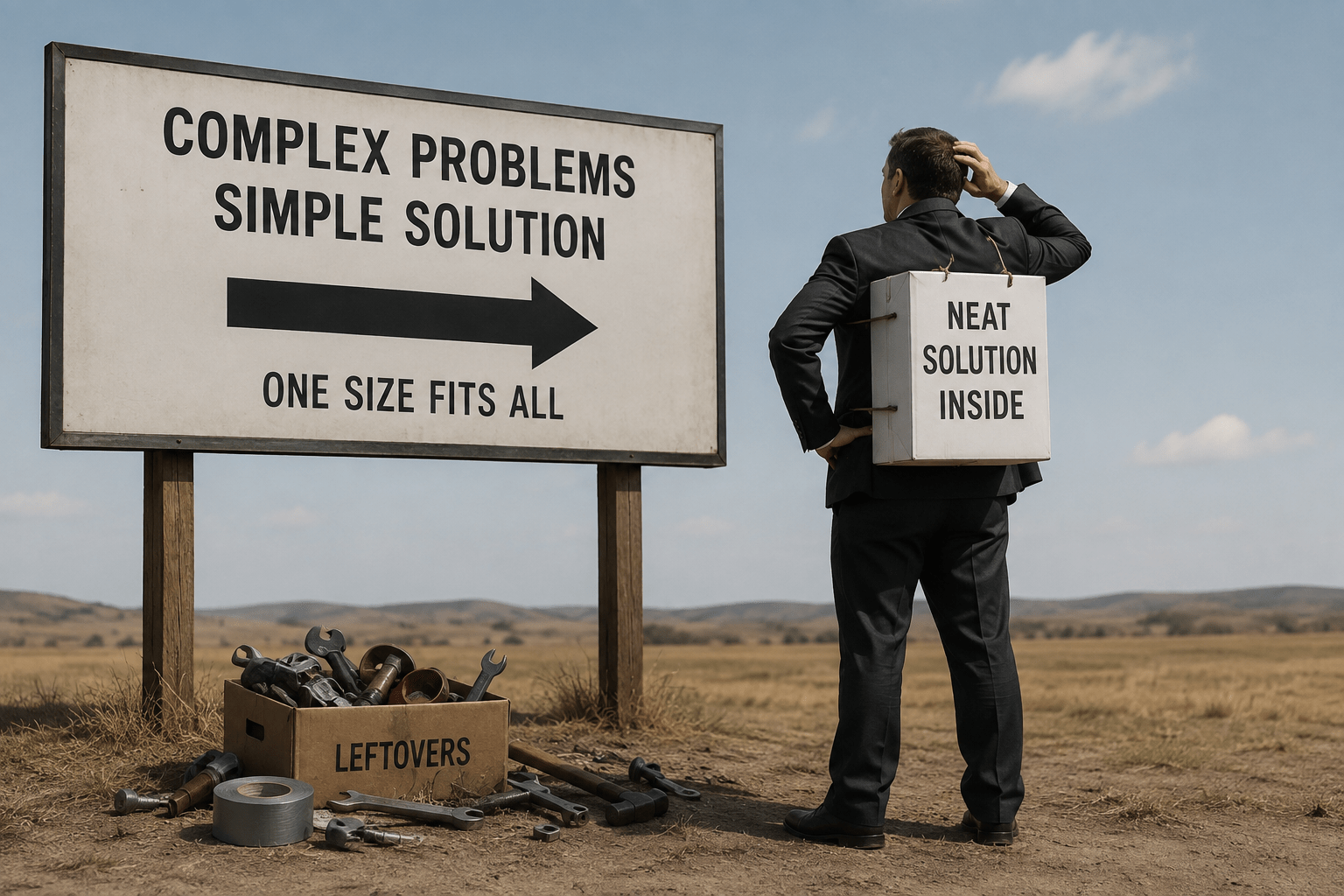
If we knew the solution, we probably would not have the problem.

With complex problems, the solution is rarely sitting there politely waiting for someone clever enough to notice it. Stuart talks instead about steps, experiments, things we can try, learn from and adjust.

So perhaps GPS survives. Goal. Problem. Steps.

I rather like that. It removes the requirement to stride into every complicated situation carrying The Answer.

It also exposes another habit we have. We are often in an extraordinary hurry to solve the problem before we have worked out what the problem actually is. Something goes wrong and we deal with the bit we can see.

People are not collaborating. Students are dropping rubbish. A community is not engaging. A candidate loses an election.

Right. Fix that.

Except those things may be symptoms. The interesting questions sit underneath. Why is this happening? What assumptions are we making? Who knows something we don’t? Who sees the situation differently?

And the question I am finding increasingly important in some other work I am doing is this.

Have we actually spoken to the people most affected?

It is astonishing how often the answer appears to be no. Reports get written, programs get designed, conclusions get reached and entire narratives develop. Meanwhile, somebody sitting right in the middle of the experience is thinking, “You could have asked me.”

And then I am preparing to stand in front of children and put this on a screen.

Stay curious. Ask before you assume. Understand the problem before you solve it. Listen to learn. Share the thinking. Try something small. Learn what happens. Keep going.

The children are not the only people who could use the reminder.

I am also going to ask them something I have found unexpectedly difficult myself.

Who do you know who does this? Who stays curious when everyone else has already decided? Who asks another question? Who listens because they genuinely want to know the answer? Who can say, “I don’t know”? Who can discover something new and change their mind without behaving as though they have suffered a humiliating defeat?

I can think of a few people. Stuart is one.

What I notice when I talk to him is that having expertise has not made him less curious. Quite the opposite. He keeps asking questions. What is the actual dilemma? Who else sees this differently? What could we try? What might we learn?

Perhaps that is what expertise should look like.

Knowing enough to know that you probably don’t know everything.

There is another uncomfortable question sitting underneath my student workshop. We spend a great deal of time telling young people they will need curiosity, critical thinking, creativity, communication and collaboration to navigate the future.

Who are they watching do it now?

Because one workshop will not do it. Not for them. Not for us.

A workshop might introduce an idea. It might give us language for something we had never noticed before. It might even make us uncomfortable enough to rethink something.

Then comes Monday.

That is when the learning starts.

Navigating Conversations Dismissed as “Woke”


In today’s political and cultural discussions, the word “woke” has evolved from a term signifying awareness of social injustices into a divisive label.

The term “WOKE” is often used pejoratively to shut down ideas without engaging with their substance. This shift has significant implications for dialogue, understanding, and meaningful connection.

Here’s how we can navigate conversations where this kind of dismissal arises:

1. A Misunderstood Label

Originally, being “woke” was about staying alert to societal inequalities, a call for empathy and awareness. However, the term has been co-opted and weaponised to ridicule progressive ideas. This misuse undermines the genuine intentions behind the term, turning what could be an invitation to discuss complex issues into a barrier to conversation.

How to address it:
Recognise and clarify the original intent behind the term. For instance, you might say, “I think there’s some misunderstanding here when people talk about being ‘woke,’ they often mean being aware of and addressing societal challenges. Can we explore the specific issue you’re concerned about?”

2. Avoidance of Complexity

Labelling something as “woke” often acts as a shortcut, bypassing the effort it takes to understand or address opposing views. Instead of tackling the nuances of an idea, the label serves to discredit it entirely.

How to address it:
Encourage deeper engagement by asking thoughtful, open-ended questions:

  • “What aspects of this idea do you find challenging or unhelpful?”
  • “Have you considered other perspectives on this issue?”

These questions prompt reflection and can steer the conversation towards a more meaningful exchange.

3. Polarisation and Defensiveness

Using “woke” as a derogatory term often reflects defensiveness or an unwillingness to consider ideas outside one’s ideological comfort zone. This dynamic increases polarisation, fostering an “us versus them” mentality that hinders understanding.

How to address it:
Acknowledge the defensiveness without escalating it. You might say, “I understand why this topic might feel polarising. What do you think is at the heart of the disagreement?” This can create a space for empathy and shared values to emerge.

4. Erosion of Dialogue

When terms like “woke” are used dismissively, they derail conversations and reduce opportunities for genuine connection. Instead of discussing the core ideas, the focus shifts to the emotional weight or connotations of the label itself.

How to address it:
Shift the focus back to the issue at hand. For example:

  • “Rather than focusing on labels, I’d like to hear more about your specific concerns regarding this topic.”
  • “Can we move past the term and discuss the underlying problem?”

5. Reframing the Conversation

Reframing is a powerful tool for navigating dismissive language. By steering the dialogue back to the issue itself, you can encourage critical thinking and engagement.

Sample reframes:

  • “What part of this perspective do you think is worth exploring further?”
  • “Do you think there’s common ground we can build on here?”

This approach not only de-escalates tensions but also invites collaboration and mutual understanding.

Why It Matters

Dismissing ideas as “woke” isn’t just a linguistic choice, it reflects broader trends in how we approach disagreement. By refusing to engage deeply, we miss opportunities for growth, compromise, and progress. Navigating these conversations with curiosity and care can help bridge divides and foster a culture of respectful dialogue.

A Call to Action
When faced with dismissive labelling, consider this: Every conversation is an opportunity to connect and learn. By resisting the temptation to retreat or retaliate, we can model the kind of meaningful discourse we wish to see.

Have you encountered this dynamic in your own conversations?

How do you respond when someone uses terms like “woke” to dismiss opposing views?

#woke #dialogue #polarisation #socialjustice #complexity #meaningfulconversation #curiosity #empathy #reframing #debate

Sixty-Eight Seasons Later and Why Exploring the World Matters More Than Ever

Flying back to Australia this year after two seasons away, I felt as if I’d missed a chapter in nature’s book—one I thought I’d read dozens of times. After nearly seven decades of watching winters turn into springs and springs into summers, it was humbling to see how much I still missed by being away. This shift from one season to the next was more than a change in scenery; it was a reminder that the world moves on, whether we’re present or not.

For most of my life, the rhythms of nature have been a constant. I’ve watched Japanese maples bud, daffodils bloom, and wisteria unfurl in countless spring displays. But this absence made me realise how easy it is to take these transitions for granted. Seasons come and go as predictably as the sun rises, yet the details change, and those changes are only visible if we stop and truly look. With every year, I’ve come to understand more deeply how essential it is to stay curious, to investigate the world with fresh eyes, and to never assume that just because you’ve seen something once, you’ve seen it all.

As I reflect on 68 years of life, I’m struck by how much the world itself has changed. Landscapes, communities, climates—each season, each place, has a story to tell if we’re willing to listen. Investigating the world isn’t only about seeing new things; it’s about allowing new perspectives to influence who we are and how we understand our place in the world. Whether that investigation takes the form of travel, reading, or simply watching the familiar with curiosity, it brings fresh layers to our knowledge and resilience.

Curiosity fuels every step forward. It’s what keeps us asking questions, pushing boundaries, and opening doors to unexpected paths. No matter our age, curiosity encourages us to keep learning, and learning keeps us vibrant. This recent journey of ‘missing’ a season has been a reminder that there is always more to see, more to learn, and more to appreciate in the world around us.

So, let’s make investigating the world a priority—whether it’s by visiting new places, nurturing relationships, or simply staying open to change. Seasons may come and go, but with each passing year, there are still new stories waiting to unfold, and it’s up to us to bear witness.

#Curiosity #SeasonsOfLife #InvestigateTheWorld #NeverStopLearning #NatureAndPerspective #TravelAndGrowth #StayCurious #PerspectiveMatters #LifeLessons #EmbraceChange