

I am about to spend World Peace Day talking to a group of 10 to 15 year olds about curiosity, critical thinking, communication and collaboration. Which is slightly confronting when you start looking around at how adults behave.
Before the workshop, the students will answer a short survey. They will answer the same questions afterwards. I am interested to see what changes, and I am also realistic enough to know they are unlikely to walk out several hours later transformed into world-class collaborators who calmly interrogate every assumption before breakfast.
That is because people do not change overnight. Oddly, we seem to forget this every time we organise a workshop.
How many times have you spent a day learning some marvellous new way of doing things, walked out thinking, “This is excellent” put the folder somewhere safe and carried on exactly as before? I have.
We have somehow developed a culture where learning is treated as an event. Book the facilitator, find the room, provide lunch, learn collaboration, home by four. Job done.
I learnt the limitations of that model the long way around.
When I came back into agriculture, people decided I did not look like the stereotype of someone they expected to see representing the industry. Apparently that was useful, so I was pushed out the front and into the media.
This was all very new to me, and I was not remotely comfortable with it, so I demanded training. Then more training. Then more training.
It took me about 15 years to feel comfortable.
The other day I gave a presentation and a number of people told me it was the best presentation they had ever seen.
They should have been at my first one.
It had 127 slides.
I wish I were exaggerating.
That experience changed the way I thought about developing other people. When I started the Young Farming Champions program, I wanted people to have what I had eventually learned I needed, time, repetition, feedback and somewhere safe to keep practising.
That is how confidence grows.
Then agricultural bodies looked at what we were doing and decided they wanted something similar. The young people were already there. The Action4Agriculture team was already training them. What changed was the desire to have the program sit inside their own organisation.
This is where I became increasingly frustrated with the way institutions behave. We talk endlessly about collaboration, but the system often rewards the person who can point to something and say, “That was my idea. I built that. That was my result.”
Once that becomes the prize, curiosity becomes inconvenient.
Nobody asks, “Why is this working?” or “What could we add to what is already here?” The question becomes, “How do we create our own version?”
And that is how duplication starts to look like achievement.
The result can be beautifully efficient.
Train them on Saturday.
Face of the industry by Monday.
It is a wonderfully efficient system, provided human beings work like software updates.
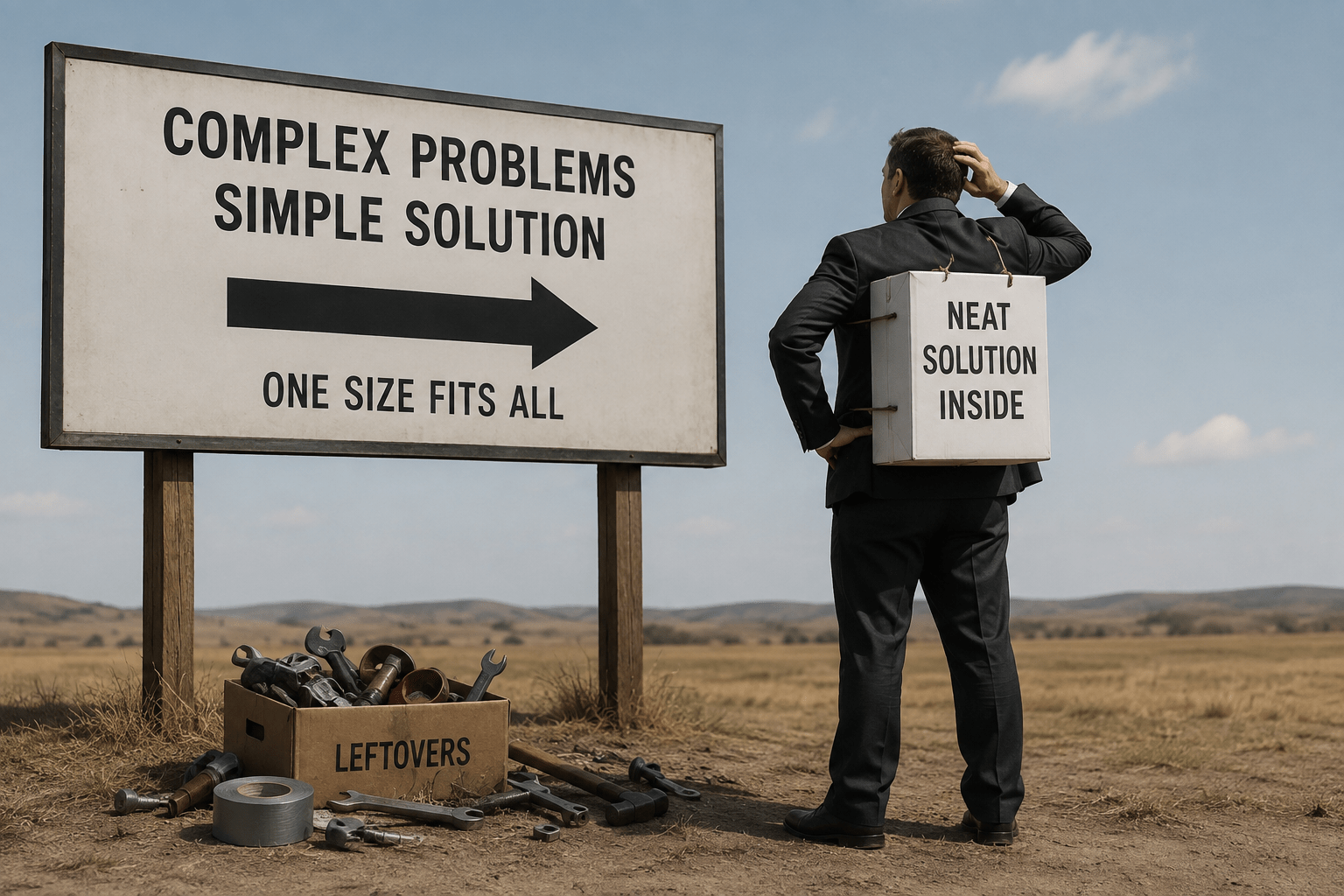
Recently I have been spending time with collaboration specialist Stuart Waters, and he has been subtly dismantling several things I thought I knew. One of them is my GPS model.
I have used it for years. Goal. Problem. Solution. Where are we trying to go? What is getting in the way? What is the solution? Perfectly sensible.
Except Stuart pointed out something rather inconvenient.
If we knew the solution, we probably would not have the problem.
With complex problems, the solution is rarely sitting there politely waiting for someone clever enough to notice it. Stuart talks instead about steps, experiments, things we can try, learn from and adjust.
So perhaps GPS survives. Goal. Problem. Steps.
I rather like that. It removes the requirement to stride into every complicated situation carrying The Answer.
It also exposes another habit we have. We are often in an extraordinary hurry to solve the problem before we have worked out what the problem actually is. Something goes wrong and we deal with the bit we can see.
People are not collaborating. Students are dropping rubbish. A community is not engaging. A candidate loses an election.
Right. Fix that.
Except those things may be symptoms. The interesting questions sit underneath. Why is this happening? What assumptions are we making? Who knows something we don’t? Who sees the situation differently?
And the question I am finding increasingly important in some other work I am doing is this.
Have we actually spoken to the people most affected?
It is astonishing how often the answer appears to be no. Reports get written, programs get designed, conclusions get reached and entire narratives develop. Meanwhile, somebody sitting right in the middle of the experience is thinking, “You could have asked me.”
And then I am preparing to stand in front of children and put this on a screen.
Stay curious. Ask before you assume. Understand the problem before you solve it. Listen to learn. Share the thinking. Try something small. Learn what happens. Keep going.
The children are not the only people who could use the reminder.
I am also going to ask them something I have found unexpectedly difficult myself.
Who do you know who does this? Who stays curious when everyone else has already decided? Who asks another question? Who listens because they genuinely want to know the answer? Who can say, “I don’t know”? Who can discover something new and change their mind without behaving as though they have suffered a humiliating defeat?
I can think of a few people. Stuart is one.
What I notice when I talk to him is that having expertise has not made him less curious. Quite the opposite. He keeps asking questions. What is the actual dilemma? Who else sees this differently? What could we try? What might we learn?
Perhaps that is what expertise should look like.
Knowing enough to know that you probably don’t know everything.
There is another uncomfortable question sitting underneath my student workshop. We spend a great deal of time telling young people they will need curiosity, critical thinking, creativity, communication and collaboration to navigate the future.
Who are they watching do it now?
Because one workshop will not do it. Not for them. Not for us.
A workshop might introduce an idea. It might give us language for something we had never noticed before. It might even make us uncomfortable enough to rethink something.
Then comes Monday.
That is when the learning starts.


