Coles Please remember real people farm

Today I am re-blogging below  this post from Milk Maid Marian which highlights the heartbreaking issues in the Australian dairy industry. Marian makes some very powerful and insightful comments and puts forward some thought provoking and very doable solutions. The question are the right people listening and most importantly will they act?

In my neck of the woods  I spoke to my Parmalat Farm Services Officer yesterday who I know has been feeling the strain of working with dairy farmers for the past six months and struggling to deal with the devastation she is witnessing in the Australian Dairy industry. She asked me how our cows handled the heat. I said surprisingly well but then we had learnt from our past mistakes and put in 48 hours with almost no sleep to assist our dedicated team to hose our cows down (and other mitigation strategies) in the 43 degree heat to ensure they were as comfortable as possible and so far it has worked .

I also want to share this video with you.

It is powerful for a number of reasons, but mostly it highlights something Coles seems to have forgotten and that is real people farm and a lot of them are in pain because of Coles marketing strategies.

michael strong Photo Sylvia Liber

Coles remember real people farm – Photo by Sylvia Liber

Woolworths on the other hand are getting smart and recognising how important their farmers are and doing something about it . See article here. As Marian warns don’t kill the goose that laid the golden egg Coles.

The video also highlights farmer should never underestimate the impact of building direct relationships with their customers which is the very reason why I instigated Art4Agriculture  and the Archibull Prize 

Back to Marian –  this is what Marian had to say this morning ……..

Dairy farmers gathered in their hundreds in south-west Victoria last night for a crisis meeting. What makes it a crisis? Very simply, dairy farmers are working seven days a week for free and petrified of losing our shirts.

Local agribusiness bankers tell me they are busy refinancing and arranging extra debt but land sales are at a standstill around here. Reporting on last night’s dairy crisis meeting, Simone Smith of The Weekly Times, described a “dire picture”:

“Warrnambool-based Coffey Hunt farm accounting specialist Garry Smith said across his client-base, farmers milking mostly between 450-500 cows, average feed costs were up 15 per cent – a $150,000 rise – with the cost of power for the first quarter of the year up 50 per cent.”

“He estimated across his client-base earnings would be 10 per cent down on last year with a combination of cash-flow and income down $260,000.

“Charles Stewart real estate agent Nick Adamson said better quality farms had dropped in value between 8-15 per cent, while others were up to 45 per cent down on peaks of several years ago.”

None of this is pretty and astonishingly, Peter Reith decided to appear on ABC’s The Drum website with a six-point plan that, at first, I thought was a spoof. Take a look and make up your own mind.

It’s not as simple as cutting petrol taxes and municipal rates. It’s tricky because of this conundrum: milk and dairy foods are considered so important that nobody wants to pay what they are worth to produce.

Every day I read comments on Twitter that go something like this: “My kids drink three litres of milk every two days, so I can only afford to buy $1 milk”. I know first-hand how tough it is to feed a family when you’re on struggle street, so I have a lot of sympathy for people in this predicament and it’s impossible to respond with anything other than compassion.

It’s hardly surprising, then, that there is no political appetite for an increased milk price. But the truth is this: dairy farmers should not and cannot fund an ersatz Australian welfare system by subsidising the cost of food. Welfare is the role of government.

So, while my dander is up, here’s a simple list of five tricky things that would make a big difference to this dairy farmer:

1. Deal with the supermarket duopoly
Down, Down, Down is not about you, dear milk drinker. The real reasons for the supermarket war are expressed in corporate ROIs rather than family budgets. At the end of the day, it will be the little people with the least market power – you, the shopper, and me, the farmer – who will pay.

2. Level the global playing field
Julia Gillard announced that Australia would be Asia’s food bowl but guess what? Unlike the world’s most powerful dairy exporters, the Kiwis, we do not have a free trade agreement with China, putting Australian dairy at an immediate 15% disadvantage. Nor do we receive the government subsidies that support our European and North American competitors.

3. Assist with the impact of the carbon tax
Australian dairy farmers are suffering a double whammy under the carbon tax. First, processors are passing the extra cost onto us in the form of lower farm gate prices (because the consumer won’t pay extra and nor will global commodity markets), reducing our incomes by around $5,000 each per year. At the same time, our costs – especially electricity and refrigerants – are rising in quantum leaps each quarter.

4. Support smart farming
Long exposed to the blow-torch of global export markets without subsidisation, Australia’s dairy farmers are among the most efficient in the world, according to research body, Dairy Australia. We can produce very high quality milk at a very low cost because we have invested in research and development. No longer. We are spending less and less on R&D and the Victorian government has just made massive staff cuts to our brains trust, the Department of Primary Industries.

5. Remember, I am the goose that lays the golden egg
I will not be able to continue to deliver high quality milk at such a low price while enhancing the environment and caring for our cows without sacrificing the basic wellbeing of my family and that, I refuse to do.

Coles your are breaking my heart

A few things lately have reminded me of the phrase “live everyday like it is your last” and for me that is waking up everyday to fulfil my legacy for youth in agriculture.

Today we hosted Nuffield Scholar Joe Delves and after spending this week in workshop with a number of our inspiring Young Farming Champions and Young Eco Champions I wish I had known more about Joe so I could have ensured he joined us earlier to meet and inspire the team.

What a breath of fresh air he is and excitingly just the right age to be a Young Farming Champion ( looking forward to bringing the program to UK Joe so we can extend the network and get the same outcomes in your country)

Joe Delves @ Culwalla

Joe Delves lifted my spirits today and I thank Nuffield for giving him the opportunity to do just that  

As you might have guessed Joe hails from the UK. Here is part of his blurb on the Nuffield site

I am a third generation dairy farmer from East Sussex. We are currently running 210 cows and 160 followers ( replacement stock), …. I have a wife called Becky and two gorgeous daughters, Faith who is three and Evie who is one. Our goal as a family is to demonstrate that dairy farming can be sustainable, profitable and fun!!


My Nuffield project is to “How best to save/promote the dairy industry (UK)”

My main reason for wanting to study this topic, was to see if there was some way of linking up exiting farmers and new entrants in the dairy industry. Hoping that this would help to combat the decreasing number of farmers and the ever increasing average age of the dairy farmer. In between these two issues you have other factors such as subsidies, taxation and a lack of long term business planning. I have spent the past months travelling the UK looking at farms and talking to farmers young and old. There is a clear lack of career path for young people, they also lack those farming hero’s to aspire too. We have lost a lot of our pioneer spirit in the UK which I think is the effect of farmers becoming heavily reliant on subsidy. Through my Nuffield Scholarship i hope to reinvigorate the UK dairy industry.

One of the first things Joe said to me is “In the UK my generation likes to think of ourselves as 1st generation business men”. Joe is not only a wealth of ideas he  has put them into practice including innovative ways to give young people a start-up in the industry using corporate investors to buy the land that young farmers cant afford and then finding support for them to fund  purchase of cows and infrastructure

On a personal level it was heartbreaking to show Joe the farm today ravaged by extended dry conditions put to the test by our innovative efforts to counter the devastation caused by the milk price wars instigated by Coles. I have never seen our farm look this barren and in fact I took pictures but don’t want to post them   

This week Coles came out and said “It not our fault dairy farmers are suffering”  Well I say Coles its time you thought about the legacy you wake up everyday to leave for the Australian dairy industry because to me you must have hearts of stone to sleep at night. I can tell you, because I know Australian dairy farmers are being brought to their knees and admit it or not Coles you are part of the reason why.

Come and see my what is left of our beautiful farm, hear our story. We strive to be the best of the best and we are almost broken. How much further you can push us I don’t know, how you justify your marketing practices I don’t know. What I do know you are part of the problem and its time you become part of the solution. Here is a start Coles how about you follow Sainsbury’s lead “Sainsbury’s raise lamb prices for farmers”

Coles no-one but you believes the spin anymore

I have been quiet on the milk wars saga of late. This is in main because I am finding it hard to keep up and its exhausting me. All in all the whole debacle is just bizarre. One minute large numbers of NSW and QLD dairy farmers are being paid just 12c/litre for large volumes of their milk known as T2 milk. The next minute they are being told all their milk will be paid at T1 price (full price) from February to July 2013. Then they have just being told they will be paid at T1 price  as of 1st December 2012. Fantastic news if cows where machines and you could just turn their udders on and off but it appears that whilst the rest of the world knows they aren’t machines but living breathing things the milk processor Lion doesn’t

Then the Xcheque newsletter lobbed into my in tray this morning and allowed me to share with you a reasonably uncomplicated update on the milk price situation and farmer exits. Xcheque is owned by the very insightful and bright mind that is Jon Hauser. The newsletter directed me to this excellent article penned by Kai Tanter and titled “Let them eat cake – the ongoing saga of T2 milk price and a Lion in winter”

So for all the fabulous dairy farmers supporters out there here is an update on the situation at the farm gate from the experts

Let them eat cake - the ongoing saga of T2 milk price and a Lion in winter

“Let them eat cake – the ongoing saga of T2 milk price and a Lion in winter” by Kai Tanter

What kind of responsibility do processors have to their farmer suppliers? The fight around tier two (T2) milk payments in Australia is one where domestic processors, and their supermarket customers, seem to want to have their cake and eat it too – flat milk all year round but at a market benchmark price that has no relevance to this requirement. This has resulted in a commercial and public relations mess. It also appears to have triggered another wave of farmer exits from the Australian dairy industry.

Lion is the processor who has copped the most flak over this issue from farmers recently. They may be moving into their good books after announcing a price rise for the first half of next year. Their NSW, Queensland and Tasmanian suppliers, many of whom claim they have been treated unfairly by Lion, will no longer be subject to T2 milk prices from February to July next year. The T2 price is currently 15 cents per litre (averaging around 12c/litre ). This will be replaced by the T1 price for all milk – currently 47.5 cents per litre for northern NSW and southeast Queensland.

The most recent round of T2 prices were introduced in July of this year. The price is for milk that exceeds Lion’s requirements for their domestic fresh dairy product business. Many farmers were in uproar and said that they could not produce milk at those price levels, or at the effective average price of tier one (T1) and T2 milk. This however seems to have been the point. Lion said that they had too many farms in NSW and Queensland and that they didn’t need the milk, and especially during Australia’s peak production period across spring and early summer.

“Basically there needs to at some point be a rationalisation of the amount of farms that are in those two states,” said Lion’s director of procurement, Murray Jeffrey.

Things seem to have changed over the last couple of months, hence the removal of T2. But why? Australia’s pasture based milk production is highly seasonal and it is normal for more milk to be available in some months than others. Lion says that it is the recent decline in milk production that has allowed them to make the change.

“Given that there’s been a steady decrease in volume over the last two or three months it’s allowed us to purchase Tier 2 milk at Tier one prices in South East Queensland and NSW,” said Mr Jeffrey.

Figure 1. Central / North New South Wales + Queensland milk production.

nsw-qld-milk-production


Less now, maybe more later – but at what cost?

Lion’s price attack on surplus milk might have given them more than they bargained for. The Land recently reported that since the introduction of T2 pricing in July, Lion’s milk receivals have decreased by 15 percent relative to two years ago. This is much more than a normal season decrease, especially against the background of relatively good rainfall and low prices for irrigation water.

It’s not just in the last three month’s that Lion’s receivals have fallen. Ian Zandstra, president of Dairy Farmers Milk Cooperative (DFMC), who are Lion’s major supplier of fresh milk, estimates that Lion’s milk pool from DFMC suppliers has decreased by 20 percent in the last two years. He attributes this to the low milk price.

The seasonality of Australia’s milk production is in part responsible for this situation. There is a lack of fit between the demand for dairy products, which stays the same all year round, and the supply of milk, which varies depending on the season. Processors like Lion want to be guaranteed a set supply of raw milk all year round, but if a traditional dairy tries to meet this demand, it results in surplus milk during high yield months.

The two tier milk price system has been devised to send a clear message to supplier about how much milk the processor (=supermarket and consumer) wants and when they want it. It is not a bad idea in principle but the brutal and uncommercial value that has been placed on T2 milk completely undermines the overall value of the dairy enterprise.

The justification for the low T2 price is that this is the effective return to the processor when they transport it to Victoria and sell it to a commodity processor. In other words “It is not our responsibility to add value to this milk … and by the way you will have to pay for the cost of getting rid of it”.

The supermarkets are just as culpable in their denial of responsibility for this milk. From an earlier article:

Coles claim that they have no effect on T2 prices, saying that their retail and farmgate milk prices have been decoupled. “Coles’ house brand milk contract with Lion is based on tier one milk pricing… [and] Coles has no influence on Lion’s decision to reduce tier two milk prices,“ said a Coles spokesman.

They might be one step removed from the buying process but in our opinion the supermarket chains cannot divorce themselves from the economic reality of the dairy industry.

The underlying assumption in the argument presented by the spokesmen for Lion and Coles is that the price for T1 milk is fair and reasonable compensation for the flat milk production profile they require. According to Murray Jeffrey:“We already pay NSW and Queensland suppliers a premium on the world price.“

But do they, and what is the world price? It turns out that the world price is the price that export processors can extract from world markets for commodity dairy ingredients. It bears no relationship to the price that farmers are paid for fresh milk in other developed countries, and it certainly bears no relationship to the cost of producing milk on a flat production basis all year round. Discounting T2 milk well below cost and its intrinsic value is just rubbing salt into an already festering wound.

So the reality for Australian farmers that are servicing the domestic consumer market is that they either need to cop a huge penalty for producing surplus seasonal milk, or move to flat production with a tier one milk price that is inadequate to support this production system.

In the southeast of Australia ( Victoria and Tasmania ) farmers at least have a choice. They can choose to supply an export ingredient processor where they have half a chance of matching the milk price to the lower cost of a seasonal pasture based production system.

What choice do farmers in the northern half of NSW and Qld have? Ship their milk south? Sell milk at the local farmers market? We don’t think so. The choice seems to be: accept this milk payment system or get out of milk production. From the recent reduction in milk supply it looks like the second option has been a popular choice.

This has been a year full of contradiction and irony for the Australian dairy industry. “Down Down Down” has been the catch cry from the supermarkets. In association with this has been the supermarkets call of “Me Me Me” when it comes to allocation of shelf space to product brands. “No No No” has been the consumer cry regarding the inclusion of permeate in milk – with the effect that removal has increased the cost of fresh milk production. “Down Down Down” has been the message to farmers on milk price. “Up Up Up” has been the cost direction for the purchased feed that is so essential for a flat domestic milk supply.

Just about the only thing that makes sense at the moment is “Out Out Out” which has been the farmer response in those regions where there is nowhere to go with this unsustainable economic equation. It looks like Lion may have come to the same conclusion. The last word goes to outgoing Chief Executive Rob Murray:

“We don’t make any money [on milk],’’ Mr Murray  said. ‘‘The simple truth of that is nobody is making money and you can’t make money if [consumers] buy milk at $1 a litre, it physically can’t be done.’’

Mr Murray described Lion’s dairy division as a “charity”, saying that “in fact a lot of charities do better”.

The dairy industry sings for its supper

Back to me

If Lion think they are a charity where does that leave the farmers supplying fresh milk in this country?.

davesview_77

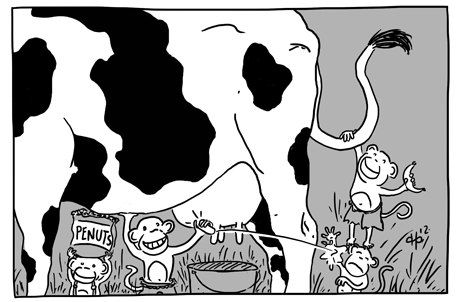
On dole queues?. Not good enough Coles. Its time to take responsibility. When you pay peanuts you get monkeys and farmers aren’t stupid and they are voting with their feet big-time . And where does that leave consumers? Milk from China?   

WE NEED OUR DAIRY INDUSTRY says Richard Makim

Today’s guest blog post continues to show the diversity of vocal proud and loud agvocates supporting the Australian dairy industry. Richard Makim is a very well known 4th generation NSW grazier.  Richard and his wife Judy have 7 children and live and farm at  “Moredun” in Ben Lomond NSW.

This is what Richard has to say……………………………..

We need our dairy industry because Australians need affordable, reliable, quality and fresh nutritious food and that is exactly what our Australian dairy farmers provide for us everyday. In a rapidly changing and growing world there are many competing interests for human sustenance. In trade, alliances change, regimes come and go, and big developing countries in our region, with fast growing economies, will challenge us with their bargaining chips for their near insatiable demand on resources (including food).

Then there is oil. We rely heavily as does most of the world on cheap, always available fuel. Run through some ‘what if ‘ scenarios. David Holmgren does this well.

  1. What if oil doubled in price?
  2. What if it was difficult to obtain?
  3. What if it wasn’t available for 3 months?

These various scenarios would become scary for food security and trade.

What really is at stake in this discussion is our national vision. As successive government policies smash our primary industries (lack of competition and management of the dollar) we lose our national ability to produce our own food (half our dairies have gone since deregulation). We are already a net importer of some major basic foodstuffs. Our trading partners haven’t levelled their ‘playing fields’ as fast or completely as we have, putting us at a serious disadvantage. Bob Katter, in his recent book, ‘An Incredible Race of People’, gives a long list of the industries and their decline, including a special chapter on the Dairy industry. The figures show that both the consumer and the producer have come out worse from deregulation. Bob quotes Professor Ted Coulson from the School of Economics, University of Qld., as saying, ‘ What has happened to the Dairy industry is one of the 3 great shames of Australian history”. To add insult to injury, the major supermarkets have used this staple as a loss leader.

How do we see ourselves as a nation? Are we to close down our countryside and most of our Primary industry and let all our manufacturing go offshore? Is speculation of the ballooning money markets and mining expected to carry the country? Are we to expect the ‘Brisbane line’ mentality of the recent live export shutdown be applied to any other industry as a result of sensationalist reporting and social media driven polls?

An industry like Dairy isn’t turned on and off like a tap. We already have a problem in Agriculture with an aging population and not enough succession. Why? Because the work is hard, the hours long, the risks regular, and returns in real terms probably haven’t improved in 30years. And in some industries, gone backwards. If there is a major primary agricultural industry where morale is high and these situations don’t exist, I haven’t heard of it.

With 95% of our population urbanised, the disconnect with where and how our food is produced and gets to retail is alarming. Agriculture in general has failed to address this dialogue and governments appear to be satisfied to keep plucking ‘the goose that lays the golden egg’. This is neither wise nor sustainable on the forefronts of health, environment, or economy.

Stand up for our dairy industry by signing Lisa Claessen petition to Coles here

Lisa Petition Coles

Another 8000 signatures required before Coles will listen

Where is your ANZAC spirit Coles?

Today this media story ‘Kirin dairy business no longer a curdling story’ is doing the rounds on twitter along with this classic photo from a report on German dairy farmer protests in Brussels 

246688_494716883872628_2097300242_n

Back to Oz ‘OUTGOING Lion chief executive Rob Murray said the fresh milk part of the dairy business was in a terrible state and not too dissimilar to the profitability profile of a charity. ”We have a challenge which is the core of the business, the fresh milk business, which is a charity – in fact, a lot of charities do better than that,” Mr Murray said. He went on to say the blame … was down to Coles and Woolworths, which nearly two years ago launched their own-label milk priced at $1 a litre, effectively undercutting branded milk sold by Lion. ”We don’t make any money [on milk],” Mr Murray said. ”The simple truth of that is nobody is making money and you can’t make money if [consumers] buy milk at $1 a litre, it physically can’t be done.”

This begs the question if Lion see themselves as providing a charity service (giving milk away for free) where does that leave their farmers?

Dairy farmers are a volatile lot in the EU aren’t they? There were images like this in 2009 when Belgian farmers continued European-wide protests by spraying about three million litres fresh milk onto their fields.

0,,4701138_4,00 

Back to OZ where earlier this year the owner of Coles Wesfarmers announced “their full-year net profit rose 11 per cent to $2.126 billion and its Coles unit capped a third year of market-beating performances as it stepped up its price war with bigger rival Woolworths.” See previous post here.

Its clear Coles P&L doesn’t mirror that of a charity. Their CEO Ian McLeod earns $15.63 million in salary alone. McLeod’s spectacular earnings are more than double that of his boss, Wesfarmers CEO Richard Goyder, who made $6.9 million last year.  I don’t know whether to laugh or cry when they spruik the milk price wars are solely to help Australian families.

Australian dairy farmers tend to be a pretty peaceful lot. We have a lot of faith in the ANZAC spirit of helping your mate out, regardless of the consequences and knowing that your mate will do the same if the situation was reversed. The sense of doing what needs to be done when it needs to be done. 

The ANZAC spirit of people like QLD school teacher and blogger Lisa Claessen who has organised a petition which you can sign here.

The ANZAC spirit and fighter for all things of value to rural and regional OZ Alison Fairleigh who has an innate sense of what’s right and wrong and what is good and evil in the world.

As Alison reminds us ‘As consumers we have the power to drive market trends. We can stop buying home brand milk, and vote with our feet and our wallets.  We can all accept our personal responsibility for ensuring a sustainable dairy industry for the future of all Australians’.

As a farmer I ask Australian consumers to help us fight Coles where it hurts them not in our fields and in our streets. Lets show them we will never surrender our farmers just so Coles can line their pockets with gold driven by short term vision and pure greed

Lets get our ANZAC spirit out Australia.  All it takes is a signature here.

Farmers and the Community maintaining the rage in the Milk Price Wars

The Farmer’s Angel Alison Fairleigh has gone into to bat for Australian dairy farmers. You can read the full version (snapshot below) of her fabulous blog post here

Someone described consumers to me the other day as “notoriously dense”. Just like sheep, we have a herding mentality and the large supermarkets (Coles & Woolworths), with their multi-million dollar marketing budgets, play on this mentality perfectly for guaranteed market share, mega profits and shareholder satisfaction.

Let’s take a look at $1 per litre milk as an example of how well the duopoly pull the wool over consumer eyes.  People purchase the so-called “discounted” milk because it’s cheap, because food budgets are tight and because they feel they are making a small saving on an item that is a staple for most families. But are they really saving? As this infographic from Dairy Defenders portrays, they are paying for it on other items.

supermarket

Our dairy farmers are continuing to maintain the rage too with Milk Marian Marian appealing to Curtis Stone’s sense of community in this thought provoking blog. Marian is appealing to Australians to email Curtis as she thinks he maybe he’s” blissfully unaware of the damage” to Australian farmers and the threat to Australian food caused by his highly successful marketing campaigns on behalf of Coles. Marian says “I intend to appeal for help by emailing him at contact@curtisstone.com and am sure he’d love to hear from you, too”

I will be emailing Curtis too and inviting him to visit Paradise.

Clover Hill Dairies

Perhaps he might even like to stay the night so he can get up and help milk the cows and meet all our wonderful young staff whose jobs and futures are under threat by the fallout from the supermarket milk price wars.

He can meet some of our cows that we have nurtured from their first breath.

Emma and calves

He can meet Peena the lamb. I am sure he will find her just as fascinating as the cows do

Peena the Lamb

He can meet Nick and Emma who are looking forward to bringing up the 8th generation of dairy farmers at Clover Hill

IMG_3385

It will be interesting to see the response to my invitation. I am confident Curtis would love to come but will Coles let him?. My impression is they are just not interested in seeing the real story.  I have probably got more chance of getting Bill Gates to visit my farm than Coles allowing Curtis Stone to come.Coles management just don’t get it and sadly I don’t think they want to get it. Management have short term targets and short term vision and all they care about is getting their bonuses and appeasing shareholders.

As farmers we get up every day to do our very best to live up to the promise of best outcomes for people. animals and the planet. As a result of the milk price wars there are now hundreds of farmers receiving prices like 12c/litre for their milk. It is ridiculous that Coles just don’t understand this is not enough money to fed cows, feed your family, reduce your footprint and deliver best environmental outcomes and spend money in your community or employ people, let alone all the other things on farmer wish lists. Something has to give and just how do you chose and live with the decisions you make.

Maybe the only answer is to become as detached from reality as Coles appears to be and if that is the only option one thing I know at Clover Hill we wont choose to ever stoop that low

Come and visit paradise Curtis and see for yourself. We will show you our best country hospitality as we are very #proud2dairy

Follow us on Twitter @chdairies

Coles under siege the choice is yours and the choice is now

I have been moved by the number of farmers from other industries and members of the community who have very vocally come out in support of Australian dairy farmers. Today’s blog post highlights the diversity of these people and shares why they are so passionate.

Firstly Queensland school teacher Lisa Claessen who publishes her own blog Telling Tales has launched this petition to get Coles to rethink the decimation they are raining down on the dairy industry through the milk price wars. Please read it and share it with your friends and most importantly sign it. You can find Lisa’s petition here

Lisa Claessen

QLD schoolteacher Lisa Claessen goes in to bat for Aussie Farmers

Secondly these thoughts from South Australian grain farmer and wheat trader Corey Blacksell

IMG_0741

We are all in this together says grain farmer Corey Blacksell

Being a grain farmer in a predominantly export orientated State; one might wonder why I have been so vocal in my support of dairy farmers.

Our property is located 295kms, by road, from the Port of Adelaide. We are predominantly grain growers, but also have a small flock of merino ewes that produce a first cross lamb, annually. We spread these operations across our 4640ha property. We began farming in our own right on July 1st, 2008.

So why does that mean I should be vocal in my support of the dairy industry? Apart from being fellow farmers, there are far deeper economic and principled reasons for my support of the dairy industry.

Firstly, I put my farmer hat on. As a grain producer in the predominantly export supply chain that is South Australian grain, it is my aim to remove myself from that supply chain. Having built on farm storage there is no point in participating in the export supply chain. In excess of $80 tonne ($40 freight and $40 storage and handling) are removed to form my farm gate price. Located on the SA/Vic border I aim to access the Victorian domestic market, a market that’s in equilibrium for supply and demand in an average season.

Dairy makes up approx 50 per cent of the cattle that consume feed grain in Australia, consuming around 1.5 tonne per head per year according to Dairy Australia. There are 1.6 million dairy cows in Australia (2010/11). This equates to approximately 2.4 million tonne of feed grain per year Australian dairy cows consume. The value adding of grain, into protein, creates a domestic demand for my grain and leaves the dollars in Australia and this is a win win for my family and my community.

Secondly, I put my consumer hat on. The permanent discounting of fresh food, by the supermarkets, is placing at risk the supply of Australian grown food, food that is universally accepted as being of the highest quality and integrity; food that the shopper can buy with confidence.

In an age when prices only go up, I ask myself how it is fresh food prices are coming “down down”. Who is paying for this deflation? Further to that, who will pay for this in the future?

The future may not be higher prices, but lower quality for the same price. Cheap food today will not create cheap food in the future. Cheap food will mean imported food, from countries with standards lower than our own. No one can demand a consumer pays for quality, but consumers must have the option. The risk is this option will be removed by the duopoly. That’s right, you will be given what Coles and Woolworths decide they want to sell you. They will want to sell you the things that make them the most margin.

“How can this be” you ask. Easily, it’s happening now and no one is even aware of it. The best eating and tasting fruit and veg do not make it to the shelf. Only the fruit and veg that creates the best value for the seller makes the shelf. One dollar milk is another example of best price, and not best quality.

Australian consumers now have a clear choice; cheap food leading to imported food of questionable quality and integrity or Australian produced high quality food.

The choice is that stark.

Perhaps a quote from The Conversation regarding the car industry can give us an insight into the future of Australian food production, minus the subsidies. You exchange manufacturing for agriculture!

If Australians want an auto industry, they must be prepared to pay for it – as ever – through the tax system. If they don’t, then they must also shoulder the consequences: a depleted skills base; a hollowed-out manufacturing sector; major job losses in every Australian state; and the decimation of a large number of regional and urban towns.”

It’s our choice now.

This great animation from the Hungry Beast opens the lid and exposes how Woolies and Coles are taking over OZ in leaps and bounds

Why Coles should stop the Milk Price Wars

Today Young Farming Champion Jess Monteith and I went to visit her friends Tim and Natalie Cochrane. You can read an earlier post about  Jess here

Jess wasn’t born on a farm but after meeting people like Nat and Tim who own a dairy farm at Terara just north of Nowra and helping them show cattle she fell in love with all things dairy . Jess’ little herd of registered Holstein and Illawarra cows now live at Tim and Natalie’s property with each new drop of calves helping set up a future for Jess to start providing milk for lots of Australian families just like her friends.

The visit today was to get some more photos for Jess’ Archibull Prize in school presentation. Jess is being sponsored by Paul’s Milk and will visit Caroline Chisholm College at Glenmore Park in her role as a Young Farming Champion.

IMG_4800

Jess and her favourite cow Eve

I was struck today by all these young people full of hope for a bright future in the dairy industry not just Jess but Tim and Nat who have two small children

IMG_4728

Tim and Nat milk four hundred cows. Generations of farming families and cow families make them and their cows the team they are today

IMG_4711 

The next generation wait their turn to join the herd

IMG_4751

Everybody waiting and wondering if there will even be any dairy cows let alone farming families on the flats at Terara if the crippling milk price wars don’t stop soon.

AJK Eve First calf 

Jess’ favourite cow Eve on the day she was born

People in the dairy industry have a very close relationship with their cows. The nature of the industry means husbands and wives work side by side and often their children join them in the dairy.

image  

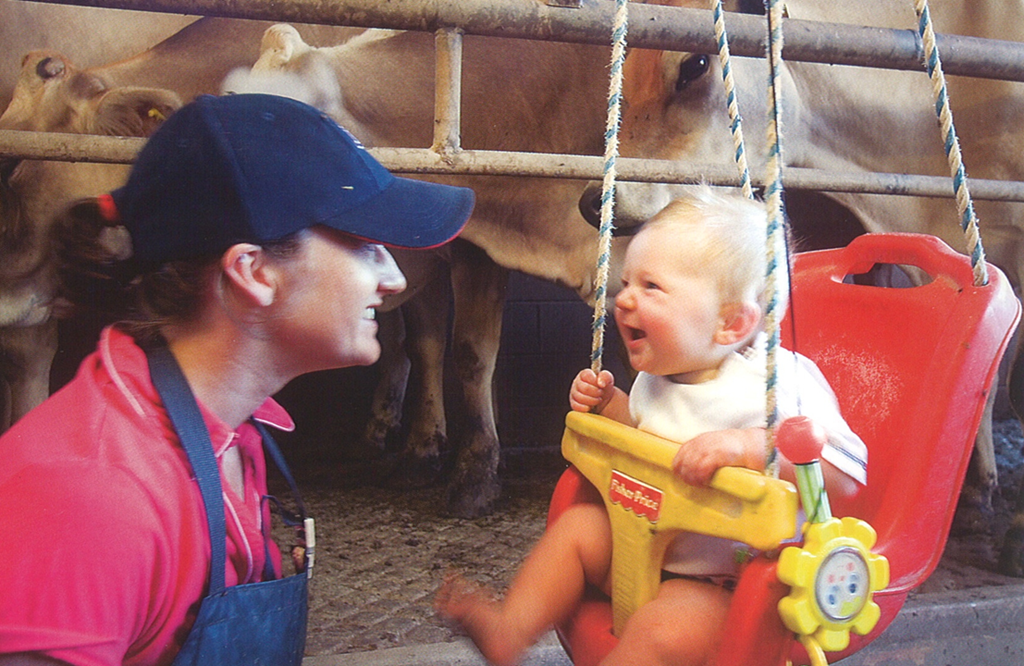
This photo says it all

IMG_4871

Dairy farming today is technology rich and phenomenal efficiency gains mean we can produce 60% more milk from 50% less cows than we did 50 years. They tells us if we do x,y, and z we can achieve further efficiency gains and maybe even survive this senseless round of milk price discounting being conducted by Coles.

But we can only work so many hours a week, what we need is smart young people like Jess working in agriculture and we need a milk supply chain culture that values people       

The dairy industry needs to be able to invest in our young people and nurture them. Tell me Coles how we do that on milk that is being valued at 15c/litre.

Help the dairy industry invest in Jess’ future Coles. You can do this. Its easy

STOP USING MILK AS A LOSS LEADER

This is the real story Coles

One thing that really saddens me about the current dire state Australian dairy farming families are finding themselves in, is their inability to tell the real story

With 2011-12 pre-tax earnings to $1.356 billion Coles can afford multi million dollar campaigns that spruik they are ones delivering cheap groceries to Australian families.

That is absolute rubbish. Its Australian farmers who are producing high quality, nutritious food for Australian families at the lowest prices as a percentage of income never before seen in this country.

Yes again the statistics tell the real story.   Food is less 10% of income in this country.   That is 80% lower than it was in the 1900’s.

Its a beautiful thing really that farmers get up every day to do this. They don’t demand  $15 million dollar salaries like Ian McLeod the CEO of Coles.

Our farmers look after over 60% of Australia’s land and yet only 6% of that land is arable and only half again is suitable for growing crops.

Not much is it. We have such a big country and a 5.7% arable land. That’s almost half the world average.  We have so much to lose if we starve our dairy farmers and sadly Coles that is effectively what you are doing

That’s a whopping 54% of the land they just look after so the rest of us can have the clean water and those amazing landscapes we too often take for granted.

AYOF  (6)

Even more amazing Australian farmers on average feed 600 people that’s 580 more people each than our farmers did in 1950.

I can guarantee this, because I know, because I am Australian farmer too, that if I can convince Coles to stop using milk as a loss leader and my processor can make enough money so it can flow down the supply chain to my family farm,  my family will be spending any excess dollars in our pockets on our cows and those beautiful landscapes that we so proudly look after. Maybe Coles there might even be a little bit left over for a bonus for our dedicated staff

IMG_3780 C

This is what is threatened Coles –  jobs of wonderful Australians like Louise

What I can assure you is we wont be spending it on huge self serving advertising campaigns and destructive pricing policies that walk over Australian farming families to put mega profits in the till and pay huge huge salaries to CEO’s

IMG_4269

This is what’s is threatened Coles – the cows and Australia’s beautiful landscapes

This comment from Ian Verrender in Business Today SMH August 30th 2012

Crying over Spilt Milk

Who really benefits from the milk prices wars

I think the statistics tell the real story

Coles tell us its “Down Down Down campaign” saves its shoppers $450 per year.

Coles on the other hand recorded a 16.3 per cent increase in 2011-12 pre-tax earnings to $1.356 billion.

Coles CEO Ian McLeod earns $15.63 million in salary alone. Cant even imagine what his bonuses are 

McLeod’s spectacular earnings are more than double that of his boss, Wesfarmers CEO Richard Goyder, who made $6.9 million last year.  

Coles home label brands now account for around 51% of Coles milk volumes, up from around 25% in 1999/2000.  This result has been rapidly assisted by the current $1/litre milk discounting marketing strategy

I don’t know whether to laugh or cry when they spruik the milk price wars are solely to help Australian families.

We dont think its funny Coles