Invitation for agriculture to refocus – what are we fighting for

When we tell our farmers their worth is measured by how much they contribute to the GDP we are setting ourselves up to fail  

As I watched Landline last Sunday this image of David Burkus came to mind 

Agriculture in this country seems to have lost its way. All the leadership books I have read and all the leadership courses I have attended tell me the importance of having a purpose and values we can all align with. 

Those same books and leadership courses also tell me this is NOT a vision that will inspire Australian farmers to get out of bed everyday 

Why are some people and teams more motivated, more innovative, and more successful than others?

Why do some teams of talented and seemingly compatible people fall short against lesser teams with less suitable members? Why do some leaders cast bold inspiring visions that fail to materialize, while other, seemingly inconsequential leaders rally their teams to victory? More often than not, it’s actually quite simple:

They picked a fight. David Burkus

Young Farming Champion Dione Howard took a deep dive into David Burkus work when she interviewed world renowned leadership coach  Dave Stachowiak

I firmly believe one of the biggest threats to agriculture in this country is how undervalued farmers feel and Landline on 14th Nov was a strong reminder of that.

I look forward to the day agriculture in this country acknowledges people are its great resource and invest in their wellbeing and that starts with a purpose and shared values we can all align with 

From battlefields to boardrooms and everywhere in between, leaders who frame their mission as a fight to be won against a threat that must be removed have been able to bring together even the most divided teams and push them to the highest levels of performance. They’ve tapped into something more inspiring—and more visceral—than casting a visionary strategy or struggling to get buy-in on a mission statement. They’re fighting to remove an injustice. They’re fighting to make their customer’s lives better. Sometimes, they’re even just fighting to survive. But, surprisingly, they’re rarely framing their fight as a battle for market share against the competition.

Those who pick the right fight don’t have to manipulate their people; they inspire them. And the people who follow don’t do it because they have to; they follow because they choose to fight alongside.

People don’t want to join a company; they want to join a crusade.  Source 

It is such a joy when the movement you started spreads its wings

Starting and sustaining a movement is both rewarding and exhausting. I have spent the last 15 years searching for organisations to work with that:

  • understand why agriculture is so conservative
  • acknowledge the barriers to innovation and change and
  • want to work with others to help our farmers turn perceived problems into opportunities.

I am at that point where I believe we have those partners and I can move on to the next chapter in my life

One of the greatest joys from my journey has been watching the emerging leaders we identity and train to be confident communicators who are curious about the world beyond the farmgate becoming changemakers and influencers in the agriculture sector.

They are innovators and life long learners and active in their communities and they are making things happen

This year’s innovation highlight has been the Leadership is Language series where they have identified thought leaders from across the globe to be part of this webcast series where they can share what they are learning with everyone.

The two most recent interviews are a must watch for everyone in the agriculture sector and every in business 

This is a heart wrenching interview What if you don’t come home? between Young Farming Champion Dione Howard and Austral CEO David Carter who shares how we can all learn from worker, health and safety mistakes

And our most recent interview with two extraordinarily courageous women in agriculture who exemplify anticipatory leadership discussing the Icky and the Ouchys of Social Licence

Catherine Marriot reminds us 

“Just because people don’t like hearing it, doesn’t actually make it any less true. And so the risks are still coming at us. I guess we can choose to address those risks and be proactive rather than reactive.” 

and Alison Penfold invites us to 

 “ get on the front foot and collectively work together so that we are in control of managing the risk.  Ensure we are not actually divesting it or delegating it to others, including government, to manage on our behalf. So I think anticipatory leadership is, for me, absolutely critical in any leadership job” says Alison Penfold  

“I think with anticipatory leadership, you need an extra special level of courage and clarity of communication skills, because you’re bringing up things that are pretty Icky and pretty Ouchy. And in order to put those across in a way that enables change, you need good communication skills” say Catherine Marriott

Mega proud of our team who are not only learning to lead themselves and lead others they are sharing what they learn with the world and multiplying their impact 

Happy National Ag Day everyone 

#AgDayAU #YouthinAg


Anticipatory Leadership – training yourself to see problems as opportunities

“The difference between a good leader and a great leader is one who
learns to anticipate rather than react.” —Craig Groeschel

There is no shortage of extraordinary women in the agriculture sector who have courage. 

It was exciting to bring two of our most courageous communicators Catherine Marriott and Alison Penfold together for this interview for the Leadership is Language series.

A must listen. Two authentic women. So real, so gusty discussing the Icky and the Ouchy

They offer agriculture a new way of doing what matter most – communicating to create shared value for everyone who produces and everyone who consumes

“New challenges always equal new opportunities. When you see a
problem, train yourself to think ‘opportunity.’” —Craig Groeschel

You are The Way You Value and Devalue

As I start to put the finishing touches on handing over the reins of Picture to You in Agriculture to the younger generation I am looking forward to focusing on my legacy project. 

It has been clear to me since returning to agriculture 20 years ago the biggest threat to innovation and change in the sector is how undervalued farmers feel. Compounding this is the silo mentality of organisations within the sector. 

What is super exciting is not everyone feels and operates this way. My legacy project will bring together the organisations who believe in collective action for collective impact to deliver shared value projects for the good of the whole  

I have seen a lot of ugliness in the last 20 years, I have seen a lot of thoughtlessness 

The impulse to devalue others always signals a diminished sense of self, as you must be in a devalued state to devalue. That’s why it’s so hard to put someone down when you feel really good (your value investment is high) and equally hard to build yourself up when you feel resentful. Source 

What is inspiring is I have met a lot of visionaries. 

At this point in time I am looking forward to seeing if agriculture is open to embracing the values based advocacy model Cathy McGowan and her team have created in Indi for values based politics 

Watch this space 


Have we lost our moral compass?

Do you think we have lost our moral compass?

From destroying the habitat of Koalas to horses participating in a race for life or death to electing politicians who are not role models for anything but how best to incite everything that is ugly in the world.

Farmer and very wise man Peter Mailler has written a very important OP-ED on the Changing Face of Democracy and invites us all to have some serious conversations

An extract

A functional and robust democracy can only exist if the electorate is well informed. We must be able to trust the government for democracy to truly work and to trust the government, it must be trustworthy.

Many politicians, parties and lobbyists are deliberately dishonest about what they have done, what they will do and what their opponents have done to influence voters.

In such a corrupted environment, there is little hope that the electorate is well enough informed for democracy to function properly. The dishonesty undermines trust in the government and breeds discontent in the electorate.

Governments develop and enforce laws that ensure business people and companies can’t engage in false or misleading behaviour for commercial gain. So why is that standard different for people, parties or interest groups engaging in false or misleading behaviour for political gain?

It is past time for truth in advertising laws that hold political actors – politicians and/or influencers – to the same advertising standard as the business world.

It should be an unambiguous, punishable and punished offence to deliberately mislead the electorate for political gain.

Beyond the lying, democracy is in crisis as election outcomes are increasingly influenced by the resources available to the contestants, as opposed to any genuine contest of ideas and issues within an electorate.

Vested interests are channeling significant resources into major parties that are likely to form government, or hold the balance of power to effectively ‘buy’ influence.

This picking of winners by vested interests reinforces the structural bias of the electoral system to larger and better-resourced parties.

It is anti-competitive in its nature.

Read the full article here

If you are like me and don’t like the way we are all being manipulated by the people with the power ( power we gave them) are using it how do we come together to design and deliver a system with integrity?

When we know we are heading in the right direction and you are looking forward to seeing the fruits of our labour

Everyone wants to be proud of the industry they work in. Yesterday I found myself embarrassed to be a farmer.

I was sad that people could feel so undervalued they would share a meme that attempts to add value to themselves by undervaluing others. 

I was sad that at leadership level we apparently aren’t having conversations about what is clearly a much bigger issue.

We are better than this.  I need help. I want to understand how we can reframe our messaging in agriculture from being locked in the Dreaded Drama Triangle to embracing The Empowerment Dynamic

I am looking forward to growing a tribe of people I can have these discussions with. I am looking forward to every agricultural organisation seeing people as its greatest resource and telling them that.

Change starts with us – lets make our People Pillar our first pillar

Before I go – how can agriculture do messaging differently. We could ask Dorie Clark  

Getting off the toxic negativity train

I am currently reading Seth Godin’s book “Marketing You Cant Be Seen until you learn to See”

He gives very wise advice to people with a cause. That all important reminder that involves metaphors around starting small and growing your tribe and letting your tribe be advocates for the cause. You know the ones about not being able to boil the ocean. In his case its the difference between putting purple colouring ( Seth likes purple) in the ocean or in a swimming pool

Today I jumped in the ocean and invited everyone on LinkedIn to join the cause to fight toxic negativity in agriculture. Lets not stop at agriculture. Far too many other sectors use memes like below (sans my addition of yellow text) to feed their feeling undervalued base

When this meme ( sans my addition of yellow text) arrived by “Messenger” from some-one who was asking for advice on how to call it out, I wanted to scream. How do farmers get to a point where they feel so undervalued that we think its okay to bring the rest of the world down with us. When will we address the underlying cause that stops people realising how counterproductive this type of messaging is.

The impulse to devalue others always signals a diminished sense of self, as you must be in a devalued state to devalue. That’s why it’s so hard to put someone down when you feel really good (your value investment is high) and equally hard to build yourself up when you feel resentful. Source 

Why did I ignore Seth’s advice today. Because  I need a bigger tribe that believes in the cause. A tribe that wants everyone to thrive. Our farmers (and every sector who thinks like this) need help. They need communication skills help. We so need to learn how to frame our messaging. We so need leadership.

Some great advice in this article from Harvard Business Review. How to Thrive When Everything Feels Terrible  

Seek out positive relationships — inside and outside of work.  Research has found that de-energizing relationships — in which one person possesses an enduring, recurring set of negative judgments, feelings, and intentions toward another person — have four to seven times greater impact on an employee’s sense of thriving than energizing, positive relationships. To offset these effects, surround yourself and spend more time with energizers — the people in your life who make you smile and laugh, and lift your spirits.

You may not be able to stop the flow of negativity in your life, especially right now, but you can resist its toxic effects by making smart choices about who and what you surround yourself with, the mindset you adapt, and the information you consume. Not only will you be better off because of these choices — those around you will too.

Young Farming Champions meet our Kreative Koala Kids

Reading the Foundation for Young Australians latest report – The Missing Young People in Australian News Media it is clear it is pretty profound what our teachers do, helping the young people they teach realize that they have more potential and skill than the world tells them that they do.

A Picture You in Agriculture we think a lot about the hopes and dreams of young Australians. We want to understand their frustrations and we invest our time in helping them change the culture.

As agents of change we see part of our role is to consistently help the idea spread from person to person, engaging a tribe as you make change happen.

To paraphrase the Boss (showing my age) we work with the teachers and students to determine 

“What is the work for us to do in our short time together?”

One thing we can do at Picture You in Agriculture is help change the way young people view the world of work. 

As a result of COVID there is up to 100,000 more young Australians between the ages of 15 and 24 not in employment, education or training and 60% of young Australians are not confident they can get a job or have the right skills to get a job

Building young people’s confidence starts in our homes and in our schools. Research tells us that young people going from primary to secondary school have closed their minds to up to 70% of the current careers available let alone be thinking about the careers that will exist in ten years’ time that don’t exist today

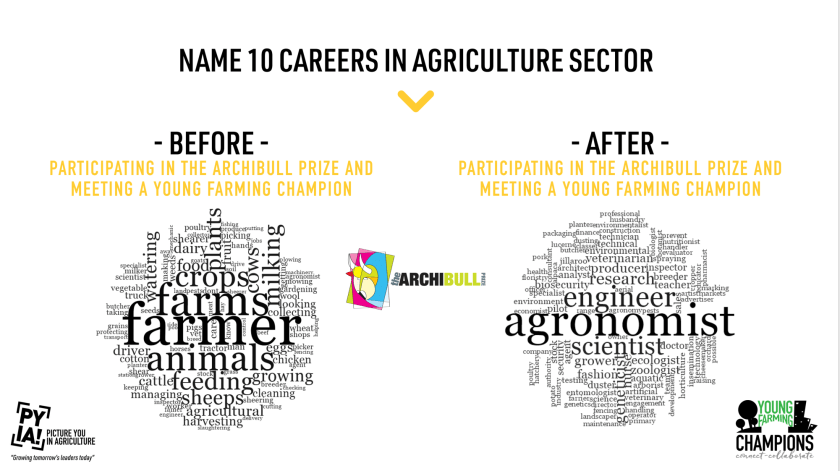
To open their eyes to the diversity of careers in the agriculture sector over the next three weeks our Kreative Koala kids will get the opportunity to meet 15 of our Young Farming Champions who will be zooming into their classrooms 

This slideshow requires JavaScript.

Knowing how much impact our Young Farming Champions have on young peoples perceptions of careers in agriculture I am looking forward to hearing the stories