Why Are We Fighting About Cows When the Real Problem is Us and Trust?

It’s the great cow controversy of 2024, and social media is on fire. This time, it’s not about dairy vs. oat milk or even beef vs. tofu. It’s about a tiny supplement called Bovaer, designed to reduce methane emissions from cattle, and the uproar is deafening.

On Facebook, it’s war. Some are decrying Bovaer as the latest corporate conspiracy, something Bill Gates would whip up in his private jet to poison our milk. Others see it as the saviour of the planet. But here’s what’s really happening: we’re missing the point entirely.

Let’s be honest. The problem isn’t cows. It’s us. The more people we have, the more food we need to produce. That means more cows, more methane, and, yes, more impact on the environment. But when a practical solution comes along to reduce that impact—something backed by a decade of research and field trials—we throw up our hands in shock. Why?

There’s a fundamental trust gap between the people making these solutions and the people consuming them. Scientists, bless their well-intentioned hearts, roll out their data and expect us to just get it. But most people don’t live in peer-reviewed journals. They live in real-world uncertainty, where the line between “helpful innovation” and “corporate takeover” feels razor-thin.

And social media isn’t helping. Instead of nuanced discussions, we’re fed bite-sized outrage. A single post about Bovaer can spiral into fearmongering faster than you can say “methane,” leaving consumers more sceptical than informed.

Take a moment to consider this: humans pop supplements every day with little to no evidence that they work. Collagen powders, detox teas, mystery vitamins—there’s a whole industry thriving on the “it can’t hurt, right?” mentality. But introduce a scientifically-proven supplement for cows, and suddenly we’re all chemical experts, clutching our organic milk bottles like lifelines.

The debate over Bovaer isn’t really about methane or cows. It’s about trust. Trust in the people who make our food. Trust in the researchers who develop solutions. And trust in each other to have real conversations instead of trading cheap shots online.

We can’t fix this problem by vilifying farmers who are trying to do the right thing, whether they’re grass-feeding their cows or testing methane-reducing additives. Nor can we solve it by blindly defending corporate-backed solutions without addressing consumer concerns.

Here’s the truth: no single fix is perfect. Grass-fed systems sequester carbon but still produce methane. Feedlot systems can use products like Bovaer but rely on grain, which has its own environmental cost. The real solution lies in recognising that everyone—farmers, scientists, and consumers—is on the same team. We all want sustainable food systems. We all want to protect the planet. We just need to stop fighting long enough to figure out how to get there.

So, next time you see a post about cows “killing the planet” or a product like Bovaer being the hero or villain of the story, pause. Ask questions. Demand transparency.

But don’t let fear or outrage guide the narrative. Because if we don’t tackle the root problem—how we produce and consume food—we’re just mooing in circles.

Will agriculture ever learn? How many own goals does it need to kick? Trust and Transparency is everything.

I rest my case 4 December 2024 SMH – Panic over additive in cattle feed sparks milk and meat furore 


#Bovaer #MethaneReduction #SustainableFarming #GrassFedBeef #DairyFarming #ClimateAction #FoodSecurity #LivestockSolutions #EnvironmentalImpact #ConsumerTrust

A Marketing Moo-vement in the Wrong Direction?

Cows are clever but kangaroos and wallabies are doing it in high heels and backwards

“Beef cattle produce 12 times more methane than kangaroos per kilo of meat, so they have a much bigger impact on the environment,” Professor Wilson said. Source 


While this graphic admirably attempts to shine a light on the often-overlooked virtues of livestock—turning food we can’t eat into protein—it somewhat misses the mark as a compelling piece of marketing. It’s a bit like trying to sell a car by saying, “It’s not a bicycle!” Yes, it’s technically true, but it’s not exactly the kind of rousing endorsement that wins over hearts and minds.

This blog post is part of a series on livestock industry marketing faux pas

The focus on how livestock make use of inedible materials, though an interesting fact, comes across as a bit defensive, as if the industry is constantly on trial, needing to justify its very existence. It’s as if livestock farming is nervously raising its hand in class to say, “But I’m useful, too!” Meanwhile, we could be highlighting the genuine, undeniable positives of animal agriculture—things like maintaining beautiful grasslands, sustaining rural communities, and producing some of the most nutritious food available.

This is a prime example of livestock marketing going udderly awry. The  reality is, comparing livestock to, say, herbivorous marsupials with their impressively low methane emissions might just backfire. Instead of putting livestock on the back foot, why not put them in the spotlight for the right reasons? Rather than harping on about what they do with inedible crops, we could be championing the innovation and sustainability practices within the industry that are shaping a better future.

So, instead of trotting out charts that feel like they’re pleading the case, perhaps it’s time for a more confident narrative—one that celebrates the irreplaceable role of livestock in a sustainable food system. After all, the best defence is often a good offence, especially when you’ve got a story worth telling.

#AgriMarketing #FarmFails #Sustainability #Livestock #FoodSystems #Moo-vement #EcoFriendly #Agriculture

Why Haven’t We Moved On? Rethinking How We Market the Beef Industry

This blog post is part of a series on livestock industry marketing faux pas

It’s often said that perception is reality, and nowhere is this more true than in how we market the beef industry.

The problem isn’t a lack of innovation—on the contrary, the industry is brimming with new technologies, sustainable practices, and forward-thinking approaches. Yet, when it comes to how we communicate these advancements, we often fall into the trap of focusing on the negatives or relying on sarcasm to make our point. It’s time to ask ourselves: why haven’t we moved on from this outdated model of communication?

The power of storytelling cannot be overstated, yet we often pay influencers and create memes about the beef industry often fail to inspire or even worse amplify misinformation. Why don’t we focus on  telling the stories of the farmers who are pioneers in sustainability? Or the ways in which the industry is contributing to local economies and communities? These are the stories that resonate with people and build a connection with the industry.

Positive storytelling has the potential to transform how the public views beef production. By continually sharing real, relatable stories of innovation and commitment to the environment, we can foster a more informed and supportive consumer base.

This social media campaign is a prime example of how well-intentioned efforts can miss the mark by coming across as defensive and somewhat condescending. While the influencer’s passion for defending the industry is evident, the approach taken in this campaign highlights several issues that undermine its effectiveness.

Relying on sarcasm DOES NOT win hearts and minds.

Where the campaign falls down

In this campaign, the tone dismisses legitimate concerns by implying that critics of the meat industry are either uninformed or overly simplistic in their thinking. Phrases like “pretending that cattle… spontaneously disappears from the universe” and “glancing around a fact” come across as particularly condescending. The complexities of issues such as water usage, greenhouse gas emissions, and nutrition require thoughtful discussion. Instead, the campaign resorts to sarcasm, which can be perceived as avoiding these nuances rather than engaging in a constructive dialogue.

The campaign also exemplifies how direct comparisons with other industries, such as rice production and almond milk, can shift the focus away from addressing the beef industry’s own challenges. This type of “whataboutism” can easily be seen as deflecting criticism rather than engaging with it. Additionally, by highlighting the negatives of other industries, the campaign risks alienating consumers who may support both the meat industry and these other sectors. This creates an “us vs. them” dynamic that is counterproductive to fostering a balanced and inclusive conversation about sustainability.

The campaign acknowledges some concerns about the meat industry, such as water use and climate change, but it quickly downplays these issues without providing substantial counter-evidence. This approach can reinforce negative perceptions by making the response seem defensive rather than transparent. Instead of focusing on the progress the Australian meat industry has made—such as in reducing emissions or improving sustainability—the campaign spends more time discrediting others. This is a missed opportunity to highlight positive aspects of the industry and build trust with the audience.

How can we do it better?

To make better use of an influencer in promoting the Australian meat industry, the messaging could have been more constructive and inclusive:

  1. Acknowledge Challenges: The influencer could have openly recognised the challenges and concerns related to meat production, such as water use and greenhouse gas emissions, and paired this with factual information about the industry’s efforts to address these issues.
  2. Focus on Positives: The campaign should have focused on the tangible improvements the industry has made, such as advances in sustainable farming practices, reductions in emissions, and contributions to nutrition, with clear, evidence-backed examples.
  3. Inform, Don’t Deflect: Rather than dismissing or downplaying concerns, the influencer’s platform should have been used to inform the audience on how the industry is actively working toward solutions, helping to build credibility and trust.
  4. Collaborative Tone: The tone of the campaign could have invited dialogue and collaboration rather than creating divisions, encouraging a broader conversation about how all industries can contribute to sustainability.

The beef industry is full of innovation, passion, and progress—but you wouldn’t always know it from the way it’s marketed. It’s time to move on from focusing on negatives and relying on sarcasm. Instead, let’s highlight the positives, embrace innovation, and tell the stories that matter. By doing so, we can reshape public perception and ensure that the industry’s true achievements are recognised and celebrated. It’s not just about changing the conversation—it’s about changing the way we connect with the world.

#SustainableAgriculture #BeefIndustry #PositiveChange #InnovationInFarming #SustainabilityMatters #EnvironmentalStewardship #AgricultureLeadership #TransparentFarming #MeatIndustry #GreenFarming


Have we taken our badge of honour too seriously – I am a farmer I wear many hats

I have been watching with great interest the agriculture sector call to arms to tighten our biosecurity protocols to keep Foot and Mouth Disease and Lumpy Skin Disease out of Australia

There are messaging experts all over of the world. I am yet to see my generation of agriculture embrace this area of expertise.

As an example the acronyms FMD and LSD mean very different things for non farmers

I was impressed that it was young people in agriculture who were early embracers of the possible confusion of the acronyms and cleverly drew it to the attention of others and the movement towards positive action messaging was quickly adopted.

As part of our school programs we engaged messaging expert Les Robinson to share with teachers and students best practice

We use campaigns like MLA’s Myth Busting Campaigns as examples of how NOT to do it

We invite schools to show us how we could do it better

Google Good Meat – wow two very different sites.

Good Meat

Good Meat

If the big idea is to stop the scroll and look up the website – mmmh   – I leave the thinking behind this strategy to some-one else

I do my bit to explain it here using what I have learnt from the messaging experts

Young people are so exciting – they are ACTIVE and they are AWARE. They have the capacity to create movements of change.

Lets give them agency and voice. Let them become the new experts

#CreatingABetterWorldTogether

and leave it to Cathy Wilcox to remind me humans are not an homogenous group

How can farmers support the image of Brand Agriculture

“Marketing is an activity that has exited for over 150 years. Marketing activities commenced when farmers and tradespeople had a surplus of goods and decided to barter these goods in exchange for an item or service provided by some-one else.”

Whilst farmers were at the forefront of marketing 150 years ago, today Agriculture has very limited opportunity and dollars to ensure its voice is heard and its products promoted in a way that farmers are comfortable with.  In fact a  few years ago I attended an event where I learnt from one of the presenters that the marketing team at Meat and Livestock Australia had less than 7% of the budget of the marketing team at MacDonalds

Pretty confident Dairy Australia would have similar constraints. Hence the questions about accountability of dollar spend value in this post by Marian MacDonald about the recent TV advertising campaign featuring water slide tester Deb Poole are very relevant

According to the post Deb has a huge responsibility on her shoulders. Marian asked the marketing team at Dairy Australia this question. “ What are the objectives of the campaign and who is the target audience? and the answer was

The overall marketing objectives are to:

  • Improve perceptions of dairy products and the industry
  • Decrease the percent of women who agree “I’m concerned dairy foods will increase my weight”
  • Increase the percent of women who agree “dairy foods are essential for good health and wellbeing”
  • Increase the percent of women who agree “I trust the dairy industry”
  • Increase proportion of women who make an effort to consume enough dairy.

Wow Deb Poole is a wonder woman if she can change all these perceptions.

As Marian quite rightly said the big question to ask before the campaign was even conceived  was ‘Is TV the best and most cost effective marketing and communications medium to achieve this?”  The big question now is –  “How do you effectively measure it ( and Deb) was?”

I did some large promotions with Dairy Farmers back when it was a farmer owned co-operative. Dairy Farmers employed consultant Ed Geldard to advise them on large community engagement projects and events. Ed certainly had lots of credibility in this space . Ed was the general manager of a sponsorship consultancy, the Sponsorship Unit, and helicopter company Aussie Copters. Ed consulted for a lot of big companies like Telstra and Channel 9 and even wrote books with his wife on the topic of how to get the best bang for your buck on advertising and sponsorship. I was a lucky girl I learnt a lot from Ed and I am even luckier still in that people have invested in programs I now help coordinate so our team can put into practice what I learnt.

One of the key things I learnt from Ed  was the importance of measuring success. As I had skin the game (I was one of the 1000 plus dairy farmers who owned Dairy Farmers) knowing how to measure success was very very important to me.

If you read Ed’s book The Sponsorship Manual you will see there is a list of 14 reasons why businesses invest in the marketing and communications space with ‘changing attitudes and behaviours’ at the top.

So obviously the first thing you have to know is “what people’s attitudes and behaviours are” and Dairy Australia has obviously done that research and have been very concerned about what they have learnt about the images and perceptions towards milk and its consumption of their most important customer – women. You can see from the research results outlined in Marian’s post why the Australian dairy industry  would be very keen to improve women’s images and perceptions of milk as a healthy product produced by people who care and can be trusted.

Evaluating success is also very expensive and if you want to do it well it can be 10% and upwards of your budget.

The Archibull Prize surveys the images and perceptions of many things about the industries that feed and clothe us.

Below is just a small survey example. As  you can see like Dairy Australia we also learnt from our entry surveys there is a great deal of room for improvement. You can also see  why we get very excited when we see the results of the program exit surveys.

Secondary students attitudes to farming

Changes in Attitudes

Farmers were at the forefront of marketing 150 years ago. Being at the forefront of marketing today is just as important as it was 150 years.

 Brands today are now creating value not just by the products or services they represent, but by the meanings they generate. People like to think that their purchases stand for something – consumers with a conscience are informed and discriminating and they will change their purchasing habits based on how they perceive the product. 

As the marketing gurus keep reminding us image and perception do matter and that means marketing is a shared responsibility between everyone in the supply chain. How do we as farmers ensure we are doing everything we can to support the image and perception of Brand Agriculture?

Wendell Berry

How do we as farmers improve our image of being good environmental citizens?  Reports like this show we are facing an uphill battle


Australian farmers advocacy groups have to change or die

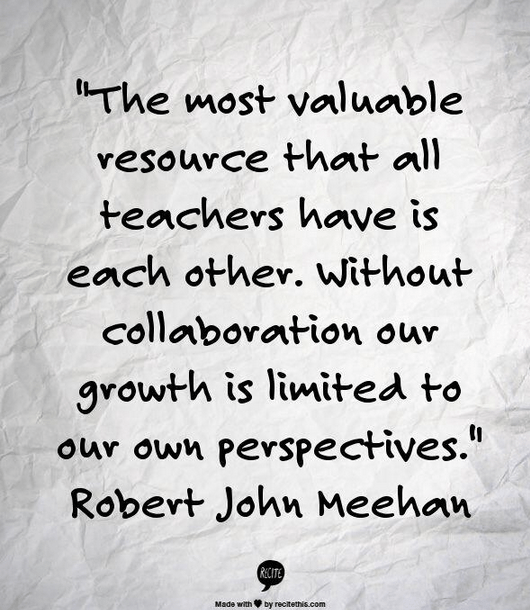
The most valuable resource farmers have is each other. Without collaboration our growth is limited to our own perspectives – appropriated from wise words from Robert John Meehan

Last Monday I attended a meeting in Sydney that brought around the table a group of people all determined to create a prosperous NSW dairy industry that had the capacity to grow and support that growth

I learnt things that scared me. Things like there are 20 plus organisations in NSW all trying to meet the needs of NSW dairy farmers

20 plus organisations that if we were all honest have very little idea what each other’s roles are and what each other does

Hopefully we haven’t got 20 plus organisations and individuals all vying for meetings with politicians and policy makers. But we wouldn’t know because in the main we don’t talk to each other.

I am confident the dairy industry isn’t alone

In fact the Australian Farm Institute is about to release its research into the efficacy of our state and national farming advocacy groups that decrees ‘Australian farmers’ advocacy groups have to change, or die’

This is a complex problem that trusts me get more complex when you put your hand up to take an active role in these state and national bodies.

I have spent a lot of time thinking about why they don’t work. Why I couldn’t be more effective. What I could do to be more effective.

But instead of beating myself up I am focusing on looking for models that work and I trying to work out why they work

The key thing that frustrated me as a farmer representative was how little I knew of what was happening in the background

For example the dairy industry has research, development and extension programs that focus on

1. Animals, Feed and the Environment see here

2. People and Business see here

In fact the dairy industry is renowned for the quality of its R&D but often struggles to get uptake of extension.

Now I found even at representative level there was no opportunity for me to get exposure to any of this R&D unless I asked for and had a meeting with a head of department at Dairy Australia, spent a lot of time on their website or stumbled across it because of my involvement elsewhere.

Because of my involvement on an NFF Blueprint Committee this document the Australian Dairy Industry Sustainability Framework came into my Inbox When I saw it I went WOW. Does a document get any more impressive than this? I doubt it

Now to me this Sustainability Framework is the dairy industry’s answer to Meat and Livestock Australia’s Target 100 initiative

What is bizarre is this. I am a dairy farmer who knew nothing about the Australian Dairy Industry Sustainability Framework yet I know a considerable amount about Target 100.

I think these two examples exemplify the problem on many levels and maybe the solution.

MLA has given their farmers ownership of Target 100. There are now over two hundred farmer stories

Two hundred plus farmer stories sharing the same key messages

Stories about farmers from right across Australia including young farmers like Jasmine Nixon , Tim Eyes , Hannah Barber, Josh Gilbert and Geoff Birchnell and Danille Fox

There are a number of other clever key marketing nuances that set the two programs apart.

Ultimately the answers to agriculture’s woes are sitting right in front of our noses.

The 21st century gives us the perfect communication tools.

All we have to do now is get on with it

Self-Promotion is not a dirty word.

Let’s celebrate success and share our stories and start talking to each other

CollaborationLike teachers none of us can afford to be an island 

How can we meet community expectations if we don’t know what they are

Following up on my post The real story about Animal Abuse I am in this space at the moment because I am on two industry peak body committees whose role is to set policy to help achieve the best outcomes for farm animal well-being in this country.   

Yogurt is made from happy heathly cows

The federal government Department of Agriculture Fisheries and Forestry (DAFF) is currently in the process of working with stakeholders to develop Australian Standards and Guidelines for Welfare of Livestock

In this case the stakeholders are

  • government and non-government organisations
  • veterinary and community groups
  • animal industries
  • animal welfare groups, and
  • farmers and stock handlers

The development process has recently undergone an independent review by Price Waterhouse Cooper (PwC) and they have released their findings which can be found here

The Business Plan for the development of Australian Standards and Guidelines for
Welfare of Livestock states the following as the objective of the Standards and Guidelines:

… the national livestock welfare standards, with complementary
guidelines, provide welfare outcomes that meet community and
international expectations and reflect Australia’s position as a leader in
modern, sustainable and scientifically-based welfare practice
.

This objective includes a requirement for the Standards and Guidelines to meet
community expectations and what the review has found is there is currently a relatively low understanding, or agreement, on what these expectations are.

This gap according to PwC is apparently contributing greatly to the problems of conflicts within the process. Without a strong statement of objective, each party involved in the process has their own benchmark of what the Standards should be seeking to achieve – a common complaint from Animal Welfare organisations is that the Standards are not sufficiently ambitious and do not ‘raise the bar’. Conversely, industry supports the establishment of processes which reflect practicalities of agricultural business.

According to PwC and I couldn’t agree more that what is needed is greater articulation and consideration of the broader community expectations in this area, which are likely to be something of a balance between these two polarised viewpoints.

PwC go on to say this identified gap in understanding of community expectations should be addressed through focused social science research. Outcomes from this research can then be balanced with industry input and scientific knowledge on animal welfare matters.

Hooray to that I say.  For too long government and the food supply chain, that is farmers right through to retailers have been second guessing consumer images and perceptions of modern farming practices and getting bogged down by lunatic fringe highly vocal agenda driven campaigns

I am pleased to report Dr Heather Bray see previous post and the team at Adelaide University had received funding through the Australian Research Council to do this absolutely pivotal social research.

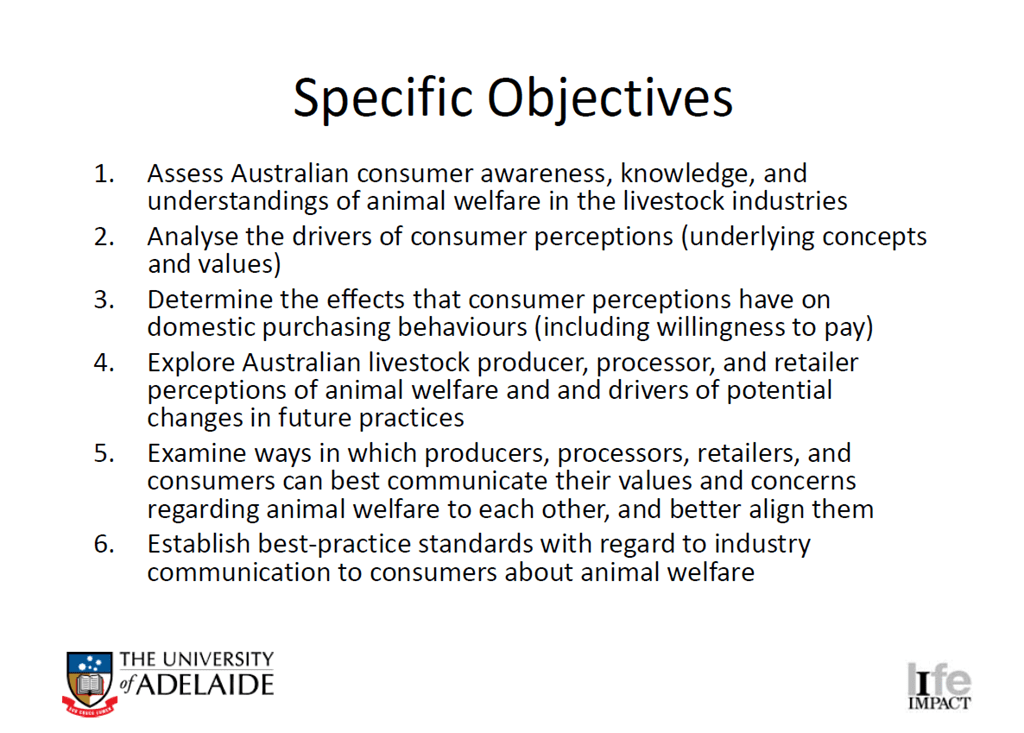
This ARC Linkage project LP 130100419 aims to

Porject Aims

and has the following specific objectives   

Objectives

with the following outcomes

Research from Translation

Some of the previous ARC Discovery Projects have used focus groups to explore consumer understandings of ‘food ethics’ and they found for example that categories (such as organic) are defined in various ways, if values are taken as key drivers of purchasing patterns.

So although ‘organic’ for example has a scientific definition, some consumers associate it primarily with nutrition, some with purity/natural products, some with sustainability, and some with elitism.

Hence as the research teams have found it is critical not just to ask what they think, but why they think that (associated values)

At an industry level I would also like to applaud the Sheep Meat Council and Meat and Livestock Australia for developing A producer’s guide to sheep husbandry practices which provides information from a range of research and on-farm experience that will enhance animal welfare and potentially improve production outcomes.

As NSW RSPCA Chief Inspector David O’Shannessy recently shared 99% of animal welfare issues are caused by ignorance not malice and the key to change is to raise awareness of, and commit to best practice education. Just like the community (over 60% of animal welfare complaints relate to companion dogs and horses) farmers often have wide ranging views on what is acceptable best practice

The Sheep Meat Council and MLA are setting the perfect example for industry by leading the way through education. Its is my understanding that the dairy industry in Western Australia is also heading down a similar path and I am very keen to hear from other livestock industries who are also moving in this direction.

It is pivotal that farmers have these resources available for their use and adaptation, and utilize numbers from credible sources in order to show consumers and animal welfare groups the true side of farming today.

It is also imperative that we communicate our commitment to do it better and better and encourage our farmers to reach out to their networks in local communities – business associates, neighbours, and friends to share our knowledge and set the record straight about our industry, our work, our goals and commitments, our challenges and our successes.

Doesn’t this gorgeous picture of sheep being moved to ‘higher ground” during the NSW flood sum it all up. Farmers do love and care for their animals  

890356-nsw-flooding

Great follow up blog by Milk Maid Marian One Woman’s Kindness is Another’s Cruelty

Why cant Agriculture fight the good fight together

I have found there are two main types of people in agriculture and this of course is generalisation

There are people who are focussed on doing the right thing and people who predominately want to do their own thing and of course there are some people who manage to get a nice balance between the two (most impressive).

I find this in our business. My husband and my son love farming, they like the solitude, they love their cows and they hate the politics. They just want to do their own thing and they worry about me and cant understand and hate the fact I put myself out there and ride the ridges and sometimes get shot out.

So I get this mindset and you wont change people like my husband and son but I cant forgive industry bodies who cant see why the big picture is so important. Who cant see why silo thinking is destroying agriculture

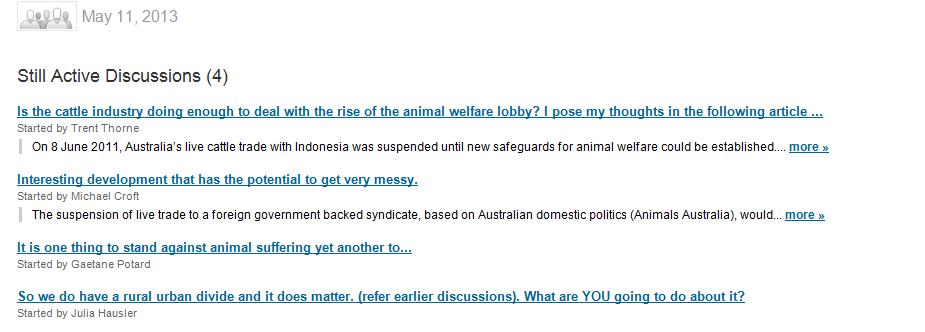
Recently I have become actively involved in the AgChatOZ LinkedIn discussion group and must admit I am fascinated by the two way conversations and other people opinions and most importantly the thought they have put into the solutions and what they think the solutions are. The current active discussions are

image

Julia Hausler posted this question this morning

So we do have a rural urban divide and it does matter. (refer earlier discussions). What are YOU going to do about it?

John Keily can back with

What am I going to do? Well, I’m going to ask you what you think of this ad

and I replied (BTW my previous comment on the ad here )

It generated this

Whilst the first video reached over 15 million people (compared to 35,000 for the spoof version ) and over $1Million was donated by RAMs to feed the poor together they highlight the polarising views in America

To me its imperative Agriculture doesn’t preach at people.  Charlie Arnot and his team are doing an awesome job of doing it the right way by providing farmers with the skills sets to tell their own story.

Australian farmers have a great story to tell and its time to say YES to the Australian Centre for Food Integrity so we know how to tell our story well. Not just for 90 seconds at the Superbowl. We want our story remembered everytime our consumers reach for a product on the supermarket shelf and take that little bit of extra time to make sure it was produced by an Aussie Farmer

What really makes me cranky is.  Why doesn’t  Australian agriculture do this together?

MLA through Target 100 is telling the story and very impressively on behalf of all cattle and sheep farmers.

AWI and Cotton Australia are working together to debunk the myth that cotton grows on sheep. See here for this great example

Dairy Australia on the other hand is spending $21 million plus on the Legendairy campaign  to tell dairy’s story

Yes your are right Dairy Australia

The Australian dairy industry has a magnificent and Legendairy™ tale to tell. This is an industry underpinned by some of the best people and practices in the world producing a truly amazing product. It defines the social fabric of many Australian agricultural regions and affects the lives of almost every Australian in some way.
The nation’s dairy industry is literally brimming with inspirational people and their stories — Legendairy™.

Yes and so do all  Australian farmers. Our dairy farmers rely on the grains industry, the vegetable industry, the cotton industry, the sugar industry, the list is endless. They rely on agriculture being dynamic, exciting, innovative and profitable.  Its not a competition about  which industry has the most impressive farmers.

Just imagine what we could achieve if Dairy Australia joined forces with MLA for example. I am an MLA levy payer as are all dairy farmers. MLA invited me to tell my story. I haven’t yet. I haven’t needed to – the beef farmers are doing on awesome job on my behalf. I salute them all.

Call to arms farmers. We can do our own thing but we cant afford to let industry do it in isolation. We must all ask the right questions and lobby hard for the greater good.  Its not just our future that depends on it. Australia’s health, wealth and happiness depends on it