Andrea and Mark Hannemann climate action farmers who are designing their own destiny

I love innovators, doers and people who are proud to share their story. Agriculture so needs more people who can combine all three.

One such person is the wonderful Andrea Hannemann who with husband Mark, farms on 1700 hectares in the Cleve region on the Eyre Peninsula in South Australia

‘We as farmers are always striving to do things better, improve efficiencies, increase yields, adopt the latest technology and maintain a healthy landscape, all to ensure our farming enterprise remains viable well into the future. This requires constant monitoring and the ability to adapt and change’. says Andrea

Andrea Hannemann

I first met Andrea when I joined the Climate Champions program and as regular readers  know the program itself has changed my life let alone what I have learnt from all awesome people involved in it

Climate Champions

Andrea to me is the quintessential quiet achiever.  Follower her twitter feed @andyhann1 and you will see what I mean. In a phenomenally short period of time, Andrea has built up a twitter network of thought leaders who ask the tough questions and challenge each other and the system

Andrea and Mark identified water security as one of the biggest threats to their farm’s sustainability and they weren’t going to sit around and wait for some-else to find the solution

‘The Eyre Peninsula is a huge area and we think it’s up to us as individual farmers to be self sufficient and create our own renewable, reliable and sustainable water supply.’

Andrea’s story* is a testament of what you can achieve when you take a great idea and put it into action…………..

Mark & I are 4th Generation farmers from the Cleve Hills on the Eyre Peninsula in South Australia. We are in the business of producing healthy food and fibre and we love what we to do.

Mark and Andrea Hannemann

We crop wheat, barley, peas, chickpeas, vetch and canola and run 900 Merino ewes & 900 cross bred lambs.

Misty Morn

Over the last 10 years we have found our weather patterns are definitely changing with more extremes of heat and cold and storms. And our rain events – that’s interesting in itself – we call them rain events now when we used to just call it rain.

We have catastrophic fire days now, and we’ve had some horrific bushfires here. The hot north winds are more harsh and frequent. In 2009 we had quite rigorous thunderstorms, with a lot of hail damage. I guess they’ve always happened but they are more concentrated and cause more damage than they did in the past. Everything seems to be a little bit more concentrated.

Our country here is very undulating with loam over clay soils. Historically the farming rotation used to be 2 years of pasture and sheep and then the third year we would plant a crop. During those 2 years where you had sheep running over your country, it would pack down like cement. As soon as you got a rain event it’d all run off and form gutters and cause substantial soil erosion.

To counter this our next step was to contour all our country. The contour banks gathered the water from the gullies into the dams and controlled the erosion, so we didn’t get gutters forming in our paddocks.

But it was not the answer. The contours created small lands, over-sowing and inefficiencies. They also hindered the introduction of auto steer and GPS technologies. Over the last 13 years we have adopted minimum-till practices with stubble retention and we direct drill straight into last year’s stubble

May 2010 092

We found we weren’t getting the water runoff we used to as the moisture was staying in the improved soil profile and so adopting minimum-till practices has enabled us to grow good crops on less rainfall, because of this improved soil moisture retention. This meant we didn’t t need the contour banks anymore and so we took  them all out.

Historically we’ve relied on 40 dams on the property for our water. We relied on those dams for our stock, our garden water and for spraying our crops. But we can’t rely on them anymore for stock. We’re just not getting the water into the dams. Over the last 3 or 4 years we’ve had some fairly dry years and we couldn’t rely on any of the dams.  On top of this the 40 old dams lost 2 metres of water through evaporation each year, coupled with soakage and seepage loss. When summer came and we really needed the water, they were usually just full of mud in the bottom, which also created a hazard to the stock as they came in and tried to drink.Our house dam has been there 100 years and it’s only ever been empty 4 times. And 3 of those were in about the last 7 years.

Is that climate change or the way we are farming now you ask?  Probably a bit of both

A lack of a “good quality water supply” for stock and farm use was identified to be the major challenge that would restrain our long term viability in agriculture.  We had little chance of securing a SA Water supply connection as we are on the far western end of the River Murray pipe system, which is already an over-allocated and depleted water source and is in very poor health. ‘The Eyre Peninsula is a huge area and we think it’s up to us as individual farmers to be self sufficient and create our own renewable, reliable and sustainable water supply.

We were carting water from 14 kilometres in a little truck all summer for stock. It was time consuming and expensive. We thought the best way forward was for us to be self sufficient.

We needed to change, we did not want to change our farming practices, so we had to change the way we collected the water. We have now developed a water-harvesting scheme which is, hopefully, going to satisfy our water needs for stock, for spraying and for domestic use.

We selected a site which is the highest point on our farm and we had some major earthworks done to prepare the catchment area, which is 80 X 40 metres. The catchment area gravitates down into a 3-metre deep holding dam which is 30 X 30 metres.Both the catchment and the dam are lined with 1-mm high-density polyethylene plastic.

It’s 98% efficient in catching water. For every millimetre of rain, we collect a litre of water per square metre. Even with a heavy dew, we’re collecting water. On our average rainfall, which is a bit over 400 mm a year, we should get 1.6 million litres of water, which is enough to run our property for a year. We’d probably be ok with even 300 mm. We’re still going to get 1.2 million litres of water because we’re not losing any through evaporation and soakage.

From the dam, water gravitates down to the house and throughout the entire property. On the way, we’ve got feeder troughs going off into every paddock. We’ve got a tank at the house into which we collect and use water for spraying, for our domestic use, for gardens, and for stock. From the house, we feed water to another block, which already had poly pipes on it. We just had to put troughs on them. Now our whole farm is fed by these feeder troughs. So this one dam has the potential to service our whole property, whereas before we were using 40 open dams.

IMG_2307

The Hannemanns’ lined catchment and dam before the floating cover was installed

The catchment area has to be lined if you want to get close to 100% runoff. The 1-mm polyethylene is reasonably stiff. We had to get FABTECH from Adelaide to weld it onsite. There’s $50,000 worth of plastic invested in the catchment and dam area.

The reason we lined the dam is mainly for quality of water and to minimise soakage. We use the water for spraying so we don’t want suspended clay particles in it. We don’t use it for drinking water, but the quality would be up to doing that if we wanted to. When the dam was full we installed a floating cover on the top at a cost of $10,000. That cut our evaporation losses by 100% making it a hugely efficient system.

October 2010 021

Dam at capacity, awaiting the installation of the floating cover The water is then gravity fed from the dam throughout the property via a pipe system, supplying water for the paddock troughs, which are only turned on as stock movements require.

With the cover now on the dam, the quality has improved even more. When you keep the sunlight off, you get no algae. And there’s no chemical seepage into it. It’s good quality water. Better than what we had before.

Oct Nov 2010 068

Floating cover installed – job finished! Because the water scheme is based on gravitation, there are no pumps involved. No working parts. It’s minimal maintenance. You go to a paddock and switch a trough on if you’ve got sheep in there. It’s so simple.

If it sounds exciting, it looks really ordinary. It’s a lot of black plastic and tyres!

When you bring it back to dollars and sense and return on investment carting water was costing us about $11,000 a year and it’s really unsustainable to cart water in a truck up a hill on a 30-km round trip. It was leaving a huge environmental footprint. We hated that. It was very inefficient and very time consuming.

This harvesting scheme is going to cost us about $100,000 so the payback period is 10 years. We feel we can’t afford not to do it. Our water security is good for the next 25 years; that’s how long the plastic lasts.

A video of the catchment during a thunderstorm can be viewed here

We would also like to go into the area of further improving our soil and improving our soil carbon. For every percent that you increase your soil carbon, per square metre, you can hold an extra 8 litres of water. That stored moisture is productivity and profitability. It’s also sustainability. So that’s something that we’d like to work on. However increasing soil carbon by 1% is not as easy as it might sound and so we’ve just got to take it a step at a time.

We manage our sheep numbers to coincide with rainfall events and availability of feed. For example if we have a really good rain event in March, we can sow some forage crops for the sheep.  If we get plenty of feed the we actually buy in more sheep. This means means the sheep had more cross-bred lambs which we can then feed on our crop stubble later this year. Farming sustainably is about wisely making the most of every opportunity

We make hay when the season’s good. If we have a lot of feed, we’ll cut that for hay and store it. We also store oats and barley seed for feed. We just do it year by year depending on what the year’s looking like.

Frost is a major issue in our region, but it’s pretty hard to plan for it. Different crops are flowering at different times and it depends on when you get hit.

Our crops do hang on here a little longer. We’d be 3 or 4 degrees colder through here on average than 10 or 20 kilometres away, so we’re always starting harvest a couple of weeks later than everyone else. Whether that’s a good or bad thing, it’s just a matter of timing with frost.

We do use different crop varieties that flower at different times. That lessens our risk. Of our 2 wheat varieties, one has a bit longer growing season, the other one is a bit shorter. So if one gets hit the other is spared. It’s like a hedge.

Mark Hannemann Checking wheat sample


Canola’s the same. We’ve had canola varieties with different growing seasons and one variety did get hit with frost, while the other one got through because it wasn’t flowering. So I guess that’s how we manage frost, and that’s about the best we can do. Because even if they forecast a frost there’s nothing you can do about it.

Green & Gold Canola

Paddock of Canola

Our hot north winds are getting more severe. Our crops were heat stressed two years in a row in September on Grand Final day. It knocked everybody’s yield around. It would be terrific if we had new and better varieties of crops that can withstand heat stress because I guess we’re going to have more of that.

We rely on the internet a lot now for our information to run our business so it’s really important. We need accurate forecasting, long term and short term. We need a seasonal forecast. But it needs to be accurate.

We rely on the seasonal forecasts, mainly at start of seeding. A few years ago we just about did our complete seeding dry, and that worked out well. We dealt with the weed issues later on, which was good but fairly expensive. In this country if you leave seeding until late it can get too wet, and if you’re well into the middle of July with your seeding program you have a fair yield penalty by leaving it that late. So we have made the decisions with the help of forecasts to go in early. We just have to deal with the weed issues later on.

Application of nitrogen is another thing we use forecasts for. If you want a rain event to wash some urea in, you’ve certainly got to rely on the forecasts for that. It helps us plan and gives us the opportunity to use our inputs as wisely as we can and hopefully increase our yields, our productivity and our profitability. With better forecasts you can move forward with more confidence and make those decisions that are so important to your business. So, accurate forecasts are really, really important to the viability of our business.

This is why Mark and I put our hands up to be Climate Champion farmers so we could share our highs and lows, the good and the bad and have the opportunity to feed information from farmers back to researchers about what they need to better manage risk on their properties

*Andrea wrote me a short version of her profile on the Climate Champions website but its too good a story to shorten so I have reprinted the majority of it for today’s post

Andrea and Mark are also 1 of 100 Farmers sharing their story on Target 100 here

They are also inspiring thousands of school children through this fabulous study guide

‘Water our most Precious Resource’ which you can download here 

Far too many untold stories

As my readers know I am a proud farmer,and that says a lot as the last thing I ever wanted to do was farm. But until I took on the role of sharing my farming story there was so much about farming beyond the dairy industry that I knew so little about. This is one of the reasons I became a Climate Champion which offered me a once in a lifetime opportunity to meet other like minded farmers from other industries and wow what an awakening and life changing experience that has been. It truly saddens me that I am the only dairy farmer that has been funded to have this opportunity

The National Farmers Federation has done a great job of helping me expand my knowledge by creating this great little resource – Farm Facts. Which the very clever Craig Taylor has summarised in what I believe tells the story innovatively, simply and succinctly.of how are farmers are doing a brilliant job of producing more from less (and that’s the key to successful sustainable  farming in this country) 


One of the things that still fascinates me is despite the vastness of our country just how little of it we can grow food on and how precious our natural resources are to sustain our standard of living now and in the future.

Yes we all know Australia is a pretty big place and what most of us don’t realise (including me until recently) is believe it or not over 60% of it is owned, managed and cared for by Australian farmers. To put this into perspective the white bits on the map below are the 40% of Australia that are classified as non agricultural land.Agricultural Land in Australia,

What’s even harder to believe is that only 6% of our agricultural land is suitable for growing food. This means our 134,000 farmers have a huge amount of land between them that doesn’t generate an income   It therefore goes without saying that Australian farmers are at the frontline of delivering environmental outcomes on behalf of the Australian community and they have a very big unpaid gardening/park keeping gig in any man’s language. I was as flabbergasted as most people when I found out these statistics that overall  94% of what farmers own and manage returns them no direct in your pocket benefit. As one of those farmers of which 50% of our farm is pristine rainforest it does however give great satisfaction and warms your heart to see it support diverse native vegetation and wildlife.

Cows on Picasso Laneway Marie Pier  0001

Can you just imagine what its like following the cows home through this – I can tell you its doesn’t get much better

However its very clear as many of our farmers readily admit they don’t have the skillsets nor the time to do all of this gardening alone. Luckily Australia has a whole team of very special professionals called natural resource managers who partner with farmers to help them get the best outcomes for Australia’s scare natural resources.

I wrote parts of this blog post to share this great story about the cotton industry and the exciting young people who eyes are being opened to just what some of our Champion Industries and their great farmers are achieving not just for themselves but for the wider community. You can read it here and be as proud as me   

YFC-02

Some of our great young farmers and natural resource managers who are working together to care for Australia’s scarce natural resources

The Food Machine

Fairfax environmental journalist Matt Cawood has been quoted as saying

“Agriculture is the most fundamental human activity. Without it, we don’t have cities, the Internet, cappuccino. And we are quickly realizing that how we conduct agriculture determines the health of the planet.”

Yesterday Bess Gairns sent me via twitter a link to this video The Food Machine with the comment ‘Amazing would love to see an Australian version’

The Food Machine

If you have time ( its runs for 50 minutes) do watch it. Its just mind blowing

Reflecting back on a previous post where I quoted Dr Jude Capper

“We have cars and airplanes. We have treatments for cancer and heart disease. Why is it that in every other business sector we celebrate increased efficiency and productivity thanks to new technology while when it comes to food more and more people want it done the old-fashioned way?”

The key thing The Food Machine reinforces to me is just how much as Matt Cawood reminds us we wouldn’t have if agriculture did business like it did in the 1950’s .

Surely it is time we let the Little Golden Book idea of farming go. It is imperative we acknowledge the world is a totally different place in 2013 than it was in the 1950’s and if we are going to get the best outcomes for our landscapes, waterways, our people and our animals and the economy  we have to start were we are at and learn from our mistakes and not focus on where we have been.

Matt Cawood sums it up perfectly for me  

“The future lies in developing technology and thinking that lessens our ecological footprint and respects the natural processes that underpin all life,”

UPDATE – once again twitter delivers ( Thank you Alison Fairleigh) we do have an Australian version thanks to ABC24 just loaded today.  BTW it only runs for 3.4 mins

Strangling the host

Here in paradise we have some superb, vulnerable and endangered species of native rainforest and woodland trees

There is nothing more spectacular than the strangler fig and this one is just divine.

Figtree Corner

In the rainforest the strangler fig germinates only in the branches of a host tree from the seed deposited by birds. Many roots are sent down and they gradually envelope and strangle the host tree leaving the fig in its place. The root structure of this one is quite compelling isn’t it

We have called this area you guessed it Figtree Corner. The cairn in the front is a tribute to Ron White one of our neighbours who was the chair of our Landcare group at the time of his passing. We are growing the native bleeding heart just in the front of the fig. It is one of Erin’s favourite trees.

Native bleeding heart

The strangler fig trees have adapted by starting their lives off as epiphytes, as at the ground level of the rainforest there is little light and a huge amount of competition for water and nutrients meaning that the majority of plants that start off on the ground have to adapt or die. The strangler fig has adapted by using other trees to get itself into the canopy where it is lighter.Strangler Fig Garvins
Once the strangler fig sprouts roots, it begins to use them to strangle the tree. as well as this it competes with the host tree for nutrients and water, then the strangler fig has a large growth spurt like this one in another spot on the farm, and once it begins to grow leaves they are very large and they tend to cover those of the host plant.

This Morton Bay fig recently lost one of its branches in a storm and it was splitting down the trunk. We thought it would die so one of the neighbours has inserted a “baby’ in a pouch on the trunk which seems to be doing very well

Figtrees  (4)

These trees are making me feel old I can remember when I first spotted the Figtree in the third picture and it was no more that a foot long. Scary 

Got my walking shoes on today

With my 2013 mission to live everyday as if it was your last, today Michael and I joined forces with our good friends Bev and Don to do the magnificent 6km section of the Kiama Coastal Walk from Kiama to Gerringong.

Loves Bay to Werri Beach Lagoon

Bev and Don are doing a walking holiday through Spain and Morocco later in the year so now looked like as good a time as any to get fit.

Loves Bay Kiama Coastal Walk

And before you knew it we were off – looking pretty confident at this stage considering all four of us had major surgery during the year

Kiama Coastal Walk  (2)

Our section of the walk took as on a ‘dramatic, coast-hugging route between Kiama Heights and Werri Lagoon’.

Kiama Coastal Walk  (5)

A popular spot for taking out the tinnie

Kiama Coastal Walk  (12)

Looking back to Kiama

Kiama Coastal Walk  (11)

The boys were keen to set the pace. Check out that work boot tan

Kiama Coastal Walk  (14)

Sadly there were far too many fisherman playing Russian Roulette on the rocks without lifejackets

Kiama Coastal Walk  (9)

and illegal squatters Tut tut

Kiama Coastal Walk  (18)

Kiama’s very own ‘apostle”

Kiama Coastal Walk  (19)

The Kiama coastline at 8am this morning – just divine

Michael Strong

says Michael

A little bit of history for you from the brochure ……….

“The Kiama area was once dominated by a vast rainforest known as the Long Brush. By the time the cedar-getters arrived in the Kiama area in 1815, the local Aboriginal people would have been aware of the impending changes to their way of life. Strange and deadly diseases would have already arrived and the spread of the destruction of the bushland was certainly feared.”

Kiama Coastal Walk  (16)

By the 1820’s Kiama was supplying 9/10ths of the Sydney Cedar Market. The round insert and reference on the map shows the tiny patch of coastline that still supports the rainforest. As you can see from the first picture the cows in the pastures along the coastline would welcome the return of some trees

“As land grants were taken up, the traditional owners were forced from their lands.”

Kiama Coastal Walk  (4)

“Before long the magnificent forests were cleared to provide timber for the new colony, expose the volcanic soils for crops such as potatoes and wheat, and clear the way for dairy farms”*

Kiama Co-op Butter Factory

Kiama Pioneer Butter Factory – Australia’s first Dairy CO-OP opened in 1869

At the half way mark we were all starting to feel pretty confident we were going to make it

Kiama Coastal Walk  (13)

Lynne and Michael Strong

Lynne and Michael looking confident

Bev and Don Coltman

as did Bev and Don

Kiama Coastal Walk  (20)

When you see these magnificent cliffs you know have made it and you can pat yourself on the back.

Werri Beach Lagoon

Before we knew it we had reached Werri Beach Lagoon

Werri Beach  (2)

and Kerrie was waiting to take us to breakfast

Sea Vista

and how lucky were we to avoid the queues we saw as we left ?

Breakfast at Sea Vista (1)

after tasting the food. (Which dairy farmer chews his nails????)

Breakfast at Sea Vista (2)

and drinking the milk shakes and lattes

Werri Beach

and taking in the view at the Sea Vista Cafe, Gerringong, we could understand why people were prepared to wait 

Such a special day, so many wonderful natural resources to appreciate and along the walk you may be reminded of days past,

or you may just enjoy the rolling hills, boulder beaches, sea caves, rock platforms and exposed cliffs that create the dramatic scenery and from May to June and September to November, the walk provides great vantage points for whale watching.

Michael Strong and Bev and Don Coltman

Well worth a visit we can guarantee you !!!!!!!

* BTW  You can read the history of dairying in the Illawarra here

New gig takes me to Western Australia and salt country

Part of my prize for winning the Bob Hawke Landcare Award is an honorary position on the Australian Landcare Council.  

I will be the first to admit winning Australia’s newest and most prestigious award for sustainable agriculture does not make me an expert on sustainable agriculture everywhere and paradise is a long way from the salt plains of WA for example and has very different issues and needs.

So when I found out this board gets out of the boardroom and visits every state and goes on farm ( commercial and lifestyle ) and talks to people and has two way conversations I knew this was for me  

My first board meeting was in Katanning the home of host  board member Ella Maesepp 

Ella is one of those people I labelled instantly as a “doer” First and foremost Ella is a broadacre farmer. She is the District Landcare Officer with the Katanning Land Conservation District Committee as well as the winner of the Environment Category of the 2004 Western Australia Youth Awards. 

What a champion she is. We took a small bus from Perth to Katanning with a number of stops along the way and Ella managed to arrange “great coffee” at just right moment everywhere we went. #legend    

In this part of the world salinity is a huge and heartbreaking problem.   

The first stop was Wagin the home of the Big Ram

IMG_7227

This ram certainly has some assets that make him stand out don’t you think?

IMG_7222 

Here is some background

We learnt about this region’s endangered species the Red Tailed Phascogale. We have a similar marsupial in Paradise that likes to eat my little chickens. So cute but very pesky   

The Red Tailed Phascogale

As you can see from this map this little guy was once quite prolific

The decline of the Red Tailed Phascogale 

We also got a first hand report on the community driven Wagin Food & Fibre Hub an excellent  example of the risk that comes with a pilot project, and the struggle for funders to balance innovation against that level of risk. ,

Our first farm stop was “Tamar” the property of Adrian and Jill Richardson. Jill also happens to work with Ella in the Landcare Office

Adrian Richardson sharing his story

Adrian Richardson sharing his story

Located 20kms northwest of Katanning, Tamar runs approximately 3000 Merinos and crops mainly oats, barley and wheat.IMG_7297

This property has got to be seen to be believed. Amazing. They work with the guru that is Ron Watkins.  

Ron Watkins runs “Payneham” farm, 15km north of Franklin in south western WA. Ron has looked beyond the traditional farming practices of the area, toward sustainable and integrated farming systems that work within the local ecosystem. He isolated several factors to address but gave priority to turning a salinity problem into an asset.

Ron set out to fully utilise the natural shape of his terrain and harvest surface and sub-surface water flow, aiming to store a large volume of water to combat waterlogging, salinity and erosion. He installed drains along the contours of the property, planted up to 1,000 trees per kilometre protected by electric fencing and fenced off all remnant bushland. Ron also had the foresight to include his neighbours in his projects early on, enabling a complete sub-catchment plan to be implemented. His initiatives have been such a success that he has around 60 farmers nationally seeking his advice on landcare best practice strategies.*

This is what using Ron Watkins farming principles looks like at Tamar

IMG_7309

Tamar Farm showed the benefit of whole-farm planning, and implementing according to the plan. IMG_7313

Then it was on to Ella’s farm – Dunbar Farm

IMG_7336

Ella and her husband David Potter. Firstly we were treated to a tour of Ella’s house which  was designed by Solar Dwelling and owner built between 2010 and 2012. The external walls are straw bale and with two stone mass thermal walls. All stone, timber and  straw have been sourced from the property  

Ella's house

A feature is the room with a view

Room with the view

accessed via this spiral staircase

Spiral staircase

From the distance the problems are well hidden by good farming practices.

DElla's property

Up close we saw the devastation caused by salinity and the use of saltbush to help manage the problem Saltbush.

At Dunbar Farm perennial pastures, mainly Lucerne and saltbush have been introduced to the system since 2005 with improvements in salinity and productivity. Tall what grass and puccinellia have since been added with 4 paddocks currently under a perennial phase, and 6 areas of saltbush have been established and fenced out from the paddocks since 2005

Ella's property2   

Next up was Craigmore Farms the property of Ian Knapp.

Craigmore Farms

an has also made extensive use of saltbush with excellent results as shown below. Craigmore had a large, flat expanse of bare, eroding, salt affected land.

Before 

Before

Following on from the success of saltbush planting of their neighbours ( Ella and David) next door at Dunbar a massive saltbush establishment program was undertaken in 2010 with 20,000 seedling alone planted in that year. Drainage lines were fenced off and planted with tress the following year.

After

After

The result has been a significant stabilisation of the soil, visible increase in grasses, and a massive splash of green across a once bare area as pictured above. Impressive isn’t it   

Adrian Richardson and Ian Knapp however have completely different views on trees, as a result of their different landcare approaches and financial capacity. As Ella commented when there are such different views locally, how do you communicate a shared view to the wider community? Methinks this is a fairly standard issue in all regions. Nine out of ten farmers learn from other farmers and as long as you have farmers like the Potters, the Knapps and the Richardsons prepared to open their doors and share their successes and failures progress will be made

All the farmers highlighted that it is relatively easy to get funding for trees & seedlings, but support for salt-tolerant species is hard to get.

This is because

a) salt tolerant are not the plants that grew there originally, but have to adapt because the soil & groundwater conditions have changed

b) there is often a production benefit to salt-tolerant species e.g. saltbush for grazing.

The majority of the content for above is part of a report by Ella on the field trip and there are at least two more blog posts in this report that I will leave for later. Both are an excellent opportunity for guest blogs posts from the key stakeholders who I know would do a very entertaining job

Ella made the following insightful observations on Drought-proofing

  • There is a marked contrast between the outcomes that the Drought Reform Pilot was aiming for and actual on-the-ground drought proofing. The Pilot was more concerned with economic / business planning and identifying viable alternatives for when the drought happens, than actually establishing whole-farm systems to prevent on-farm water shortages in the first place.
  • ‘Drought-proofing’ is a diverse term, and the language surrounding it needs to be better defined. It could be interpreted to mean ‘storing water’, or ‘providing sufficient water to crops & livestock’, or ‘building resilience into a farm business’ or many other things!
  • Full drought-proofing of a farm (improving water capture, store and use) costs big money! (and from me  in most cases the kitty just ain’t big enough when the community wants quality food and fibre at rock bottom prices) 

Priorities

  • Salinity still exists and is still a major issue that landholders are struggling with in WA!
  • Opportunities could be facilitated to share learnings regarding salinity adaptation and management across Australia eg WA, SA, Vic, NSW.
  • Solutions to problems are diverse and it is important that government / funders / policy makers are prescriptive.
  • Assessment panels etc need to be aware that their decisions affect people (not just projects) and therefore need make sure there is clear information as to why decisions are made, so volunteers et al understand and feel valued.

Well said Ella

* Extract from http://www.stepcommunication.com/images/pdfs/2004%20National%20Landcare%20Awards%20Booklet.pdf

Farmer Vicki Jones is living the dream

As promised in an earlier post I am now delighted to share Vicki Jones’ presentation from the Naturally Resourceful Conference in Mitchell this month.

I am confident Vicki’s story will move you just as much as it did me

IMG_7453

Hello my name is Vicki Jones……………………

Yes Jones one of the most common names in the phone book and I am married to a farmer, so I am Mrs Jones the farmer’s wife. I love what I do as a farmer’s wife and am very passionate about the land.

I suppose this came about at a very young age as I grew up on a cattle property on the western downs and even though I initially chose a different path, I have ended up just where I wanted to be. Lucky I guess or you could say well planned.

For the last couple of years as my involvement in the local land care group grew, I found myself volunteering to be the Chair of Mitchell & District Landcare. I did this because I believe in the foundations of land care and not only does it give us access to factors that affect our land scapes and environment it also allows us to be a part of a very important group of people who also have the same goals and love for their land.

For those of us who are fortunate to own a piece of this wonderful country, land care is a major part of our lives. Most of us get out of bed every morning with the intention to care for our land and to make it better for our future generation. We do this because we have too…. we are the ones with the money on the line, we can’t afford to get in wrong, we have to keep searching to make things better. It is easy for others who do not have any money on the line to have an opinion of what we as farmers need to do, or better still what not to do. However it is those of us that are the resourceful ones that are in the pilot seat of our future and chose this life because we can and it’s what we as people of this land do.


I will just give you a brief background. After leaving boarding school many years ago I went on to study dentistry and worked for Queensland Health on and off for 20 years having breaks for children and other pursuits. Dentistry is not all it’s cracked up to be as nobody likes you and it actually has the highest suicide rate of all professionals.

I did have a career, but as a wife and mother I always put my family first. For the first 10 years of our marriage we worked and lived on Bruce’s family dairy farm near Toowoomba and as seeming to be the theme of a couple of the speakers I heard yesterday, this was also not what it was cracked up to be.

Bruce had always wanted to have his own cattle property. It was his lifelong dream and as I had grown up on the land it soon became mine as well. After working on the family dairy farm for 15 years it became apparent that his dream was not going to happen unless he did it himself.

In one of a few heated discussions with Bruce’s parents, about our decision, we decided to walk away and make it on our own. Bruce’s dad told him that if he left the family farm to go west, that he would go broke.

So with these words from the man he admired most still ringing in his ears he packed up his young family and moved west. We bought all that we could afford, a small cattle property south west of Mitchell.

Just to give you an idea of the scale of how small. The surrounding properties and the regional average is about 20 – 60 thousand acres and we had purchased 2500 acres. So we don’t have a very big ship, but what we do have is our own boat and we can paddle it where ever we chose. And we chose to do the best with what we have. We could not buy this place and run it like both our fathers would have, because it was not big enough and it needed to pay for itself. If it was not profitable it just became and expensive place to live.

Oolandilla Park” was the beginning of our dream.  The only thing a bit tricky was that it only ran 80 head of cattle. The house had never been lived in, the fences / yards were all falling down and in terms of type of country, south of Mitchell was not a best street kind of suburb. As we found out from all of the comments from the locals. So we had some work to do. We were wondering what we can do to give us the biggest bang for our buck, as we realized that something had to change or our dream was not going to happen.

Slide1


With the help of MDLA, Queensland Murray Darling Catchment & farmbis my husband and I were fortunate enough to be involved in a pilot study  being participants in RCS’s Grazing For Profit School in early 2007. Sixteen local farming enterprises attended the course and up to 4 enterprises continued on the Graduate Link and Executive Link modules. We were privileged to have Terry McCosker as our facilitator. We took on this information with great enthusiasm and applied the grazing management principles immediately. This has since proven to not only change our business forever, but also our personal lives. It heightened our awareness of our environment and taught us to love our grasses just as much as our cows.

Slide3

When we started to measure our ground cover & grasses in March 2007 we found that we had 23% ground cover and 5% desirable grasses.

Slide4 

We immediately changed our grazing management to include rotational grazing of livestock, fenced off dams and boundary fenced for feral goats and kangaroos. Don’t get me wrong we still have some kangaroo’s, we just now have a sustainable level. Before they were in plague proportions and not very healthy. The rotational grazing has allowed us to rest each paddock for 12 months of the year every year.

Slide5

By changing our grazing management for only 2 years we had been able to increase our desired grasses by 1000% and the litter has improved by 350% giving us an overall ground cover now of 90%. While doing this we were also able to increase our livestock numbers by 325%.

Slide6

 After a while the wattle suckers and a few other species started to come up pretty thick and we became a bit concerned. We had neither the time nor the money to address them.

Slide7

We left them alone and concentrated on what we did want and not want we did not want and that was grass. As we were monitoring our grass we discovered that the suckers were changing. A scale/moth/grub or something was getting into them and they were slowly dying. Where the woody weeds had been the grass was higher and thicker.

We also noticed that due to the higher stock density that the cattle were now changing their diet to include some of the woody weeds. Things were happening that we know not much about, but however were changing for the good.

Slide8

During this time we have also been monitoring our microbial activity and water cycle.  The microbial activity and fungi within our soils are becoming more evident and the water cycle is increasing positively. This has allowed us to have an increase, in usable rainfall. Rather than having water running away, we now have moisture retention with less rainfall.

Slide10

Slide11

We are always on the lookout for worms and what’s happening in the soil and until this year we had not found any live worms, but when we did we celebrated. These things are the life blood to our soils and if we can have an increase in cattle numbers and have worms popping up in the paddock then we must be doing something right.

Map

Until a few weeks ago we did not know that this map existed. Our eldest son was doing an assignment at school and he found the map. As you can see it clearly shows what’s happening with the ground cover and the moisture retention.

Other things that we have done to increase our profitability have been courses such as

  • KLR Marketing
  • Low Stress Stock Handling
  • Advanced Stock Movement and Dog School

One of the courses that we have been attending for the past 4 years is the Livestock Movement course which introduces the working dog into the enterprise. We have learnt so much form these courses and implementing the strategies, has made such a difference to our bottom line that we have fallen in love with the working dog an now have our own registered stud “Dunyellan Working dogs” and have been training and breeding kelpies and collies for sale as  a hobby. Like we needed something else to do.

Slide12

So, the big question is, are we there yet, have we achieved our dream? Well not quite, with everything that we have implemented we are not quite viable, but are pretty close. We do realise that we need to have a larger scale, however with what we know now, we definitely know it’s not about how much land you own but what you can do with it.

Slide13

Bruce and I have always built our lives on goals and trying to work out in what direction we need to go next, which is the most beneficial to our lives and our business. We know that it does not matter where you are today in this state of your lives or business because that is only a temporary indicator.

This conference is helping to provide the tools for you to take the clay of your life in your hands and mould it to your dreams. Just like moulding real clay, it’s not about the results but the process of the moulding that counts. Look and speak in the direction that you want to be and never look back.


Without these opportunities and courses we would not be where we are today. So, thank-you to MDLA and QMDC for allowing us to move our business forward.


Young Eco Champion Erin Lake reports from Bush Blitz Hiltaba

You will remember the gorgeous Eco Warrior Erin Lake was lured to Canberra earlier in the year to take up a graduate position with Department of Agriculture, Fisheries and Forestry

clip_image004

Back here on the farm we all thought she would be gobbled up and spat out by the bureaucracy and how wrong we were. Erin has had a wonderful time. In fact she has now got a permanent position in Canberra and she couldn’t be happier. 

Last week she was lucky enough to be a part of the 16th Bush Blitz expedition to the Gawler Ranges in South Australia, as part of the Graduate program with the Department of Sustainability and Environment (SEWPaC) and today in her guest blog she shares many of the highlights from her trip 

November 2012 ………

The Hiltaba and Gawler Ranges Bush Blitz is the second for the year, and is being run for two weeks in total. My role was to help organise the field logistics, participant contracts and payments, and to assist as a field officer during the expedition. After months of planning and organisation we finally hit the road, and headed 8 hours north-west of Adelaide to a remote former sheep station in the Gawler Ranges!

clip_image006

Hiltaba Station is a 77,000 hectare property in South Australia’s Arid Zone

The Bush Blitz crew arrived at the station last Sunday, and have been helping the team of scientists settle into the campsite for two whole weeks of intensive survey work.

clip_image008

Luxury accommodation…. The Bush Blitz camp and shearer’s quarters

While this property has only recently been converted from a sheep station to a conservation reserve, many of the scientists have commented on the exceptional diversity of unique species and habitats that this majestic property contains within. Peter Lang from the SA Herbarium says that the Bluebush plains here at Hiltaba are a real treasure because they are often converted into cropping or grazing land making it difficult to find large areas in such good condition.

clip_image010

Expansive Bluebush Plains- in good nick


Creatures Great and Small discovered on Bush Blitz Hiltaba

Hiltaba Station’s location adjacent to the Gawler Ranges National Park significantly adds to its ecological value, because it provides another jigsaw piece within the East Meets West NatureLinks wildlife corridor.

Greg Johnston, a leading ecologist with the Nature Foundation of South Australia, says that the Hiltaba Bush Blitz provides a unique opportunity to gain a specialised understanding of the species occurring on the property, which will significantly assist in the management of the unique biodiversity of the area.

Greg has been an amazing host, and has been working alongside the scientists daily to assist them in gathering information that can then be used to feed back into the ongoing management of the property in the future. Here he is with vertebrate expert Dave Stemmer from the SA Museum- looking at the three different species of bat which had been collected that morning.


clip_image012

Greg Johnston (left) from the Nature Foundation SA and Dave Stemmer (right) from the SA Museum are very happy to be back in the field

clip_image014

Going batty- Four individuals of three different species in one morning! Not a bad start and really highlights the amount of diversity which occurs in the area- no wonder Greg and Dave have such happy faces!

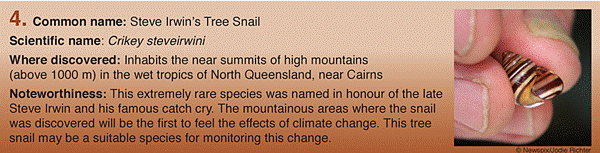
Mammals are only one part of the Bush Blitz experience however, and John Stanisic will tell you that it is always important to scratch the surface. John is one of Australia’s leading land snail experts and is known across the country as the Snail Whisperer. You may have heard of the Steve Irwin snail Crikey steveirwini ? Well it was John who named this snail after the late wildlife warrior, and he says that the story of the naming went around the world in 48 hours! That’s hot press for the slow moving sluggers!

clip_image016

According to John, Hiltaba station contains a very diverse range of snail species, supporting the full suite of species that occur in the region, and he has already found 10 different species.

While they are not usually recognised as particularly charismatic species, John explains that snails are crucial for local ecosystems and actually have quite interesting ecologies. They predominantly live in sheltered rock piles where there is a long-term stable moisture regime and have a number of strategies to improve their chance of survival. They are able to excrete what is called an ‘epiphragm’ which is a mucous shield, protecting them in times of drought. Snails are also important indicators of environmental health, and provide play a major role in breaking down organic material in the soil.

clip_image018

10 species of land snails have been found at Hiltaba- representing the full complement of the local fauna

John’s favourite snails are the large banded tree snails which are brilliantly coloured. There are around 30 different species and they live in the rainforest around Mackay and Proserpine.

Short range endemisim for snail species is very high as you can imagine, and some species are thought to only occur in ranges of around a couple of hectares, which means that whole species can be easily wiped out if proper precautionary measures aren’t taken to protect them. John’s findings at Hiltaba have added another 8 species to the current list of snails recorded for the Station.

Creepy crawlies are coaxed out of the woodwork at Hiltaba!

One of my less favourite things encountered on my Bush Blitz journey so far has been the spiders! The weather has been particularly good for spider hunting and luckily I had spider expert Barbara Baehr by my side to help me get around my arachnophobia while photographing them! Barbara is an absolute treasure to work with, and came all the way from Germany to study some of Australia’s most feared creatures.

clip_image020

Barbara is primarily interested in the Lycosidae family which are the wolf spiders, and Opopaea – the Goblin spiders. She has even named one after Sir David Attenborough and got to present a framed specimen to him earlier this year!

Barbara has spent many hours at Hiltaba sorting though the leaf litter looking for tiny spiders to observe under the microscope. She has also been probing sticks into giant holes in the ground and ‘tickling out’ enormous trap door spiders. She is able to catch them quite comfortably and refers to them as ‘darlings’- most certainly not the description I would give them…

clip_image022

Under the microscope- spiders are Barbara’s specialty

Who said that Fishing was bore-ing?

I was fortunate enough to go out for a day in the field collecting groundwater samples from a number of bores at Hiltaba Station, looking for tiny creatures which live in the groundwater. These ‘stygofauna’ could be tiny worms, molluscs or crustaceans and are usually blind. Stygofauna experts Remko Leijs and Rachel King showed us how to collect the samples and then we took them back to the lab to see if there were any stygofauna swimming around under the microscope. clip_image024

Fishing is not my strongpoint at the best of times- now i have been really put to the test- fishing for creatures that are millimetres in length!

The Hiltaba Bush Blitz has enabled the first stygofauna to be collected from the region, and so far Remko and Rachel have found worms and molluscs, meaning that the groundwater here is still in great condition.

Remko is also one of Australia’s top native bee experts, and was kind enough to show me some of the Hiltaba collections under the microscope.

So far, 26 species of native bees have been surveyed at Hiltaba from just one flowering Eucalypt, I had no idea that there were so many different species!

clip_image026

This native bee (I call him Lego man bee) has been mounted and will be taken back to the SA Museum

Remko explained that there is still not a great deal known about Australia’s native bees and there are not many people in Australia who are studying them. Bees are a difficult subject to study, as you can imagine it is very hard to count the populations. They are collected by sweeping a net over the flowering parts of trees and shrubs

clip_image028

It is tough being a bee sometimes…

There are 1500 species which have been described, however in the last 30 years there has been a lot of revisions and of the 500 that have been revised, around half have been found to be new species.

To revise a species, you need to first obtain the holotype- which is the specimen that was used to first describe a new species. Many of the holotypes are held by international museums such as the British Museum, so obtaining them adds a further level of complexity to an already complex process.

Remko’s favourite bee is the Blue Banded Bee as you can see it is very beautiful, and he has dedicated a lot of research into studying the populations. Remko is also looking into how Australia’s horticultural industry can utilise these native bees for pollination, rather than relying on importing foreign honey bees.

clip_image030

Bee-autiful, the Blue Banded Bee collected from Hiltaba Bush Blitz

A botanical paradise of flowers and fruits

I have been lucky enough to go out surveying with the Botanists from the South Australian Herbarium, doing a big loop around Hiltaba station’s north eastern corner. Peter Lang from the Herbarium is exceptionally knowledgeable about the local plants, having worked in the SA’s successful Biological Survey program -which set out to collect baseline data on the plant communities right across the state.

clip_image032

Peter Lang presses specimens for the Herbarium

Hugh Cross is a genetic biologist and is also a lichen and moss expert, and today we managed to collect a number of different species of lichen to be examined back in the lab. clip_image034

Hugh collecting lichen from this Western Myall (Acacia papyrocarpa) tree, which is probably around 200 years old

clip_image036

These colourful lichen specimens will go back to the lab for further analysis

Hugh and I also went looking for parasitic plant specimens such as Exocarpus and Santalum (Quandong). We collected a small sample from a number of individual trees in an area, and these samples will be taken back to the lab to test their DNA. Hugh and his associated back at the Herbarium are interested in finding out whether neighbouring parasitic trees are ‘clones’ and have the exact same DNA, or whether there is any genetic variation amongst the populations. Genetic analysis of plants and other tissues is certainly progressing full steam ahead. Hugh says that “Genetic analysis of the soil has allowed us to discover a wealth of hidden diversity beneath the ground”. It is a fascinating ecology that we usually just step over.

Juergen Kellermann also accompanied us on our botanical mission across Hiltaba. Originally from Germany, i was astounded by Juergen’s knowledge of Australian flora (not to mention his exceptional navigation skills!). He was very excited to find numerous populations of Stenanthemum arens, which is a member of the Rhamnaceae family of plants (the buckthorns).

The (Sten-an-them-um) is an endemic species and has only been found in areas around Hiltaba station. While it may not be much to look at, it is a very important indicator of the health of Hiltaba’s arid vegetation communities, showing us that they are able to provide refuge for a unique and diverse range of species.

clip_image038

Juergen gets a closer look at the Stenanthemum arens

clip_image040

One of my personal favourite botanical finds was this Ptilotus (tie- lotus) species, which is similar to the Foxtails that you would plant in your garden. Such beautiful colours and a very delicate flower.

Bush Blitz is a biodiversity discovery program between the Australian Government, BHP Billiton and Earthwatch Australia which aims to document the plants and animals across Australia’s National Reserve System.

clip_image002

How will I spend $50K

This week I was honoured and humbled to receive agriculture’s newest and most prestigious accolade The Bob Hawke Landcare Award in front of 850 people at the Sydney Convention Centre.


As you can see from this picture I was pretty chuffed

_DSC0096

Me with National Young Landcarer of the Year and Young Eco Champion Megan Rowlatt

_DSC0127

The adorable John Carter from South East Landcare and Megan

_DSC0070

It was Michael’s first outing since his big op and he was determined to be there and he was pretty pleased that he pulled that off

The award comes with two extraordinary opportunities. Firstly I will receive a prize of up to $50,000 to develop my  knowledge and skills in sustainable land management and secondly I will also have an honorary position on the Australian Landcare Council for a period of two years.

So you may ask what am going to do with $50K. Well firstly I wont be spending on me .

What I would like to do is look at change and what drives change and what hinders change. I would like to look at this from three different angles. Firstly young people, secondly my generation and thirdly farmers in my region. My project will be cross industry and I look forward to meeting lots of new and exciting and dynamic thought leaders and doers in the agrifood sector.

I firmly believe farmers of today do not have the opportunity to access and develop the skills sets that will allow them to survive and prosper in 21st. Firstly we have to acknowledge that producing great food and fibre just isn’t good enough any more. Secondly we have just got to get out there more and build relationships with all the key players and pivotally get intimate knowledge and understanding of how the supply chain works.

We have got to be able predict what our customers are thinking before they think it.  We have to be able to predict what the processors and manufacturers are thinking before think it and we have to be able to predict what the supermarkets are thinking before they think it. We have to be at least one step ahead of the curve every step of the way. This will require expertise farmers have not traditionally had access to and my commitment to my fellow farmers is to change this paradigm in my lifetime.

My vision is for an exciting, dynamic, innovative and PROFITABLE agrifood sector that our next generation best and brightest see as a  career of first choice. My mission is to turn my vision into everyone’s vision and this will require government, industry, the community and farmers, in fact the whole of supply chain working side by side.

First stop for me is the Bush Capital next Tuesday where I have meetings with policy and decision makers as well as the opportunity to attend the DAFF Youth in Ag Think Tank and hear what the bright young minds see as the way forward for agriculture in this country

Let me re-share this reflection with you on why I farm and why I live and breathe my mission

I am often asked why I like being a farmer and to be honest it was never my lifelong dream to farm. I farm today because the people I most care about in the world farm and they are in it for the long haul.

I grew up on a farm and even though I enjoyed being hands on in the day to day running of the farm and the lifestyle that comes with it the idea of being a farmer was most definitely not on my list of top 10 professions.

I have been back on the farm for ten years now and I will be the first to admit farming is a highly rewarding profession for a multitude of reasons.

Today I will list just a few

Firstly farmers are an essential service, they feed people and whether people admit it or not everybody wants to be needed.

Secondly farming today is a very risky business and I like the mental intensity, the constant review process, the drive to get up each day and do it better. The fulfilling challenge of balancing productivity, people, animals and the planet

Thirdly inspirational people farm. Feeding, clothing and housing the world now and in the next 50 years is going to require an extraordinary effort. This means we need extraordinary people to take up the challenge. When I work with inspirational people, they light my fire, feed my soul and challenge me to continue to strive to make a unique contribution to agriculture and the community.

and then there is this

the satisfaction you get when you have managed to farm in a way that balances the needs of the rainforest and the animals who live there

Lynne In The Rainforest

with farm productivity that allows you to supply 50,000 Australians daily with milk whilst at the same time ensuring your cows cow remain happy and healthy.

AYOF  (3)

the buzz you get when next gen share the passion and commitment

Nick  (3)

the fascination of watching generations of cows tread the same path each time they walk into the paddock

IMG_7331

the amusement you get when the cow who detours to the water trough

IMG_7312

then charges down the paddock like a teenager to ensure she doesn’t miss out on the sweetest grass

IMG_7319

and the special relationships you develop with the people and the animals in your team

Emma Fav  (7)

the satisfaction of working with next gen

View album

Why I farm

VIEW SLIDE SHOW

to turn this

Picasso Cows Arboretum 07 Aug IMGP2068

into this

reveg east laneway

then this

IMG_7383

and today

IMG_7384

Picasso Corner a triumph for community partnerships, biodiversity and the farm

and then the raw reality of watching the circle of life each day. When the chickens you nurtured  from eggs are killed and eaten by a goshawk (thanks to twitter verse for identifying my nasty bird) and wake up next morning and remember the chickens got three weeks of a great life they wouldn’t have had without you interfering with nature. Even if in the end it was nature who decided they would play a different role in the food chain .

IMG_7301

I love to farm because its real, there is a true sense of place and time. There is an purity and an innocence that comes with a respect of the land that feeds us that living and working in the city will never deliver.

BTW Thank you so much to everyone for the emails, phone calls, flowers, twitter you have all been so wonderful with messages of congratulations. Totally overwhelming xoxoxo

IMG_5662

Ag Youth Think Tank

I am looking forward to attending this event next week immensely. All those bright young minds with a positive vision for the agrifood sector.

Ag Think Tank

Taking of bright young minds how proud was I too be sitting next to the National Young Landcarer of the Year winner at last nights award ceremony.

What an absolute angel Megan Rowlatt is and how exciting is it to have her as part of our team of Young Eco Champions . You can read her story and be inspired here

Megan Rowlatt 

Megan with her award at the NSW Landcare Awards