Show me the love

Did you know that one teaspoon of healthy carbon-rich soil can contain almost as many organisms as there are people on the planet, that is, close to 7 billion living things – and a greater diversity of life than the Amazonian rainforest.

At Clover Hill Dairies our soil organic carbon varies from 5.5% to 12%. Now for anyone not au fait with soil organic carbon stats I can assure you that’s damned impressive and I am very proud to share this with you. I am even more proud to tell you that extensive soil carbon tests on many dairy farms in our region show similar results. That’s a lot of living organisms our regional dairy farm soils are proudly feeding and supporting.

Why am I telling you this?

Because Coles uses it marketing power and financial might to run loss leader marketing strategies with our Aussie farmer’s produce – like milk.  Marketing campaigns that give Australians the impression they are the reason for cheap groceries in this country when its our farmers who should be getting the credit for this

This behaviour is crippling NSW dairy farmers. The destructive pricing policies just have to stop because it doesn’t stop with our dairy farmers – it is undermining the financial viability of our great Aussie farmers.

I don’t have millions of dollars to spend in TV advertising campaigns to right this wrong. In fact my business like all Dairy Farmers Milk Supply Coop and Lion suppliers will take a heavy battering this year from the fallout from these Coles destructive pricing policies

But I do have voice and I have taken a pledge to get out there and tell every single Australian the real story behind food at rock bottom prices in this country and why they should be proud and loud of our Aussie farmers

This week I am speaking at ABARES in Bega. Since I first put forward the title of my presentation a lot has changed in the NSW dairy industry and the new title “Show me the Love” more reflects the need for everyone to think differently about the way farmers are embraced in this country

By the end of my talk I want nothing less than a pledge from every single person in the room to use their  LOVE to wake up Australia and get them behind our farmers!!!!

What do you reckon? Can I pull it off?

Show me the Love

 She certainly hopes I can because her future depends on it. 

This is the real story Coles

One thing that really saddens me about the current dire state Australian dairy farming families are finding themselves in, is their inability to tell the real story

With 2011-12 pre-tax earnings to $1.356 billion Coles can afford multi million dollar campaigns that spruik they are ones delivering cheap groceries to Australian families.

That is absolute rubbish. Its Australian farmers who are producing high quality, nutritious food for Australian families at the lowest prices as a percentage of income never before seen in this country.

Yes again the statistics tell the real story.   Food is less 10% of income in this country.   That is 80% lower than it was in the 1900’s.

Its a beautiful thing really that farmers get up every day to do this. They don’t demand  $15 million dollar salaries like Ian McLeod the CEO of Coles.

Our farmers look after over 60% of Australia’s land and yet only 6% of that land is arable and only half again is suitable for growing crops.

Not much is it. We have such a big country and a 5.7% arable land. That’s almost half the world average.  We have so much to lose if we starve our dairy farmers and sadly Coles that is effectively what you are doing

That’s a whopping 54% of the land they just look after so the rest of us can have the clean water and those amazing landscapes we too often take for granted.

AYOF  (6)

Even more amazing Australian farmers on average feed 600 people that’s 580 more people each than our farmers did in 1950.

I can guarantee this, because I know, because I am Australian farmer too, that if I can convince Coles to stop using milk as a loss leader and my processor can make enough money so it can flow down the supply chain to my family farm,  my family will be spending any excess dollars in our pockets on our cows and those beautiful landscapes that we so proudly look after. Maybe Coles there might even be a little bit left over for a bonus for our dedicated staff

IMG_3780 C

This is what is threatened Coles –  jobs of wonderful Australians like Louise

What I can assure you is we wont be spending it on huge self serving advertising campaigns and destructive pricing policies that walk over Australian farming families to put mega profits in the till and pay huge huge salaries to CEO’s

IMG_4269

This is what’s is threatened Coles – the cows and Australia’s beautiful landscapes

This comment from Ian Verrender in Business Today SMH August 30th 2012

Crying over Spilt Milk

Tree Huggers Unite

Our guest blogger today is the gorgeous Megan Rowlatt who is a finalist in the National Young Landcare Leader Award and a Young Eco Champion and part of the Clover Hill Dairies eco team .  

Hi my name is Megan Rowlatt, and I hug trees

Profile Pic eroo

Jamberoo Tree Hug


No really. I do. All the time. See…

RNP tree hug

Royal National Park Tree Hug

Positano italy tree hug

  Positano Italy Tree Hug

Grand Canyon tree hug

Grand Canyon USA Tree Hug

Growing up in the NSW coastal town of Corrimal with my mum, dad and younger brother, I had a wholesome childhood. Playing with other kids in our street until the street lights came on, climbing trees, playing in the bush along the foothills of the Illawarra escarpment after school, visiting local swimming holes in the national park, and with regular camping trips and family holidays to a range of destinations, this set the foundations for a keen sense of adventure, a desire to travel the world, and a love of our natural environment.

.Nan and pop from my dad’s side resided in a beautiful little country town called Crabbes Creek on the north coast of NSW. I spent many of my first years in the crystal clear creeks with my dad and our family dog and over the years developed an emotional connection to the landscape, particularly rainforests and fresh water bodies. I’m a sucker for a rope swing and a swimming hole.

Megan and Dad

1 year old me and my dad in Crabbes Creek, NSW.

Growing up I was a keen bushwalker and still am. I love climbing things, especially mountains (even though I am secretly a little bit scared of heights. But don’t tell anyone. I like to look tough).

Path of the Gods, Amalfi Coast – Italy Austrian Alps Royal National Park


Kosciusko National Park NSW (me and my bro), Whistler Mountain Canada, Füssen – Germany

I’ve travelled the world (but not nearly enough of it) and love learning about other cultures, exploring new environments and letting my mind flow over the possibilities of where life will take me next. I love laughing, and I mean laughing hard, and I always surround myself with people who make me smile. But I always come home. There really is no place like home and travelling abroad and living away for a period of time helped to develop a deep appreciation of just how amazing our country is. Sometimes I am so awe-struck by the beauty of our landscape it gives me goose bumps. And when you love something so much and want to make sure it’s there for future generations to enjoy, you get involved.

My home…

My favourite swimming hole, Royal National Park

Megan (4)Megan (6)


Megan (1)

Exploring the creek line, Royal National Park

My home (7)Lagoon


My local beach at sunset, and local lagoon North Wollongong, NSW


My home (4)

My bike 


My home (8)

And this is the view I am greeted with every time I come home from traveling.

After finishing high school I decided that I wanted to complete a degree in primary teaching figuring the lengthy school holidays would satisfy my desire to travel and allow more flexibility in the amount of time I could take off, but soon after commencing a Bachelor of Education degree I developed a love affair with my science electives. Through my first year of study I was so torn, I was spending more time with my two environmental science electives than my education subjects and things were getting out of control. After breaking down in tears to my dad one night crying “I don’t want to be a primary teacher anymore I want to be an environmental scientist (insert sooky stressed face)” he looked at me and plainly said “why are you crying you weirdo? If that’s what will make you happy, do it” and so I did, and immediately made the leap into Bachelor of Environmental Science degree’s arms at the University of Wollongong. (See ya education, you just weren’t the right one for me).

Having spent all of my life growing up in the Illawarra I began to get itchy feet and was craving a change of scenery so I moved to the Gold Coast in 2003 and transferred to a Bachelor of Science in Ecotourism. Working with people has always been in my nature, I spent many years working in bars and hospitality. Interacting and meeting new people was the biggest attraction for me in this industry so it was only natural that I would enjoy studying a degree which offered opportunities for me to explore the tourism industry as well as develop skills and knowledge in environmental science.

After spending four years away from home and taking advantage of the beautiful warm weather QLD has to offer, I began to miss our coast line (seriously, we really do have the best coastline in the world).

My home (3)

See. It’s pretty amazing. (Me and my best friend)

I returned to Wollongong and was immediately employed as a casual Visitor Services Officer with NPWS working at Royal National Park. Being casual, I had some spare time and I wanted to continue to develop my knowledge around natural resource management (NRM), so I began to volunteer with Conservation Volunteers Australia (CVA) where I started to really become aware of regional environmental issues. A position as Landcare Community Support Officer came up during my time as a volunteer with CVA. Looking at the selection criteria I didn’t think I had a chance but I applied anyway. The next day I had an interview and the day after that I was employed! Almost five years on, I am still loving the role.

Funded by Southern Rivers Catchment Management Authority and hosted by Conservation Volunteers Australia, as the Landcare Community Support Officer for the Illawarra region, my role is to assist Landcare volunteers, private landholders and farmers, as well as the wider community to develop skills and knowledge around natural resource management. This includes delivering training to build capacity of volunteers and individuals working in natural areas to carry out quality on-ground activities, engaging new volunteers into Landcare, managing and distributing online resources through newsletters, social media and a range of websites, and applying for a variety of grants to carry out environmental projects in the Illawarra region.

This job couldn’t be more perfect for me. I get to travel around the region and meet and work with loads of wonderful people. I love my volunteers and the groups I get to work with, they are just beautiful. I also am fortunate enough to be able to travel around the state for meetings and forums where I have an opportunity to share my experiences and be inspired by other NRM professionals and volunteers. I find managing online resources and developing resources such as newsletters satisfying as I am able to apply my own creative flair to these products.

Some of the places I get to see for work…

Bermagui River

Bermagui River at sunset NSW

Little Blowhole

Little Blowhole, Kiama NSW

Dapto

Albion Park NSW

But after attending my very first state Landcare forum in Queanbeyan I was surprised to learn that there was a real lack of young people in the Landcare movement. Many existing groups were of retirement age and no significant new recruitment was occurring. So I started to question why this was the case and why I had been attracted to volunteering and what was lacking that was deterring younger people from joining.


In 2009 I set up Illawarra Youth Landcare and run the group in my own time. Illawarra Youth Landcare is a Landcare group exclusive for young people aged between late teens to early thirties. We travel around once a month and visit an existing Landcare or Bushcare group in the Illawarra and assist them with their on-ground work. This gives the host group an opportunity to share their knowledge and skills with a younger generation and volunteers are able to explore the region and develop awareness about the environmental management issues we are facing. In addition to local projects I also organise overnight expeditions to other parts of the state. We partner up with other organisations and look at what other environmental issues persist beyond the Illawarra. These trips allow for volunteers to bond and develop friendships while giving something back to the environment.

To date we have a membership of over 70 people and over 120 followers on Facebook. Volunteers come from all sorts of backgrounds and are motivated for all different reasons to volunteer with the group. The key is flexibility, variety and opportunity for a fun social experience. It’s all about having a good time because at the end of the day, if it’s not enjoyable people are not going to become involved. I wouldn’t. Landcare is just as much about the people as it is the environment, and gen Y are generally time-poor and prioritise study, career and social commitments. So it’s difficult to gain any long term commitment from volunteers of this demographic. So I simply try to cater to this.

Over the last few years we’ve been involved in some amazing projects, a highlight for me was the Hawkesbury Source to Sea paddle we did with Willow Warriors in 2010. On this extremely hot (43 degrees in fact) weekend, we paddled along the Colo River working with a range of different Landcare and Bushcare groups. The weekend was jam packed full of swimming, kayaking, more swimming, rope swings, BBQs and a few beers (which I also love), fishing and oh yeah, some bush regeneration and a whole lot of laughing!

Here’s a short video of our adventures so far…


In 2011 I was awarded the Be Natural Young Landcare Leader award for NSW and am now a finalist in the National Landcare Awards as the NSW representative under this category. This is a huge achievement and being nominated means a lot. But living in a country as beautiful and diverse as ours, I could never stand back and not be involved in making it a better place for future generations to enjoy the way I did.

You can check out more about Illawarra Youth Landcare at www.illawarrayouthlandcare.com.au

Following in their footsteps

Excitingly the recent State of the Environment report has show  Australian farmers have made some major inroads in their farm environmental stewardship outcomes through a strong commitment to Landcare principals   

Most of Australia’s land environment is managed by one of three groups: state and territory agencies responsible for public land of various tenures, family and corporate agricultural and pastoral businesses, and Indigenous Australians.

The effectiveness of management has improved for most land uses, particularly those that are most intensive. While land–management practices have improved during the past few decades, in agricultural systems the loss of soil carbon, and soil acidification and erosion, are problematic and may have major impacts on production.

However, there is a serious gap in both the professional and the technical capacity necessary for effective land management. This gap will increase and its consequences become more acute as we face the challenges that climate change will bring to land environmental values and production systems.

Obviously if our farmers are going to achieve the best environmental outcomes they must have access to the best advice and have the opportunity to work side by side with natural resource management professionals  With this in my mind Art4Agriculture have accessed Caring for our Country funding to role out the Young Eco Champion program for 2012/13 This program will train a team of 5 young natural resource management professionals from Southern Rivers region of NSW. They will be trained to develop leadership and communication skills and become local faces of sustainable primary production and natural resource management. See Erin Lake our 2011 Young Eco Champion in action here

Eco Champions will work with Young Farmer Champions to present Archibull Prize activities in 15 schools throughout the region using a range of authentic and contemporary learning tools that allow young people to explore the economic, environmental and social challenges of sustainable agriculture and biodiversity conservation activities through the ‘Archibull Prize‘ competition.

Today our guest blogger is Heather Gow-Carey one of our exciting Young Eco Champions


Here is Heather’s story ………………….

My name is Heather Gow-Carey. I am 22 years old and am currently undertaking honours in my fourth and final year of an International Bachelor of Science (Geoscience) at the University of Wollongong.

Photo 1

Me

I grew up in the rural community at Dignams Creek on the Far South Coast of NSW. Environmental and natural resource management has always played a huge part of my life. The influence of my parents’ professions in the direction of my educational career has subconsciously shaped my decisions and their support has been unwavering at every stage of my development.

Photo 2

Helping out tree planting on the Hawkesbury River when I was just learning to walk.

I was born in Western Sydney but moved to the South Coast with my parents when I was two years old. They were looking to get away from the city and pursue their goals in setting up South Coast Flora, a native bushfood nursery. It is this specialised plant propagation that first introduced me to the theories behind environmental management. As long as I can remember I have been helping out in the nursery, going to markets and assisting mum out in her botanical pursuits collecting seeds and cuttings to be used in the nursery.

Photo 3

 Out collecting seeds with Mum.

My father was involved in the National Parks and Wildlife Service for a number of years and now works as the Landcare Community Support Officer throughout the Eurobodalla Shire. Hence my weekends as a youngster were filled with farm visits, tree plantings, weed control and numerous conferences and meetings. Luckily I had my younger brother to have tree planting competitions and someone to hang out with when dad had to attend to business matters. From both of my parents I have developed a love and a respect for the environment that I value immensely. It has shaped my love for the outdoors and even though I have had to move away to attend uni, I love going back home whenever I can.

Photo 4

 Playing in Dignams Creek when I was little.

About 15 minutes away is the closest town, Cobargo. It is a small town that has earnt the name of the ‘working village’. There are around 500 residents if you include the many farms around the area and there is a very strong sense of community, with all of the locals willing to pitch in to help each other out. I was part of the swimming club, soccer club, rugby club and scout group, as well as always exhibited and volunteered for the annual Cobargo Show. The show was and still is, one of the highlights of the Cobargo calendar. Even though it is such a small town, the show always draws large crowds in competitors, exhibitors and visitors and is well known as a quality agricultural show. There were several years where I made it my goal to enter every youth section in the pavilion, and even many of the open sections. When I was about 12, a prize was introduced for the junior exhibitor with the highest overall point-score, so I busied myself making arts, crafts, jams, baking, growing fruit and veggies, even entered some prime compost to take out the top prize!

Photo 5

The Cobargo main street.

One of my other interests is art. When I was little I wanted to grow up to be an artist, but soon learnt that most artists don’t get rich and famous until they are dead! So I had to rethink my career ideas. I was lucky enough to be involved in the Jindabyne Sculpture by the Lake exhibition – a competition for local artists held each Easter Long Weekend and with  from my art teacher I first entered at the age of 14.

I had always felt very strongly about using water responsibly and hence, I made a giant plug that floated out in the middle of the lake to inform people of my water-saving message. This was a great opportunity to raise awareness about the scarcity of water and the fact that we all rely on it so much, and yet we have so little that is actually able to be consumed.

My community involvement continued throughout high school, being involved in several sporting groups, community groups, the Rural Volunteer Bushfire Service and more Landcare activities. There was hardly a weekend or week night spare in my schedule! I was recognised for my efforts on Australia Day 2009, being awarded the Narooma Young Citizen of the Year.

Photo 6

After being awarded Young Citizen of the Year.

My HSC helped to shape what I chose to study and the last three and a half years of university really have taught me so much about the different areas of physical geography, human geography and the ways in which people interact with their environments. I have all of the theory behind me; I just need to put my ideas into practice.

Even though I am not from a farm in the traditional sense, I feel as though my upbringing really has shaped the person that I am, and what I would like to achieve out of life. Through this program I hope that I can encourage and support young Australians, and especially those in rural areas, to become involved in natural resource management and sustainable agriculture.

Wow we looking forward to working with young lady as you can imagine

The Young Farming Champions program is funded through the Australian Government’s Caring for our Country program. Art4agriculture thanks you for believing in us  

c4oc-pos

Friend or Foe

In our region almost 90% of prime agricultural land is owned by lifestyle farmers. They represent a major and growing sector in the Australian rural landscape and now play a critical role in the protection of Australia’s natural resources.

The-Farmers-hat-

Lifestyle farmers have diverse views, drivers and values. Many are new entrants to farming with little or no background in agriculture, and their knowledge of land management and agriculture tends to be poor. Their local knowledge is also limited and they lack the practical or tacit knowledge that larger farmers have such as good agronomic knowledge, identifying soil types and weeds, applying fertilisers or herbicides, building fences, operating machinery or vaccinating cattle.

Growing concern has been raised over the level of knowledge and skills within the lifestyle farm sector, and the ability of these farmers to manage their property in an ecologically sustainable fashion.

Depending on your point of view and who you mix with lifestyle farmers could be viewed as potential threats or possible allies for maintaining healthy, viable landscapes. I tend to mix with the one’s who care about Australia’s natural resources with a fervent passion and take every opportunity to up skill

In our region we are lucky enough to have the unique personality that is Richard Scarborough. Richard is a knowledge hub on all things natural resource management like no other and he takes every opportunity to share his vast expertise with those who want to learn and there are plenty of lifestyle farmers in our region who want to learn.

IMG_2943

Richard Scarborough at Clover Hill sharing his knowledge of the pros and cons for planting wildlife corridors.

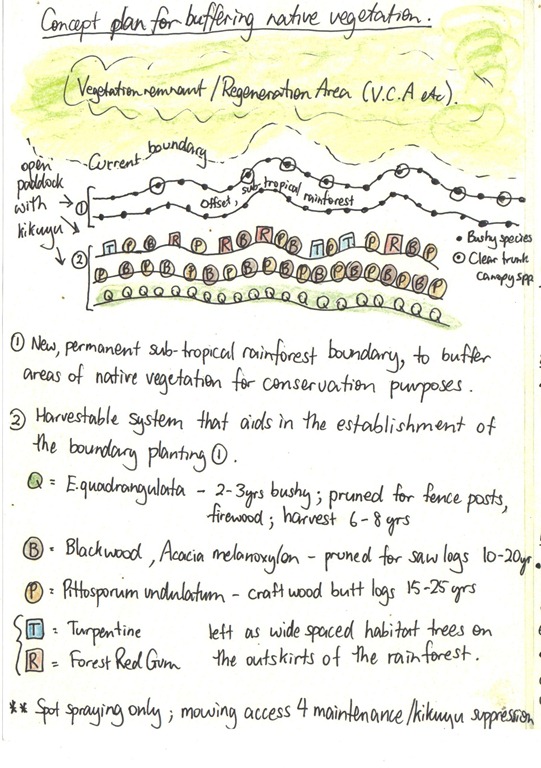
Richard has drawn this diagram to show us the SMART way to plant trees to achieve the best outcomes for the landscape, the native animals and the farm animals.

Concept Plan for bufferring Native Vegetation

In our region Richard on behalf of Landcare Illawarra is conducting the Illawarra Woodland and Rainforest project which means locals have a wide diversity of tree species to pick from. A wide diversity of trees means a variety of food sources for wildlife and that’s a very good thing indeed.

Richard tells me rainforest tress DO NOT need a pioneer canopy and its very important not to use wattles in this capacity. Why you ask?  Well wattles are very fast growing and will compete with the rainforest trees for nutrients and water

So if you want to use Eucalypts and wattles Richard says its important to segregate them and create competition free niches for rainforest trees.

If you follow Richard’s clever strategy  you will have wattle and eucalypts for farm timber, furniture making and fence posts and superb rainforest trees for eternity.

Here is a tip:  Rainforest species will grow faster in response to light competition and its ideal to plant the trees far enough apart to allow slashing with a tractor or ride on mower.

Stages of development

Thanks Richard for sharing.  You are a natural treasure

Also check out this video which showcases some other people who are inspiring their neighbours and pooling their skills for the beneift of the natural resource base and the wider catchment

Local knowledge for local problems

Last Saturday we hosted a field day at the farm on behalf of Landcare Illawarra. The event was organised by the delightful Megan Rowlatt from Conservation Volunteers Australia

Megan

Megan Rowlatt at the farm

It was a great day. The weather was kind. The experts were all there to share their knowledge and the participants engaged and fun to be with.

IMG_2891 a

Participants were engaged and ready to learn

IMG_2948

On the home run – Picasso Corner Laneway

I shared with the participants the challenges, the mistakes and success stories of our journey to enhance and manage our native vegetation alongside improved farm production outcomes

A range of representatives from organisations such as Landcare Illawarra, Southern Rivers Catchment Management Authority, Conservation Volunteers, Small Farms Network as well as local project officers, bush regeneration officers, and landholders were be on hand to discuss the range of techniques used and the funding available to landholders to help them work with and manage native vegetation on private land. See details below

I am confident the highlight of the day was the waterfall  tour which took the participants deep into our untouched and pristine rainforest country to one of our many magnificent waterfalls.

Waterfall  

Birds Nest

Clover Hill Rain Forest

IMG_2942

One and a half hours later the hardy participants climbed there way up from the bottom of the rainforest 

If you live in my region (Southern Rivers CMA) here is a short blurb on the natural resource management bodies who can help you ensure healthy landscapes and clean waterways on your farm

Landcare Illawarra

Richard 1

Richard Scarborough, delivers the Illawarra Woodland and Rainforest project

Landcare Illawarra is a community-based organisation which helps Illawarra residents living in the 3 local government areas of Wollongong, Shellharbour and Kiama on the NSW South Coast to get involved in a broad range of environmental activities.

The Landcare Illawarra Management Committee assists groups and individuals involved in environmental activities. Its objectives are to:

  • Coordinate information and support for groups and the community involved in environmental activities in the region
  • Support applications for environmental grants
  • Apply for and direct funds to selected activities
  • Provide a connecting voice between the community and the Southern Rivers Catchment Management Authority
  • Provide a linkage between state government authorities, local councils and the community

The Landcare Illawarra project officer, Richard Scarborough, delivers the Illawarra Woodland and Rainforest project. Part of his role is providing landholders with a range of advice on native vegetation management, tree planting activities and weed management.

Native tube stock is available to landholders in the region who would like to extend the diversity of rainforest or woodland tracts on their properties free of charge as part of this project thanks to funding from the federal government and SRCMA.

For more information visit www.landcareillawarra.org.au or contact Richard Scarborough on 0438 988 387 or email richardscarbrough@dodo.com.au

Small Farms Network

Andrew Britton

Andrew Britton from the Small Farms Network

The Network’s primary role is to organise and deliver training/workshops on sustainable land management, including weed control, pasture and livestock management and the deliver of on-ground incentives to landholders on behalf of the Australian Government, Southern Rivers CMA and the Sydney Catchment Authority. Membership exceeds 800 landholders with weekly email updates keeping all landholders informed about a range of training events, funding opportunities and members activities.

The Small Farms Network currently provides support to all rural landholders in the Wollongong, Shellharbour, Kiama and Shoalhaven Council areas.

For more information visit www.smallfarms.net.au or contact Andrew Britton at abritton@southerncouncils.nsw.gov.au p. 02 4232 3200 m. 0437 134 736

Escarpment to Sea program – Southern Rivers Catchment Management Authority

Michael Andrews

Michael Andrews delivers the Escarpment to the Sea program

This program can offer a number of biodiversity conservation services to landholders within priority corridors or for those with remnant patches of rainforest or woodland vegetation present on their properties. Increasing the connectivity of vegetation, especially at the landscape scale, improves the prospects for sustaining long term biodiversity and helps maintain habitats and protects animals that may be affected by the effects of climate change.

For more information about this program visit http://www.southern.cma.nsw.gov.au/htmleditor/documents/Escarpment%20to%20Sea%20flyer.pdf

Contact Michael Andrews at michael.andrews@cma.nsw.gov.au or 02 4224 9715

Conservation Volunteers Australia

Renee

CVA  co-ordinators Renae Riviere and Jess Zickar.

Conservation Volunteers recruits volunteers from Australia, New Zealand and around the world to join important environmental and wildlife conservation projects. Founded in 1982, this non-profit organisation has grown to become the largest practical conservation organisation in Australasia with offices in most capital cities and many regional centres across Australia and New Zealand.

In the Illawarra, Conservation Volunteers has supported a number of landholders in the region to carry out a range of restoration activities including weed removal from creek lines, tree planting and fencing activities to improve biodiversity on private land.

For more information about regional projects contact Wollongong regional manager Renae Riviere at rriviere@conservationvolunteers.com.au or call 02 4228 9246 or for more information about Conservation Volunteers visit www.conservationvolunteers.com.au
Where possible these organisations will work in partnership with each other to deliver a range of projects which aim to deliver the best outcomes for the catchment and the wider community.

Some further great info can be accessed in this brochure “Working with Landcare”

Splendour in the Rainforest

Fountaindale Dam is a beautiful area bordering our farm but was sadly suffering from benign neglect and we have taken it upon ourselves to build community partnerships to help rectify this.

Erin Lake with the support of Tay Plain from Clearcut Productions and Ann Burbrook have created this superb video to show you the magnificent  outcomes .


It is so rewarding to have played a role in this fantastic project

I documented the journey in an earlier post which I have reproduced here


IMG_7909

This important community area covers diverse environmental zones including the headwaters of Fountaindale Creek which flows into Minnamurra River and wetlands.

Fountaindale Dam 10001

Red circle indicates area of Fountaindale Dam at Jamberoo

Whilst the dam borders our farm it is actually owned by Kiama Council who built it a long time ago in the hope of supplying Kiama with water. An expensive pipe dream as it turned out.

IMG_0139

Lots of farm generations have had fun playing under the dam wall

Above the dam are a number of hobby and lifestyle farms and many small mountain streams which bisect significant areas of high conservation value remnant rainforest feed into the dam. The hobby and lifestyle farms unfortunately in the main don’t fence their cattle out of the waterways and this has led to considerable degradation of the upper stream beds during the drought.

The region is also habitat for the spotted quoll – a beautiful little native animal (which also has a penchance for chooks)

Spotted quoll

Spotted quoll cute and endangered but don’t let him near your chickens

Zieria Granulata is an endangered shrub found only in the Illawarra region of NSW and also thrives here.

Siannon CtG 0008

With the support of Kiama Council and funding from a Community Action Grant and Erin’s expertise we cleared the invasive evil lantana from the banks of the dam.

IMG_6357

Lantana is considered to be one of the ten worst weeds worldwide but it is so entrenched in the Australian landscape its thickets now provide a substitute habitat for a range of animals, including bandicoots, whipbirds, quail, wrens, birdwing butterflies and brush turkeys, where it has replaced the natural understorey vegetation.

IMG_0230

Every wise landholder knows removing Lantana is a waste of time unless cleared areas are revegetated with native trees or pasture immediately and regular maintenance is a must until the vegetation is well established.

Fountaindale Dam Jan 18th 2011  (8)

Once we had cleared the Lantana we sowed ryegrass in the open areas and did spot spraying of secondary weed nasties in the rainforest understory.

Jack's Paddock

We ensure all our paddocks around the dam have a permanent pasture coverage which helps keep the nutrients on the pasture where they should be and not washed into the waterways during major rainfall events. 

This weekend Erin and her eco warriors have planted a further 400 rainforest tree species such as Black plum, bleeding heart and myrtle ebony as part of a new wildlife corridor.

IMG_7821

Petrol powered plant auger makes light work of digging the holes

IMG_7809

We even landscaped the backyard of our friendly neighbourhood wombat

IMG_7886

Michael bravely put his hand up to plant all the Giant Stinging Trees (Dendrocnide excelsa)-

The purpose of these plantings is to strengthen the existing wildlife corridor that links the lower rainforest to the rainforest around the dam. Once the trees in the wildlife corridor are established we will be planting rows of native grasses to act as a nutrient buffer zone between the pastures and the dam. This will ensure minimal farm runoff can get into the community waterways and help reduce the nutrient load on the waterways.

IMG_7903

All the rainforest trees that have been planted here have been provided by Landcare Illawarra as part of the “Illawarra Rainforest and Woodland project”.

This project aims to increase the genetic diversity of plantings in the Illawarra which has the potential to increase the level of fruiting of individual species. This is an important project as it aims to ensure genetic variability in the many species selected. Landcare Illawarra has collected seed from multiple locations to guarantee this.

IMG_7799

Many hands make light work and another great effort from Next Gen Eco Warriors

IMG_7852

Well done Erin

Fruits of the Forest

In partnership with Landcare Illawarra we are opening the farm to members of the community on Saturday June 23rd 2012.

11699_ManagingVegetation_Flyer LR

On hand to answer the community’s questions and conduct guided tours will be a range of representatives from organisations we work with such as Landcare Illawarra, Southern Rivers Catchment Management Authority, Conservation Volunteers, Small Farms Network as well as local project officers, bush regeneration officers, and landholders to give you a guided tour through the property and discuss the range of techniques used in working with native vegetation on private land.

One of those people will be the fountain of all knowledge on The Illawarra Woodland and Rainforest Project Richard Scarborough who was at the farm today to collect seed from our Yellow Ash and found a plethora of fruits of the forest.

IMG_2564

On the left we have Native Jaffa, some blue gum seed and some orange thorn, with the yellow ash on the right. At the top of the photo is celery wood seed. 

IMG_5618

Also on hand will be the gorgeous Erin who has had an integral role in us playing our part to help increase the genetic diversity of plantings in the Illawarra and potentially increase the level of fruiting of individual species.

If you would like to join us please contact Megan Rowlatt at Landcare Illawarra by email communitysupport@conservationvolunteers.com.au or by phone on 02 4229 7526

I am not feeling the love

When I was invited to speak at 2012 Agricultural Land Conference  “Managing the future of Australian farm land” being held by Australian Farm Institute at the end of May I was very excited and honoured

“This two-day conference brings together policy-makers, industry representatives and landholders to consider the most up-to-date information on these issues, and to engage in discussions about what future Australian farm land policy should aim to achieve”.

We recently hostedDr John Keniry in his role as NSW Natural Resources Commissioner who also just happens to be chairman of the board of Australian Farm Institute and you should have seen his eyes light up when he spoke about the work the institute does and what it achieves and I don’t blame him I am very proud of it too

So why did I get this gig and why I am struggling.

Well I got the gig because I am expert in the joys and challenges of farming in a peri urban landscape with both our farmshaving a high rural urban interface.

The tentative title of my talk is “Farming in a Goldfish Bowl – is it doable” Well at the moment it is but it’s not getting any easier and I am starting to question our resilience and why we bother. Now as anyone who knows me or has heard me speak there is no-one more upbeat about farming and proud of farmers being part of the noblest profession than me

In fact I started a Youth Movementto shout it far and wide but at the moment I am not feeling the love and I am angry

Let me share with you why

I normally start my talks with “I have big picture vision for agriculture in this country. I want a dynamic, innovative and exciting agrifood sector that the next generation best and brightest see as a career of first choice but agriculture has a number of internal issues to address before this will happen”

The elephant in the room is farmers lacking the very necessary skills sets to effectively and productively engage with consumers and policy and decision makers and come to the decision making table with the solutions.

Farmers are less than 1% of the population and we know as little about the other 99% as they know about us and that’s dangerous. Sadly it is becoming very dangerous for food security in this country.

Internationally renowned agriculture sustainability expert Louise Fresco points this out very well.

“Never before has the responsibility of feeding the world been in the hands of so few people. Never before have so many people been oblivious of this and have the luxury of taking food for granted” Hear her insightful TED talk here

How does this relate to our story?

Setting the scene. We farm in paradise on possibly the most fertile soil with highly reliable rain fed pastures in Australia – there is no denying that

clip_image002

View from my front verandah

We supply more than 50,000 Australian with milk every day on just 118 ha and to top it all off we do this in a highly sensitive rainforest environment

clip_image004

Wow I just love bringing those cows home through Picasso Corner and taking in what we have achieved through strong natural resource management community partnerships

We do it in the middle of a dairy centric rural residential subdivision where houses sell for in excess of 2.5 million and even include a Glenn Murcutt house

Dining court yard with lights

We do it on the edge of Jamberoo where not only do the thousand people who live in the village see our farming practices everyday so too do the tens of thousands of people who travel by on the highway each year .

IMG_8665

Now don’t get me wrong our region loves its farmers and so does the local council. Sadly in the main they love their farmers not because they produce food but because they maintain the landscape and paradise. We do such a good job the local real estate agent took a picture of the Lemon Grovefarm and splashed it right across one of their exterior walls. (must get a picture of that myself)

My Clover Hill neighbours are gorgeous but there a number of them who say privately they love the vista the cows provide but would prefer the cows and their manure had a virtual presence. There are times I cant blame them – turned up to a few events with manure on my shoes myself.  We know reality says you can’t have one without the other. I do hope the ever declining farmer terms of trade and external pressures out of our control don’t determine my neighbours actually witness the ramifications of a cow free landscape shortly.

But I can live with these minor frustrations what I am really angry about is despite successful farming in this country requiring ongoing innovation, efficiency gains, increasing intensification and active farmer/community/decision policy maker engagement this isn’t happening.

Why isn’t it happening you ask?

At a regional level farmers find themselves locked into a system where they are unable to free up capital constrained by archaic planning systems based on prohibition and mathematical exercises. We have regulators who impose urban ideas of separation and rigid rules which they apply in isolation with no understanding of the landscape or landforms.

Too often so called agricultural experts are selected by tender not expertise leading to regulators being ill-informed. The one size fits all and a lack of collaborative ethos stymies diversification and innovation. Well-meaning green councillors have preconceived ideas and prejudices of farmer motivations and are driven to reinvent the landscape into what they think it should look like. In fact this was recently played out when all of the “prime agricultural land” in Jamberoo was zoned landscape or environmental land and because of lack understanding of how our local dairy farmers farm the dictionary definition of dairy farming actually precluded dairy farming. Just as well we identified and reversed that impending disaster before it was too late.

Most of all I am angry with Coles. $1/litre milk is not sustainable. Food has not been realistically priced in this country for a long time and now Coles is hell bent on devaluing it to the level where farmers feel worthless.

What is the answer?

Well Coles and their partner in crime in this race to the bottom to demoralise farmers and destroy agriculture’s viability in this country are out of my control.

However engaging with, and convincing the community and the regulators that fostering the rural idyll of 1950’s style agriculture is unrealistic and counterproductive to innovative, dynamic, profitable sustainable agriculture in the 21stcentury is one I will pursue fervently.

We all have a role to play Australia. Countries who do value food because they can’t grow it themselves will continue to buy farmland in this country. Don’t get angry with them instead recognise valuing your farmers is not enough. Firstly we must be prepared to vigorously lobby our regulators to give our farmers a mandate to innovate, achieve efficiency gains and intensify their businesses. Most importantly we must realistically value the food our farmers produce and be prepared to pay for it.

In the words of Louise Fresco “Food is as important as energy, as security, as the environment. Everything is linked together.” Yet we continue to ignore this at our peril and we are denying these young people a future as part of the noblest profession and this wont happen eitherJulia if we don’t have the farmers to fuel the agribusiness sector.

Thank you Australian Farm Institute for the opportunity to be heard and vent and hopefully help bring the solutions to the table

Some other food for thought can be found here

Richard Black – Farming needs “Climate Smart” Revolution

http://www.bbc.co.uk/news/science-environment-17495031

Geraldine Doogue – Foreign Investment in Australian Agriculture

http://mpegmedia.abc.net.au/rn/podcast/2012/05/sea_20120505_0810.mp3

Shaun Coffey – What Price Cheap Food

http://shauncoffey.blogspot.com.au/2012/03/what-prices-cheap-food-or-do-we-want.html?spref=fb

Marian MacDonald – Confidence to Grow

http://milkmaidmarian.com/2012/05/04/confidence-to-grow-could-foreign-ownership-be-a-godsend/

Lynne Strong – I must be a good person because I am a Christian

http://cloverhilldiaries.com/2012/02/23/i-must-be-a-good-person-because-i-am-a-christian/

Nate Berg – One things missing from the Urban Farm Movement – Farmers

http://www.theatlanticcities.com/neighborhoods/2012/04/one-thing-missing-urban-farms-farmers/1834/

Farmers holding positions of influence

Today Clover Hill Dairies hosted a visit by Natural Resources Commissioner Dr John Keniry and A/Executive Director Bryce Wilde. As always we take every opportunity to share farming stories and farmer commitment to people, animals and the planet with the wider community and people of influence.

Can you imagine how excited I was to find out the commissioner is also a sheep farmer from Cumnock running lambs and producing wool.

With farmers at less than 1% of the Australian population you don’t tend to run into people of influence with a strong farming background who know as much about growing pasture as you do

IMG_0995

Dr John Keniry and the SRCMA team at Clover Hill

As it turns out Dr Keniry has worn many hats in his lifetime including a degree in chemical engineering with first-hand experience in the food and sugar industries. He is Chairman of the Pork CRC and Sheep Innovation CRC and Chairman of the Board of the Australian Farm Institute so he comes to the Natural Resource  Commission with an understanding of the everyday challenges of farming and managing on farm issues and that’s very comforting to this farmer.

IMG_0975

The pasture was looking pretty impressive. I can see the cows licking their lips already when they see this. Erin’s wildlife corridors were looking equally good. Look at those trees grow Erin. What about the Persicaria a vulnerable species that has taken a liking to our creek beds. How rewarding is it that we have been able to link, enhance and establish additional populations of this native herb around the farm  

IMG_1006


Not been able to join us for lunch Michael is not complaining as there is plenty of Panacotta left over to keep him dairy indulged over the next few days

IMG_1003 


Decrease Text Size