A career in agriculture is not for the faint hearted – Do we spend enough time building human capital and resilience ? 

I am forever curious and I spent yesterday reading the National Agricultural Workforce Strategy 

A career in agriculture is not for the faint hearted – Do we spend enough time building human capital and resilience . Graphics source 

The strategy confirms that Australian agriculture is a complex and sophisticated system. Its performance relies heavily on the quality of its people. It highlights the need to:

  • modernise agriculture’s image
  • attract and keep workers
  • embrace innovation
  • build skills for modern agriculture
  • treat workers ethically.

I love the way the report talks about agriculture being so much more than the farm and to recognise this the committee chose to use the term “Agrifood”

It is a spectrum comprising a number of stages. Starting before the farm with custodianship of the land and the sea, it progresses to encompass the farm itself; the stage between the farm gate and the point of sale, which includes value-adding; and shaping of, and by, buyers’ preferences. Ultimately it is the end consumer’s preferences that dictate the workings of each stage. Throughout the process, there is a significant supply chain component.

It goes on to say

None of the players in any of these stages stands alone. They are all linked in a web of interdependencies, where harm to one weakens the whole (for example, poor labour hire practices injure the reputation of the whole sector); and, conversely, enhancement of one strengthens the whole (for example, a focus on continuous learning in one industry spills over into another). Cooperation among the players in the various stages benefits the entire sector more than if one gains a temporary benefit by disadvantaging another. Unlike the 20th century, the 21st century has seen a growing realisation in the various elements of the Australian AgriFood sector that they all hang together, and that cooperation is more constructive than conflict.

The committee noted with concern

 the converging problems of agricultural workforce shortages, reduced employment opportunities for young people and poor perceptions of agricultural jobs and careers.


As we face increasingly complex major global and domestic challenges, Australia’s social and economic future is reliant on a fit-for-purpose education system and easy to navigate training pathways that equip young people with the skills they need to transition through school, to higher education and/or the workplace and thrive

The committee then made this beautiful statement

If the sector places capability development of its people at its core, if a general recognition prevails that this is a highly diverse sector encompassing a number of stages, if the ultimate arbiter is acknowledged to be the expectations of citizens and the tastes of consumers, if industry leaders rise to the challenge, and if they unite to plan actively to recruit and educate the new workforce, Australian AgriFood will not just survive in the 21st century. It will thrive.

I came to agriculture from a 25 year career in retail and I have always been frustrated by the lack of desire or lack of availability in the agriculture sector to upskill from a human capital perspective.

For example  I spent 3 years at uni learning pharmacology – my degree did not prepare me for the world of retail but the University of New England and Financial Management Research Centre (FMRC)  filled that gap 30 years ago. I don’t know of anything similar in agriculture except the Rabobank Business Management offering . I havent done the Rabobank course so I don’t know if it covers team management and motivations.

I was so impressed by the FMRC course I still have the manual 30 years later

This slideshow requires JavaScript.

Is agriculture having enough conversations with our team members? Are we doing regular surveys like this one from McKinsey? What do we know about our team members?

There is some very important work being done by Professor Peter McIlveen and Dr Nicole McDonald looking at the Vocational psychology of agriculture. (e.g., the skill, knowledge, openness to change, and motivation of farmers). Their research couldn’t come at a more important time

This research by McKinsey shows why we shouldn’t guess and why the research is so important. 

Source 

Advocacy at its best – when three very courageous women in agriculture stand up for human rights

My recent post Advocacy at its worst – when agriculture chooses the divide and conquer route to market  created significant discussion.

Problems are challenges to be solved and when we have the right solution we need to advocate at the highest level to ensure those solutions are put in place.

And we have some very wicked problems in Australian agriculture including  human rights and modern slavery issues we should have addressed a long time ago.

The more modern and sophisticated the whole AgriFood sector becomes, the less room there is likely to be for unethical operators, particularly in labour hire, and the mistreatment of transient workers. The Committee is strongly of the view that every possible means should be brought to bear to stamp out these ugly practices. Source 

Photo source The Weekly Times 

What does real advocacy look like – three very courageous women in Session 11 at the recent ABARES conference showed Australian agriculture industry leaders exactly what it looks like.

“This is real issue for industry bodies and it goes to industry leadership we can’t address our workforce labour issues until we deal with the elephant in the room… and stop sweeping our problems under the rug” Professor Joanna Howe

Professor Joanna Howe answers the question “What is the problem”

The problem is, when there’s so many people doing the wrong thing, and when there’s a reliance on undocumented workers and dodgy contractors, which are unregulated, and when the industry hasn’t shown the leadership on these issues, it becomes very, very difficult. The main thing that the industry has fought for, is an ag visa and for more expanded migration pathways without recognizing that they’ve lost their social license. That there are real issues with the industry saying, give us more visas, give us more overseas workers, when investigation, after investigation is showing problems. I think that there is a need for the industry bodies to step up and to own this issue and to face the difficult solutions that will result in structural change.

There are growers that need to go out of business because their business model is based on exploiting workers. There are other growers that can then pick up the slack and expand their operations because they have the economies of scale and the competency, but it’s not just about large business. For example, in the Northern territory, a small mango farmer that we knew, that we interviewed, he brought in six workers on the seasonal worker program. It was more expensive for him to do so, but he was running a very sharp operation and making profits, even though that program is quite expensive, but he knew that it was a better program for him to use than the backpacker program, which is a revolving door for undocumented migrants. It’s not just about the small farms, bad, big farms compliant, that’s not what it is, and there’s not what I’m saying, but the industry needs to recognize that there’s some very hard decisions ahead and just arguing for an agriculture visa without acknowledging the extent of the problem or being open to doing real hard work about it.

For example, industry created the Fair Farms initiative through Growcom in Queensland. Good program, but if I’ll be honest with you, it doesn’t involve … I’m just being honest, it doesn’t involve unions. Yes, it’s got involvement from the Fair Work ombudsman, but the amount, they have very few inspectors across an entire country. We know that there’s problems across this workforce and while unions cause a lot of trouble for farmers, they are a necessary evil. If we’re going to put it that way from the growers perspective. In that, they do monitor standards. If we need to clean up the industry, they’re a part of this and they’re going to be involved. We saw the impact that they can have and the piece rates case. The fair farms program should be tripartite. Otherwise, it’s just the good growers who sign up to that accreditation program and who use it. It does nothing to affect the bad growers who are doing the wrong thing and getting away with it” Watch the video here

What does best practice look like

We ALL have a role to play – everyone in the supply chain from farmers to retailers to consumers can ask themselves what role can I play in stepping up to say no to modern slavery in this country

#creatingabetterworldtogether

Agriculture creating a culture where people feel physically, emotionally and identity safe

This is the fifth article in a series that looks at the Action4Youth workforce Attract-Train-Retain workforce strategy and road map  model created by the Action4Agriculture team in partnership with Professor Felicity Blackstock. 

The model acknowledges careers’ awareness starts in primary school and leverages the relationships that Action4Agriculture’s school programs have developed with schools over the past 15 years

It was rewarding to see the announcement yesterday that the cotton industry is increasing its investment in understanding people and how they think, feel and behave.  

One of the key elements of the Action4Youth model is the pastoral care package.  If agriculture is going to Attract, Train and RETAIN people, they must feel physically, emotionally and identity safe in their workplaces

The graphics shown above have been created for a program aimed at attracting young people who are disengaged from school to the foundation careers on farm/in the oceans for the dairy, fishing and wool industries

It can be adapted, replicated and scaled (or shrunk) for all industries.

Interestingly enough that is where it is getting the most traction. There are no shortage of industries with dollars to invest in best practice workforce engagement strategies that don’t have what agriculture has.

The question is are we making the most of what we have?

Agriculture is not alone in having a huge labour shortage.

With Australia’s  birthrate at its lowest ever level of 1.6 (more people choosing career over having children) and reduced accessed to overseas workers we are going to have to be very committed to building and investing in relationship building with the next gen workforce. We have to be equally committed to agriculture being the image we want the world to see.

This slideshow requires JavaScript.

Agriculture in self reflection. What does self awareness look like? What is the image we want the world to see.

One of the golden rules in the Young Farming Champions program is to avoid re-enforcing the negative and using deficit language ( which agriculture by the way has turned into an artform)

But if we are going to address the pain points in the Action4Agriculture Action4YouthExplore, Connect and Support young people to thrive in careers in agriculture Attract-Train-Retain Workforce Strategy and Roadmap we must be prepared to put our dirty linen out for washing

This slideshow requires JavaScript.

And like all forward thinking sectors there are times when self-awareness and self-reflection are key to being the change required to be the image you want the world to see.

The graphics below are from the  YouthInsight Study done in WA in2017

Scott Graham from Barker College has identified others


Action4Agriculture’s work in schools has shown it IS possible to change of teachers and students images and perceptions

This slideshow requires JavaScript.

Its possible to raise awareness of the diversity of careers

But we cant do it alone and Scott Graham and Barker College cant do it alone.

Creating resources and putting them on a website and hoping teachers see them is an equally ad hoc transaction that it not a best return on investment of expectations for anyone.

None of us can do it alone and we cant do it in silos.

How do we build a culture of co-operation in the agriculture sector  because we are not alone in needing to attract the best and brightest

Job vacancies rose 18.5 per cent to hit a record of 396,100 in the three months to November 30 as employers embarked on a hiring spree at the end of the delta lockdowns in NSW, Victoria and the ACT, the Australian Bureau of Statistics reported

Of all the sectors looking for workers agriculture is the only one that gets its own subject in the school curriculum. How cool is that. 

Job vacancies rose 18.5 per cent to hit a record of 396,100 in the three months to November 30 as employers embarked on a hiring spree at the end of the delta lockdowns in NSW, Victoria and the ACT, the Australian Bureau of Statistics reported.

How is agriculture ensuring we are front of mind when young people make career choices?

How are we helping young people explore and connect with our sector.?

How are we supporting them to thrive when they get there?

At Action4Agriculture we have created an Action4Youth Workforce Strategy and Roadmap. It looks like this.

This slideshow requires JavaScript.

Forever grateful to Professor Felicity Blackstock for helping us create our Action4Youth model

We have also identified there are numerous pain points on the journey that need addressing by the agriculture sector and the education system

There are a number of exciting people and organisations working in this space

One of those is  Scott Graham the current winner of the Prime Minister’s Prize for Secondary School Science Teachers

Scott is head of agriculture at Barker College. He is undertaking a PhD under the supervision of Emeritus Professor Jim Pratley et al

Last Monday I was one of 21 people who had the opportunity to listen to Scott’s HDR endorsement

This was a new opportunity for me and what I learnt gave me a lot to ruminate on

It reminded me to celebrate the advantages we have in the world of agriculture

There is a huge labour shortage out there “Employers wanted 400,000 workers before omicron hit”

And of all the sectors looking for workers agriculture is the only one that gets its own subject in the school curriculum. How cool is that. 

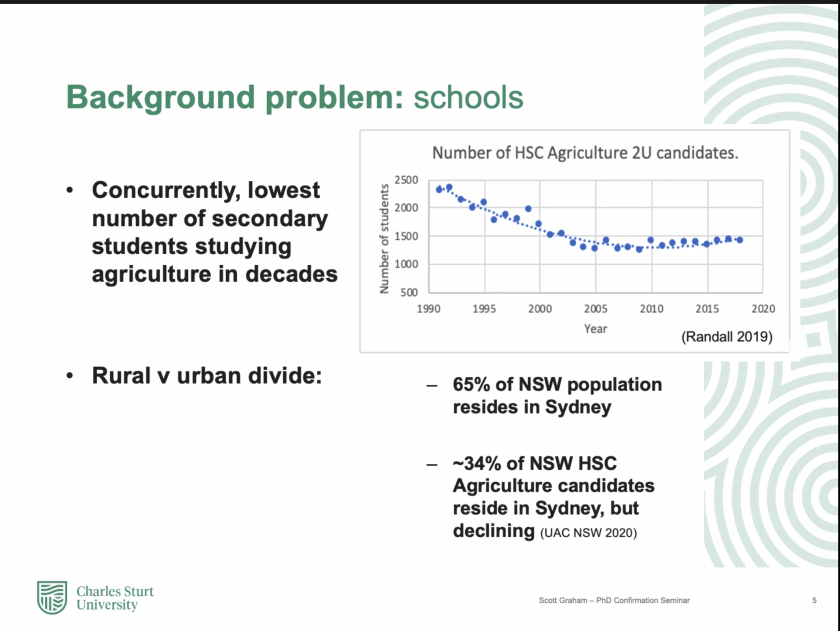
What Scott’s PhD is looking at is how do to we encourage more urban students to select agriculture as a subject with the ultimate aim they choose agricultural career pathways. Scott is ideally placed to research and report on this as he and Barker College have done a phenomenal job of the former and are keeping a close eye on the later

Barker College appears to be well and truly bucking the trend

Scott has identified the issues. Here is a few of them

At Action4Agriculture  we are complementing the work Scott is doing by tailoring our school programs to teachers and students NOT teaching/studying agriculture.  We are using similar principles to Scott and Barker College

Our programs are student-centred, individualised, contextual and culturally sensitive.

They involve key influencers, are accessible to all, can be targeted at specific groups when required and all evaluated for their effectiveness.

Students are mentored by our Young Farming Champions young people working in agriculture who are debunking stereotypes

  • Agriculture is not all Akubra’s and moleskins or mud and flies
  • 80% of jobs are off farm, 40% are in cities

Our Young Farming Champions represent the diversity of people in the agriculture sector. Students can see they are young people like them – they can be confident that they will fit in- that agriculture is a place where you feel identity safe.

What a great time to be on this journey with Scott with his research complementing our two year project with UNSW uni students working with BCG 

#action4youth #AGSTEMcareers

Career decisions – How did you make them ?

I am currently on a journey with UNSW students who are part of a Global Consulting Group initiative to support agriculture to attract the best and the brightest

I am curious what drove your career decision pathways?

I remember in Year 11 at my rural high school  I had early entry into a Arts Law degree at ANU – not a profession I had a genuine interest in but it was a signal of what was possible

Far too many young Australians from Rural and Regional and Remote OZ don’t get these signals.

Its time for us all to step up and say ensuring “equity and excellence” is our joint responsibility


How does agriculture as a career choice reach the hearts and minds of young people (and their parents)

In an ideal world agriculture as a career pathway would have equal opportunity as any other sector to reach the hearts and minds of young people (and their parents – particularly important for 1st generation Australians)

School-to-work pathways have changed dramatically and traditional routes to work have been described as irrelevant (FYA, 2018)

The journey of young people through education into the world of work and the influences on their planning and decision making, including aspirations, sources of information and formal, school-based career education is a complex web to encounter.

Just getting in the school door can be very challenging for all sectors not just agriculture

Agriculture does have some very successful initiatives including the Action4Agriculture suite of programs Kreative Koalas and The Archibull Prize

Our secret herb and spice is our Young Farming Champions ( they know how to change hearts and minds)

Others that come to mind are Cows Create Careers run by Jaydee Events and Australian Wool Innovation’s suite of programs that introduce young people to the world of working with wool

As this graphic highlights agriculture needs to attract a very diverse workforce in the next ten years. I am excited to be working with a team of bright young minds at University of NSW through a partnership with the Global Consulting Group to come up with innovative ways we can attract the best and brightest into careers in Research, Development, Innovation and IT

This slideshow requires JavaScript.

I met the team last week and we started our relationship by getting to know each other and our motivations. All of the team are either engineering students or science/commerce students and none have an agricultural background.

The students are supported by an expert from Accenture

I think I am going to learn a great deal and we can get a win:win for everyone

The Global Consulting Group (GCG) is a charity which provides pro-bono consulting services to other charities and not-for-profits.

We do this by connecting university students with experienced professionals who then work together to solve business problems for other  charities, combining the energy and passion of today’s youth with the experience and wisdom of our industry leaders.

The organisation currently has more than 150 volunteers across several locations in Australia and has completed over 150 projects for clients such  as the United Nations, Tedx, Our Big Kitchen and Shelterbox. GCG is sponsored by Bain and Monitor Deloitte, and has informal partnerships with  a range of reputed consulting firms.


Time for agriculture to move from awareness to action to ensure we are workforce ready now and in the future  

Its was wonderful to read that Australian universities are reporting a significant increase in young people studying agriculture careers.

If the agriculture sector is going to effectively leverage this increase in workforce talent and increase growth we must integrate workforce planning into our core strategic planning processes and establish a clear action plan that covers us now and well into the future.

Over the next six weeks Picture You in Agriculture will be posting their “Crafting Careers” series written by journalist Mandy McKeesick.

Crafting Careers is a culmination of a number of interviews with thought leaders in the agriculture and education sectors that call for us to move from awareness to action to ensure we are workforce ready now and in the future

The Crafting Careers series is an initiative of the Youth Voices Leadership Team and their commitment to

  • expose young people as early as possible to agriculture careers in schools
  • ensure there are multiple touch points along their school journey
  • equip students and job seekers with navigation resources and
  • ensure industry routinely assesses its skills and credential requirements

Over the next six weeks Rob Kaan MD of Corteva, Dr Neil Moss from SBScibus, Craig French from Australian Wool Innovation, Professor Jim Pratley and Scott Graham from Barker College will share their vision for a thriving agriculture sector that has a human centred design approach – we are all only as good as the people we surround ourselves with

As you will see from the research quoted below agriculture is not alone in being behind the eight ball in planning in advance for its workforce needs. The time has never been better to get ahead of the curve and ensure agriculture attracts, develops and retains the best and brightest

According to Ranstad half of employers fail to plan a year in advance for changes in their workforce, and only 13% plan for a two-year period. Rather than being reactionary, agriculture can commit to being an employer of choice and ahead of the curve in ensuring we have the skill sets needed to not only thrive but also grow our sector .

Skilled talent shortages are expected to persist across Australia and the wider Asia Pacific region – even in countries where growth is slowing – due to the restructuring of many economies, labour markets and large multi-national organisations.

The region faces nothing short of a corporate leadership crisis – it’s time for organisations to re-think their approach to attracting and developing leadership talent.

To predict how this will affect agriculture we have the opportunity to :

1. Assess the current strategic position of the sector  – including factors such as the size and diversity of workforce, business goals, long-term plans for expansion or diversification, and location-specific circumstances.

2. Review existing talent – including managers and employees at all levels – and flag those whose functions will be critical to future success and how they can be up-skill these vital team members.

Consider the political and economic environment our sector is likely to operate in within the next two to five years; for example, employment regulation and the number of women in senior roles are likely to increase during this time.

We should also think about what additional talent we will need and the experience, knowledge, skills and capability required.

Effective workforce planning in the coming decade means our sector will need to use a mix of enabling tools, systems and strategies to attract, develop and retain an increasingly mobile and skilled workforce.

Adapted from predicting your future employment needs | Randstad Australia

Did you know?

Agriculture graduates enjoy strong full-time employment outcomes on graduation, with a full-time employment rate of 79.5 per cent, compared to the graduate average of 72.2 per cent. Source

It is such a joy when the movement you started spreads its wings

Starting and sustaining a movement is both rewarding and exhausting. I have spent the last 15 years searching for organisations to work with that:

  • understand why agriculture is so conservative
  • acknowledge the barriers to innovation and change and
  • want to work with others to help our farmers turn perceived problems into opportunities.

I am at that point where I believe we have those partners and I can move on to the next chapter in my life

One of the greatest joys from my journey has been watching the emerging leaders we identity and train to be confident communicators who are curious about the world beyond the farmgate becoming changemakers and influencers in the agriculture sector.

They are innovators and life long learners and active in their communities and they are making things happen

This year’s innovation highlight has been the Leadership is Language series where they have identified thought leaders from across the globe to be part of this webcast series where they can share what they are learning with everyone.

The two most recent interviews are a must watch for everyone in the agriculture sector and every in business 

This is a heart wrenching interview What if you don’t come home? between Young Farming Champion Dione Howard and Austral CEO David Carter who shares how we can all learn from worker, health and safety mistakes

And our most recent interview with two extraordinarily courageous women in agriculture who exemplify anticipatory leadership discussing the Icky and the Ouchys of Social Licence

Catherine Marriot reminds us 

“Just because people don’t like hearing it, doesn’t actually make it any less true. And so the risks are still coming at us. I guess we can choose to address those risks and be proactive rather than reactive.” 

and Alison Penfold invites us to 

 “ get on the front foot and collectively work together so that we are in control of managing the risk.  Ensure we are not actually divesting it or delegating it to others, including government, to manage on our behalf. So I think anticipatory leadership is, for me, absolutely critical in any leadership job” says Alison Penfold  

“I think with anticipatory leadership, you need an extra special level of courage and clarity of communication skills, because you’re bringing up things that are pretty Icky and pretty Ouchy. And in order to put those across in a way that enables change, you need good communication skills” say Catherine Marriott

Mega proud of our team who are not only learning to lead themselves and lead others they are sharing what they learn with the world and multiplying their impact 

Happy National Ag Day everyone 

#AgDayAU #YouthinAg


Anticipatory Leadership – training yourself to see problems as opportunities

“The difference between a good leader and a great leader is one who
learns to anticipate rather than react.” —Craig Groeschel

There is no shortage of extraordinary women in the agriculture sector who have courage. 

It was exciting to bring two of our most courageous communicators Catherine Marriott and Alison Penfold together for this interview for the Leadership is Language series.

A must listen. Two authentic women. So real, so gusty discussing the Icky and the Ouchy

They offer agriculture a new way of doing what matter most – communicating to create shared value for everyone who produces and everyone who consumes

“New challenges always equal new opportunities. When you see a
problem, train yourself to think ‘opportunity.’” —Craig Groeschel