Australian farmers everywhere are currently operating in a highly volatile environment with little or no flexibility at the mercy of policy and decision makers who make decisions with little or no consultation
On top of this we are all essentially being asked by our supermarket oligopoly to subsidise food at rock bottom prices so they can put cash in their tills and money in their shareholders pockets. I have spoken to many of our proud and loud leading farmers recently right across the country and I am getting the same message “It’s a burden that is putting lives on the line”
There are also pressures from consumers who are demanding food produced on farms with high standards of environmental stewardship and animal wellbeing. Good farmers have no problem with this as they share exactly the same values.
However this push to “slow down” as highlighted by this upcoming debate on Tuesday 15 May 2012, at the National Wine Centre, Cnr Botanic and Hackney Rds, Adelaide being held in conjunction with the Collaborate Innovate 2012 conference continues to highlight the community’s disconnect with the realities of commercial farming in the 21st century
The debate is titled “Innovation in agriculture has led to ‘fast’ food. It’s time to ‘slow’ down”
The blurb reads
Innovation has always been part of Australian agriculture from the ‘stump-jump’ plough and Federation wheat, through to minimum tillage, precision agriculture and molecular plant breeding.
Although our innovative agricultural sector feeds approximately 60 million people annually, Australia is now a mostly urban society, increasingly disconnected from food production.
Is it time for a ‘back to basics’ approach to reconnect Australians with food production? Has technology lead to industrial agriculture and cheap food that is not understood or valued by Australian consumers?
Or is continued innovation the only hope for Australian agriculture; to remain internationally competitive and feed an increasing global population?
This timely paper by Mick Keogh from the Australian Farm Institute which you can read in full hereI believe does a great job of putting this affluent society idealism of “Little Golden Book Farming” into perspective. There are some key insights from the article at the end of this post
The paper is titled “Will Locavores destroy the planet?” I am personally a great fan of the Locavore movement and am working with some amazing local thought leaders to actively promote it in my region. I am a fan because I agree with Dacian Ciolos when she says this. “The Locavore movement … empowers consumers to play an active part in the economic development of their local area” and that’s a great thing. It’s not the Locavore movement that will destroy the planet it’s a one size fits all mentality.
Our farming systems cannot be locked into a religious type paradigm of what we think is best. Our farmer must be free to continue to adapt to our changing resource base, the seasons and climate, the economy and our markets. We must acknowledge this if we are going to keep feeding our world from an ever shrinking resource base with a market place that continually wants to pay less for food that costs more to produce. We know we must always use technology and innovation smartly and consider the collateral effects of its use ensuring that our management and farming practices are at best practice. Our farmers must be able to innovate, achieve efficiency gains and intensify their businesses and consumers have to be prepared to pay realistic prices for the food they buy to enable our farmers to this.
This drive to “slow down” and go back to the 1950’s way of farming mentality is summed up nicely by Mick.
“It is important to recognise that the safe, secure, inexpensive, globalised food system that exists in most developed nations is one of humanity’s greatest success stories, and the principle reason that for the citizens of these nations hunger and famines are an abstract concept, rather than harsh, everyday reality.”
There are no easy answers to the challenges our farmers face and our farmers have a pivotal role to play in being part of the change that agriculture must have. We are pushing through some new frontiers, and this will require a whole of industry vision and a collaborative approach.
I farm for many reasons but in the main its because I believe farmers are part of the noblest profession – the people who grow the food that feeds those we love and cherish.

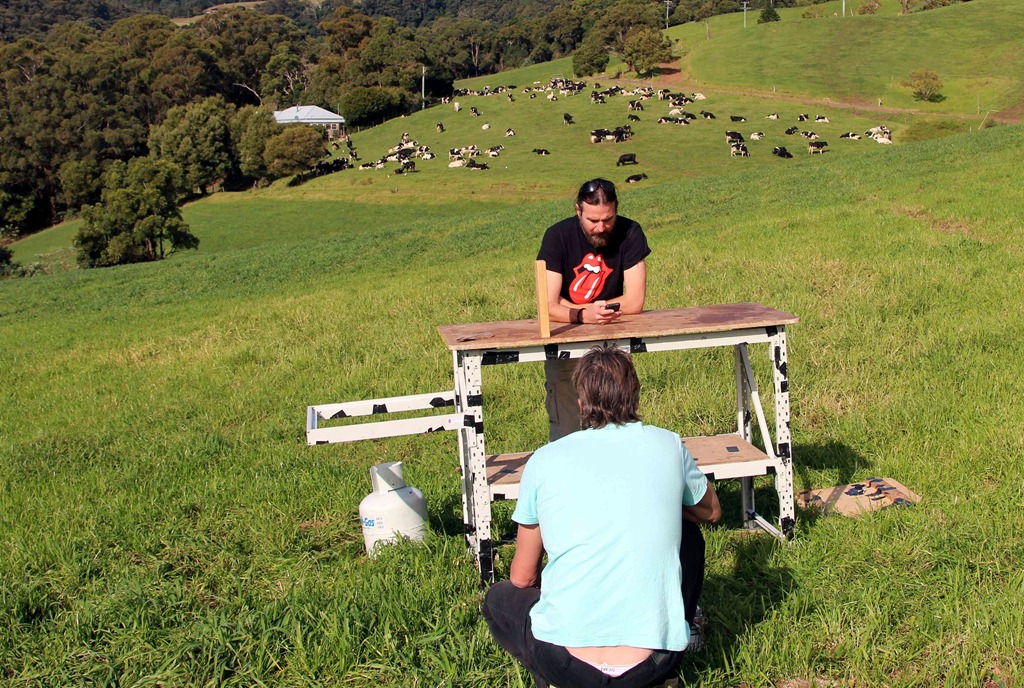
The view from my office this morning made the early start all the more rewarding
Extract
Will locavores destroy the planet?
Mick Keogh: Australian Farm Institute
‘Local food’ is an increasingly common concept used in food magazines and restaurant menus, and a local food movement seems to be quickly emerging in Australia, encouraging a greater focus on foods sourced from within a particular region. For farmers and food producers, some of whom are under siege from imported products due to the effects of the high Australian dollar and relatively high labour costs, a move by consumers to favour local foods is welcomed. A greater focus on local foods also provides an opportunity to develop new marketing channels, and to avoid food brands disappearing down the insatiable maw of the major retailers. It also provides an opportunity for smaller producers to develop brand identities and to revitalise regions based on food tourism. For a major agricultural exporter such as Australia, however, the international ‘local food’ movement also brings with it some new risks, and the potential for a retreat from the globalised agricultural markets relied on by much of Australian agriculture. In what would also be a surprise for many ‘foodies’, the local food movement has the potential to dramatically increase agriculture’s impact on the environment.
Environmental impacts
One often-claimed attribute of local food systems that is not supported by available research is the claim that local food systems are better for the environment. There have been a considerable number of robust comparisons carried out, and the result is often that the established globalised food supply system has considerable environmental advantages over competing local food systems.
A number of research studies have been carried out to compare the greenhouse emissions and energy use associated with livestock and dairy products from New Zealand that have been transported to the United Kingdom, and similar competing products sourced from the United Kingdom (Saunders & Barber 2008). Table 1 provides a summary of the results of that comparison.

What the table highlights is that the energy and greenhouse emissions associated with the transport of the dairy products from New Zealand to the United Kingdom (UK) are a relatively minor component of the total energy and emission profile of the New Zealand dairy product. The table also highlights that the added energy use and emissions associated with the UK dairy system (where animals are housed for much of the year and require feed and heating) results in the energy and emission footprint of the UK dairy products being almost double that of the New Zealand products, even with the New Zealand transport disadvantage fully accounted for.
A UK consumer opting for the local UK dairy product would unwittingly be selecting a product that has double the energy and environmental footprint of the competing New Zealand product, despite the New Zealand product having been transported almost 18,000 kilometres!
In further comparisons also reported for other commodities, similar results were obtained (Saunders & Barber op.cit.). A comparison for lamb production, for example, revealed that the New Zealand lamb shipped to the UK had an emission ‘footprint’ of 688 kilograms of CO2-e per tonne of lamb compared to the UK product with an emission footprint of 2850 kilograms of CO2-e – more than four times as high.
Comparisons of onions and apples produced in New Zealand and shipped to the UK revealed that, in comparison with competing ‘local’ products, New Zealand apples had an energy and emissions footprint that was only approximately 68% of that of the UK apples (although the results were dependant on the season in which the comparison was made) and in the case of onions the UK product was better for the environment due to its lower emission and energy footprint, but the difference was less than 10%, and data for some parts of the UK onion supply chain was not available.
This highlights that a number of different factors have an impact on the outcomes of such comparisons. For example, the relative environmental merits of agricultural products sourced from different locations can vary depending on the season used for the comparison. Southern hemisphere fruit and vegetable products are relatively more environmentally friendly in northern hemisphere markets during the northern hemisphere winter, when the only competing northern hemisphere products are those that have been in storage for an extended period or that were produced in greenhouses – all the while requiring the use of additional electricity – which adds to the products’ environmental footprint.
Efficient food production
A further aspect of the local food movement that is seemingly at odds with many perceptions is the implications of a ‘local food’ model for the potential of global agriculture to provide sufficient food for a larger future population. While it seems counter-intuitive, a retreat from globalised ‘industrial’ food production on a broad scale would certainly make it more difficult to feed future global populations. There are several reasons for this, as past events such as the Irish Potato Famine highlight.
Between 1845 and 1852, the local potato crop which up to one-third of the Irish population relied entirely on for food experienced a series of catastrophic failures, due to potato blight disease. As a result, it is estimated that up to one million people died of starvation, and one million more were forced by hunger and poverty to emigrate from Ireland, reducing the nation’s population by almost 25% in a few short years. The Irish Potato Famine was by no means an isolated incident at that time. In fact famine is still a common occurrence in many developing nations – in particular in Africa, and major famines have also devastated the Ukraine, the USSR and China during the last century, and continue to plague North Korea, Zimbabwe and the Horn of Africa even today.
Famines, or catastrophic failures of food production systems, have a range of different causes, some of which are natural, and some of which are political. The Irish Potato Famine, for example, was caused by the repeated destruction of the Irish potato crop by a recurring disease, a result of poor agronomic practices and over-reliance on a single crop. It was also caused by a combination of land, tenancy and trade laws which resulted in Irish agriculture being dominated by small-scale tenant farmers with no security of tenure who all relied heavily on that single crop and who did not have access to, or could not afford alternative, non-local food supplies.
Those nations and populations that have avoided major famines over the past century are actually those nations that have embraced the globalised, industrialised, internationally-traded food system, and reduced their reliance on local food. For a wealthy, food-secure inhabitant of a developed nation like the USA or Australia, the concept of starvation or food insecurity is so remote that it does not even register. The abundance of food, the seemingly limitless variety of safe, high quality produce that is available irrespective of the weather or the season, and the endless choice of products from all parts of the world is something taken entirely for granted and which represents such a small portion of expenditure by the average consumer that it hardly registers.
It is also easy to overlook the fact that the benefits of specialisation (growing specific crops in areas where they are agronomically best suited and transporting them to distant markets), modern science and scale economies (made possible by mechanisation) mean that the world is now consistently able to produce a surplus of food, which can be safely and efficiently delivered to any location on earth in a relatively short period of time.
Some sense of the hidden benefits of food production specialisation arises from the recent estimate that for the USA to maintain current output levels for 40 major food crops and vegetables under a locavore-like production system (where no food is transported more than 100 miles) would ‘require an additional 60 million acres of cropland, 2.7 million tons more fertiliser, and 50 million pounds more chemicals’ (Sexton 2011). The result would be a profound increase in the carbon and energy footprint of the US food system, and the destruction of significant natural habitat due to land use change.
Policy implications
So-called local food systems bring many benefits, but as the preceding discussion has highlighted, they can also bring additional costs, and it is important that these are not overlooked. A global reversion away from current conventional agriculture to much more localised food systems could have important negative environmental consequences, and would also bring considerable additional limitations on the ability of the world to feed itself.
This suggests that while policies that support the development of local food systems may be attractive to policy-makers, these should only be adopted if they do not disadvantage existing conventional, globalised agricultural systems. For example, policies that seek to foster local food systems through trade barriers, unnecessary restrictions on the use of new technologies, or the use of inadequate environmental labelling systems are likely to do much more harm than good.
It is also important to recognise that a wholesale adoption of local food systems would have major negative environmental consequences, because the focus on distance travelled by food is misguided. Emissions or energy use associated with transport is often only a very minor component of the total environmental footprint of foods, and therefore reducing transport distances has little effect on the overall environmental impact of a food production system. There are much greater environmental benefits available from encouraging agricultural specialisation and trade, than there are from attempting to limit the distance food is transported.
In all the new-found enthusiasm for local food systems, it is important to recognise that the safe, secure, inexpensive, globalised food system that exists in most developed nations is one of humanity’s greatest success stories, and the principle reason that for the citizens of these nations hunger and famines are an abstract concept, rather than harsh, everyday reality.
Jon Dee, who is an environmentalist, and founder of the Australian advocacy organisation ‘Do Something!’ disagrees with Mick.
He believes the locavore movement is more than just promoting a sustainable environment and includes encouraging social and economic sustainability as well as a seasonal diet.
Do Something’s website here http://foodwise.com.au/
Hear Mick Keogh debate John Dee on Bush Telegraph here